
What is ChatGPT?
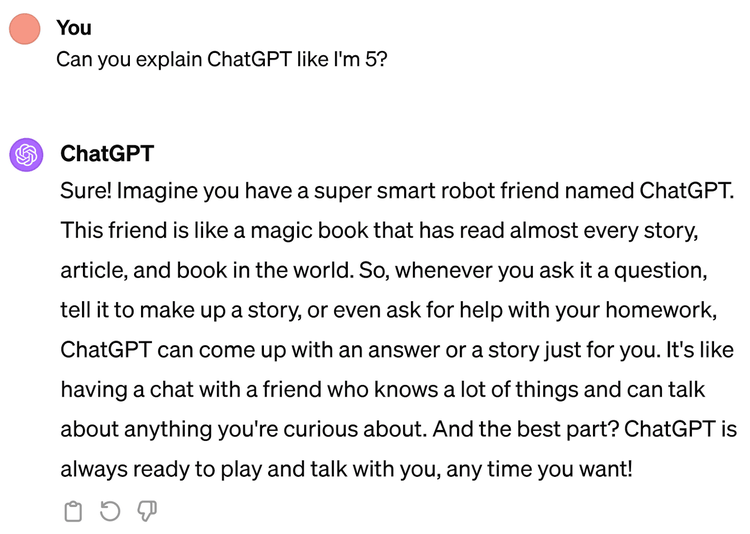
ChatGPT is an advanced form of generative AI developed by OpenAI. It’s been designed to provide human-like text and image responses based on user prompts.
The tool operates on a large language model (LLM)—a sophisticated AI program trained on vast amounts of text data. To interpret and output language in a way that resembles human conversation.
ChatGPT allows users to shape conversations Offering control over the response's length, format, style, level of detail, and language. Its applications span across various industries, from aiding in customer service to making coding more accessible.
There are four versions of ChatGPT available, the two most notable being:
- ChatGPT-3.5: Capable of generating detailed and contextually relevant responses. This version is best suited for customer interactions, quick questions, and automating small tasks. It’s free for anyone to use with limitations on response length and the number of prompts per hour.
- ChatGPT-4: Also known as ChatGPT Plus, this more advanced version improves upon language processing skills. And better interprets nuanced and complex requests. Available for $20/month, ChatGPT-4 offers additional features like image creation and voice prompt capabilities. Users also benefit from less restrictive word count output and prompt limits.
As we explore further, we’ll highlight the specific benefits of upgrading to ChatGPT Plus, but first, let's delve into the overall benefits of ChatGPT.
Further reading: Check out our article on the simple and technical explanation of how ChatGPT works.
15 Benefits of ChatGPT
The benefits of using ChatGPT range from improving operational efficiency and user experience to offering flexible solutions to a variety of problems. Integrating the tool thoughtfully with your business processes can lead to a technological edge.
Experiment with ways ChatGPT can optimize your workflows and tasks. And see how it can contribute to your creative and communication processes
Constant Availability
ChatGPT can serve as a round-the-clock customer support assistant for prospects in different time zones.
Here’s how it works.
Identify the most common customer inquiries and support scenarios. Use this data to fine-tune ChatGPT. Making it a responsive and effective first point of contact for your customers.
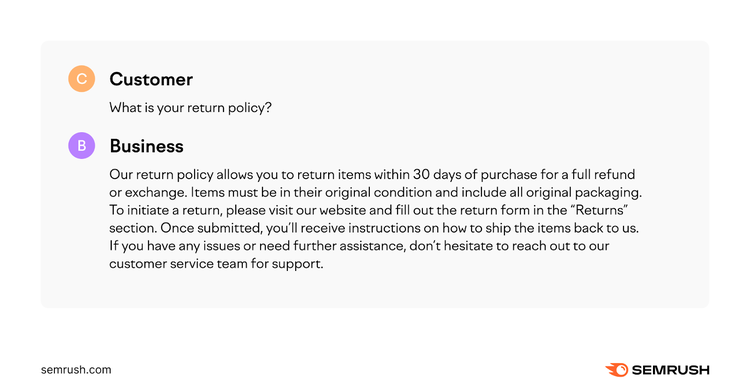
This transformation into a self-serve Q&A platform can reduce the workload on your customer support team. This approach allows them to concentrate on resolving more complex issues. Like technical troubleshooting and user security concerns.
Plus, ChatGPT can handle multiple inquiries simultaneously. Reducing queues and opening the door for a more scalable customer service experience. It also enables customers to seek help at their convenience. At any time.
Note
Programming ChatGPT, known as “fine-tuning,” is only available on certain versions at this time.
Repetitive Task Automation
Integrating ChatGPT to manage certain time-consuming tasks offers the potential to reallocate human resources toward more complex or creative endeavors.
You can automate tasks like:
- Data entry and processing: ChatGPT can assist with data entry, sorting, and basic analysis. Potentially reducing errors and improving the efficiency of these processes
- Scheduling and appointment setting: The tool might be used to help automate scheduling and managing appointment reminders. Potentially streamlining these administrative tasks
- Email and communication management: ChatGPT has the capability to draft, sort, and reply to routine emails. Which could lead to a more organized and efficient response system
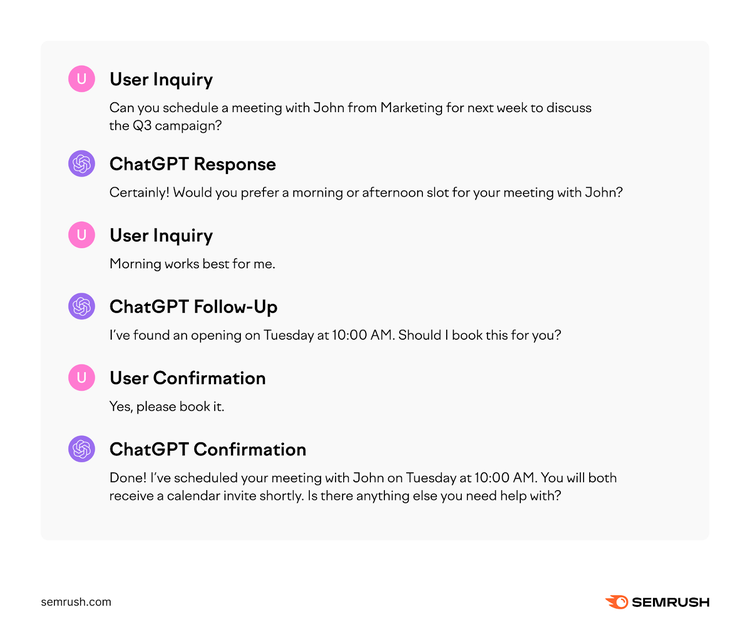
While these applications can offer significant benefits, their effectiveness will depend on how well ChatGPT is integrated and trained within the specific operational framework of a business.
Workflow Integration
Integrating ChatGPT into business workflows can significantly enhance efficiency and automation, particularly in human resources (HR).
For example, you can train ChatGPT with your organization's specific HR documentation. So it can answer common employee queries like “What's our remote work policy?” Or “How do I update my health insurance details?”
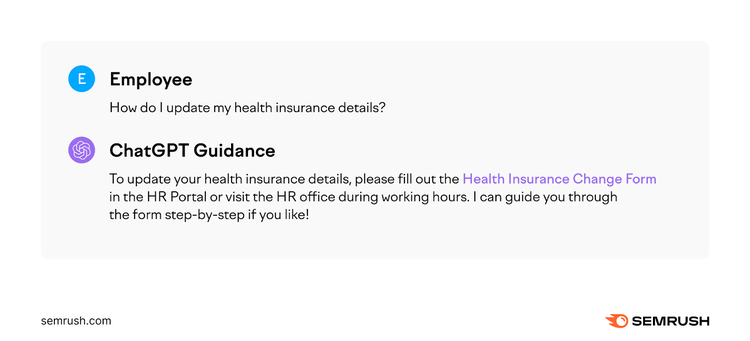
Automating routine tasks helps you focus on more complex, human-centric tasks. Like mediating conflicts and resolving workplace issues.
HR teams can use ChatGPT in their workflows by gathering the most frequently asked questions and standard company policies. Use these to train your custom ChatGPT model. Ensuring it aligns with your specific organizational context and needs.
Peak Operational Agility
One of the aspects of ChatGPT's cutting-edge performance is its ability to process and respond to queries almost instantaneously. These quick response times make it highly efficient for tasks requiring quick turnaround.
ChatGPT also produces excellent results across various domains. From creative writing and content generation to technical coding assistance.
For creative writing, ChatGPT can:
- Imitate particular styles
- Maintain a consistent tone
- Adapt text for different readers
Here are some prompts you can use to guide ChatGPT in creative writing:
- “Create a blog post in a formal and informative tone discussing the benefits of meditation”
- “Explain the concept of gravity in simple terms for a children's science book”
- “Generate a poem in the style of Robert Frost about the beauty of nature in winter”
Programmers can use ChatGPT to get code examples for common tasks. Like creating a random number generator in Python.
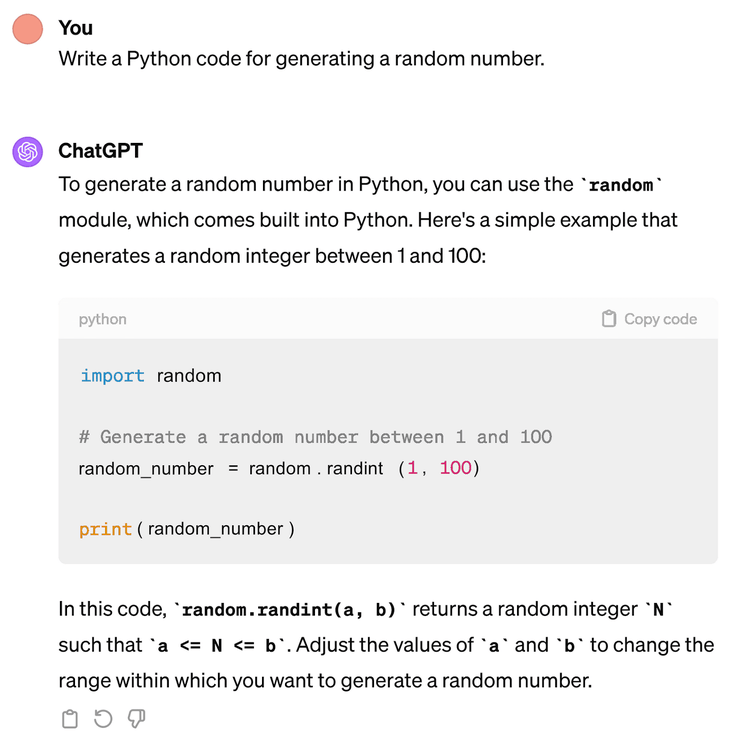
While ChatGPT is a helpful tool, it doesn't replace the need for a strong understanding of programming concepts and practices. The AI's generated code might require editing. And it can't handle complex programming tasks like coding entire applications on its own.
Versatile in Application
ChatGPT’s adaptability makes it a multifunctional tool suitable for several industries and tasks.
Natural language processing (NLP) allows ChatGPT to understand, interpret, and generate human-like text to:
- Create engaging content
- Interpret professional language, like in legal documents
- Tackle tasks like sentiment analysis in customer feedback
You can use ChatGPT’s NLP capabilities for customer feedback analysis. By entering relevant data like customer feedback and reviews. This approach helps you gain insights into customer sentiments. Which you can use to generate targeted marketing material.
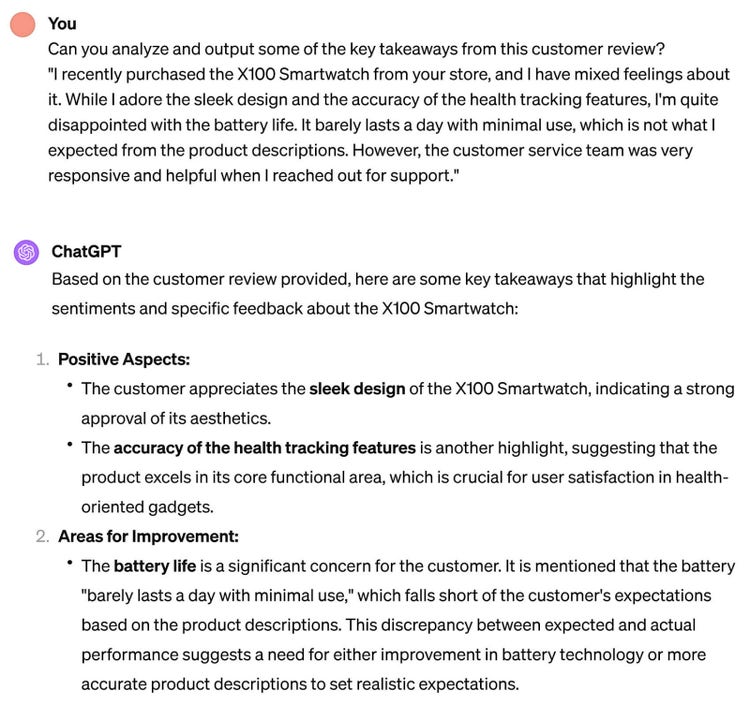
Beyond language, you can apply ChatGPT’s versatility in data analysis by integrating it with business analytic tools. To make better, data-driven decisions. Enter your reports or use ChatGPT’s data analysis plugins to get straightforward summaries. And insights on complex data sets in an easily digestible, conversational language.
Extensions and GPTs Available
ChatGPT extensions and GPTs (generative pre-trained transformers, which are replacing plugins on March 19, 2024) add more features that enrich its functionalities.
For example, you can access ChatGPT via web browsers like Google Chrome, Apple Safari, or Microsoft Edge without additional tools. However, the Merlin extension offers a more integrated experience.
This extension allows users to find and interact with ChatGPT directly from their browser's toolbar. Providing quick and convenient access to the AI model without needing to visit the website. It streamlines the process of using ChatGPT for quick searches, information gathering. Or even casual browsing assistance.
Another notable example is the Promptheus Chrome extension. Which takes interaction with ChatGPT to another level by enabling voice commands.
This feature isn't a standard capability of ChatGPT or other AI systems. Still, users can talk to ChatGPT with the Promptheus extension. Making the experience more accessible and hands-free. This feature is helpful for users who prefer voice interaction. Or have accessibility needs that make typing challenging.
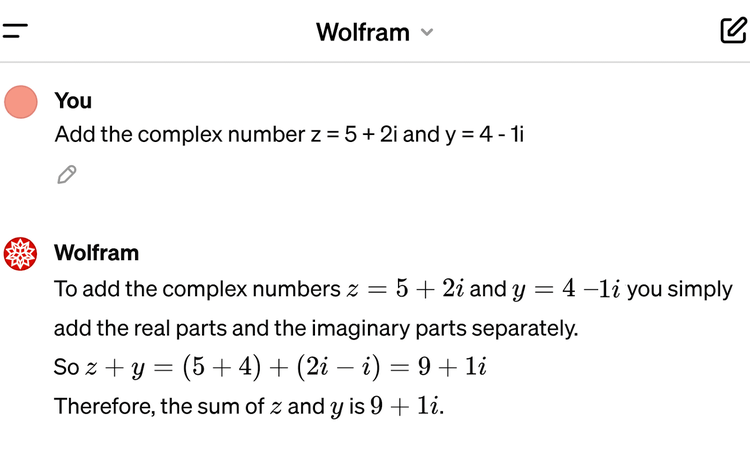
Wolfram is a useful GPT that enriches ChatGPT with information from diverse fields such as chemistry, geography, astronomy, nutrition, and engineering.
For instance, it can help you answer mathematical questions. Such as “Add the complex number z = 5 + 2i and y = 4 - 1i.”
Continuous Updates and Improvements
ChatGPT, like all other AI systems, needs to constantly update and improve to remain relevant and accurate. OpenAI updates the ChatGPT in several ways.
OpenAI periodically re-trains ChatGPT with more recent information and data. These updates help the model evolve language use and gain new knowledge. The parent company also solicits user feedback of instances where ChatGPT did not meet expectations. They use this information to further improve the LLM via training and evaluations.
Multilingual Communication
ChatGPT’s multilingual capability makes it an effective tool for communicating with users from diverse linguistic backgrounds.
For example, if a Spanish user asks ChatGPT, “Qué día es hoy?” (English translation: What day is it today?). It will respond with the correct day in Spanish.
Let’s say the same user asks a followup question in French: “Combien de jours avant dimanche?” (English translation: How many days until Sunday?). ChatGPT will respond in French with the correct number of days until Sunday.
Your business can use ChatGPT’s multilingual capability to train employees from different cultures. Respond to customers in different countries. And create user manuals in multiple languages.
Conversations That Mimic Human Interaction
ChatGPT's ability to understand and replicate empathetic, conversational tones allows for more natural and effective interactions in various business scenarios.
Here are some ways you can apply this benefit of using ChatGPT in a business context.
- Customer service: Train ChatGPT on your brand voice and typical customer inquiries. Then, use it to draft responses that require a personal touch. Ensuring your customers feel heard and valued.
- Personalized marketing communications: Use ChatGPT to analyze customer data. And craft personalized marketing emails or social media posts
- Human-like interaction for bots and virtual assistants: Integrate ChatGPT into your existing chatbot systems. Fine-tuning the AI to align with your business's communication style and the common queries it will handle
- Internal communications and HR: Use ChatGPT for drafting internal communications. Ensuring the messaging is clear, empathetic. And aligns with your company culture
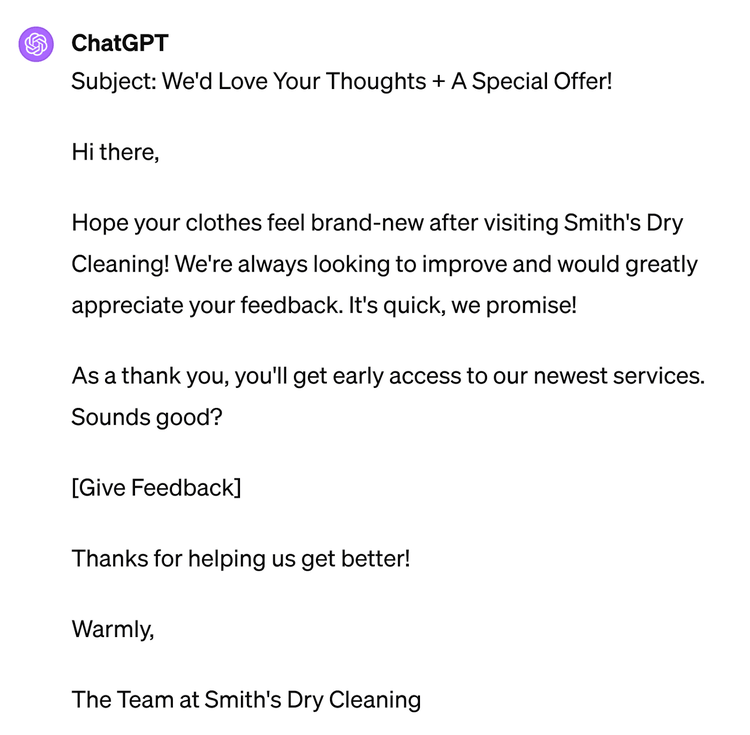
For example, you can tell ChatGPT to write a mail asking for feedback about your product using this prompt:
“Write a remarkable feedback request email for a company called Smith’s Dry Cleaning. Write in a friendly, conversational tone. Keep the email under 100 words. Use short, clear sentences. Add an incentive that users who provide feedback will receive early access to the service. Add a CTA that motivates the reader to provide feedback.”
Improved Content Quality
Using ChatGPT to improve content quality can help you make grammatical improvements, maintain a consistent tone throughout your content, and create better content ideas.
Let’s say you run a health and wellness website. And need to create content that is both informative and engaging. You can use ChatGPT to simplify technical subjects, like a new dietary study, by:
- Providing ChatGPT with the key points or conclusions of the study
- Asking it to rephrase these in simpler terms suitable for a general audience
- Using this simplified explanation as part of your article or blog post, making complex information easier to understand
You can also use Semrush’s Content Toolkit to find high-impact content ideas and generate SEO-friendly articles for any keyword you want to target.
Start by entering a keyword (e.g., dietary study) into the Topic Finder.
The tool will surface high-potential topics backed by search data and AI analysis.
Click “Start writing” next to a topic, then choose “Generate article with AI” to create a full-length draft.
To keep your tone consistent, apply your Brand Voice settings before generating the draft.
Once your article is ready, navigate to the “Improvements” tab to get real-time tips on SEO, readability, and tone of voice.
Create Top-Performing Content
with the Semrush Content Toolkit
Open for Further Fine-Tuning
Another benefit of ChatGPT is that you can customize it to serve a specific use case.
For example, say you run a personal finance blog. That provides targeted investment advice for your users based on age, income, savings, and retirement goals. You want to scale your service by incorporating ChatGPT into your blog.
Technically speaking, you're adjusting the explicitly user-defined hyperparameters of a machine-learning model. In lay terms, you're training ChatGPT, like you'd train a human assistant, to mimic your investment advice with the data of your existing users.
Here’s what OpenAI has to say about fine-tuning ChatGPT for specific use cases.
“This update gives developers the ability to customize models that perform better for their use cases and run these custom models at scale. Early tests have shown a fine-tuned version of GPT-3.5 Turbo can match, or even outperform, base GPT-4-level capabilities on certain narrow tasks. As with all our APIs, data sent in and out of the fine-tuning API is owned by the customer and is not used by OpenAI, or any other organization, to train other models.”
Enhanced Customer Satisfaction and Engagement
ChatGPT can improve customer satisfaction and engagement rates. By providing instant responses and serving personalized content.
As discussed earlier, ChatGPT can be integrated into your customer service workflows to reduce waiting times. Deliver instant automatic answers. And handle a high volume of customer interactions simultaneously.
ChatGPT can use customer data to personalize content for each customer. For instance, an AI-powered business-to-business (B2B) software as a service (SaaS) website can serve the right case study. Based on a customer’s industry or use case. Similarly, an AI-enabled ecommerce website can provide contextual product recommendations. Based on a user’s location and previous purchases.
Educational Purposes and Self-Learning
One of the benefits of ChatGPT Plus in education is its ability to offer tailored educational support.
For example, ChatGPT can act as a personalized tutor that answers student questions, explains complex concepts, and provides examples. Such personalized attention can benefit learners who may need extra help outside of the classroom.
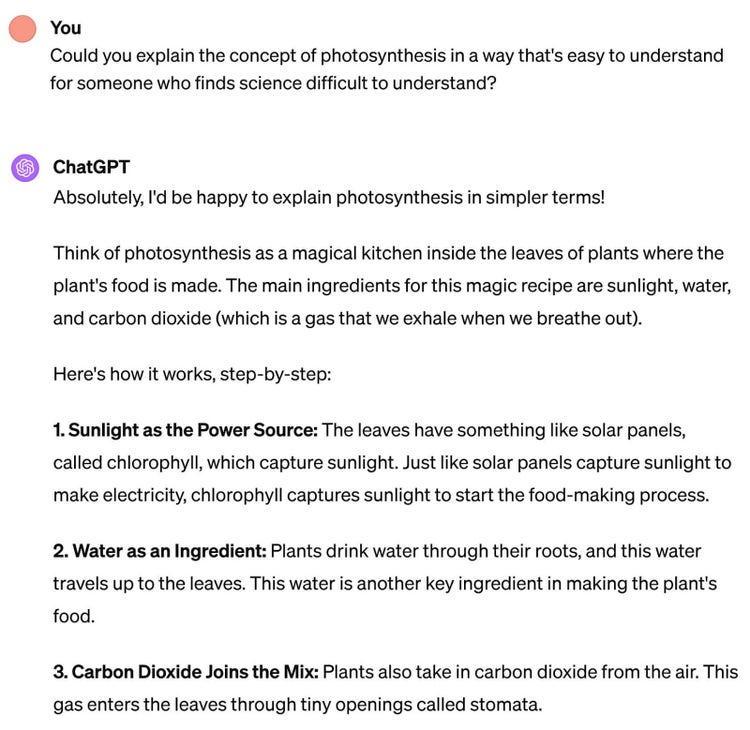
ChatGPT can also help higher education students and researchers to write better research papers and essays. For instance, it can help during the ideation and outlining stages. ChatGPT can also be used to summarize multiple research papers. And make it easier for learners to quickly grasp the key ideas in them.
SEO Automation
ChatGPT can augment a sound SEO strategy for your business. By incorporating keyword research, generating optimized content, and analyzing user-generated content to identify topics.
We already discussed how Semrush’s Content Toolkit can help you find high-performing topic ideas and create SEO-friendly content using AI and Semrush data.
SEO Writing Assistant (SWA) is another tool from Semrush that can optimize an existing piece of content for search engines and users by:
- Checking the originality of a piece of text with its built-in plagiarism checker
- Using a tool like Rephraser to rewrite sections or entire articles with keywords
- Maintaining your brand’s tone even when you employ several writers
To use SWA, log in to your Semrush account and navigate to “SEO Writing Assistant” found under the “Content Marketing” menu.
The tool’s home section automatically lists all the recent documents that were analyzed using SWA. Let’s say you want to assess the SEO quality of a new article called “Homepage SEO: What Is It & How to Do It.”
Click the “Analyze new text” button and paste the article’s text into the tool. You can also import the article using its URL if it's online.
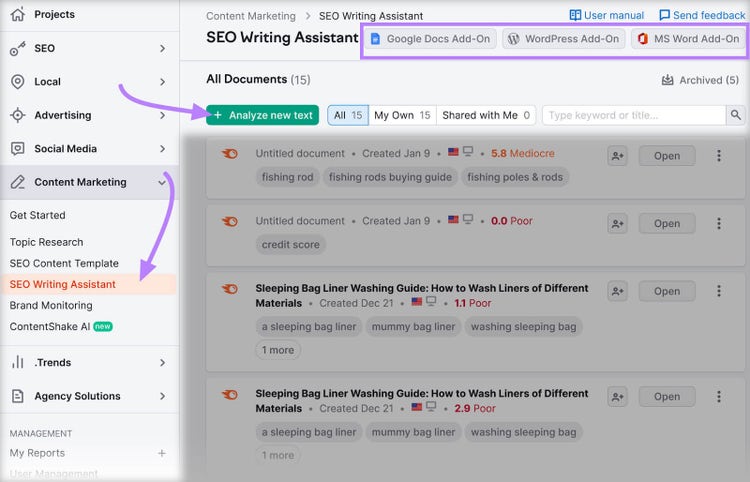
Alternatively, use the tool’s Google Docs, MS Word, or WordPress add-ons to use SWA directly on any of these three platforms. The add-ons can be found in the top right section of SWA’s homepage.
In our example, SWA gives the article an overall score of 7.5 out of 10 by evaluating its readability, SEO, originality, and tone of voice.
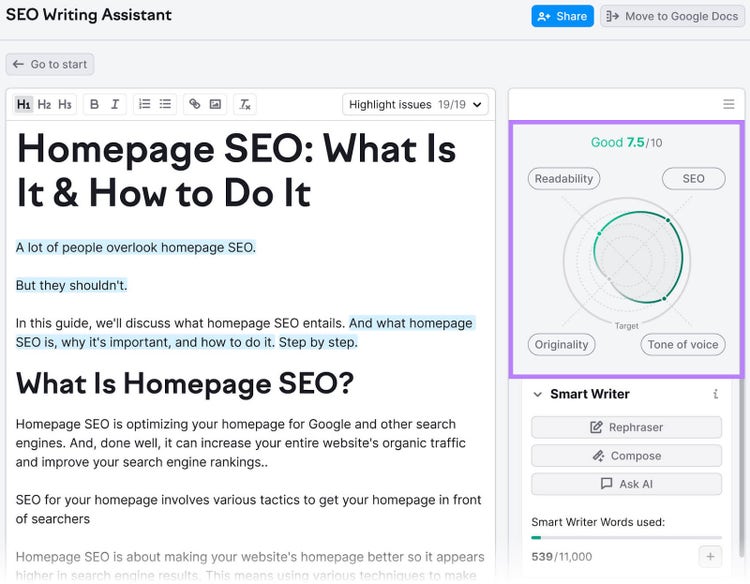
The tool also highlights 19 improvements that can be made to this piece.
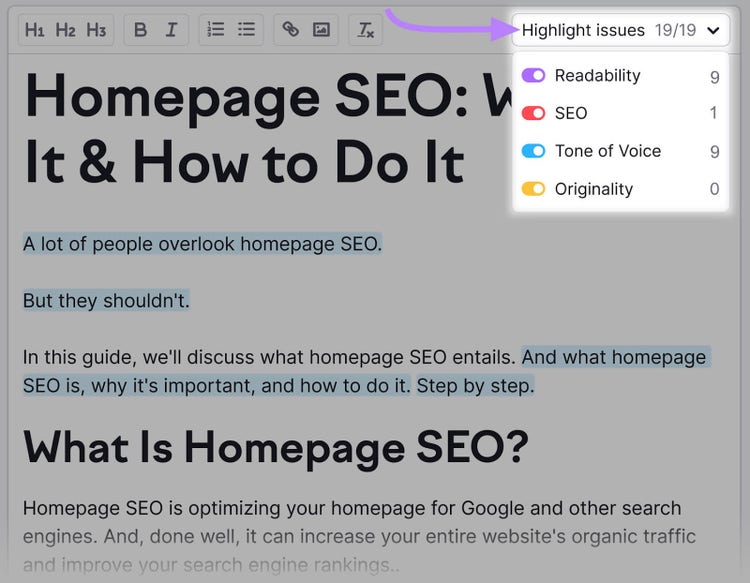
Addressing these issues will improve the article’s readability and SEO value.
Optimize Existing Content
with the SEO Writing Assistant
Scalability
ChatGPT can serve individual users asking casual questions. And large-scale enterprises handling thousands of simultaneous customer service inquiries.
Because ChatGPT uses a cloud-based and distributed computing architecture, it can automatically scale resources up or down based on demand. The service also employs load-balancing techniques. To distribute traffic across multiple servers. As a result, each server has a manageable load without any bottlenecks. Delivering faster response times.
8 Disadvantages Of Using ChatGPT
Biases in the Programming
ChatGPT’s training data contain biases you can spot in the model's responses. The OpenAI team is aware of this limitation. And is trying to minimize bias.
There are concerns that, unchecked, AI tools like ChatGPT in the workplace can deteriorate existing diversity, equity, and inclusion (DEI) efforts.
Here’s an example following a prompt asking ChatGPT, “Can you write a hypothetical announcement email I can send out to the office about our annual Halloween party?”
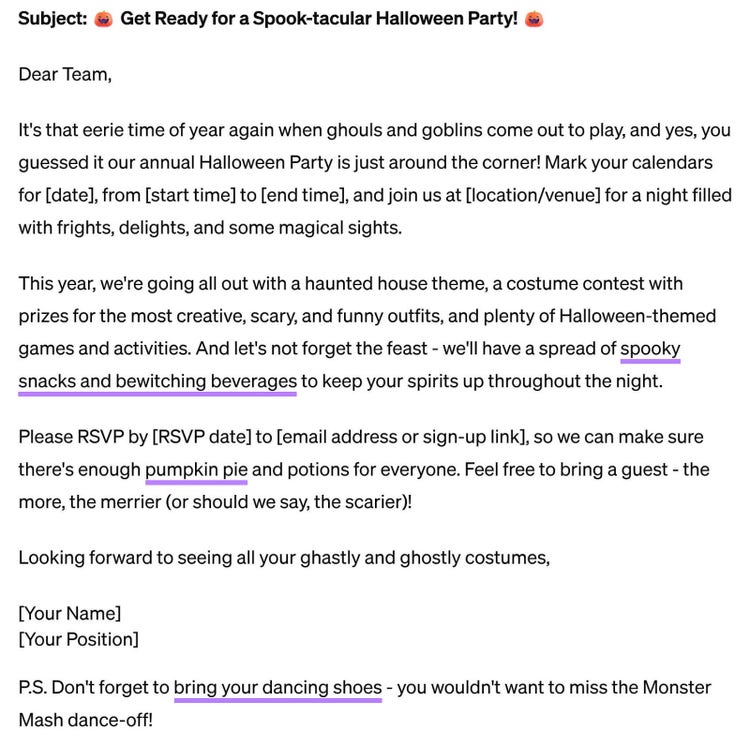
There are at least three biases in this output:
- The hypothetical email is tailored toward an American audience (eg., “pumpkin pie”). Even though the prompt doesn’t specify the location of the office or the cultures in attendance.
- The mention of “spooky snacks and bewitching beverages” possibly overlooks dietary restrictions
- Asking people to “bring their dancing shoes” may inadvertently exclude employees with physical disabilities
Efforts to mitigate these biases include rigorous testing. And updates to the training process aimed at identifying and reducing prejudiced patterns. Despite these initiatives, some biases may persist due to the complexity and breadth of the data on which ChatGPT is trained.
Ethical Issues and Concerns
The increasing use of AI-generated content raises important ethical considerations. Which include ensuring that content creation and distribution remain responsible and transparent.
AI-generated content can be so convincing that it's often hard to distinguish from materials humans create. It may also include inaccuracies or factual errors. While AI models like ChatGPT generate content based on training data, they don't possess understanding or intent. This raises concerns about the authenticity of content. And the potential for unintentional misinformation.
Potential Legal Implications
Occasionally, based on its training data, ChatGPT can generate content that closely resembles existing copyrighted material. Potentially leading to copyright infringement claims.
For example, The New York Times filed a lawsuit against OpenAI and Microsoft in 2023, accusing them of using the newspaper's articles without permission to train their AI models, including ChatGPT. The Times alleged that OpenAI and Microsoft's use of its content to train AI chatbots provides an alternative means to deliver information to readers. Thereby infringing on the newspaper's copyright. And potentially leading to billions of dollars in damages.
If you use personal data to generate ChatGPT content, such as personalized recommendations, you must comply with data protection laws. Like the GDPR in Europe or CCPA in California. Violating these laws can lead to potentially costly and severe legal and financial repercussions.
Challenges with Plagiarism
AI-generated content raises questions about intellectual property rights. Determining the ownership of ChatGPT outputs such as writing, art, or music is challenging and complicated. So, for now, this remains a gray area.
Using ChatGPT to write essays or conduct research may also raise plagiarism issues in certain academic areas.
Limited Control over Generated Content
The challenge is to fully control the nuances and context of AI-generated material.
ChatGPT, like other AI models, processes and generates content based on patterns it learns from training data. But it may not fully grasp the context in which a user makes a query.
This can lead to responses that, while technically accurate, might miss the mark in terms of relevance. Or appropriateness to the specific context or cultural sensitivities.
In the following example, the user asks ChatGPT to edit an artist statement written by an 18-year-old for an art exhibition. The conversation begins with the user clearly stating the writer is 18 years old.
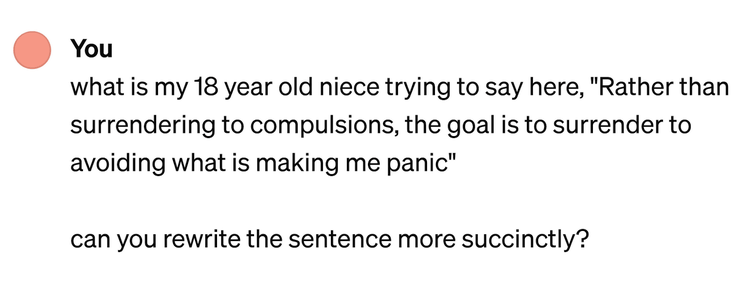
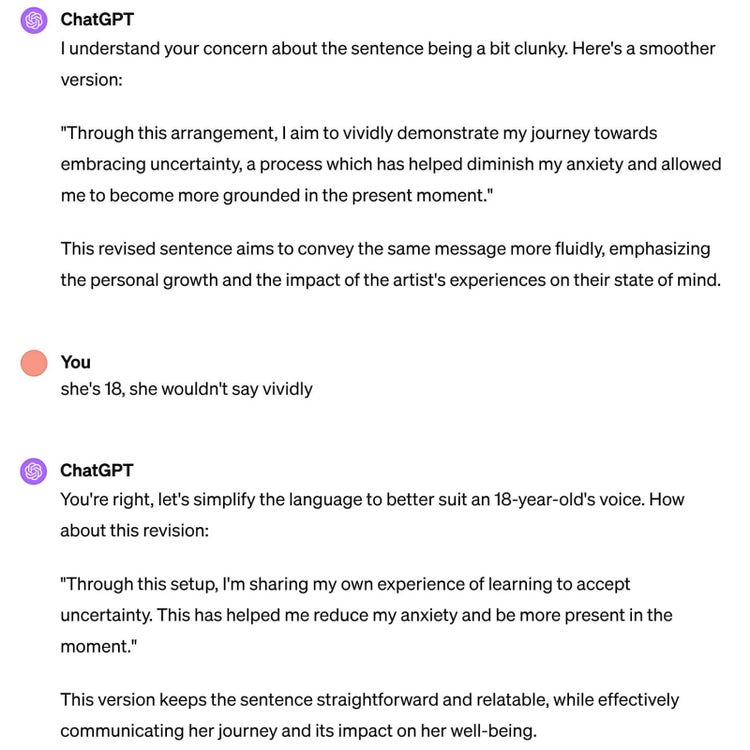
Several times throughout the conversation, the user reminds ChatGPT that the writer is 18 years old. And to better match the vocabulary choices of a teenager. Such as:
And:
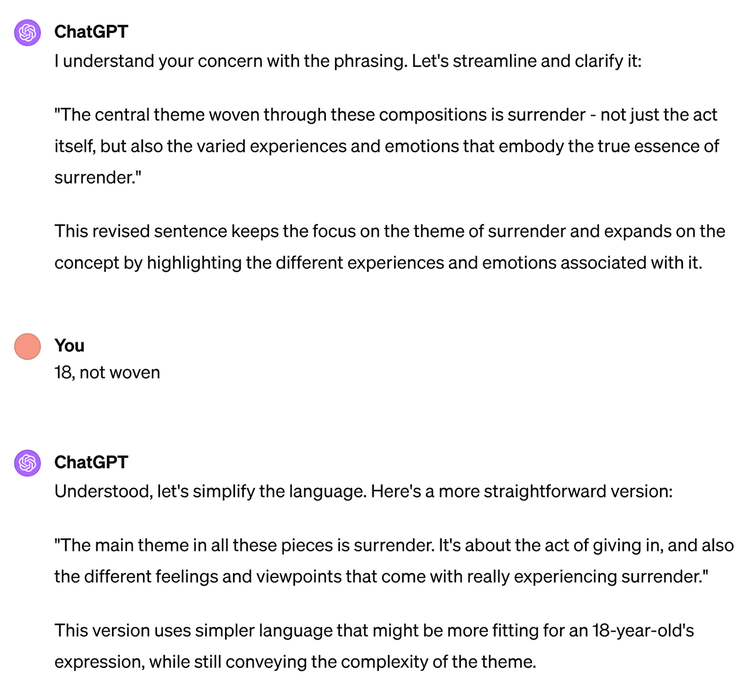
While ChatGPT can potentially be trained on certain voice and tone queues more consistently, that would be a great deal of up-front work to edit this one-page paper for one teen. The result is a lot of time and prompt finesse to get a response closer to the nuance required.
This limitation underscores the importance of human oversight in using AI for content generation. You can review, edit, and contextualize AI-generated content. Ensuring it aligns with the intended message and audience.
Lack of Emotional Intelligence
ChatGPT operates solely on text data patterns. And lacks real-world experience and consciousness. Consequently, it doesn't possess the sensitivity or nuanced comprehension that comes from actual life experiences.
This limitation isn't just confined to responding to sensitive questions. But extends to areas that require empathy and understanding of human emotions. Like customer support and performance reviews.
For example, the nuances of feedback and encouragement in performance reviews are crucial. And require a level of emotional insight that ChatGPT can't provide.
And in customer support, understanding a customer's frustration or urgency and responding with empathy is key to effective service. Which may be beyond ChatGPT's current algorithmic capabilities.
Data Privacy and Security Concerns
Users interacting with ChatGPT may share personal or sensitive information. It's crucial to ensure the privacy and security of this data. There's always the risk of data breaches or misuse.
You can take extra precautions like:
- Avoid disclosing details that could be sensitive or used inappropriately
- Look for services like VPNs and messaging apps that offer encryption. And have a clear privacy policy in place.
- Ensure all team members are aware of best practices for data privacy and security
Risk of Spreading Misinformation
You're liable for inadvertently spreading misinformation if you don’t vet or verify the information that ChatGPT generates. Proper oversight and verification processes can help you maintain the AI-generated content’s integrity and reliability.
Here are some tips you can use to significantly reduce the risk of spreading misinformation:
- Always cross-verify facts and data provided by ChatGPT. Especially when dealing with critical or sensitive topics like medical, legal or financial advice.
- Establish mechanisms for users to report inaccuracies. Or misleading information generated by ChatGPT
- Clearly communicate to users that while ChatGPT can provide useful information, they must seek information from multiple, reputable sources
Start Using ChatGPT and AI Today
With a good understanding of the benefits and drawbacks of ChatGPT, you're in a better position to use it to improve various aspects of your business operations. And content strategies.
To take things further, bring in Semrush’s Content Toolkit.
It comprises a set of AI-powered tools that help you research high-potential topics, build SEO-focused briefs, generate full-length drafts, and optimize your content—all in one place.
Take advantage of these tools by signing up for a free Semrush trial.
Claim Your Free 7-Day Trial
and Explore Our Digital Marketing Tools

Sydney has been creating content for over 10 years. She has been a writer, content manager and coordinator, editor, and strategist. At Semrush, she’s a blog editor who makes sure each article is as accurate, optimized, and helpful as possible.
Tells Google to show you more from Semrush in AI, Search, and Discover.
Table of contents
- What is ChatGPT?
- 15 Benefits of ChatGPT
- Constant Availability
- Repetitive Task Automation
- Workflow Integration
- Peak Operational Agility
- Versatile in Application
- Extensions and GPTs Available
- Continuous Updates and Improvements
- Multilingual Communication
- Conversations That Mimic Human Interaction
- Improved Content Quality
- Open for Further Fine-Tuning
- Enhanced Customer Satisfaction and Engagement
- Educational Purposes and Self-Learning
- SEO Automation
- Scalability
- 8 Disadvantages Of Using ChatGPT
- Biases in the Programming
- Ethical Issues and Concerns
- Potential Legal Implications
- Challenges with Plagiarism
- Limited Control over Generated Content
- Lack of Emotional Intelligence
- Data Privacy and Security Concerns
- Risk of Spreading Misinformation
- Start Using ChatGPT and AI Today