
10 Tips for Writing Awesome Website Content in 2025
What Is Website Content?
Website content is any text, image, video, and audio elements on a website.
Done well, it helps attract, inform, and engage prospects who land on your site. And encourages them to take desired actions, like signing up for a newsletter.
Over time, this content can help turn visitors into customers.
Types of Website Content
Different types of web content include:
- Blog posts are articles that share insights, information, or opinions on specific topics. They’re particularly good for gaining visibility in search engines.
- Company pages are core webpages about your business that rarely change, like the homepage, about us page, or services page.
- Ebooks are downloadable resources that explore a topic in depth. They’re ideal for capturing leads and showcasing your expertise.
- Free tools can be templates, checklists, or calculators that solve problems. They provide instant value.
- Visual content includes images, videos, and infographics. It makes complex ideas easier to understand and keeps people engaged.
- Podcast episodes are audio recordings that share insights through interviews or other conversations. They’re great for reaching people who prefer to listen to content on the go.
10 Tips to Write High-Quality Website Content
If you want to know how to write web content for a website, follow these tips:
1. Research Your Target Audience
Researching your target audience helps you understand their pain points, interests, and preferences. So you can create content that truly connects with them.
Ben Goodey, Founder at Spicy Margarita, puts it well:
“If you don’t know your audience—their level of understanding, the language they use, and the world they live in—it’s incredibly hard to create content that feels real and relevant. When content feels generic or out of touch, people tune out. If you want your content to resonate—and help people remember you and your brand—you need to spend serious time getting to know them.”
Learn about your target audience by manually studying your competitors’ content and reading industry reports.
Or, use Semrush’s One2Target tool to analyze your competitors’ audiences.
Simply enter at least one competitor’s URL and click “Analyze.”
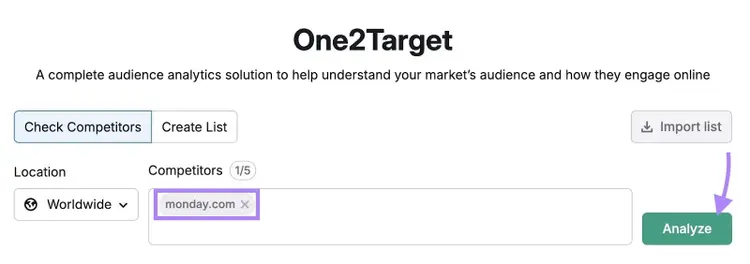
The tool will generate detailed audience reports with demographic, socioeconomic, and behavioral data.
You can even see which social media platforms they use.
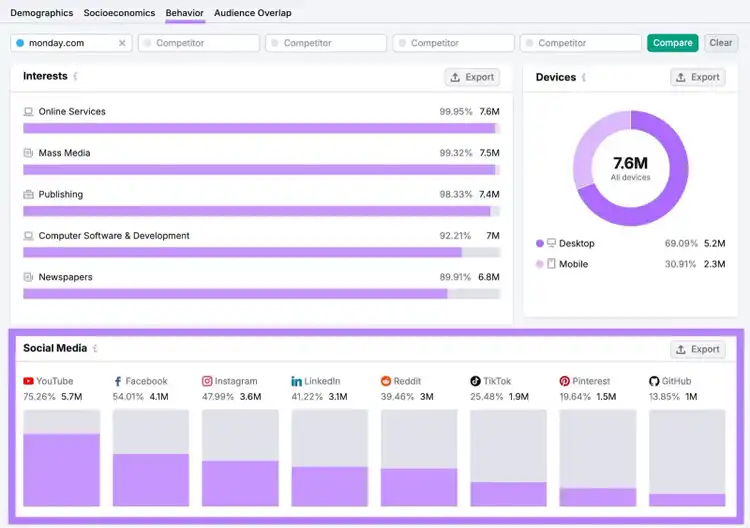
Use these insights to shape content that speaks directly to your audience and what they care about.
In the example above, the audience has a low or medium income and primarily uses YouTube. Which suggests budget-conscious messaging and content that details processes would work well.
Streamline Audience Research
with the One2Target Tool
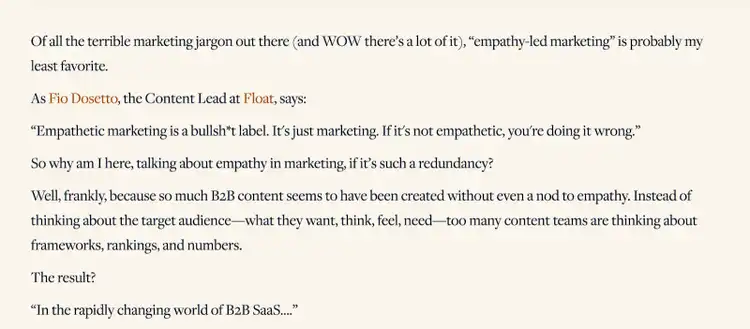
2. Make Your Content Easy to Read
When your language is clear, your message is easy to follow. And readers are more likely to stay engaged.
So, make sure you:
- Keep sentences short. Break long sentences into two or three to make them easier to read.
- Focus on one idea per paragraph
- Use bullet points or numbered lists to highlight key points and make content easier to scan
- Limit jargon to make sure readers understand what you’re talking about
- Use active voice (e.g.,“The team wrote the report” instead of “The report was written by the team”)
See some of these tips at work in this Beam Content blog post:
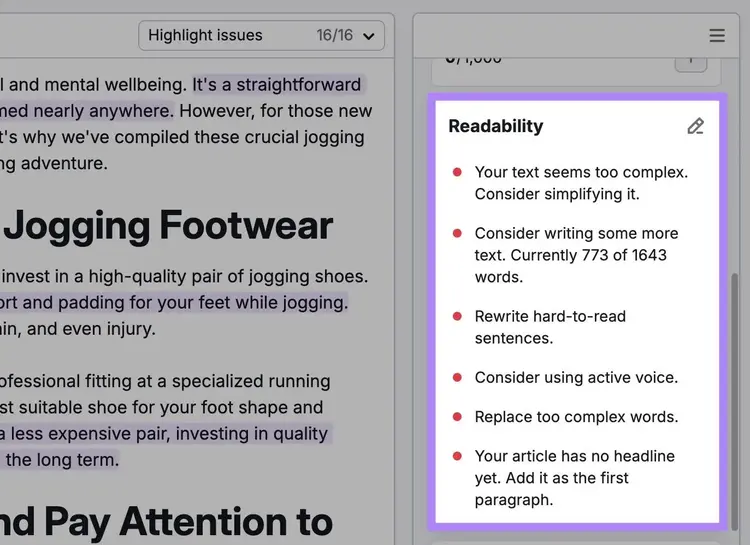
Use Semrush’s SEO Writing Assistant to evaluate how easy your content is to read.
Just enter your content, add your keywords, choose your target location, and click “Get recommendations.”
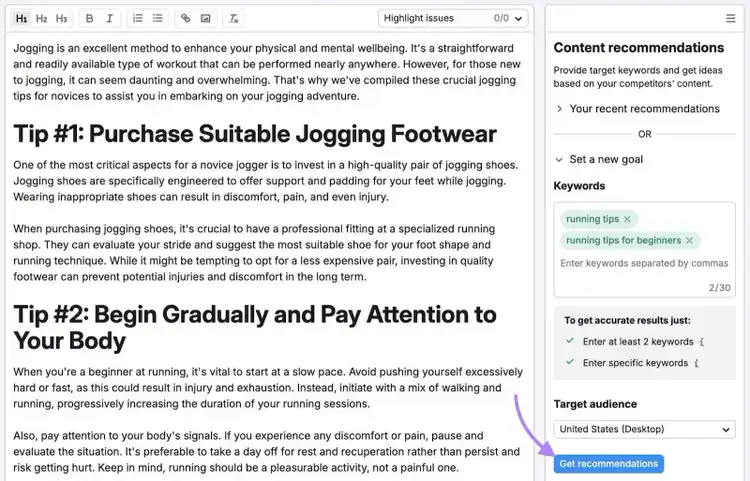
The tool will analyze your content and score it for several categories, including readability.
Follow the suggestions provided under the “Readability” section to make your content easier to digest.
3. Improve Time to Value
Time to value (TTV) is how quickly visitors find useful information after landing on your page. And ensuring it’s short is likely to keep them on the page (and your site) longer.
That's good for both your audience and SEO.
Here's how to improve your content’s TTV:
- Keep introductions short: Clearly state what readers can expect and quickly move into the main content
- Put key points up front: Don't bury important tips or actionable advice deep in the article.
- Limit background information: Briefly cover background information if needed, then link out to pages with deeper explanations if necessary
- Use clear formatting: Headings, bullet points, and visual elements can help readers quickly find the information they need
- Review your content: After writing, check whether each section quickly delivers value. And shorten sections that don’t.
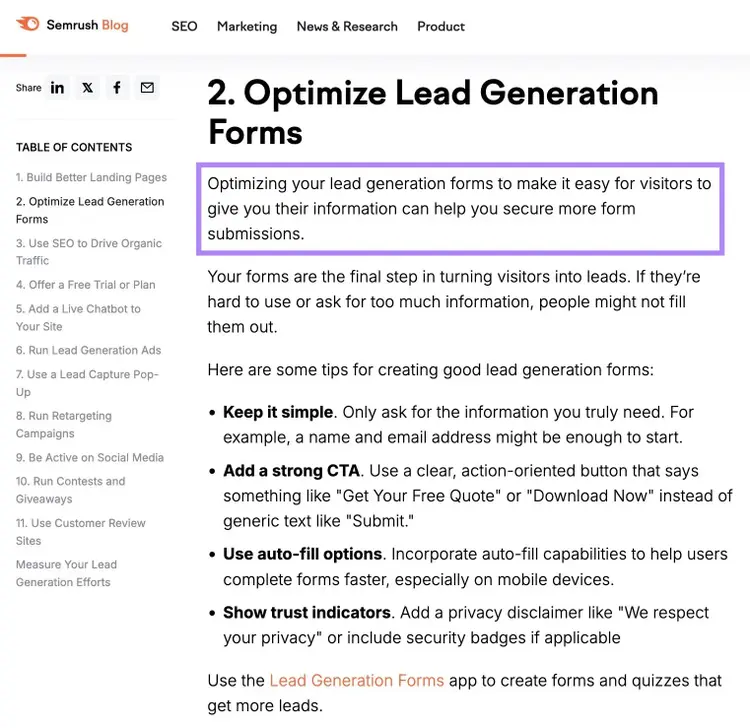
Our blog post on lead generation strategies does this.
For example, the “Optimize Lead Generation Forms” section jumps straight into how better forms drive more leads. And then follows with actionable tips for how to improve forms.
4. Add Visuals
Visuals (like images, videos, and infographics) grab readers’ attention quickly, break up walls of text, and can help readers understand content better compared to text alone.
Visuals are especially good for simplifying complex or abstract ideas. Like this website architecture design on our own blog:
Follow these tips to effectively use visuals in your content:
- Use visuals with a purpose: Every image, video, or chart should provide value, not just fill space
- Avoid generic stock photos: Stock images often feel impersonal. Instead, use visuals that feel authentic and directly relate to your topic.
- Use screenshots for tutorials: If you're showing steps or workflows, screenshots can make it easy for readers to follow along
- Add alt text: This is HTML that describes images to make them accessible for users relying on screen readers and to help search engines understand what’s being shown
- Don’t overdo it: Use visuals to enhance your content, not distract from it
5. Give Readers Actionable Advice
Webpage content writing that shows readers how to apply what they’re learning makes your content more valuable. Because they’ll be able to use that information in the real world.
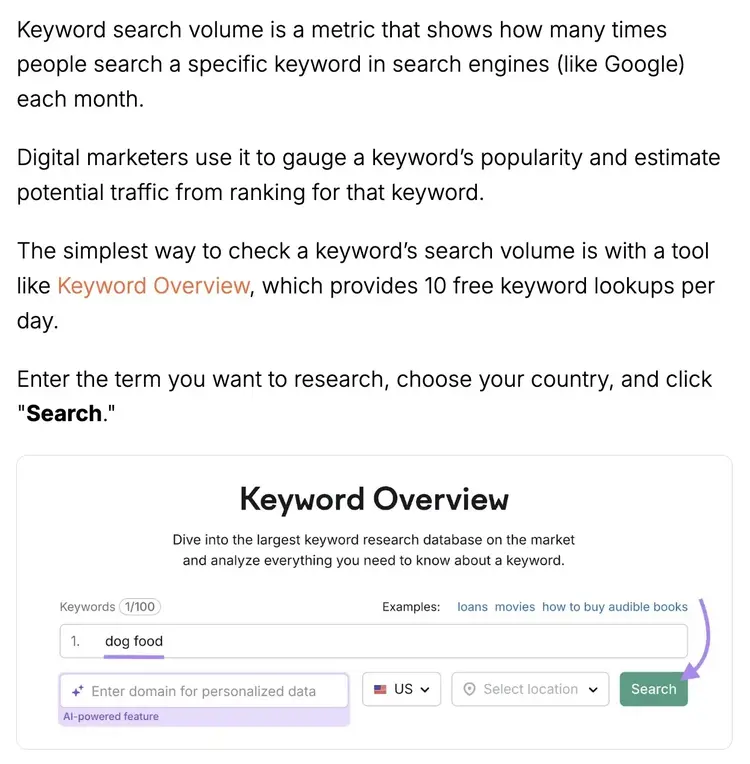
For instance, in our blog post about keyword search volume, we don’t stop at defining the term. We walk readers through how to actually check a keyword’s search volume.
Before you finish writing a section, ask yourself: “Have I given readers practical information they can apply?”
If not, consider how you can give readers what they need to start. Like adding a short checklist or simple instructions to help them put your advice into practice right away.
6. Maintain a Consistent Brand Voice
Using a consistent brand voice across all your content creates a cohesive experience and makes your brand more recognizable.
Create a brand voice guide with do’s and don’ts, tone examples, and phrases you use often to keep everyone on the same page. Especially if multiple people create content for you.
To make this easy, define your brand voice using Semrush’s Content Toolkit.
Simply go to the “Brand voice” feature and upload a writing sample.
Aim to provide it with a content sample that best reflects your style. Like content on your about us page.
Then, select “Create Brand Voice.”
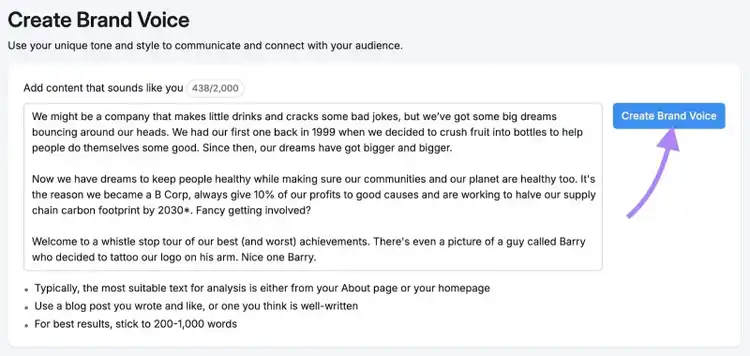
The app will scan your writing and create a brand voice profile, along with suggestions for how your brand might speak and whom it's speaking to.
Tweak it if needed.
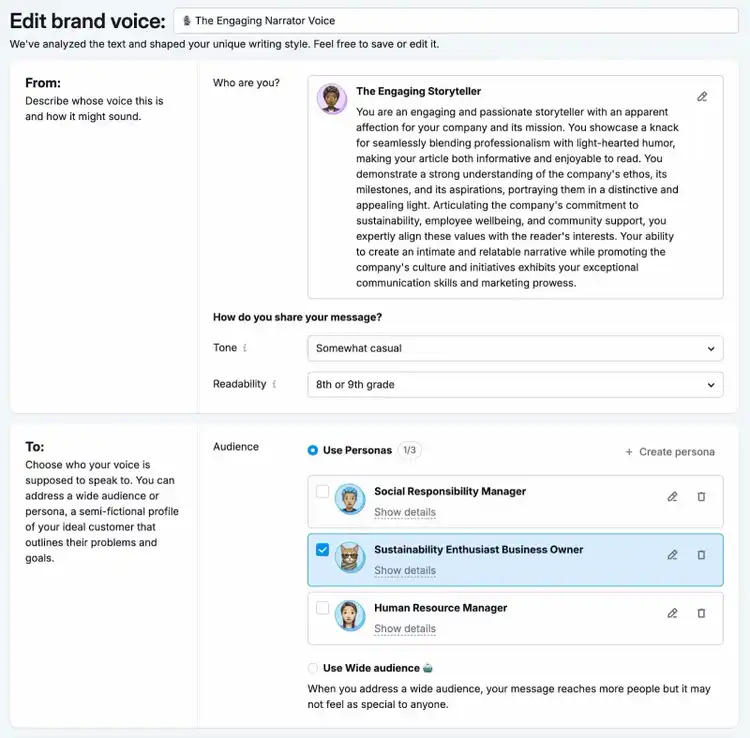
Click “Save Changes” to create your brand voice in the app.
7. Fix Grammar and Spelling Errors
Catching and fixing any grammar and spelling mistakes keeps you content sounding polished and professional.
Tools like Google Docs and Microsoft Word are good for catching basic grammar and spelling mistakes.
Options like Grammarly and Hemingway Editor go a step further to clean up awkward sentences, suggest clearer wording, and catch more complex grammar issues.
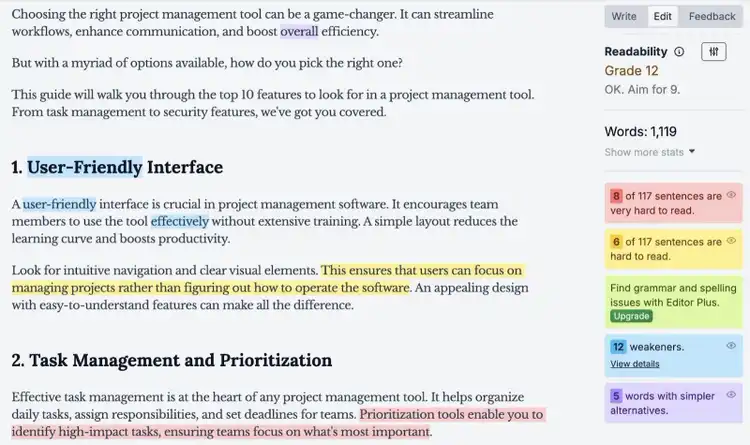
Christine Skopec, Senior Blog Editor at Semrush, recommends you work with a professional proofreader or content editor if possible.
“A dedicated editor can spot things editing tools can miss. Plus, editors know how to get the brand voice just right and improve the overall flow of information.”
If hiring an editor isn’t an option, ask a teammate or friend to review your writing.
8. Optimize Your Content for Search Engines
Implementing SEO best practices during web content creation can make it appear higher in search results. And that means more opportunities to reach your audience.
Here are a few key ways to optimize your content for search engines:
- Find and use relevant keywords: Use keyword research tools to find terms your audience is entering into search engines. Pick one primary keyword to target on each page and use it in the page title, subheadings, and throughout the body of your content.
- Write good meta tags: Include your keyword in the title tag (the HTML title that may appear as a blue clickable headline in search results) and in the meta description (the short HTML summary that may appear underneath the title in search results). This helps search engines understand your topic and encourages users to click.
- Keep URLs brief and logical: Use short, descriptive URLs that include your primary keyword. Avoid unnecessary characters.
- Add internal links: Linking to other helpful pages on your site helps readers explore more and tells search engines how your content is connected
- Optimize your images: Add descriptive alt text to describe every image and compress files to keep your site loading fast
Use Semrush’s SEO Writing Assistant to optimize your content for search engines in real time. To improve your chances of ranking well, follow the suggestions in the “SEO” tab.
9. Feature Insights from Subject Matter Experts
Adding insights from subject matter experts (SMEs)—relevant professionals with deep knowledge and experience—allows you to incorporate valuable perspectives you likely won’t find in competing content.
If you’re writing a post about product management, interviewing a product marketing manager with years of experience would be a great idea.
Also, it helps you meet Google’s Experience, Expertise, Authoritativeness, and Trustworthiness (E-E-A-T) guidelines.
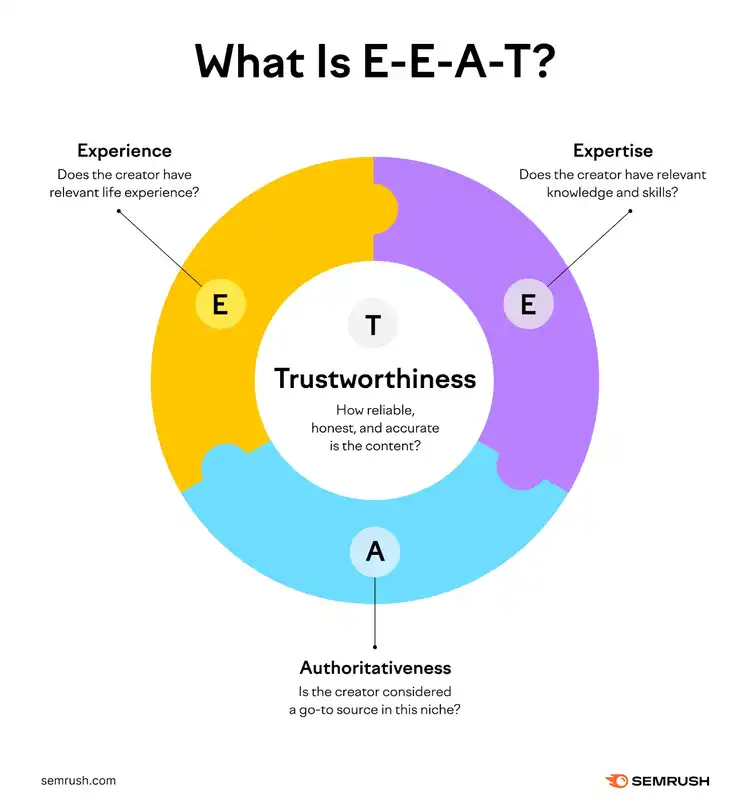
While E-E-A-T isn’t a direct ranking factor, it is a core part of Google’s Search Quality Rater Guidelines. These guidelines help reviewers assess which content is genuinely helpful.
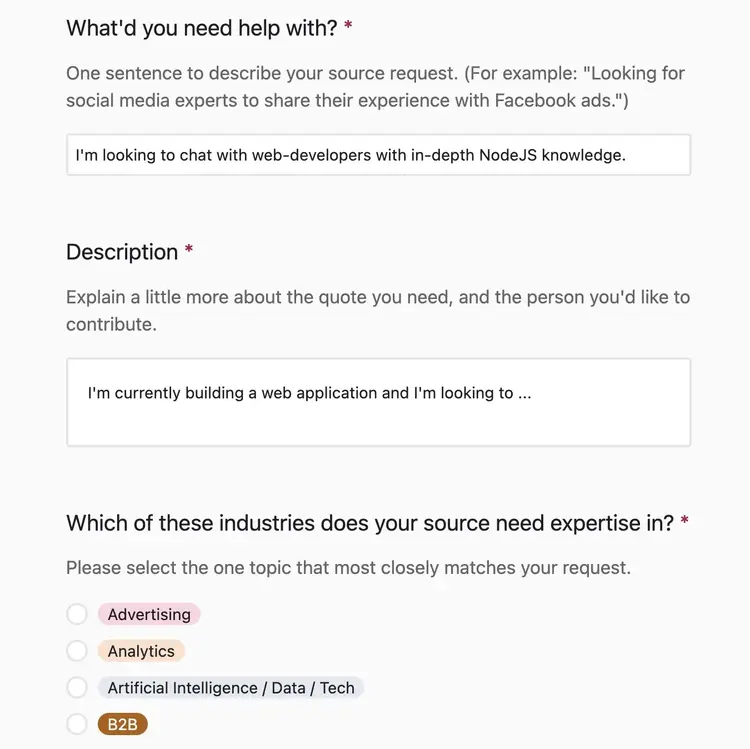
Use platforms like Help a B2B Writer orTerkel to connect with subject matter experts. Simply post your request and review the responses you receive.
And Alexander Boswell, Content Marketing Writer at Organic Growth Marketing, has a suggestion for how to incorporate experts’ input:
“Lots of writers (including my past self!) treat quotes/insights from SMEs as though they’re written in stone and use them verbatim. The majority of marketing content isn’t based entirely on journalistic standards—so we can edit quotes a bit to better suit the narrative and flow of the content.”
But it never hurts to confirm the quote with the expert before proceeding with it.
10. Incorporate Original Research
Original research gives you insights no one else has, and that can make your content stand out. When you create content around those findings, it’s more likely to grab attention and get shared.
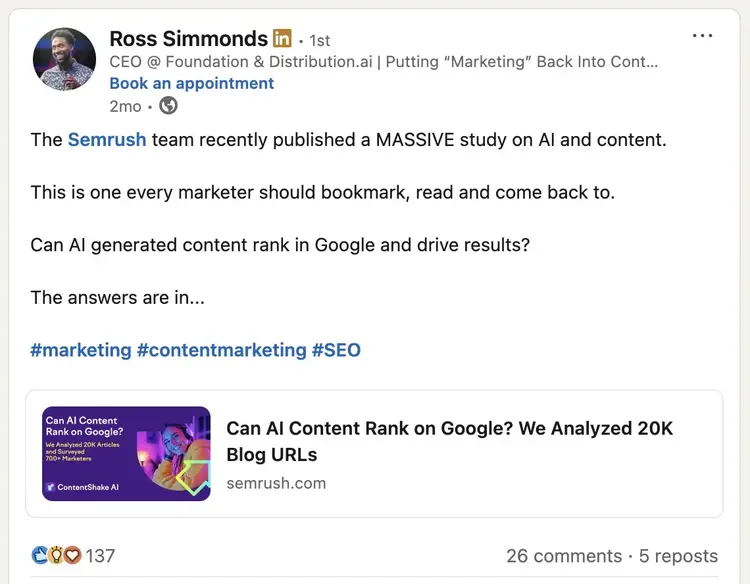
For instance, we analyzed 20,000 articles and surveyed 700-plus marketers to create a piece discussing whether AI-generated content can rank on Google.
This research was widely shared on LinkedIn. Including this post:
Creating content that includes original research can even help you build backlinks (links from other sites that point to yours).
And it doesn’t have to be complicated. You can start small. A quick poll, short survey, or lessons from your own projects are great starting points.
Consistently Publish High-Quality Website Content
Now that you know how to create great website content, you might be wondering how to do it at scale.
Semrush makes this easier with tools for every stage of content production. Like keyword research, content creation, and on-page optimization.
Sign up for a free trial today.
Elevate Your Digital Strategy
with a Semrush Subscription

Carlos Silva leads the editorial pipeline for the English blog—coordinating writers, editors, strategy, and building AI workflows that boost content quality and AI visibility. With 10+ years of experience writing and editing across in-house and agency roles, Carlos blends content strategy, SEO, and AI to help marketers stay ahead of an evolving search landscape.
Carlos Silva
Carlos Silva leads the editorial pipeline for the English blog and builds AI workflows that boost content quality and AI visibility. 10+ years writing and editing across in-house and agency roles.

Tells Google to show you more from Semrush in AI, Search, and Discover.
Table of contents
-
10 Tips to Write High-Quality Website Content
- 1. Research Your Target Audience
- 2. Make Your Content Easy to Read
- 3. Improve Time to Value
- 4. Add Visuals
- 5. Give Readers Actionable Advice
- 6. Maintain a Consistent Brand Voice
- 7. Fix Grammar and Spelling Errors
- 8. Optimize Your Content for Search Engines
- 9. Feature Insights from Subject Matter Experts
- 10. Incorporate Original Research