
AI visibility is a topic-level game: A study of 50,000 brands in ChatGPT [Study]
Brand visibility in ChatGPT shifts prompt by prompt. Two related questions in the same buyer's research can surface completely different brands. Track only one, and you'd think you're winning. Look across the topic, and the picture changes.
The question in AI search is no longer "do I rank for this keyword or prompt?" It is "when the AI answers questions across the topics key to my business, does my brand keep showing up?"
To find out how brands win and lose visibility across topics, we partnered with Kevin Indig to study 1,094 subject areas in ChatGPT.
Here's what we found.
Key takeaways
- Winning one prompt in ChatGPT is not the same as owning a topic. Real topic ownership requires a brand to appear across at least four of five related prompts, with a 5-percentage-point lead over the runner-up.
- Most topics in ChatGPT are still contestable. Only 15.2% of the 1,094 categories we analyzed had a clear owner. 85% remain open to competitors that can build consistent visibility.
- Broad SEO signals do not consistently predict topic ownership. Domain-level metrics like Authority Score and organic traffic correlate with ownership only about half the time. The competitive picture only becomes clear at the topic level.
- Once a brand owns a topic in ChatGPT, it tends to hold on to it. But only with a wide enough margin. Owners with a 5-percentage-point lead retained first place in 90% of month-over-month comparisons. Narrow leads change hands frequently.
Methodology
We partnered with Kevin Indig and Growth Memo to analyze data from the Semrush AI Visibility Toolkit.
The dataset covers 1,094 US categories, tracked monthly in ChatGPT from January through June 2026.
Each category is a topical cluster of five representative prompts covering the questions a buyer might ask in that subject area (definition, comparison, alternatives, use case, buying question).
Think of a category as a topic like “payroll software,” “small business banking,” or “best pillows for neck pain,” and the five prompts as the standard questions someone would ask about each.
Scope of the data:
- Over 220,000 domains
- Over 50,000 brands
- Over 600,000 citations
- Over 220,000 URLs
For each prompt, we tracked which brands ChatGPT mentioned in the answer and which sources it cited as links.
Definitions
- Category owner: the brand with the highest share of mentions, named in at least four of five prompts, with at least a five-percentage-point lead over the runner-up.
- Emerging leader: the most-mentioned brand appears in at least three prompts but does not meet the owner threshold.
- Unsettled category: no brand appears in at least three prompts.
💡
A note on the ownership metric: We used brand mentions in the answer text to define ownership rather than source citations. Kevin's earlier Growth Memo research showed that people pay attention to what the AI's answer says, not the citations listed underneath it. 74% of users in that research chose the top-mentioned brand as their final pick. In this study's data, the two signals also diverge: only 21% of the most-cited domains in a category were also the most-mentioned brand, and the two correlate slightly negatively (-0.229). This is consistent with our previous research on mentions vs citations.
1. Most categories are still up for grabs in ChatGPT
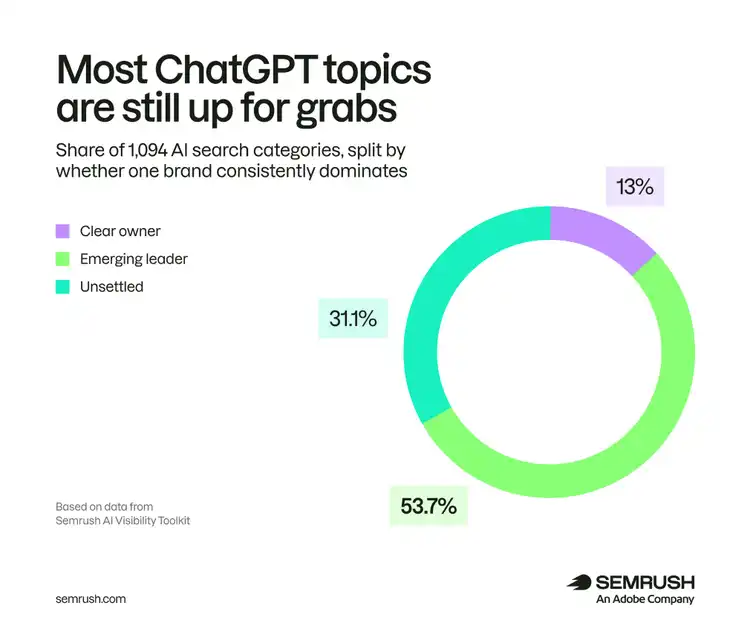
Only 15% of the AI search categories we analyzed have a clear brand winner. In the other 85%, no single brand shows up consistently across the topic's related prompts. A brand might appear in one question and be missing from the next.
Here’s the full breakdown of the 1,094 categories we analyzed in ChatGPT:
- 15.2% have a clear owner (one brand appears in at least 4 of 5 prompts with a 5-point lead)
- 31.2% have an emerging leader (one brand appears in at least 3 prompts, but without the required lead)
- 53.7% are unsettled (no brand appears in even 3 of 5 prompts)
Here's the counterintuitive part: You'd expect the biggest topics, the ones people ask ChatGPT about most often, to be dominated by established brands like they are on Google.
Higher search volume usually means stronger competition. In ChatGPT, it's the opposite
We split the 1,094 categories into two groups by AI search demand: the top half (the topics people ask about most) and the bottom half (the ones they ask about less). Only 11.3% of the top-half topics had a clear brand owner. In the bottom half, 19% did.
And that top half accounts for 98% of the AI search volume in our sample, so almost every question we tracked in ChatGPT lands in a topic without a clear winner.
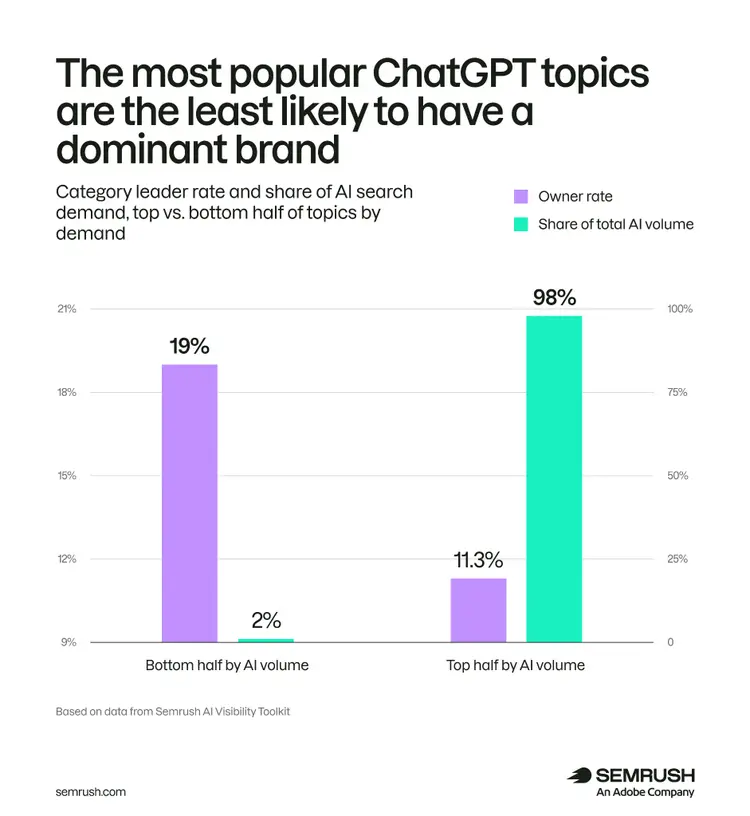
The takeaway: winning one prompt doesn't make you the brand ChatGPT associates with a topic. Showing up consistently across all the related questions does. In the majority of topics we analyzed, no brand managed to do that yet, which is the opportunity.
2. SEO metrics don't always predict who wins a topic in ChatGPT
If a brand has strong SEO fundamentals (high organic traffic, high branded search volume, a solid Authority Score), you'd expect it to win in AI search too.
We tested this by comparing the topic owner against the runner-up on three domain-level metrics: branded search volume, organic traffic, and Authority Score.
The results only line up with ownership about half the time. Only branded search volume was a statistically significant differentiator, and even then, the edge was modest.
- Owners had higher branded search volume in 55.7% of pairs
- Owners had higher organic traffic in 48.4% of pairs
- Owners had a higher Authority Score in 52.5% of pairs
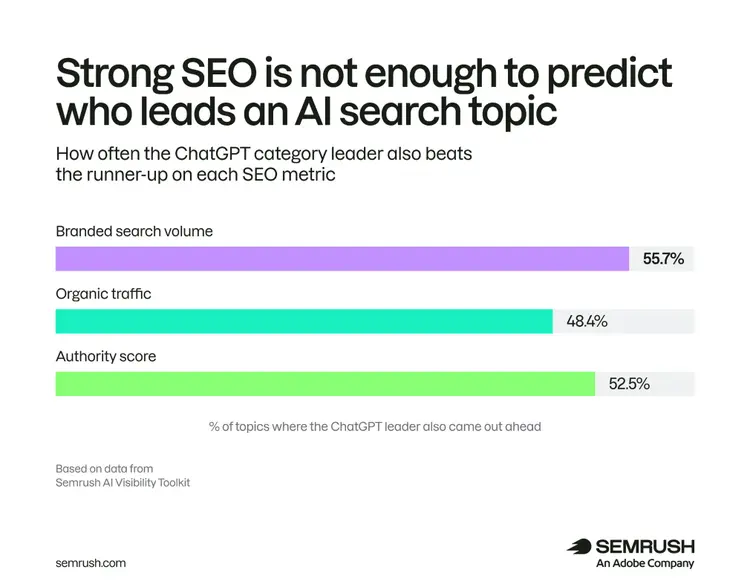
In nearly half the topics, the runner-up had at least one of these advantages and still lost. Whatever decides who owns a topic in AI search isn't captured by broad SEO strength alone.
“Treat that as a hypothesis, not a finding. What the data actually shows is: traditional SEO metrics aren't enough to explain who owns a topic. While they play their role, there’s more to it.”
Kevin Indig, Founder of Growth Memo
Strong SEO helps you show up, but once several brands are in the running, deep coverage of the specific topic is what turns you from runner-up to owner. If you're strong in Google but losing topic authority in ChatGPT, the fix isn't more homepage backlinks. It's building a deeper library of content and getting relevant mentions on that specific subject on top of the SEO foundation.
3. Once you own a topic in ChatGPT, you tend to hold it. But only if your lead is wide.
When a brand has a comfortable lead in a topic in ChatGPT, they almost always keep it. When the lead is narrow, they often lose it.
Clear category owners we analyzed stayed on top in 90.4% of month-over-month comparisons. Emerging leaders and unsettled categories changed hands far more often, with the top brand switching in 1,950 of 5,470 comparisons.
- Topics where the leader flipped: median lead of 1.3 percentage points
- Topics where the leader held: median lead of 2.9 percentage points
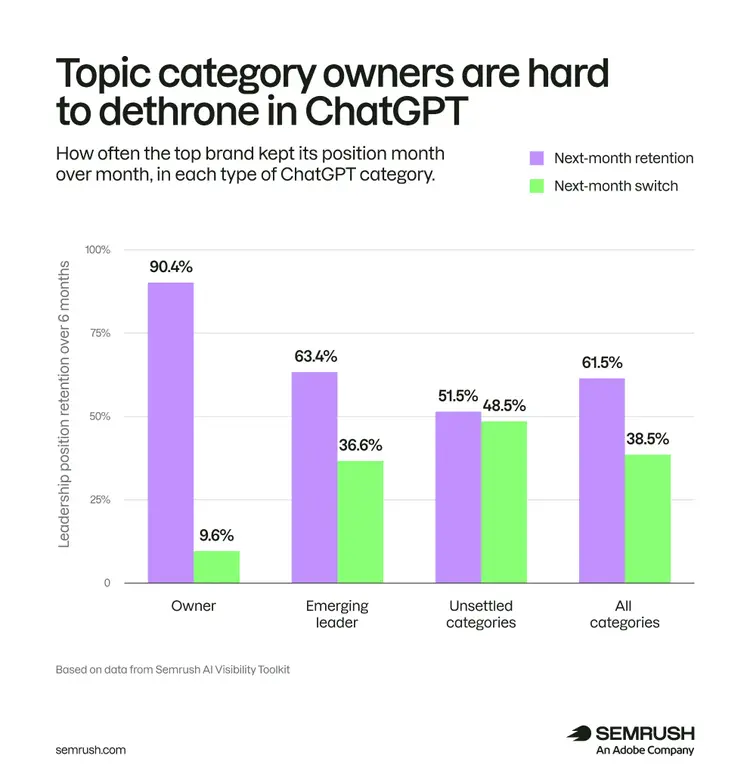
Leadership changed hands regularly. However, those shifts were concentrated in categories where the initial lead was small.
Here’s an example where a clear leader was replaced by the previous month’s runner-up:
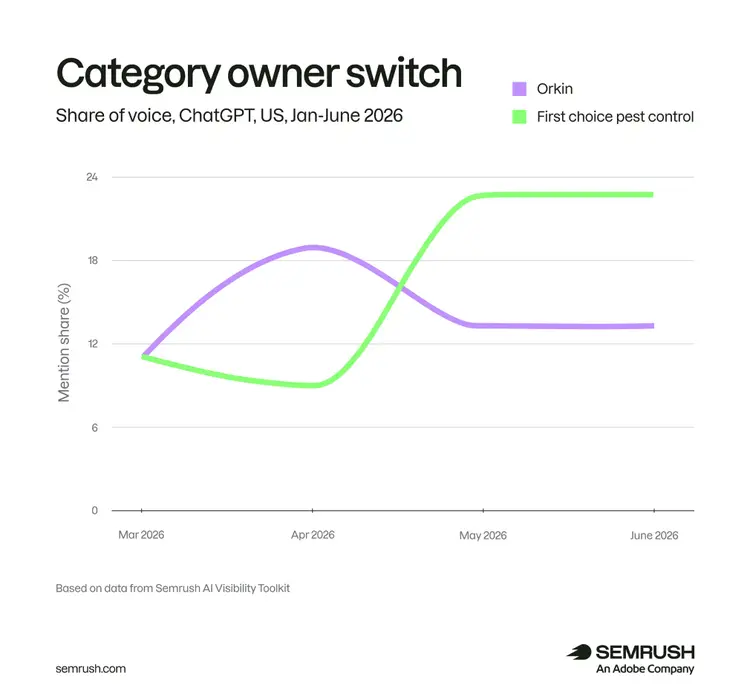
Why the switches happen isn't something this data can answer. They might reflect shifts in ChatGPT's sources, changes in how it generates answers, or real shifts in a brand's underlying relevance. What the data shows is a simpler pattern — margin matters more than direction.
The takeaway: growth doesn't equal safety. If you lead a topic with only a narrow margin, keep pushing content and coverage. A competitor growing faster can still overtake you. If you're a challenger in a topic where the current leader has a narrow lead, this is the moment to act. Once they consolidate a bigger margin, the topic gets much harder to move.
How to start winning at the topic level
The brands winning in AI search operate at the category level. They pick a focused set of topics and build the coverage, mentions, and third-party authority signals ChatGPT relies on inside each one.
This takes time to build, but it compounds. Once you become the brand ChatGPT associates with a category, there’s a good chance you can hold it.
Individual prompts are still worth watching as a signal. But your topical authority determines whether ChatGPT will surface you when a customer asks something new in that category.
Here's how to get started:
- Identify the topical areas that matter for your business. Start from what your customers care about and where you compete. The categories of questions your buyers ask when they're evaluating something like what you sell are the topics worth building around.
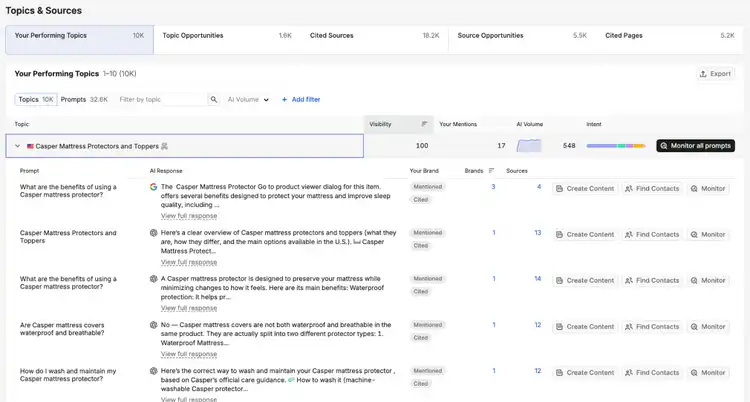
- Analyze your current topical authority. Semrush's AI Visibility Toolkit already lets you see which topics you're influencing in AI search and where you sit inside each one. Start there to get an honest baseline of where your authority is real, where it's thin, and where competitors are ahead.
- Focus your efforts. Trying to build authority across every topic at once dilutes everything. Pick two or three relevant categories where you already have some signal, existing content, and a real product angle. That's your first bet.
- Grow your topical authority. Topical presence comes from three things working together: broad content coverage across the questions inside a category, relevant mentions in the sources ChatGPT draws from (Reddit, review sites, industry publications, expert commentary), and strong entity signals (structured data, consistent brand naming, third-party citations that tie your brand to the topic).
Track and grow your topical authority across AI search
with Semrush

Margarita is a passionate Content Marketer with over 6 years of experience in various tech industries and 3 countries. She also holds two MBA degrees in Marketing.
Tells Google to show you more from Semrush in AI, Search, and Discover.