
11 Steps to Successful Content Development: Guide
Your website content can be anything from universally appealing blog posts to infographics and success stories. But all of these things should be created in keeping with a consolidated plan: your content development strategy.
A quality content development strategy comprises all the steps of content creation, from planning and research to promotion, optimization, and performance tracking. It ensures that every interaction your potential customer has with your brand becomes a positive experience and lays the foundation for trust.
In this guide, we’ll explain why a well-organized content development process is so essential for your growth, and help you to devise and implement one.
What Is Content Development?
Content development is the process of planning, creating, distributing, and reviewing content (such as blog posts and videos) for a particular audience and purpose. It’s a crucial part of any content marketing strategy, but it can also help with sales, customer service, and other communications.
Content development typically involves:
- Strategizing and planning
- Audience and topic research
- Writing and creation of visuals
- SEO
- Publishing content
- Content promotion
- Performance tracking
All these processes are closely connected. They work together to help you build a connection with your target audience and aid business growth.
Why Is Content Development Vital for Your Business?
The main reason you need a content development strategy is that it can save you:
- Time. Planning lets you meet deadlines and avoid frustration and overwork.
- Effort. You will only create content based on thorough research, and which is tailored to contribute to your business goal.
- Money. You will optimize your content, carefully choose promotional channels, and monitor each piece’s performance to make sure it hits the mark and generates ROI.
To put it simply, a content development strategy is about having an organized process in place. Next, let’s talk about how you can keep it up and running.
Build a High-Perfoming Content Development Workflow
With Semrush Content Marketing Platform
11 Steps to Successful Content Development
Now that we are done with the basics, we can move to transforming each of the above elements into part of an action plan. With these in mind, we’ll go through all the content development steps, focusing on the questions to ask and steps to take.
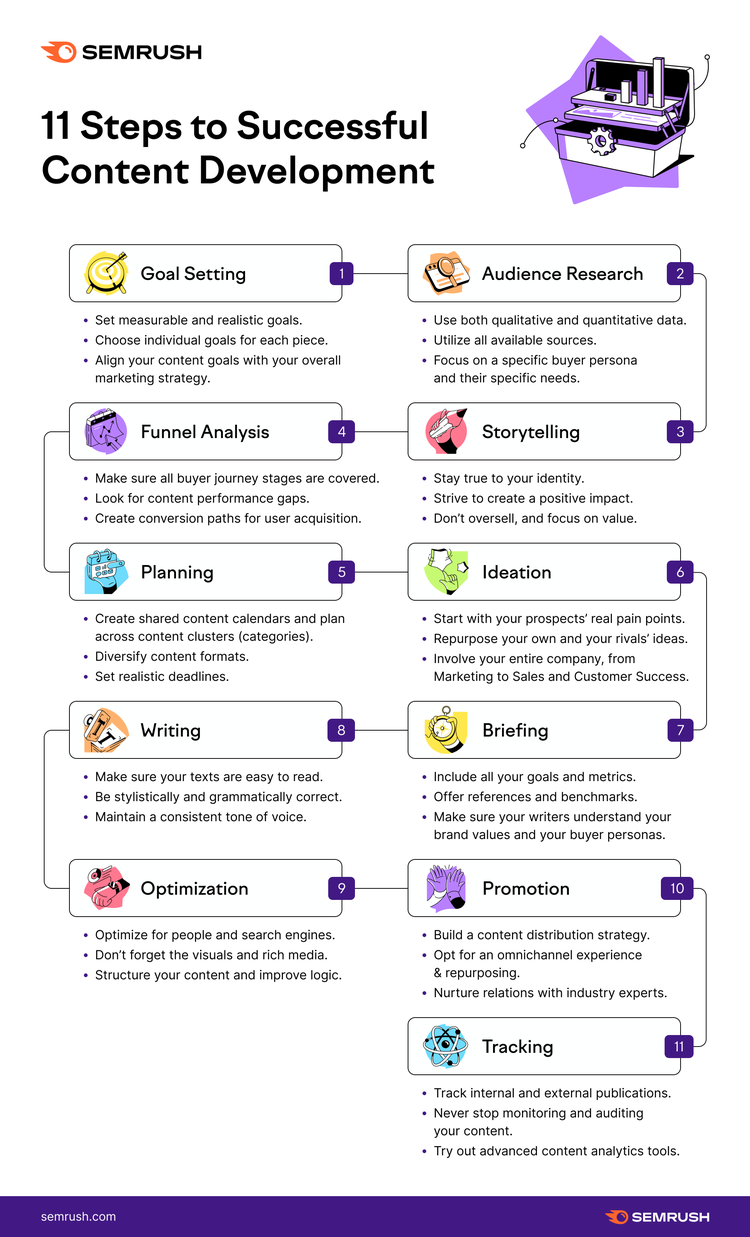
Content development steps and tips.
Step 1: Goal setting
To move away from empty phrases, you need to match each of your content ideas to measurable values.
Start by asking yourself some simple questions. For example, ‘what value does this content add?’ If the answer is ‘educates’ or ‘solves a problem’, you may be looking at a potential content piece that introduces your product as a possible solution, or encourages readers to start interacting with it.
Other helpful questions to ask yourself include:
- Where will you publish this piece?
- What is the level of expertise of your target audience?
- What will make this content different from the competition?
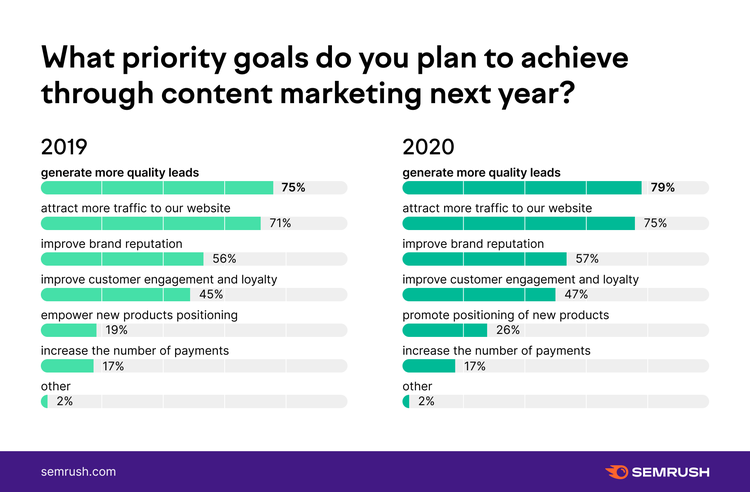
Most common content marketing goals in 2020 vs. 2019. Source: Semrush Content Marketing Survey.
Goal-setting tips:
- Set measurable and realistic goals so you can tell whether you’ve achieved them.
- Choose individual goals for each piece based on the content funnel stages, promotional channels, and audience specifics.
- Align your content goals with your overall marketing strategy to make sure content contributes to bigger business objectives and pays off in the end.
Explore the Complete Guide to Content Mapping (+ Template)
Step 2: Audience Research
The easiest way to bring the information about your prospects together is to create a buyer persona profile, which should be based on a throughout customer analysis. To avoid wasting resources, it’s advisable to draw up a template of this profile before you start collecting the data. This will let you focus on the most meaningful characteristics.
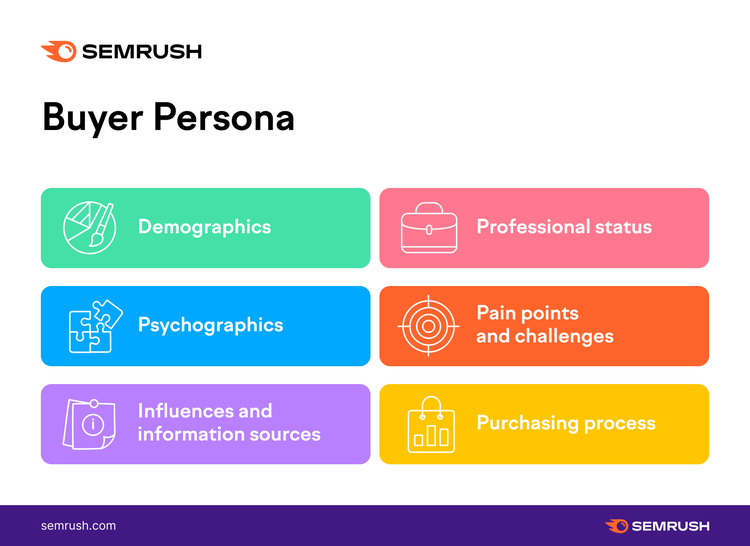
These are some of the key pieces of information to include in your buyer persona profile.
Here are some of them:
- Demographics (age/gender, location, professional/family status, etc.).
- Psychographics (values, standpoints, and goals).
- Professional/personal goals (beliefs and values).
- Pain points and challenges (obstacles and fears).
- Impactful factors and information sources (favorite events, influencers, and media).
- Purchasing process anatomy (purchase frequency, decision-making process, etc.)
Audience research tips:
- Your content audience is bigger than just your customer base. Some of them can become your brand advocates, helping you to spread the word and generate more impact with your story.
- Use both qualitative and quantitative data, and gain insights from customer-facing teams such as focus groups, social media, and reviews.
- Utilize all available sources, including unorthodox ones such as your competitors.
- Focus on a particular buyer persona and their specific needs: don’t try to cover all needs and problems with one content piece.
Step 3: Storytelling
Go back to your brand story (and message) and try to figure out what makes you unique. Integrating this in your content will help you to stand out from the clutter. The story is what makes a prospect want to find out what’s next, and become motivated to build a lasting relationship.
Storytelling tips:
- Stay true to your identity: the internet is full of indistinguishable texts and websites, and people are looking for something special.
- Strive to create a positive impact: stay nice while staying honest.
- Don’t oversell, and focus on value: if you only create content to sell, you risk losing your customers as soon (or even before) they buy.
Step 4: Funnel Analysis
Each piece of content is created not just with a goal, but also for a specific funnel stage. Why so? Because people behave very differently depending on how familiar they are with your brand and how ready they are to buy.
As a result, a product Call To Action (CTA) placed on an educational Top of the Funnel (TOFU) blog post won’t work the same as a CTA on a Bottom of the Funnel (BOFU) product landing page.
Formats that work for each stage also differ. For example, detailed ‘how-to’ guides can drive a lot of traffic, while videos can generate a lot of engagement.
Funnel analysis tips:
- Make sure all buyer journey stages are covered: break your content down or plan it by funnel stages.
- Look for content performance gaps: introduce ongoing monitoring to make sure your content performance won’t change over time.
- Run A/B tests to find the perfect candidate for each stage.
- Create conversion paths for user acquisition: choose promotional channels in advance to avoid leading people unfamiliar with your brand to a page with a product Call To Action (CTA).
Download the Ultimate Guide to Building a High-Performing Content Marketing Funnel (+ Free Template)
Step 5: Planning
Smart content planning lets you keep all the parties involved in content development on the same page. To streamline your planning process, you can use a visualization tool. It will show the time period you’ve already covered, how many pieces of each format you have pending, and how much effort will be needed to produce them.
Content planning tips:
- Create shared content calendars and plan across topic clusters.
- Link each piece to a marketing campaign, and assign stakeholders and responsibilities for each task.
- Diversify content formats to cater to the needs of different funnel stages and audiences.
- Set realistic deadlines to make provisions for unforeseen issues.
Step 6: Ideation
According to our recent Twitter poll, finding content ideas remains one of the key content development challenges.
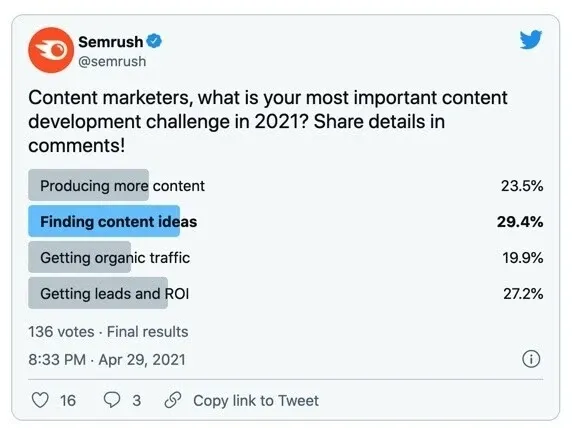
According to our recent Twitter poll, finding content ideas is the biggest content development challenge for over 29% of content marketers.
Finding topics and keywords is a common content creation routine. There are dozens of ways to do this, including, but not limited to:
- Brainstorming with your cross-functional teams.
- Researching your competitors (direct and indirect), as well as popular media in your industry.
- Surveying your customers, analyzing their customer support/sales questions, and working with them directly (think UGC and inviting customers to webinars).
- Looking at popular Google queries.
- Researching top bloggers in your niche and collaborating with influencers.
- Tracking social media conversations.
- Newsjacking.
- Using advanced tools such as Topic Research and SEO Content Template (which we’ll discuss further below).
The main point here is to validate and prioritize your research results. This ensures that you truly understand the user search intent or have a solution to the problem. It’s also about evaluating your ability to create content that’s better than what your competition has to offer.
Content ideation tips:
- Start with your prospects' real pain points, and focus on long-tail and related keywords that reflect the specifics of the topic.
- Repurpose your own and your rivals’ ideas. Check the performance of the content that already exists and broaden or narrow the topic. In many cases, you will also want to recycle a high-performing topic into a new format; for example, turning a webinar into a blog post.
- Involve departments from across your entire company in your brainstorming sessions.
Step 7: Briefing
Briefing your internal writers seems easier than briefing the external ones, as they can reach out to you for information at any time. However, writers can’t read minds. The more detailed the brief you create, the better the outcome you can expect.
Content briefing tips:
- Include all your goals and metrics. Most writers conduct their own deeper keyword and topic research, hence, they need to understand in which direction they should be heading.
- Offer references and benchmarks. If you are aware of any high-performing (or simply interesting) content on the same topic, don’t hesitate to add the link to the brief. It will help the writer understand the topic and avoid duplication.
- Make sure your writers understand and have access to your brand values, tone of voice, and buyer personas. Also, share your PR and communication policies if needed.
- Align on how you’ll communicate feedback and manage revisions. Especially if you’re working with new writers, it pays to be clear about how they can reach out to you and how you can provide information that can help them align their output to your needs.
Explore the 2021 List of the Most Outstanding Content Marketing Examples
Step 8: Writing
Writing is another routine process that should be approached with respect. There are many well-known best practices, such as checking grammar, analyzing keyword density, and working on improving your content performance.
The latter can be done by using descriptive headlines, adding lists, and leveraging visuals. However, the main point you need to remember about writing is that it is a multistep process.
Start with building the text structure, planning the word count, and defining the tone of voice — and stick to this framework while you write.
Tools like SEO Writing Assistant can help streamline this process, as well as assess your content’s readability and SEO-friendliness.

Using SEO Writing Assistant, you can assess and improve your content on the go.
Writing also includes initial editing (performed after the text is finished), as well as one or more rounds of revisions based on the comments of the stakeholders or professional editors.
Content writing tips:
- Make sure your texts are easy to read: check whether your readability score matches your audience’s education level. You should also use H1, H2, and H3 headings to clarify the text’s structure.
- Be stylistically and grammatically correct: use spell-checkers and proofreading tools.
- Maintain a consistent tone of voice: for instance, avoid jumping between the casual and formal styles, as it might make the reader feel uncomfortable.
Step 9: Optimization
Optimization is not only done for SEO purposes. The main goal of Google is to provide users with the most relevant, high-quality results based on their search queries. This should be your goal, too.
Content optimization tips:
- Optimize for people and search engines. Refer to your long-tail and question keywords (and related searches) to make sure that your post both ranks and covers all the questions your readers may possibly have on this topic.
- Ensure that you also truly understand the search intent. Don’t forget visuals and rich media. Try out other unconventional formats to keep your audience engaged.
- Structure your content and improve logic: benchmark your structure, length, headings, and keywords against your top-ranking competitors and find areas for improvement.
Step 10: Promotion
Content promotion should correlate with the goals you set at the beginning. In many cases, promotion is also a paid activity. To distribute your budget wisely, you should align your content piece with a selected promotion channel, and the step of the conversion path it covers.
Content promotion tips:
- Build a content distribution strategy where each piece works as one gear within a well-oiled machine.
- Opt for an omnichannel experience and repurpose content to save recreating it from scratch.
- Nurture relationships with industry experts to gain free placements and authoritative backlinks.
Step 11: Tracking
Tracking your content’s performance requires more effort than just reaping the benefits of the goals you’ve achieved, and reconsidering the ones you haven’t.
Tracking should consist of these two intersecting cycles:
- auditing and updating your existing content;
- and performance analytics and forecasting.
Our recent LinkedIn poll demonstrated somewhat different results from the Twitter one, indicating that getting leads and generating ROI with content can be even a bigger challenge for some content marketers.
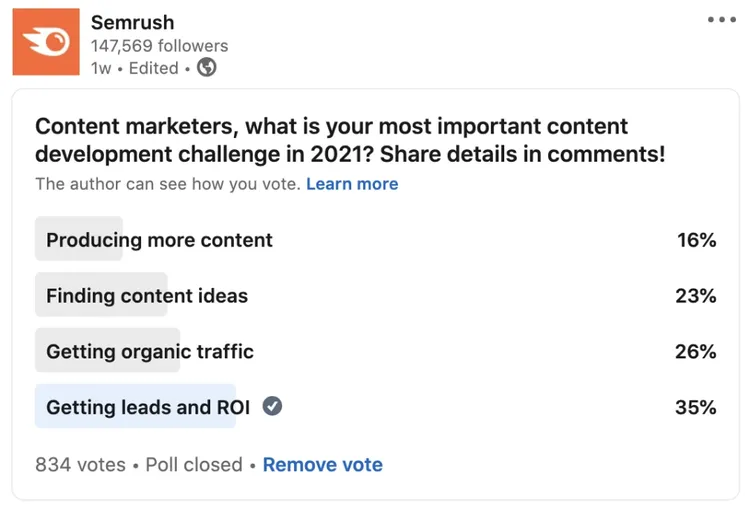
According to our recent LinkedIn post, generating leads and ROI is the biggest challenge for 35% of content marketers.
Content tracking tips:
- Track internal and external publications to find out which distribution channels are more efficient.
- Never stop monitoring and auditing your content, as the digital marketing world is volatile. You can easily lose your rankings or miss changes in the search volume of your target keywords. Try out advanced content analytics tools.
- Go beyond Google Analytics with advanced analytics tools like ImpactHero
Improving Your Existing Content Development Process
As you can see, the perfect content development process has many variables. The question is how to bring your existing process into line with it.
If you have no process at all, then you can build one from scratch following the instructions above. If you already have a well-developed process that needs some improvement, start from the top by looking for the weakest points in your strategy. Usually, these lie in the interconnections. For example, you could be creating content without a clear goal, or promoting every single piece through the same channels.
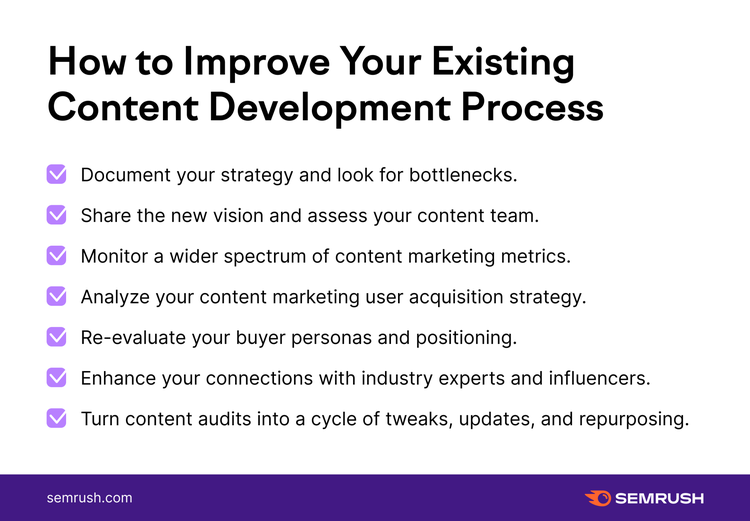
Here are the top steps to take to improve your current content development process.
To illustrate all of these points, here’s some advice based on the key elements of the content development strategy we considered at the beginning:
- Document your existing process and strategy, analyze the possible bottlenecks, and suggest improvements. For example, do you think your SEO and Content Marketing teams work together, or do they move in parallel, or even in opposite directions?
- Bring your team together and introduce them to the documented content development process. Add them to the editorial calendar, arrange regular brainstorming sessions, and find a way to marry customer-related data and topic ideas between them. You should also evaluate your content team; maybe you need more people, for instance?
- Make a list of your business goals and metrics, break them down for each content marketing campaign goal, and increase their granularity. Payments will not be the only metric to look at. Customer engagement, leads, mentions, and referrals are among other goals that can be achieved with content.
- Sort through your existing and planned content. Audit it and split it by funnel stage to make the gaps more visible. Do you have enough user acquisition techniques in place? At this stage, think about gated content and various list-growing instruments (such as newsletter subscription forms).
- Redo your in-market audience research and compare the results with your buyer persona profile. You might be creating content for the wrong people, or perhaps their reality has simply changed, which is true for many in the post-Covid world.
- Build connections with industry experts and influencers to increase your authority and streamline content production and promotion.
- Return to your audit results and make sure that all the pieces are up to date and aligned in terms of brand tone and messaging. Consider updating those that aren’t if you think they might bring your company (and your customers) value. In some cases, you may want to recreate the content completely and redirect your traffic. Finally, identify your top-performing texts and repurpose them for new formats such as podcasts or live streams.
Assembling Your Content Development Team
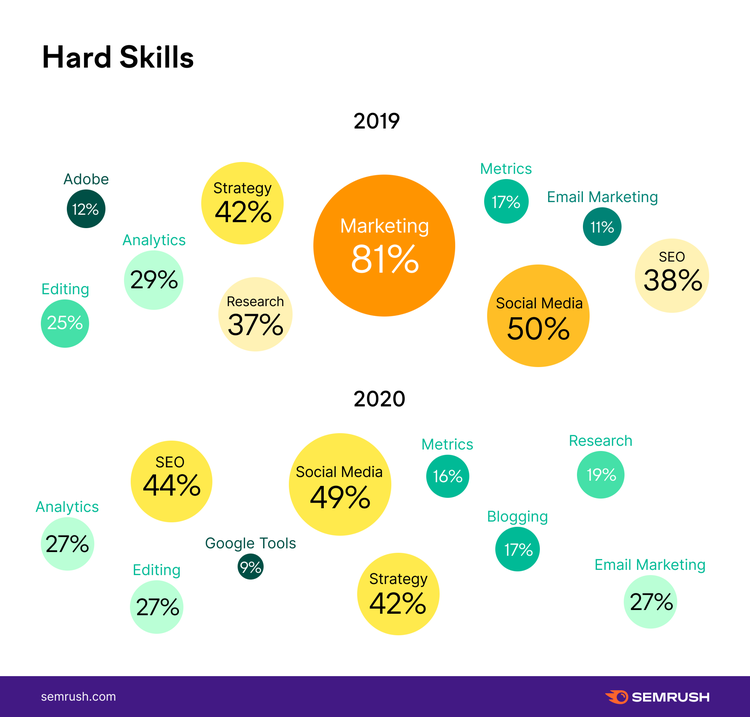
The most in-demand skills for content marketers in 2020 vs. 2019. Source: Semrush Content Marketing Survey.
To ensure the core of the content development process — content creation — runs smoothly, you need a team where each member has a clear role and a transparent scope of responsibilities. Your team may be big or small, but ideally, it should include the following:
- Content Strategist: A professional who manages the content strategy and editorial calendar, and tracks performance. They align content marketing with the overall business goals.
- Content Creators: Writers, designers, and occasionally photographers and video operators. Editors: Content experts who check your content’s grammar, facts, and message, and polish each piece to perfection.
- Community Managers and Influencer Experts: PR experts who monitor your audience engagement and respond to comments. You will need help with reaching out to media, building relations with influencers, and generating backlinks.
Of course, this is not a definitive list of the people involved in content development. You’ll also need content promoters (who usually belong to marketing teams) and analysts to supply you with content performance metrics.
Content Development Tools
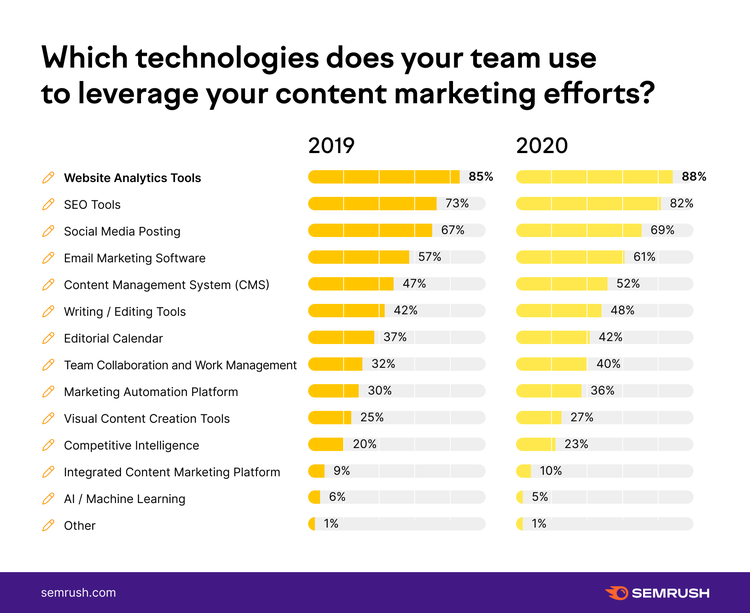
Content tools used by most content marketing teams. Source: Semrush Content Marketing Survey.
There are many tools streamlining different aspects of content development and the Semrush Content Marketing Platform covers most of them. Below, you’ll find a list of the key instruments available on the platform.
Semrush Content Marketing Platform
- Topic Research helps locate the most popular headlines based on your target keywords and allows you to explore related search queries and questions that people ask about your topic.
- Marketing Calendar allows you to manage all your content development efforts and other marketing activities in one place.
- SEO Content Templateoffers a list of recommendations for content creation based on your keywords and competitor research.
- SEO Writing Assistant lets you keep an eye on your text’s key metrics, such as readability score, number of words, and recommended keywords.
Other Tools
- ImpactHero is an automated tool that maps your content to customer journey stages, providing actionable insights and recommendations on improving your content performance. It’s also useful for choosing the right format for each stage or goal.
- Keyword Tool helps you to discover thousands of keyword ideas, and sorts them by search volume, difficulty, available SERP features, and other metrics.
- Power Thesaurus is an app that helps you find antonyms and synonyms to use in your texts.
- Grammarly is an online proofreading add-on that checks grammar and spelling, and offers advice on improving sentence structure.
- Weava is a Chrome extension highlighter that helps you organize the wealth of information and quotes you may find on website and PDF files at the ideation stage.
Conclusion
If your content marketing is failing, there is a good chance that your existing content development is the reason. It requires consistency and a holistic approach to be successful, and a tiny gap can ruin the whole system. However, if you spare the time and effort required to structure the process, find the weak points, fix the issues, and focus on your audience's needs before your monetary goals, you can expect positive business results in the long term.
Create a Smarter Content Development Strategy
With Semrush Content Marketing Platform

Margarita is a passionate Content Marketer with over 6 years of experience in various tech industries and 3 countries. She also holds two MBA degrees in Marketing.

Tells Google to show you more from Semrush in AI, Search, and Discover.