
Enterprise SEO isn’t just SEO for more pages. There are fundamental differences between optimizing a “normal” website for search, and optimizing an enterprise site. These differences affect how teams find, implement, and monitor changes at scale.
This guide covers these differences in more detail, provides a framework for prioritizing work, and gives you a step-by-step process for building and running an enterprise SEO strategy.
What is enterprise SEO?
Enterprise search engine optimization (SEO) is a marketing approach large-scale organizations use to improve their unpaid visibility in search engine results pages.
This approach is specifically designed to handle the scale, complexity, and operational needs of big (often global) organizations. At that scale, the person who finds an SEO problem is rarely the person who can fix it. As a result, enterprise SEO typically leans on templated implementations and automations to roll out changes across many pages at once.
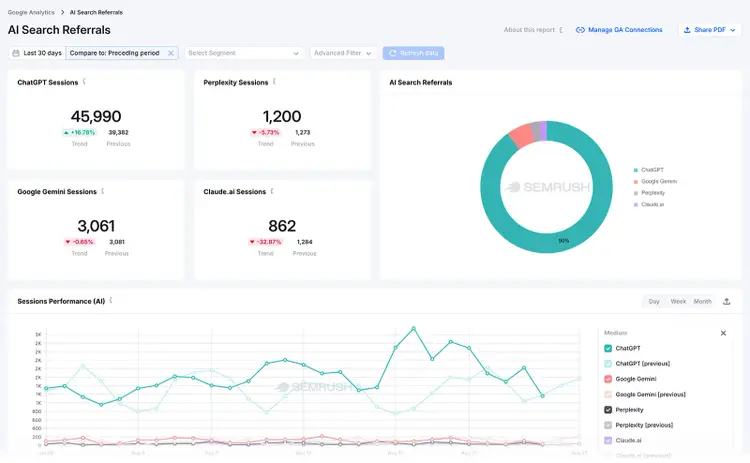
Enterprise SEO vs. SEO at a smaller scale
Here’s a summary of the main differences between enterprise-level SEO and SEO at a smaller scale:
Why enterprise SEO stalls
Enterprise SEO stalls because finding a problem and fixing it are two different jobs, usually held by different people in different departments with different budgets.
At a smaller company, finding and fixing the problem are often the same job. For example, you might spot a canonical tag pointing to the wrong URL, fix it, and publish the fix in a matter of minutes.
At an enterprise, fixing the problem involves filing a ticket, building a business case, and waiting on a team that doesn't report to you. The same canonical tag fix might need:
- A developer to make the change
- Legal to confirm it doesn't affect a regulated page
- A regional team to confirm it doesn't break a localized URL
Since you can't act on every finding directly, the real skill in enterprise SEO is being able to decide what's worth pushing, to whom, and in what order. That's the focus of the prioritization framework I’ll share later.
Where enterprise SEO gets hard at scale
There are three main areas where enterprise SEO efforts slow down: technical SEO, content, and migrations.
Technical SEO at scale
Most technical SEO problems at enterprise scale live in a template or shared system, not a single page. This means fixing them is typically something the engineering team owns.
For example, the Nike website has thousands of templated product pages across more than 80 international regions. Making one change to this template could therefore affect tens or hundreds of thousands of webpages.
In reality, this means multiple engineering teams across the globe likely manage just these templated product pages.

With so many pages, crawl budget is one of the biggest enterprise SEO challenges. Faceted navigation, filtered search results, and duplicate URL parameters can divert crawl activity away from the pages that actually drive traffic and revenue.
Proper site architecture and internal linking also need to be enforced at the template level, not page by page, since no one can manually manage links across millions of pages.
Semrush for Enterprise has a Link Recommender AI automation that helps you identify and implement internal link improvements at scale.
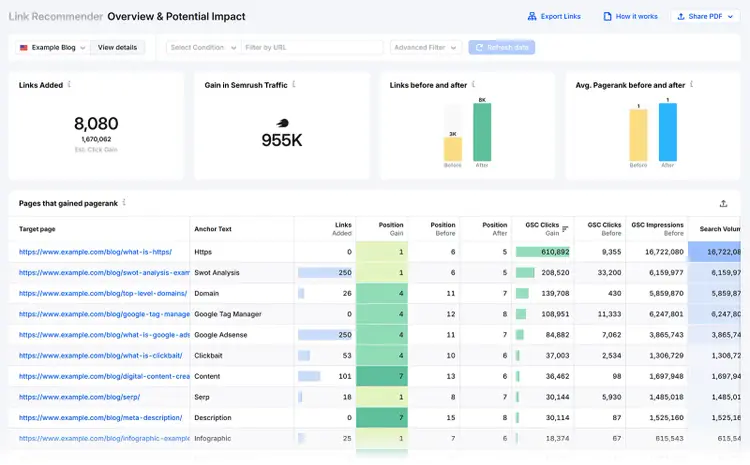
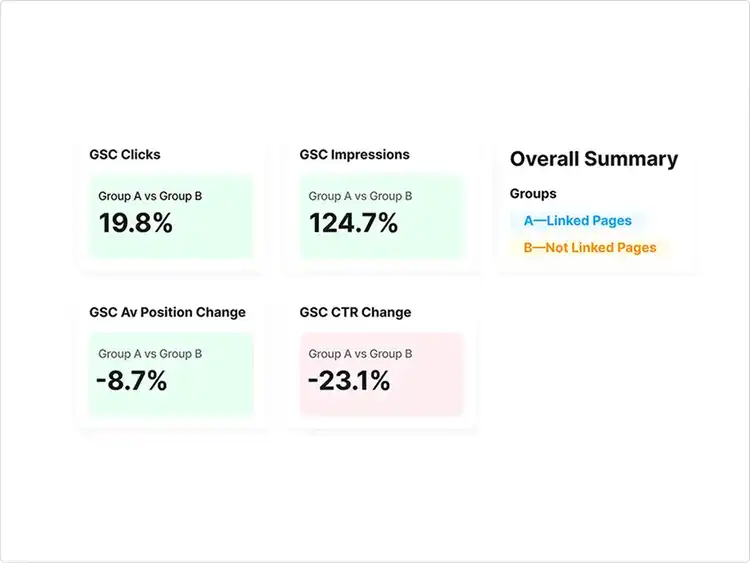
Picsart, a creative design platform, made use of this automation to increase clicks by 20%, and impressions to linked pages by by 124%.
Scaling content without scaling headcount
Most enterprise websites have too much content to review page by page, so quality has to be built into templates and workflows instead of enforced by one person.
These templates standardize what a good page looks like to apply styles and quality standards to every new page of that type. This removes the need for manual page creation and optimization.
For sites with a global presence, these pages also need to be translated effectively. Like technical fixes, this is usually a cross-team job. Legal may review localized content, and regional marketing may own translation.
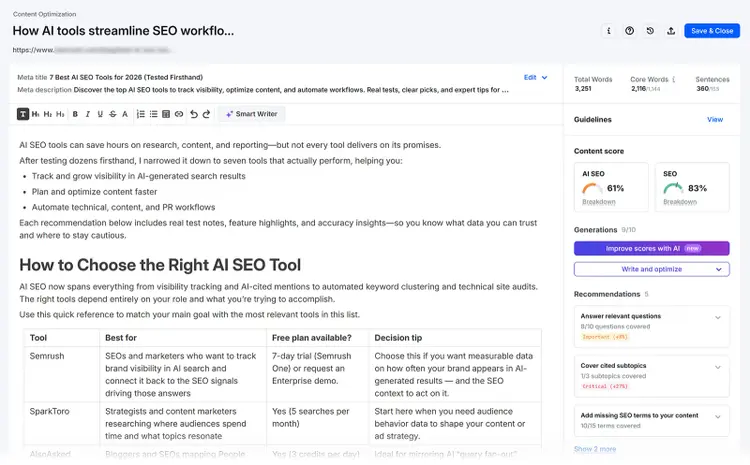
Semrush for Enterprise’s Content Optimization automation analyzes your brand’s content, then highlights missing topics, structural issues, and more. Then, it provides actionable recommendations your content team can use to prioritize updates.
Enterprise-scale migrations
Migrating to a new domain or changing content management system is where enterprise SEO’s implementation problem is most obvious, since these changes involve every page on the site at one time.
This means multiple departments are usually involved:
- SEO might own the redirect strategy, including crawling the full site and mapping all the redirects ahead of the migration
- The engineering team might handle the actual migration process
- The website might also have integrations with CRMs, ERP systems, and other marketing automations handled by various different teams
For contrast, I migrated my own blog in 2024, and the entire process (from decision to migrate to all redirects in place) took all of two days. For an enterprise-scale site, getting sign-off from all these departments takes time, meaning enterprise migrations take much longer, usually on the order of months.
The enterprise SEO prioritization framework
Use the framework below to prioritize your enterprise SEO tasks by scoring each opportunity across three areas, each on a 1 to 5 scale:
- Expected impact: How much the task could move rankings, traffic, or revenue if implemented
- Implementation cost: How much time and investment it’ll take to put in place
- Approval friction: How many teams need to sign off before it can ship
Use this formula to work out each task’s priority score:
Priority score = (Impact x 2) − (Implementation cost + Approval friction)
Here's an example of how that might play out on a million-URL ecommerce site with two equally valuable opportunities:
Both fixes have a similar potential impact, but the title tag fix should be prioritized because it's a template change one team can put in place. The product description rewrite needs manual work and sign-off from other teams, so it’s likely to have greater costs and take much longer to implement.
How AI search changes enterprise SEO priorities
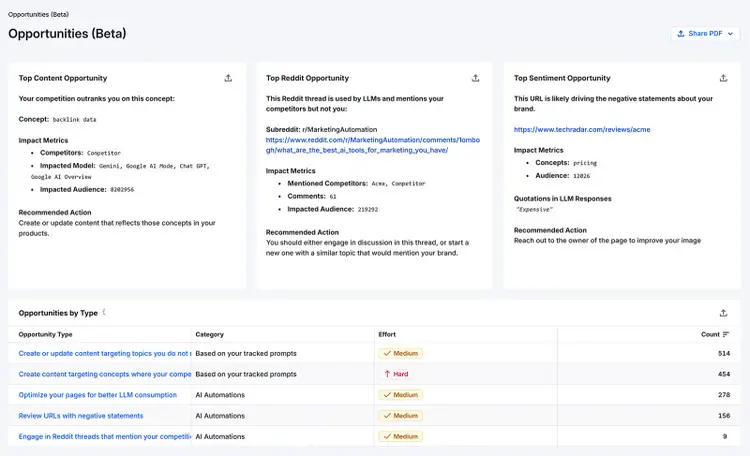
AI search changes what counts as a high-priority opportunity because whether AI tools mention, cite, and recommend your brand is a growing part of visibility. And the tasks that affect these signals often extend beyond the SEO team’s responsibilities.
Beyond revenue impact, organic ranking and traffic used to be the main signals teams would look at to decide which tasks to prioritize. But AI search visibility breaks down into four layers, and the SEO team's ability to act alone shrinks as you move through them:
- Discoverability: This covers indexing, crawlability, and whether AI crawlers can access your content, with largely the same technical foundation as traditional SEO
- Clarity: This measures how accurately language models describe what your business does and the solutions you offer, which depends on consistent messaging across your site, often set by product marketing
- Authority: This tracks whether you're cited and corroborated as a credible expert across other authoritative sources, which is largely a PR and digital PR function
- Trust: This is driven by community sentiment, reviews, and consistent, verified claims, mostly owned by customer experience and brand reputation teams
SEO can influence discoverability directly. But the largest influence on clarity, authority, and trust comes from separate teams.
Consider an example of an opportunity that spans clarity and authority on an enterprise ecommerce site. The task is to make sure how you describe a product category on your site matches how review sites and industry publications describe it. If those descriptions conflict, AI tools can end up pulling mixed signals about what you actually sell, which erodes user trust.
Using the prioritization framework above, scores for this task might be:
- Impact: 4
- Implementation cost: 2
- Approval friction: 5
- Priority score: 1
The low implementation cost reflects that your own product descriptions are easy to update, even if there are lots of them. But the high friction score reflects the fact that aligning those descriptions with how review sites and industry press describe you isn't something SEO can do alone, since those relationships are usually owned by PR or brand. That combination is what pulls the priority score down, even if there is a high potential impact.
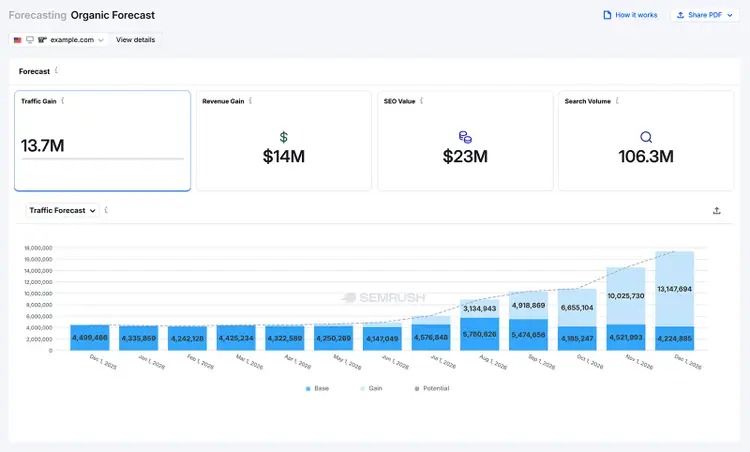
How to build an enterprise SEO strategy
Follow the steps below to build an enterprise SEO strategy with effective prioritization built in.
Step 1: Audit and establish a baseline
Before you prioritize anything, perform an enterprise SEO audit that covers:
- Technical health: Crawlability, indexation, site speed, crawl budget, and page templates
- Content inventory: What exists, what's outdated, and what's missing against your keyword targets
- Rankings and organic traffic: Current performance by page type, region, or business unit
- Conversions: Which pages and segments drive revenue
- AI visibility: How often you're currently mentioned, cited, and recommended in AI search results
Find out how to perform these checks in our full SEO audit guide.
This auditing process helps you identify and categorize opportunities, while also setting baselines for performance that you can use when reporting to stakeholders. Without evidence of performance before you make the change, you can't prove what actually improved, and the case for your next fix gets harder to make.
At a minimum, get baseline data for:
- Current rankings and organic traffic for the affected pages
- Indexation and crawl stats if the change is technical
- Conversion and revenue data for the affected segment
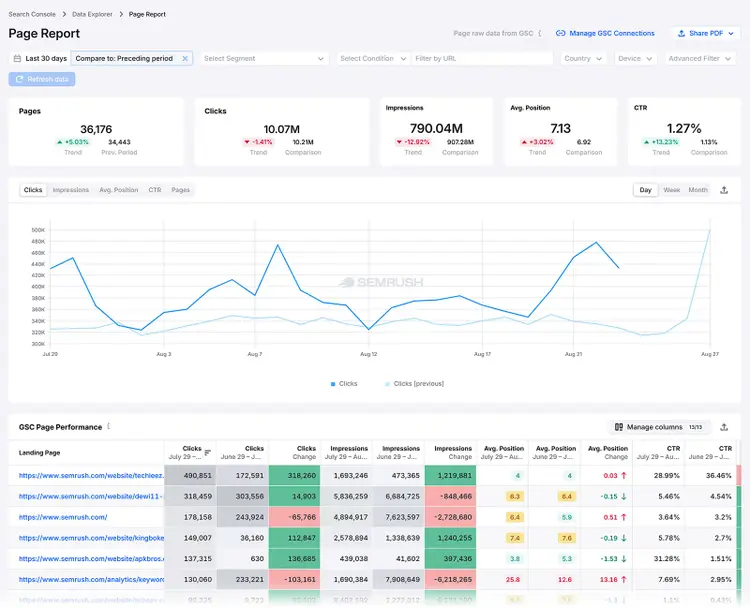
Semrush Enterprise's Data Explorer can pull the baseline and post-launch comparison into one report instead of stitching it together manually.
Step 2: Map ownership and approval paths
Map ownership and approval paths for each of the opportunities you identified in Step 1 to build consensus and coordination across multiple departments and stakeholders.
Here’s an example of what this map might look like for various types of changes:
Here’s how to ensure this map is useful in the long run:
- Define roles: Assign clear responsibilities for each enterprise SEO team member to prevent overlap and ensure accountability
- Schedule recurring cross-team syncs: Host regular meetings (biweekly or monthly depending on backlog size) where the SEO team shares scored priorities with the teams that need to act on them
- Build shared workflows: Create a common place to track requests, status, and ownership that both SEO and implementing teams can see. Semrush for Enterprise's Collaboration Toolkit covers this, tracking deadlines and progress in one place instead of chasing updates across email and Slack.
- Offer cross-department training: Foster a better understanding of how various elements of SEO interconnect.
Pro tip
Have a short conversation with each team lead about their current priorities so you can frame a request as something that helps them hit their own goals, not just another item to add to their backlog.
Step 3: Score the backlog
Take everything from your Step 1 audit and run it through the prioritization framework, adding columns for who implements it and who needs to approve it from Step 2. Score each item 1 to 5 for all three areas, then rank by priority score. It should look like this:
Here are a few practical notes for doing this at scale:
- Score in batches, not one by one. Group similar issues (all faceted navigation pages, all product description gaps) and score the group once, since they'll usually share the same cost and friction profile.
- Revisit low scores instead of discarding them. A low priority score today can change if ownership shifts or a dependency gets resolved that makes this task easier to implement.
- Keep the scored backlog visible to the teams from Step 2, not just your own team, so priorities aren't a surprise when you ask for their time.
Step 4: Plan the first two quarters
Turn your ranked backlog into a realistic six-month roadmap by mixing two types of work:
- Quick, repeatable wins: High-priority items with low cost and low friction. These should be tasks you can ship within weeks and repeat across similar page types.
- A smaller number of structural fixes: These are lower-friction items that take longer to build, like a content template overhaul or a crawl budget fix that needs a full engineering sprint.
Loading a quarter with only structural fixes risks nothing being shipped within that timeframe. This leaves a gap in your reporting, which isn’t going to persuade stakeholders of the value of your efforts, even if they do get implemented in the next quarter.
But only focusing on quick wins means the bigger technical and content issues that can have a big impact in the future never get addressed.
A realistic first quarter on a large site might look like this:
- Weeks 1-4: Ship three or four quick wins (like title tag fixes or canonical URL corrections) to build early momentum and evidence for leadership
- Weeks 5-12: Start one structural project, such as a template rebuild for a high-traffic page type, alongside continued quick wins
- Quarter 2: Take on a second structural project, informed by what quarter 1 showed about ownership and approval timelines, along with more quick wins
The quick wins build the evidence you need to make the case for the bigger asks, which is exactly what Step 5 prepares you for.
Step 5: Set up reporting before launch
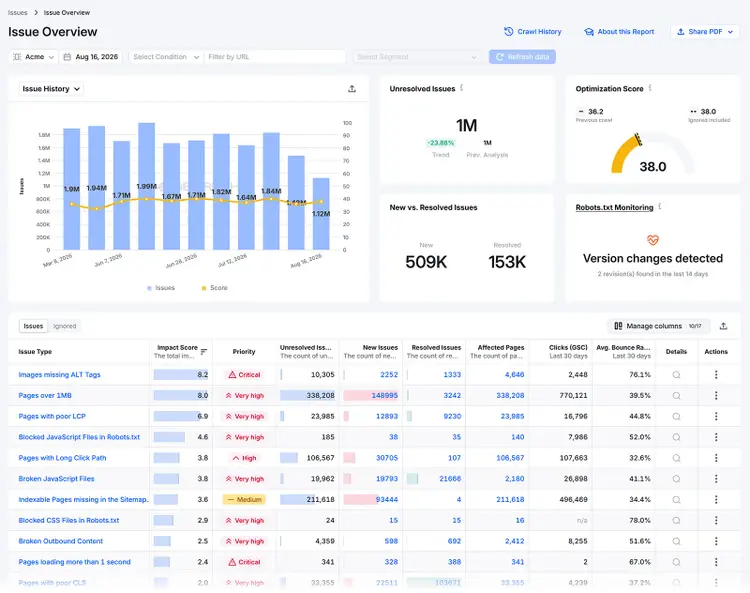
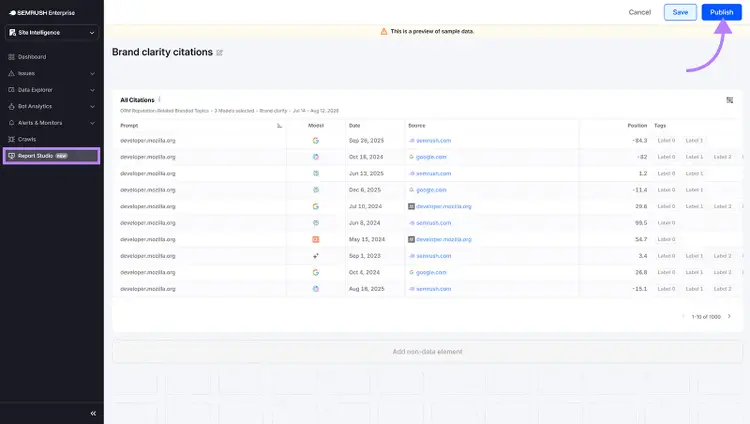
Enterprise SEO reporting needs to track the right metrics for two audiences:
- Technical teams need enough diagnostic detail to confirm the fix worked. This includes which specific pages or templates were affected, how rankings and crawl behavior shifted, and whether the change caused any unexpected side effects elsewhere on the site.
- Executives need the same result translated into business terms. This typically means how much organic traffic or conversion value the fix protected or generated, and how that compares to what it cost in time and approvals to get shipped.
How you present this matters as much as what you include. Open with the business case, like, “here's what happened, here's what it's worth, here's what we're asking for next.” This tends to land better with executives than opening with a slide of metrics.
Step 6: Reassess and repeat
Re-score your priority backlog every quarter, since the inputs to the framework keep changing. New issues will surface, approval paths will shift as teams reorganize, and what works to improve AI visibility keeps evolving.
Every project you ship and report on builds trust with the teams that had to approve it, and that trust can lower the approval friction score on future requests. You’ll get a much faster yes for your next request if you can point to previous wins.
How to choose an enterprise SEO platform
Choose an enterprise SEO platform by identifying your bottleneck, then evaluating platforms against it. If Step 2 showed your backlog stalls on approvals, prioritize collaboration and workflow features. If most of your problems are technical, look for tools with a focus on large-scale crawling. Match the platform to where your team actually gets stuck.
Here’s what to look for when picking an enterprise platform for SEO:
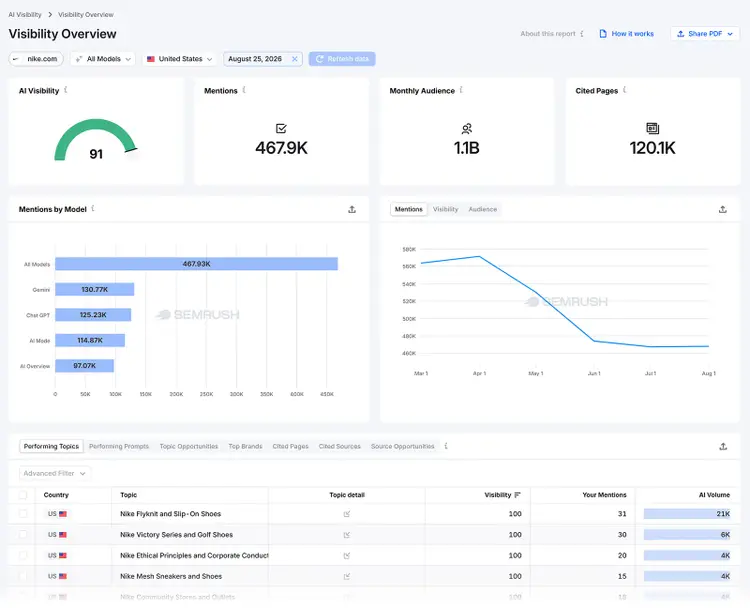
Semrush for Enterprise is one option built around these criteria:
- Data Hub for coverage and reporting
- Automations to help improve your brand’s search and AI visibility
- Enterprise Crawler for identifying a range of issues at scale
- Collaboration Toolkit for cross-team workflows
- Enterprise AIO for AI visibility tracking
Improve your enterprise SEO today
Most enterprise SEO strategies fail because teams can't implement changes and fixes fast enough, not because they can’t spot the issues in the first place.
The teams that get the best results are the ones that get good at deciding which opportunities to push, who needs to be involved, and in what order, then proving the results clearly enough that the next request is easier to approve than the last.
Semrush for Enterprise is the toolkit that helps enterprise brands do all of this day in, day out. Request a demo today to find out how you could improve your brand’s visibility in search and AI with effective enterprise SEO.
Boost your SEO & AI performance
with Semrush Enterprise

Chris is a content writer, editor, and strategist with 6+ years of experience turning complex ideas and processes into clear, engaging content. His areas of expertise include SEO, AI-assisted content production, and building editorial workflows that scale without sacrificing quality.
Chris Hanna
Chris is a content writer, editor, and strategist with 6+ years of experience turning complex ideas and processes into clear, engaging content.

Tells Google to show you more from Semrush in AI, Search, and Discover.