
As more people turn to AI platforms like ChatGPT and Google AI Mode to find products, compare options, and make decisions, appearing in traditional Google results is no longer enough.
Your brand can rank in position 1 on Google and still be invisible in AI-generated answers.
In this guide, you'll learn what AI visibility is, how to measure it, and what you can do to grow your brand’s AI search presence.
What is AI visibility?
AI visibility is how often your brand is mentioned, cited, or recommended in AI-generated responses across platforms like ChatGPT, Perplexity, and Google AI Mode.
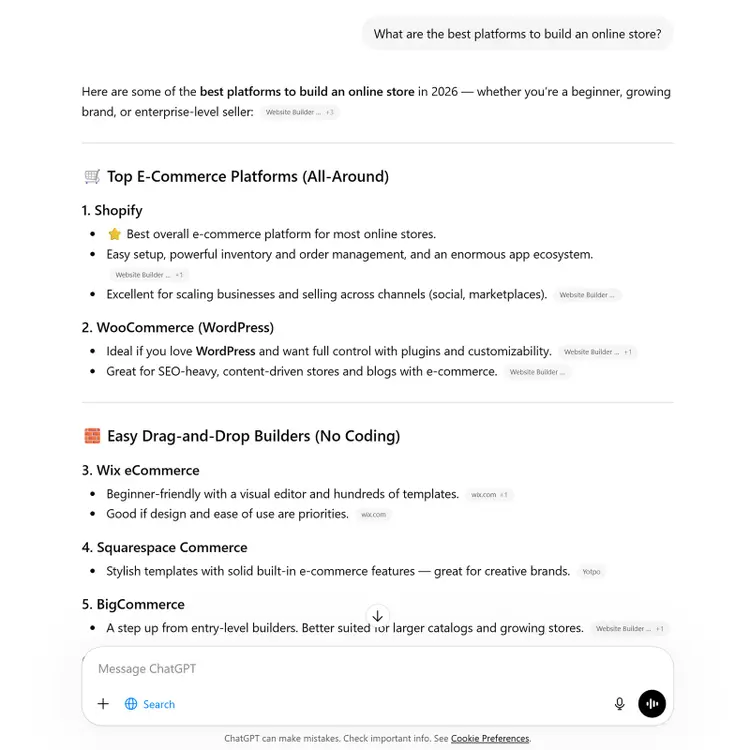
For example, when I asked ChatGPT about the best platforms for building an online store, the response mentioned Shopify, WooCommerce, Wix, BigCommerce, and Squarespace, with a description and comparison of each.
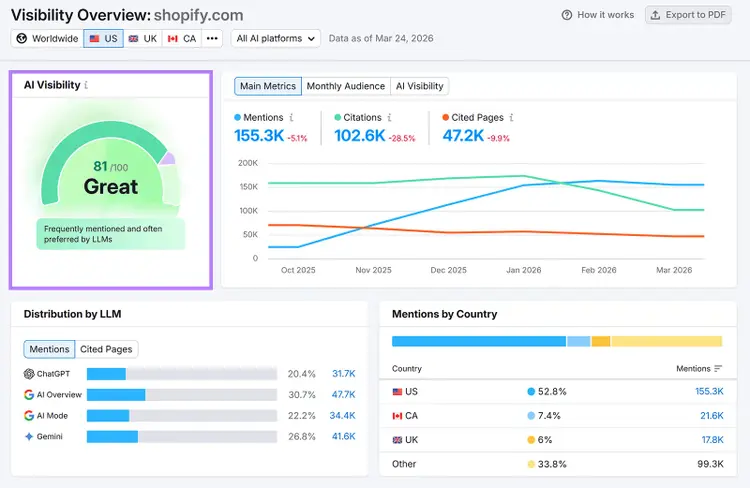
Because a single answer in a single platform doesn't show how strong a brand's overall presence is in AI search, I ran Shopify through Semrush's AI Visibility Toolkit. I saw that it had a pretty good overall presence but still some room to improve.
Why is AI visibility important?
AI visibility is important because AI search is becoming one of the primary ways people look for solutions, discover products, and make decisions.
Google remains the dominant discovery channel, but AI platforms are growing fast. ChatGPT alone now has more than 900 million weekly users.
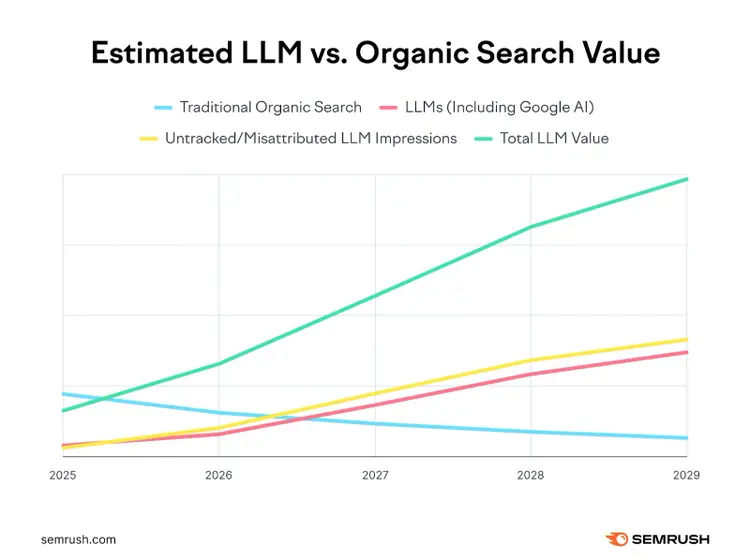
The visitors coming from AI platforms also tend to be valuable. In fact, Semrush research estimates that AI search visitors convert 4.4x better than traditional organic search visitors. Likely because AI visitors arrive having already researched their options.
And that value is only expected to grow. AI search channels are projected to drive as much business value as traditional search by 2027 — and surpass it soon after.
How does AI visibility optimization differ from traditional SEO?
Traditional SEO focuses on showing higher in traditional search engine results, while AI visibility optimization focuses on appearing more prominently in AI-generated answers.
Think of AI visibility optimization as an extension of SEO. Core signals like relevance to a query, authority, and page experience are still important.
But AI systems don't merely show results as links. They assemble comprehensive answers from multiple sources. And how they choose and use content from those sources depends on factors like how your brand is mentioned elsewhere on the web, how recent your content is, and how easy it is to understand your content.
The important thing to know is that ranking well in traditional search results doesn’t guarantee you’ll be cited in AI-generated answers.
To illustrate this, I compared the exact pages ranking in Google's top 10 traditional results against the exact pages cited by four AI platforms for 10 randomly selected SaaS queries in February 2026.
Only 44.3% of the pages ranking in Google's top 10 traditional search results appeared in at least one AI-generated answer. Here's how that overlap broke down by platform:
Further reading: Traditional SEO vs. AI SEO: What You Actually Need to Know
How to measure your AI visibility
You can measure your AI visibility by deciding on your platforms and prompts, understanding which metrics to track, and then gathering the data manually or with a dedicated tool.
Here's how to get started.
Step 1: Pick your platforms and prompts
Start by identifying which AI platforms your audience uses most and what questions they're likely to ask on those platforms.
The simplest way to identify platforms is to ask directly. If you can, talk to customers, prospects, or your sales team about which AI tools your audience turns to regularly.
You can also get a sense of what platforms your audience uses by reviewing your traffic sources. If you already see referral traffic from a specific AI platform in your analytics, that's a clear signal to prioritize it.
Once you know which platforms to focus on, build your prompt list. Think about the questions your audience asks at different stages of the buying journey.
- Research: "What is X," "how does X work," "best practices for X"
- Comparison: "X vs Y," "best tools for [activity related to your niche]," "alternatives to Y"
- Evaluation: "Is X worth it," "X pricing," "pros and cons of X," "X reviews"
Think about highly specific phrases that are relevant to your brand. Because they're closer to how people actually phrase questions in AI platforms.
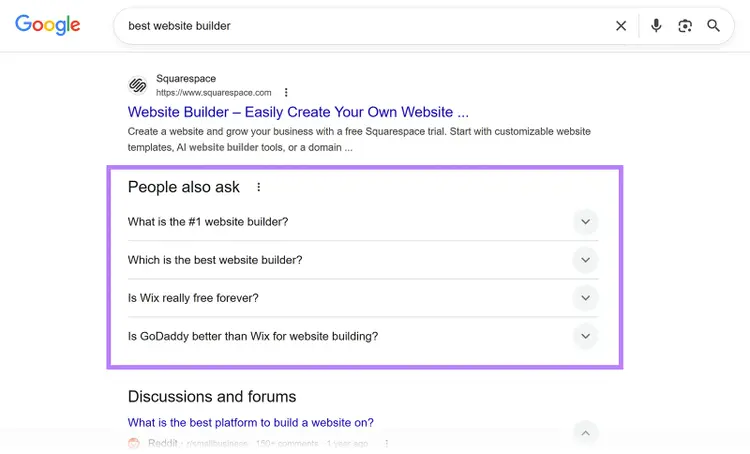
And check the People Also Ask (PAA) box in Google for the keywords you're already targeting for your SEO efforts. The PAA section surfaces questions real users are asking, and they’re often similar to AI prompts your audience is using.
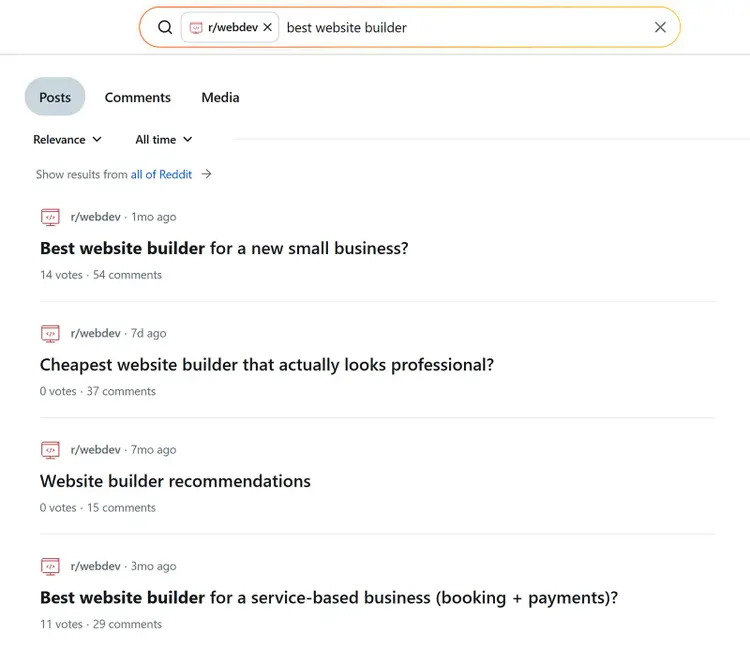
Community forums like Reddit are another place to see what your audience is asking.
Find subreddits relevant to your brand, search them for mentions of your primary SEO keywords, and sort the results by "Top." The questions that rise to the top reflect questions your audience is asking.
Step 2: Know what metrics to track
For each prompt, track these metrics:
- Mentions: Whether your brand appears in the AI-generated answer at all
- Citations: Whether that answer includes a link to your site
- Position: Where in the response your brand appears relative to other brands mentioned
- Sentiment: Whether your brand is being described positively, neutrally, or negatively
You can also track other metrics like share of voice and visibility trend over time with a dedicated tool.
Step 3: Track your AI visibility
Once you’ve defined the platforms, prompts, and metrics you’ll use to measure your AI visibility, use one of the following methods for tracking:
Conduct a manual AI visibility analysis
Use your prompt list to enter each prompt into your chosen AI platforms one by one.
For each prompt, log:
- Whether your brand appears in the response
- Whether the response includes a link to your site
- Where your brand appears relative to other brands mentioned
- How your brand is described (positive, neutral, or negative)
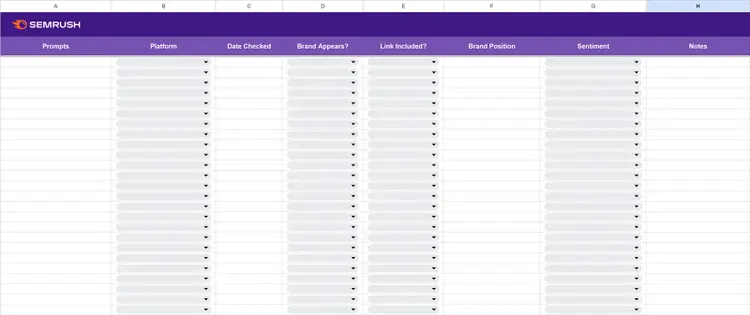
Keep your results in a simple spreadsheet with columns for the prompt, platform, date, and each of the above data points. This gives you a baseline you can compare against over time.
Here’s an example of what a simple AI visibility tracking spreadsheet could look like:
Run through your full prompt list once per week. When you re-run prompts, note what has changed since your last check.
Use a dedicated tool to track AI visibility
Using a dedicated tool saves significant time and surfaces insights that manual tracking can't easily capture.
Semrush's AI Visibility Toolkit covers all the key areas of AI visibility in one place:
- Prompt Tracking: See your prompt-level visibility in ChatGPT, Google AI Mode, and Gemini, including how your positions change over time
- Brand Performance: Understand your share of voice, your overall sentiment, and the key topics AI systems associate with your brand
- Visibility Overview: Get a full picture of your AI presence, including your AI Visibility (a measure of your presence across platforms and your industry), how many AI answers mention your brand, which topics you appear in, and where competitors are showing up but you aren't
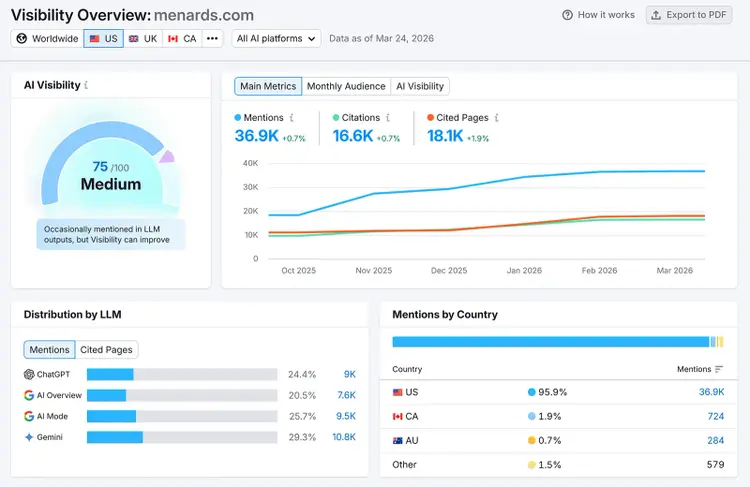
Once you have a clear picture of where your brand stands in AI answers, you can start taking steps to improve your AI visibility.
5 AI visibility tracking tools to consider in 2026
Here are five AI visibility tracking tools to consider in 2026.
For a more detailed breakdown of each tool, check out our full guide to AI visibility tools.
How to improve brand visibility in AI search
You can improve your brand visibility in AI search by making your brand easier for AI systems to find, understand, and reference using these tips:
Target the questions your audience asks AI
Content built around the specific questions your audience asks AI platforms is more likely to appear in AI-generated answers.
To find those questions:
- Check customer support tickets and sales call notes for recurring questions
- Search Reddit, Quora, and other online communities in your niche for questions people ask about your topic
- Look at the People Also Ask sections that appear in Google for your main topics. These often reflect the same questions people ask AI platforms.
For a more comprehensive and accurate list, use Semrush's Prompt Research tool. It groups related prompts by topic, so you can create one piece of content that targets several prompts at once rather than writing a separate page for each.
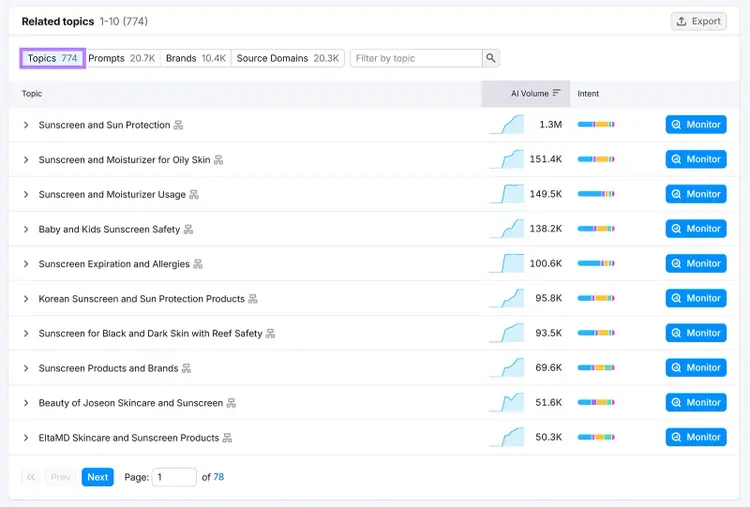
Once you have your list, create content that directly addresses those topics.
Publish original content
AI systems have a tendency to surface content that includes unique information over generic pages covering the same topics in the same ways.
Consider including first-party data, case studies, and your own expert insights in the content you create. At Semrush, we do this consistently by publishing original studies.
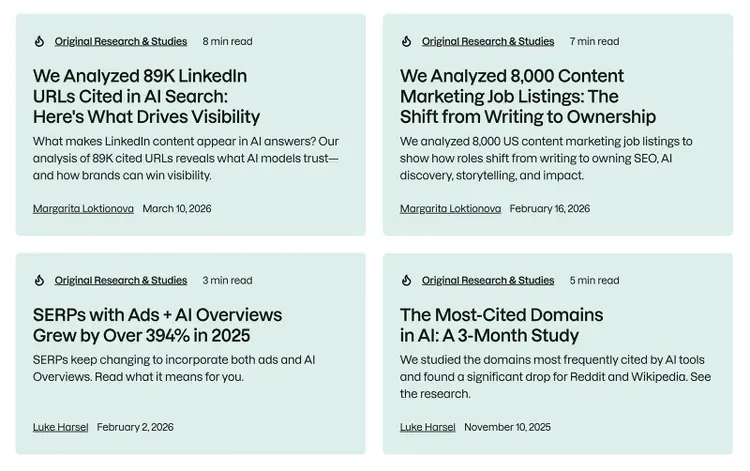
Here are some practical ways to create original content:
- Publish research or survey findings from your own customer base
- Write case studies based on real results from your customers
- Share expert perspectives from people inside your organization
- Document experiments or tests your team has run and what you learned
- Break down industry reports, studies, or trends and share your own analysis and perspective
And keep your original content fresh.Nearly 90% of pages crawled by AI bots were published within the last three years, according to a Seer Interactive study.
Structure your content for AI extraction
Structuring your content clearly makes it easier for AI systems to find, understand, and cite specific parts of your page.
Start by formatting your content in clearly defined sections, each focused on one idea. This is called chunking.
AI systems don’t read a page from top to bottom the way a human does. They pull specific sections that answer a query, so each section should make sense on its own.
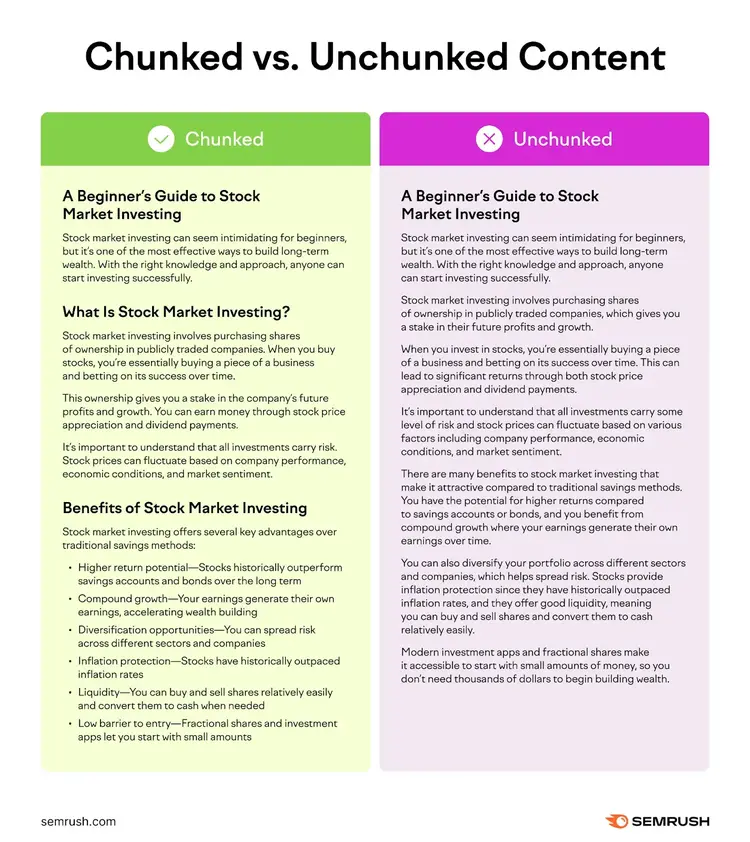
Also, use a heading hierarchy with H1 leading into H2s, H2s leading into H3s, etc., without skipping levels. This helps AI systems understand the structure and relationships between sections on your page.
Here are a few other ways to make content easier to extract:
- Use question-based headings that mirror how your audience phrases their queries
- Start each body section with a direct answer to the heading's question (or implied question)
- Keep important information visible on the page. Don’t hide it inside expandable sections or tabs that require a click to open.
- Include specific stats, named experts, and concrete data points AI systems can reference
Further reading: How to optimize content for AI search engines [2026 guide]
Earn brand mentions across the web
Brands that appear consistently in credible sources are more likely to appear in AI-generated answers.
Independent reviews, news articles, and features in industry publications all give AI systems more places to discover and learn about your brand. So, aim to get coverage in those places.
Consider web hosting company Hostinger. Independent sites regularly publish detailed content about Hostinger. Like this review on CrazyEgg that regularly gets updated:
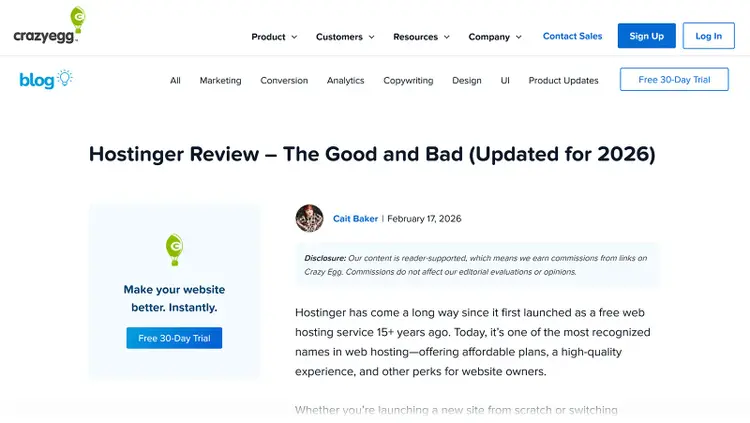
Brands with that kind of widespread presence across the web tend to show up more consistently in AI-generated answers.
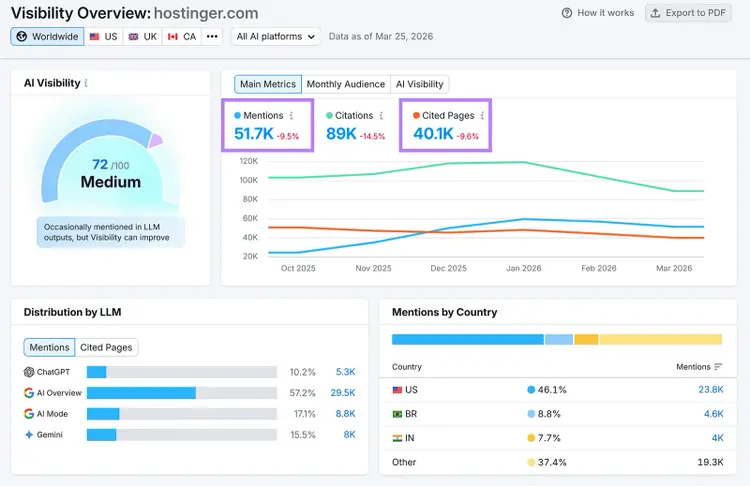
According to Visibility Overview information from March 2026, Hostinger is mentioned in over 51,000 AI-generated answers. And 40,100 of its pages are cited in AI platforms.
Here are a few practical ways to earn brand mentions:
- Reach out to review sites and industry publications in your space and make your product or service easy for them to test and evaluate
- Publish original research, tools, and other valuable resources that gives other publishers something specific to reference and cite
- Contribute guest articles or expert quotes to publications your audience already reads
- Participate in industry events, podcasts, and expert roundups to build your brand's presence across credible sources
Show up across multiple formats
Taking a multimodal approach — publishing across written, video, audio, and visual formats — gives AI systems more ways to find and reference your brand.
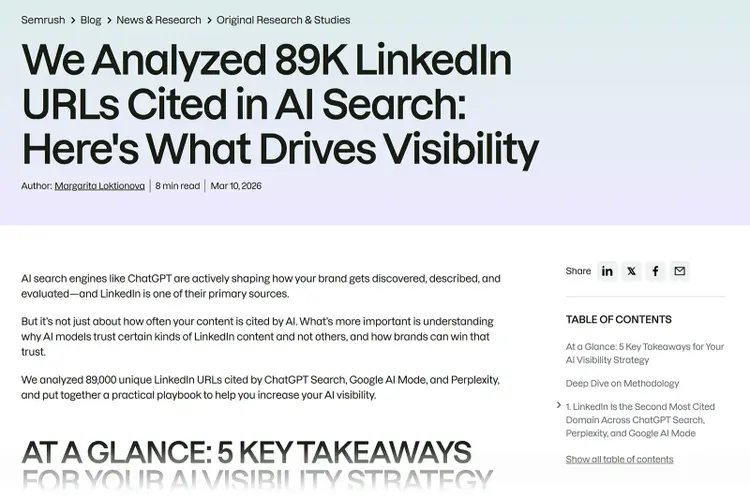
For example, we recently published an original study on how LinkedIn content performs in AI-generated answers.
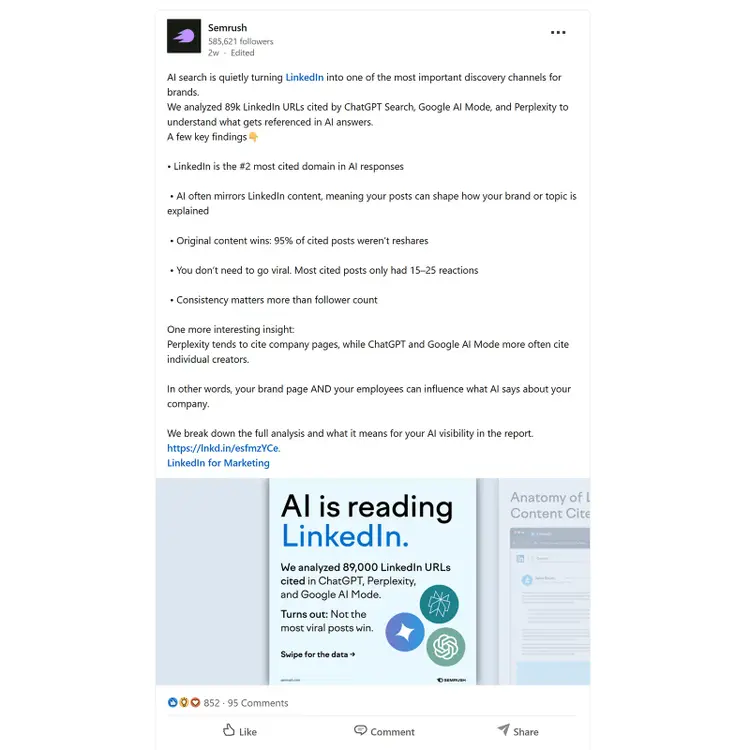
Our team then repurposed the study into a LinkedIn carousel.
Think about how one piece of content can translate across multiple formats:
- Turn a blog post into a YouTube video or a short video series
- Repurpose a research study into a LinkedIn carousel or an infographic
- Use a key finding as the basis for a podcast episode or expert interview
- Break down a long-form guide into a series of social posts or short clips
Consider prioritizing platforms AI systems already pull from frequently. LinkedIn, YouTube, and Reddit are some of the most-cited domains in AI-generated answers.
Shape perception
Consistent brand messaging across your owned properties helps AI systems accurately understand and describe who you are.
If your about page, product pages, and social profiles use different language to describe what you do, AI systems may piece together an inconsistent or inaccurate picture of your brand.
Start by auditing:
- Your homepage, about page, and product or service pages
- Your social media profiles and bios
- Any directory listings or third-party profiles
Also, manage how your brand is represented elsewhere by responding to reviews on platforms like G2 and Trustpilot and engaging in relevant threads on Reddit and Quora. These responses become part of the content that AI systems read.
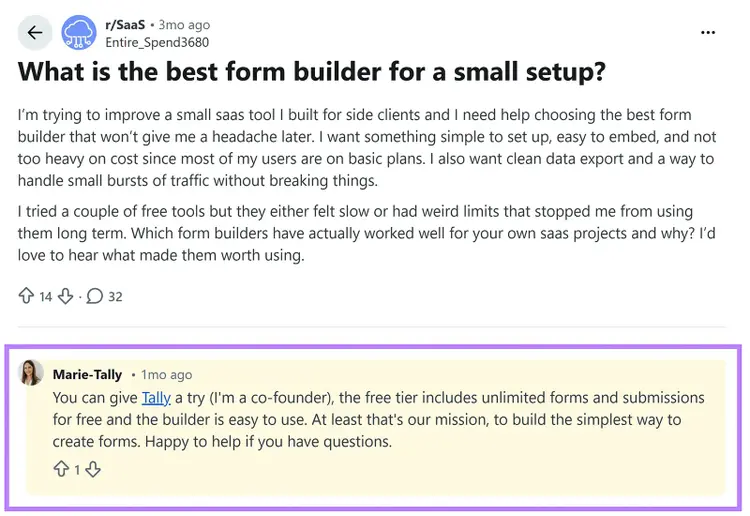
For example, the co-founder of Tally (a form builder) regularly engages with people on Reddit. In her responses, Marie Martens consistently reinforces that Tally offers unlimited forms and submissions for free — the same core message that appears across all of Tally's owned properties.
Add structured summaries at the top of the page
Adding a structured summary at the top of long-form content makes your page easier for LLMs to scan and cite.
A structured summary can take a few different forms:
- A comparison table
- A TL;DR section
- A bulleted overview of what's covered in the article
For example, here's the table we added right after the introduction in our guide to the best generative engine optimization (GEO) tools:
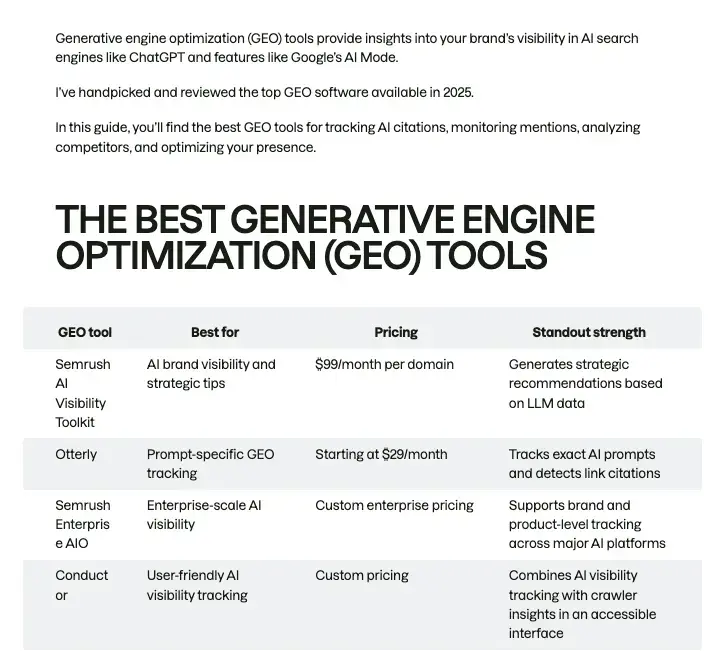
We tested this approach across 5 tool listicles, adding a comparison table at the top of each. After about four weeks of monitoring citations with Semrush Enterprise AIO, we noticed some impressive results:
-
+16.1% citations across all models
-
+21.6% boost in ChatGPT
This tactic works best for listicle-style content (best X tools, top X strategies, X ways to do Y), but it applies to how-to guides and definition posts.
Track and improve your AI visibility over time
AI platforms change constantly, and so do the sources they cite and the brands they surface in their answers.
That’s why tracking AI visibility over time helps you spot shifts, understand where competitors are gaining ground, and find new opportunities to strengthen your presence.
Use Semrush’s AI Visibility Toolkit to monitor your visibility and find ways to improve it over time.
Track Your Brand Across AI Platforms
with the Semrush AI Visibility Toolkit
AI visibility FAQs
Why should you track AI brand visibility?
You should track AI brand visibility because more people now use AI platforms to research products, compare options, and make decisions. Tracking it helps you understand whether your brand is showing up in those answers and how visible you are compared with competitors.
How can you identify gaps in your brand’s AI search visibility?
You can identify gaps in your brand's AI search visibility by checking where competitors appear in AI answers but your brand doesn't. Semrush's AI Visibility Toolkit can help with this.
How can you monitor changes in AI visibility over time?
You can monitor changes in AI visibility over time by tracking the same prompts regularly and comparing mentions, citations, and positioning. Manual tracking works for small prompt lists, but dedicated tools make it easier to monitor changes consistently across platforms.
Why should you use AI search monitoring tools?
You should use AI search monitoring tools because they allow you to more easily track your brand’s visibility across prompts and platforms. They also include additional metrics and streamline reporting to help you make changes faster.
Author Bio (star) 
Margarita is a passionate Content Marketer with over 6 years of experience in various tech industries and 3 countries. She also holds two MBA degrees in Marketing.
Newsletter Subscribe to learn more about AI
Subscribe By clicking “Subscribe” you agree to Semrush Privacy Policy and consent to Semrush using your contact data for newsletter purposes Toc Share 
Tells Google to show you more from Semrush in AI, Search, and Discover.
Table of contents
Show all table of contents Promo Widget Try Semrush
Everything you need to win AI visibility and drive SEO success Start Free Trial Unlimited access for 7 days
Most popular pages
Cards (related) What Is Keyword Search Volume? (& How to Check It)
Keyword search volume is the average number of monthly searches for a search term in a particular location. Keyword Research · Rachel Handley · 3 min read · January 10, 2025 How to Use Google Keyword Planner
Google Keyword Planner is a free tool that lets you research the queries people type into Google. Keyword Research · Rachel Handley · 7 min read · July 23, 2024 How to Get Backlinks: 10 Realistic Methods
Learn how to get backlinks by responding to media requests, creating link bait, finding broken links, & more. Link Building · Rachel Handley · 10 min read · October 17, 2024
Cta Block Boost your digital marketing efforts Get free trial