
Google AI Mode changes how search results are displayed and content is discovered.
Instead of 10 blue links, users now see AI-generated summaries, fewer clickable results, and a new interface designed for faster answers.
This guide explains what Google AI Mode is, how it works, and how to optimize your content for it.
What Is Google AI Mode?
Google AI Mode is a version of Google Search that replaces the standard results page with an AI-first layout. The interface includes AI-generated summaries and simplified link formats.
Think of it as a built-in research assistant powered by Google’s Gemini 2.5 model.
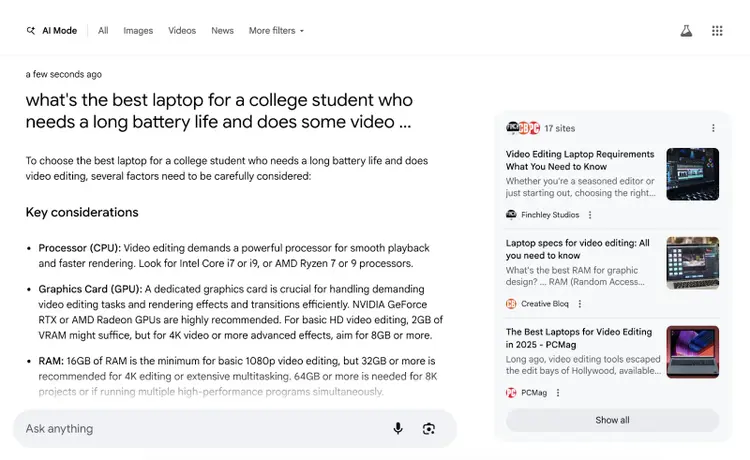
AI Mode appears as a separate tab in Google Search, alongside “Images” and “Videos,” or directly at google.com/aimode. Google also recently made AI Mode available on mobile devices when users click “Show More” within AI Overviews.
What Is the Difference Between AI Mode and AI Overviews?
AI Mode and AI Overviews both use generative AI, but they appear in different places and serve different purposes in Google Search.
AI Overviews appear in standard search results when Google determines they’re helpful. AI Mode is a separate experience accessible through the “AI Mode” tab, going to google.com/aimode, or clicking "Show More" from a mobile AI Overview.
Here’s a side-by-side comparison, as outlined by Google:
How Is Google AI Mode Different from Other AI Tools?
Google AI Mode is built to work within Google’s ranking ecosystem. That makes it more relevant to SEO than standalone AI tools like ChatGPT or Perplexity.
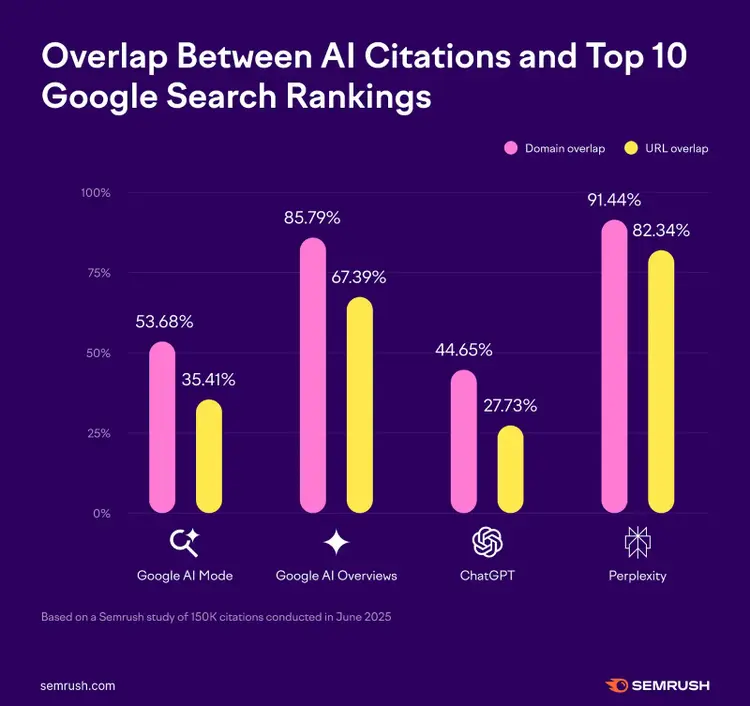
Semrush ran a study comparing AI Mode to traditional Search, AI Overviews, ChatGPT, and Perplexity
Here’s how Google AI Mode stands out:
And unlike ChatGPT, Google’s AI Mode shows ads for some queries. According to Search Engine Land, Google began briefing brands ahead of Q4 2025 on how they can use AI Mode to reach their audiences.
SEO consultant Brodie Clark also noticed ads within AI Mode:
“Ads within AI Mode are here. This marks a significant difference between Google's AI Mode and the likes of ChatGPT, with ChatGPT not having even close to the same infrastructure for ads as Google does.”
And compared to other AI tools, AI Mode is trained to reflect Google’s ranking signals, which makes it an important focus for your SEO strategy.
What Gets Cited in Google AI Mode vs. Traditional Search?
Google AI Mode doesn’t mirror the top 10 organic search results. It selects sources based on perceived trust, relevance, and formatting—not just rankings.
To see how citations differ, Semrush analyzed sidebar sources in AI Mode vs. the top 10 traditional search results for five high-intent SEO queries:
- “best SEO tools”
- “how to create an SEO strategy”
- “what is technical SEO”
- “SEO audit checklist”
- “local SEO”
Here’s what we found:
Across all five queries, the average domain overlap between AI Mode and traditional organic results was under 50%. Exact URL overlap was often below 30%.
Ranking well doesn’t guarantee inclusion in AI Mode. Your content is more likely to appear if:
- Your domain shows up across the web, including forums, directories, citations
- Your content is structured for AI readability (modular, concise, and expert-backed)
- Your brand is cited by trusted third parties, even if those mentions aren’t linked
How Does Google AI Mode Affect SEO?
Google AI Mode represents the biggest change to search in years. Traffic is down. Google Search Console can’t track it. Visibility now depends on citations, not just rankings.
Here’s what SEO professionals need to know:
Less Traffic, Even if You Rank
AI-generated answers are taking clicks from traditional search results. Ranking in the top 10 no longer guarantees visibility.
According to Pew Research, AI-enhanced SERPs have cut click-through rates by nearly 49%. AI Overviews started this trend. AI Mode accelerates it.
Semrush data shows that 92% of AI Mode responses include a sidebar with about seven unique domains. But:
- Only 53% of those domains match the top 10 organic search results
- Only 35% of the URLs match
Sergei Rogulin, Head of SEO at Semrush, says now is a good time to “Stop worrying so much about lost traffic.”
“Instead, shift your focus,” he says. “This is a new landscape, and visibility now means something different.”
Ask:
- How is your brand represented in AI answers?
- Do those answers reflect your values?
- How can you shape them?
Focus there.
A Shift from Ranking to Reputation
In AI Mode, visibility comes from citations, not first-page rankings. Google’s AI selects trusted sources, even if they don’t rank in the top 10.
AI Mode summarizes responses and links to curated sources. Only about half of those match traditional results. The rest are chosen based on:
- Authority and trust (.edu, .gov, news sites)
- Community credibility (Reddit, Quora, forums)
- Topical expertise (industry blogs, niche publishers)
If your brand isn't present where people are asking and answering questions, or your content isn’t seen as credible, you’re less likely to be cited.
Analytics Are Falling Behind
Google Search Console doesn’t yet show traffic from AI Mode or AI Overviews. That makes it hard to measure what’s working.
Traditional metrics—clicks, impressions, and rankings—don’t tell the full story anymore. SEOs must now track:
- How often your brand is cited in AI-generated answers
- Where your mentions appear (even unlinked)
- Your share of voice in AI summaries
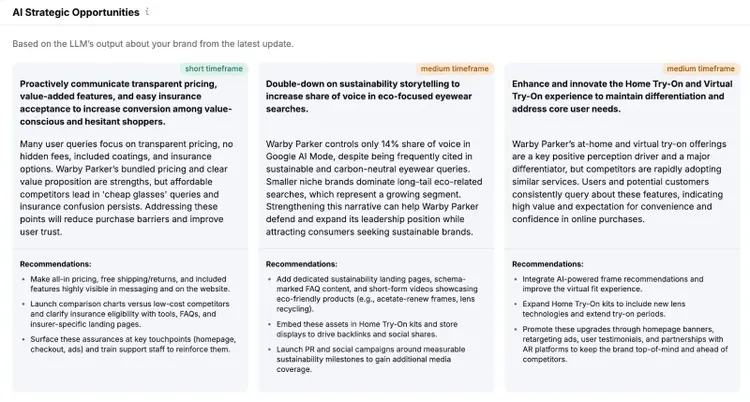
Semrush’s AI Visibility Toolkit can help. Enter your domain to see how your brand is represented in AI search:
Track Google AI Mode Citations
with the Semrush AI Visibility Toolkit
How to Optimize for Google AI Mode (Step-by-Step Guide)
Want your content featured in Google’s AI results? Follow these steps:
1. Start with Fundamental SEO Best Practices
Google’s AI favors content that’s well-structured, trustworthy, and easy to crawl. Core SEO practices still apply, and they matter more now than ever.
Focus on these fundamentals:
- Format for readability. Use no-fluff answers, bullet points, and short paragraphs in a conversational tone. Make content easy to scan.
- Demonstrate E-E-A-T. Showcase experience, expertise, authoritativeness, and trustworthiness. Use real authors, expert insights, and source citations. These factors describe content Google wants to rank.
- Get technical SEO right. Prioritize fast load times, mobile responsiveness, clean heading hierarchy, and crawlable HTML. Help search engines parse your content efficiently.
For example, Semrush often appears in AI Mode results for queries like “what is the best tool for SEO”
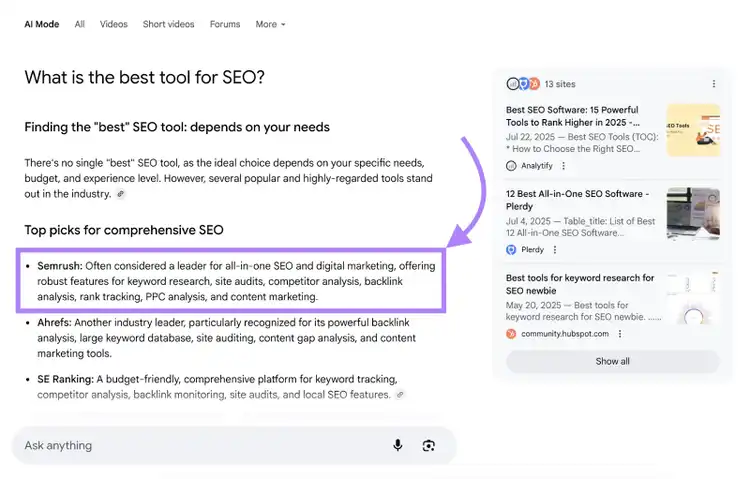
Why? Because Semrush covers the basics:
- Our content is written by subject matter experts and reviewed through a rigorous editorial process
- We build topical authority by covering SEO in depth and being cited by trusted publishers, users, and communities across the web
- We publish original data, expert interviews, and case studies that can’t be found elsewhere
AI Mode rewards structured, credible content from reputable brands.
2. Establish Your Brand Across the Web
AI Mode cites multiple sources per query. To be included, your brand must appear across trusted, high-authority sites.
Follow these best practices:
- Contribute to trusted platforms. Add helpful content on Wikipedia, Quora, Reddit, GitHub, and Stack Overflow, as these sites often appear in AI summaries.
- Create profiles in directories. Maintain accurate, optimized listings on Crunchbase, LinkedIn, and other relevant business directories.
- Get featured off-site. Write guest posts for respected publishers—both mainstream and niche—to expand your content footprint.
- Earn mentions from credible websites. Mentions (even unlinked) from .edu, .gov, news sites, and high-authority domains boost perceived trust.
- Ensure consistency. Maintain accurate NAP (name, address, phone) information across all listings to signal legitimacy.
Pro tip: Semrush’s Listing Management tool helps you easily update and maintain consistent and accurate NAP data across multiple platforms from one dashboard.
Brands that are visible, credible, and consistent across the web are more likely to be cited in AI Mode responses.
3. Create Citation-Worthy Content
Google’s Gemini 2.5 model cites sources that are credible, structured, and rich in information. To get featured, your content must be something AI can easily lift, summarize, and reuse.
Follow these strategies:
- Publish original data. Share proprietary research, survey results, or anonymized user insights. LLMs prefer citing data that doesn’t exist elsewhere.
- Use cited statistics. Source your data from credible publishers. Attribute stats clearly. This builds trust and signals that your content is research-based.
- Use expert quotes. Expert commentary boosts authority. It also gives Gemini better phrasing to repurpose in its summaries.
- Create definitive resources. Cover niche topics thoroughly. Long-form guides, frameworks, and explainers are more likely to be cited when they fully answer a query.
Bottom line:
You don’t need more words. You need more value per word. High-value content is easier for AI to process, extract, and display.
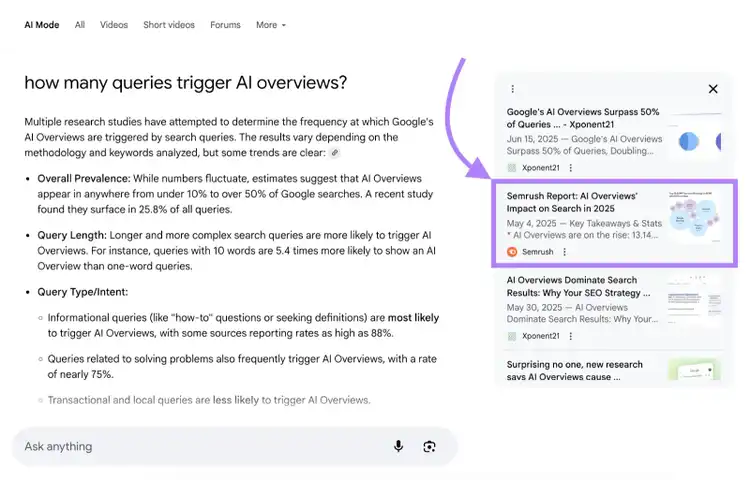
For example, one of the most cited resources about AI search is Semrush’s AI Overviews study. Why?
- It features original research
- It presents clear, structured statistics
- It’s designed for reuse with key takeaways and clean formatting
It’s been cited by Search Engine Land, Moz, and Reddit. And in Gemini-powered answers.
4. Optimize for Conversational Query Intent
Google AI Mode is built to understand natural, conversational queries similar to how people talk to voice assistants like ChatGPT or Google Assistant.
To align your content with this intent, follow these best practices:
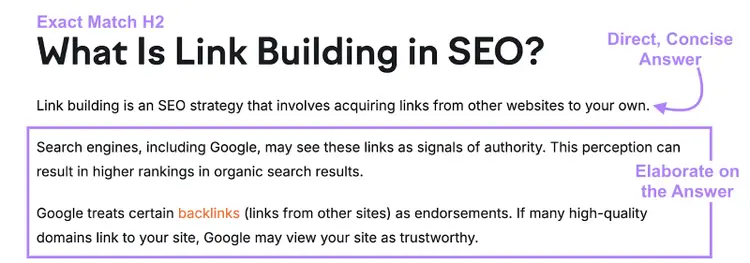
- Use question-based headings. Start with phrases like “How does…”, “What is…”, “Why does…”, or “Can you….” These match how users phrase queries.
- Answer directly and early. Begin each section with a short, clear answer, and then elaborate below
- Build out FAQ sections. Address common follow-up questions using a structured Q&A format. Add FAQ schema markup when possible.
- Write in a natural, helpful tone. Avoid keyword stuffing or robotic language. Write answers the way you would speak them aloud.
- Use conversational language when appropriate. If it sounds like something a person might say in a casual conversation, it may be more likely to be cited by AI
Take this example of content optimized for conversational query intent:
5. Track AI Visibility and Citations
Most SEO tools weren’t built for AI-powered search. Google Search Console can’t currently distinguish between traffic from traditional results, AI Mode, or AI Overviews.
That means rankings and traffic data no longer show the full picture.
To stay competitive, you need to track:
- How often your brand is mentioned in AI-generated answers (with or without a link)
- Which prompts and topics drive those mentions
- The sentiment, narratives, and accuracy of AI citations
- Your AI Visibility, share of voice, and audience size over time
Semrush’s AI Visibility Toolkit shows how your brand performs in AI Mode and other AI platforms.
The Visibility Overview report highlights which prompts and topics drive your mentions to a brand.
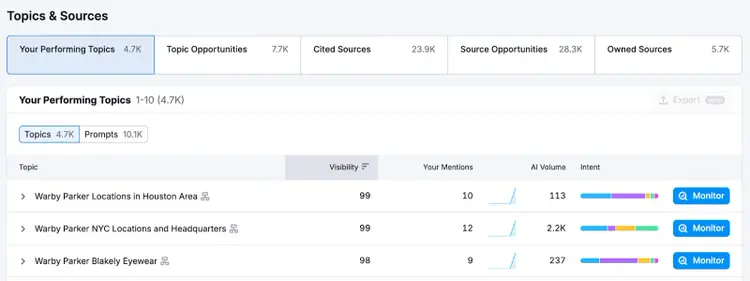
And the Brand Performance reports dive deeper into your brand’s narrative and sentiment on AI platforms.
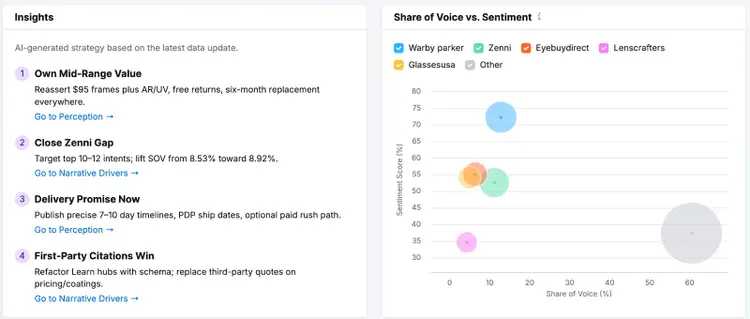
You can also track the overall sentiment of your mentions. And the narrative drivers.
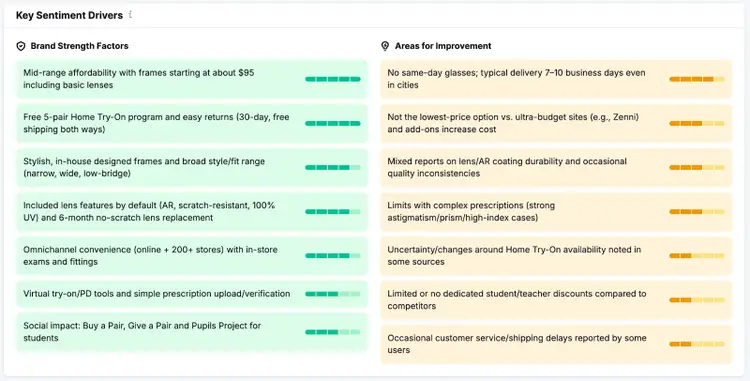
And get tailored suggestions to improve AI visibility.
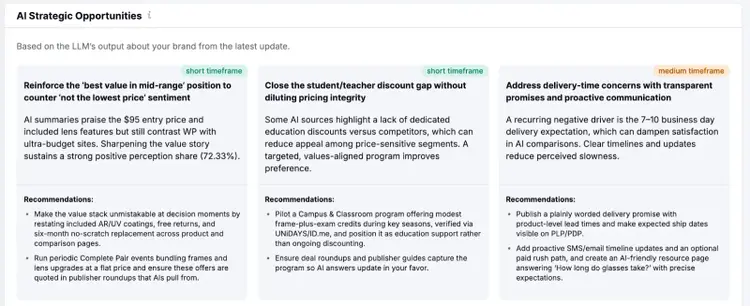
Stay Ahead of the AI Curve
Google AI Mode marks a major shift in how people find and trust information online. The focus is no longer just on rankings and clicks. It’s now about citations, credibility, and context.
Use the Semrush AI Visibility Toolkit to:
- Track how often your content appears in AI Overviews and AI Mode
- Identify missed opportunities
- Optimize your brand for the future of search
Optimize for Google AI Mode
with the Semrush AI Visibility Toolkit

Alex is a managing editor with 10+ years of experience leading content and SEO teams across SaaS, tech, ecommerce, and digital publishing. He specializes in building editorial systems that balance human judgment with AI-assisted workflows, helping teams produce original, high-impact content as search and discovery evolve. His work spans SEO strategy, content quality frameworks, and adapting content operations for AI-driven search.
Alex Lindley
Alex is a managing editor with 10+ years of experience leading content and SEO teams. He focuses on building AI-aware editorial systems that help teams produce original, high-impact content as search evolves.
Tells Google to show you more from Semrush in AI, Search, and Discover.