
People ask ChatGPT direct questions, rely on AI Overviews for instant answers, and expect synthesized information from multiple sources.
So optimizing for AI systems determines whether your content gets cited and recommended, or stays invisible.
Use this guide to optimize for AI search, track your AI visibility, and stay ahead as AI reshapes how content gets discovered.
For a comprehensive technical deep-dive, check out our generative engine optimization guide.
What is AI search optimization?
AI search optimization is the practice of making your content frequently referenced and prominently featured by AI search systems like ChatGPT, Google's AI Overviews, and Perplexity.
AI search optimization is also known as generative engine optimization (GEO) or SEO for AI search. This large language model (LLM) optimization approach focuses on getting cited more often and positioned higher in AI-generated responses rather than ranking well in organic search engine results.
Success requires understanding how these platforms select sources and making sure your content consistently appears as a preferred citation, ideally as the primary or first-mentioned source.
How AI search optimization differs from SEO
SEO optimizes for search engine rankings. AI search optimization optimizes for mentions and citations.
AI search optimization isn't a replacement for SEO. It's the next layer of the same discipline, applied to AI-powered surfaces alongside search engine results.
The nuanced differences between AI search optimization and SEO can be confusing. They're leaving many marketers wondering whether the methods used to optimize for each are different in practice.
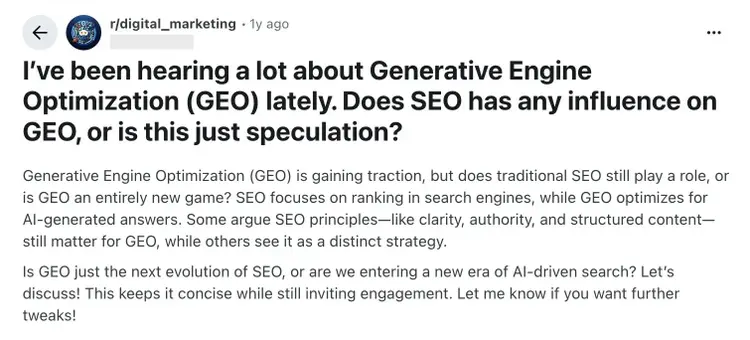
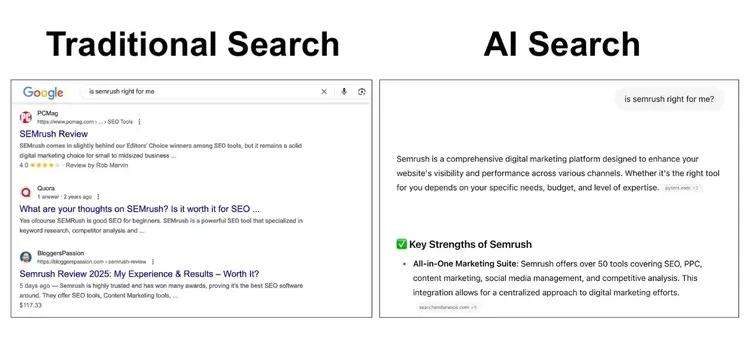
Think of it this way: AI systems now act as intermediaries between users and content. They filter and synthesize information instead of linking to it.
This changes how people search and consume information:
- People ask full questions. Instead of looking for "email marketing tips," they ask: "What's the best way for B2B companies to increase email open rates?"
- AI provides complete answers. Users get comprehensive responses without needing to click through to multiple sites.
- Brand awareness matters more than traffic. Being cited builds authority even when users don't visit your site.
- Multiple sources get combined. AI pulls information from several sites to create one answer.
All of these differences mean you need to write differently. Focus on being easily referenced and cited, not on being comprehensive.
Why AI visibility is the next SEO frontier
AI visibility is the next SEO frontier due to the increasing prominence of AI search and its effectiveness in generating conversions.
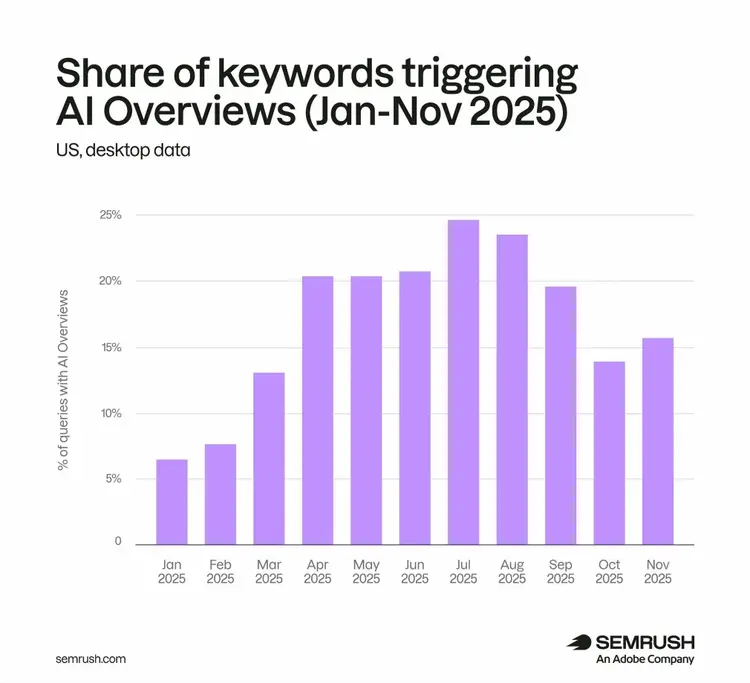
AI Overviews appear on about 16% of searches as of November 2025, after peaking near 25% in July, according to our AI Overviews research.
Even outside of AI Overviews, users of non-Google AI search systems like ChatGPT convert 4.4 times better than organic search visitors.
By the time someone finds you through an AI citation or mention, they're educated about your solution and closer to deciding whether to use it.
And the opportunity is massive.
Right now, AI search represents a largely untapped channel. While the search engine results pages are saturated with competition, AI platforms are citation-hungry, and the field isn't crowded yet.
This means there’s an unprecedented opportunity for newer or smaller sites to gain visibility by optimizing specifically for AI.
Our July 2025 research backs this up: ChatGPT cited pages ranking in traditional positions 21 or worse almost 90% of the time. Strong, extractable answers earn citations even when your page isn't on page one.
This visibility can also translate into revenue. That’s because your brand is more likely to be top of mind if your audience consistently sees it mentioned in AI output.
SEO expert Andrew Holland frames the broader opportunity in a LinkedIn post:
“The future of SEO isn’t GEO, it’s Organic Revenue Growth. Your brand search is going to become critically important. That is why SEO and GEO are tactical options within organic revenue growth. Of course, the biggest tactical option available to anybody is to increase the amount of search for their particular business. And I call this fame engineering, because that’s what you want to do: increase your relative fame within your market.”
So companies optimizing for AI visibility get in front of their audience while competitors fight over the same shrinking SERP real estate.
The window won't stay open forever. And you don't need to overhaul your entire content strategy to start getting AI citations.
How to optimize for AI search
Optimize for AI search by starting with the highest-impact changes below.
1. Verify AI systems can access your content
Verify AI systems can access your content, because they won’t be able to cite you if they can’t view your content in the first place.
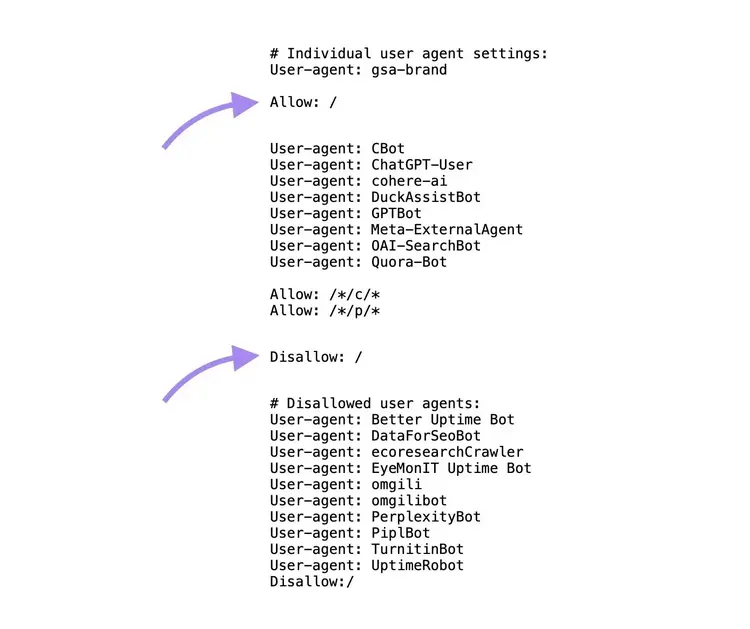
Check your robots.txt file at yoursite.com/robots.txt. Look for blocks against common AI crawlers like:
- OAI-SearchBot, GPTBot, and ChatGPT-User: OpenAI’s crawlers for ChatGPT
- CCBot: Common Crawl’s crawler, which collects web crawl data for anyone to use for free
- ClaudeBot, Claude-User, and Claude-SearchBot: Anthropic's crawlers for Claude
If you see Disallow: / for these crawlers, you're blocking AI access.
Quick action: Search for your brand name or key topics on ChatGPT, Perplexity, and Claude. If your content never appears as a source, you may have accessibility issues.
Check that your most important pages aren't blocked by:
- Login walls or paywalls
- JavaScript-only navigation that crawlers can't follow
- Server errors or extremely slow loading times
Also confirm your canonical tags are present and pointing to the correct pages. Broken or missing canonicals don't block AI crawlers, but they can cause AI systems to cite the wrong version of your content or skip it as duplicate.
2. Add specific statistics to your content
Add specific statistics — with sources — to your content because AI systems reference content with specific, sourced data more often than content with vague generalizations.
Start with 2-3 articles that already rank well for your target keywords.
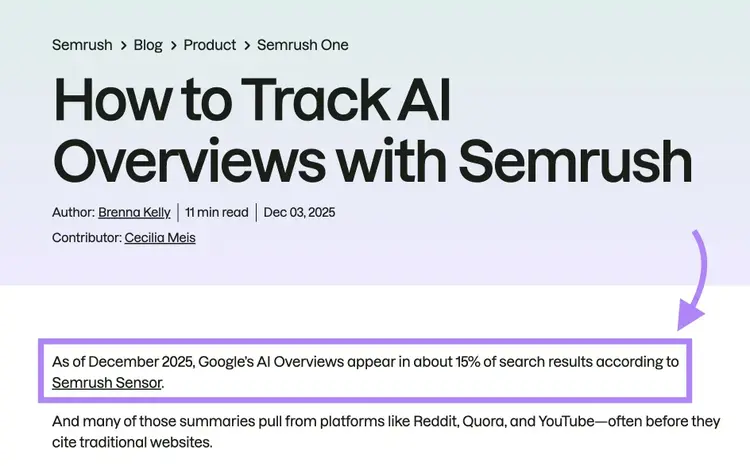
Replace vague statements like 'AI Overviews are appearing in many searches' with concrete data like the 16% figure from the Semrush AI Overviews study cited above. Use the source name, the date range, and the methodology when you can: "As of December 2025, Google’s AI Overviews appear in about 15% of search results according to Semrush Sensor. "
Like this:
This single change often produces the fastest AI citation improvements.
Quick action: Spend 30 minutes finding and adding 2-3 relevant statistics to your top-performing articles with proper attribution.
3. Test your topics on AI platforms
Test your topics on AI platforms to identify opportunities for plugging gaps in your content and improving its AI visibility.
- Ask different AI platforms the same questions your audience would ask about your niche or expertise.
- Note which competitors get cited and what types of sources appear.
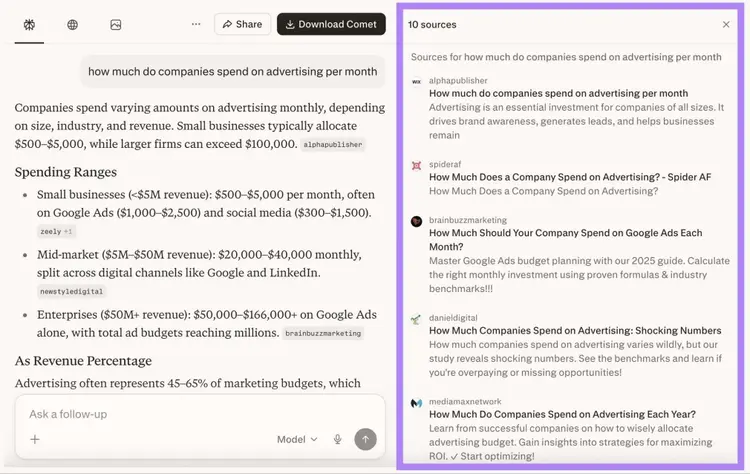
If you're consistently missing from results while competitors appear, you've identified a content gap.
Analyze how AI systems phrase their responses. This shows you what structure and phrasing they extract cleanly. Then mirror that structure in your own content.
For example, if AI responses consistently use numbered lists or start with direct definitions, incorporate these elements into your articles.
Quick action: Test five questions related to your main topic across Gemini, Perplexity, ChatGPT, and Google's AI Overviews.
Document which sources get cited and analyze what they do differently from you. Then, identify one element from these sources to incorporate into your next piece of content.
4. Structure content for direct answers
Structure content for direct answers by ensuring each content section addresses its heading’s topic completely.
AI systems extract chunks of content. As a result, they can more easily understand and cite sections that provide direct answers. This is especially true if the sections make sense without context from other parts of the page.
Use question-based headings like "How to reduce website loading time" rather than vague titles like "Performance tips."
For example, start with "You can reduce website loading time by optimizing images, enabling compression, and choosing faster hosting" before diving deeper.
Quick action: Rewrite the headings in one existing article to directly answer your audience’s questions. Then, rewrite each heading’s opening paragraph to provide a complete answer before you expand on details.
5. Make your content quotable
Make your content quotable by including expert quotes, case study results, and concrete examples, because these make your content more citation-worthy.
Generic statements like "Our approach works well" are vague and lack credibility. Instead, mention numbers, timeframes, and measurable outcomes.
For example: "When we reduced client page load time from 4.2 to 1.8 seconds, organic traffic increased 43% within two months."
This short case study gives AI systems something concrete to reference when supporting broader claims about site performance.
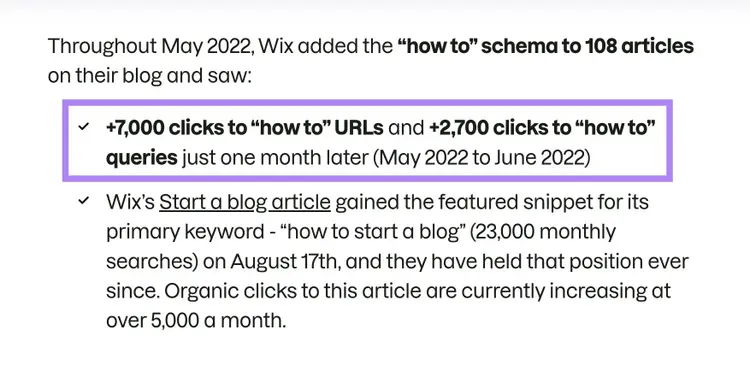
Beyond making your content quotable, establish yourself as a quotable source.
Add your credentials and experience to your author bio. AI systems look for authority signals when deciding which sources to cite.
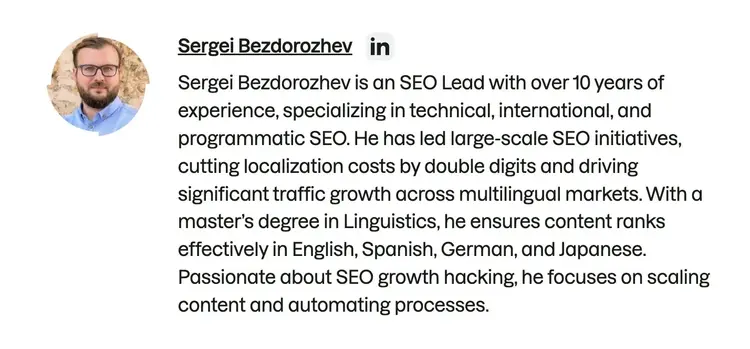
Quick action: Add one specific statistic, case study result, or named expert quote to your highest-traffic article.
These changes won't transform your AI visibility overnight, but they create the foundation that makes other AI search optimization techniques more effective.
6. Keep your content updated
Keep your content updated, because AI search systems prefer citing recent content.
This is the case even for evergreen topics:
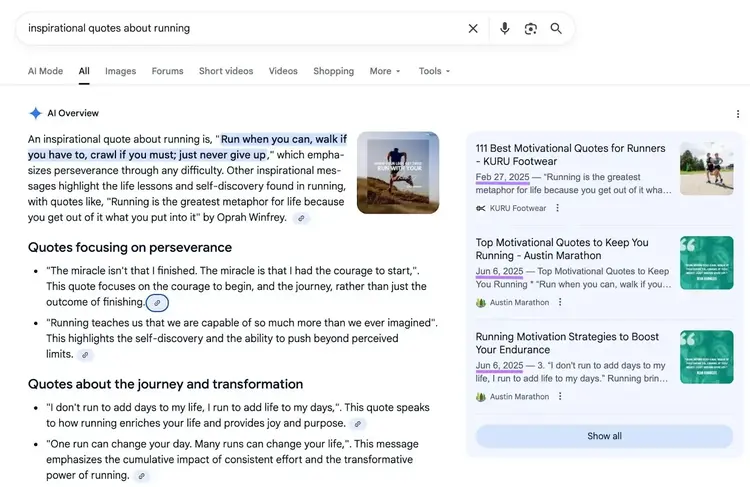
Other AI systems also prioritize recency. Metehan Yeşilyurt, Co-Founder and Chief Growth Officer at AEO Vision, posted about this on LinkedIn:
“ChatGPT prioritizes RECENT over PERFECT. That amazing guide from 2022? It's losing to mediocre content published yesterday.”
Quick action: Look for pages that are critical to your business and any pages losing visibility. UseGoogle Analytics 4 to find pages with diminishing traffic.
Then, optimize these pages’ content for AI search by:
- Incorporating recent statistics from reputable sources
- Modernizing discussions in alignment with recent developments (e.g., updating an article from last year about ChatGPT to discuss ChatGPT’s new models)
- Gathering new and original data and adding relevant insights (e.g., updating a “best tools” roundup article to include newer, more effective tools and your findings from testing them)
7. Optimize for query fan-out
Optimize for query fan-out to improve your content’s visibility for a wider range of topics.
Query fan-out is the process of AI systems splitting user prompts into related sub-queries, and then using information relevant to each sub-query to synthesize an answer to the initial prompt.
By optimizing your content for query fan-out, you position it as an information source for multiple related topics, which increases the likelihood of AI systems mentioning and citing your content.
Your content can't just answer users' main questions; it also needs to address the predictable sub-questions AI systems generate.
Quick action: Run your target topic through an AI tool and note the sub-topics, entities, and follow-up angles that the tool explores while generating an answer.
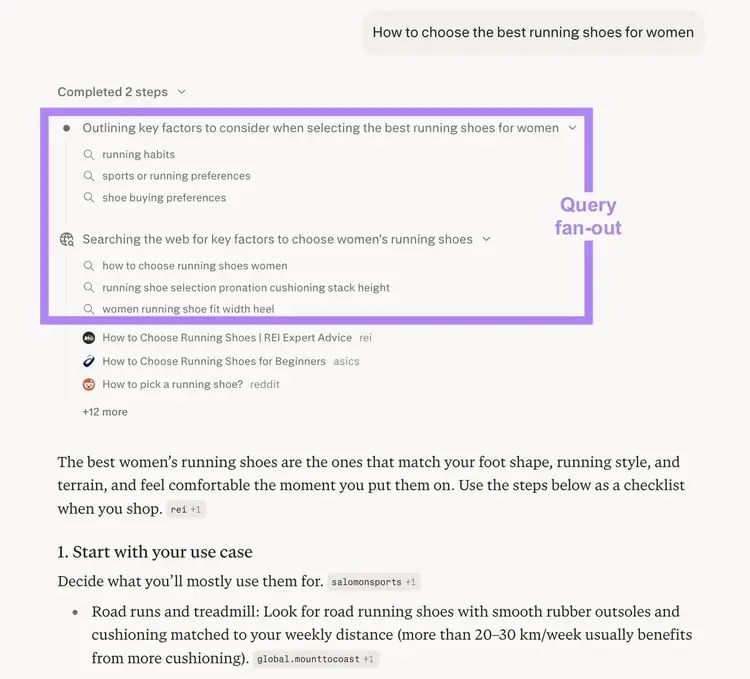
Then, check whether your content addresses each of these angles. And plug content gaps accordingly.
Check out our detailed query fan-out guide for more information on optimizing for it.
8. Optimize differently for each AI platform
Optimize differently for each AI platform, because they retrieve and cite content differently from each other, and optimizing for one platform doesn’t guarantee visibility on others.
For example, we’ve observed that:
- Google AI Overviews retrieves content from Google’s search index to generate answers with curated citation links
- Gemini retrieves content from its training data and Google’s search index to generate answers with inline source citations
- ChatGPT retrieves content from its training data. With web search enabled, it also pulls from web sources via its own crawler (OAI-SearchBot) and Bing's search index, and displays inline source citations.
- Claude retrieves content from its training data. If web search is enabled, Claude can also retrieve content from the Brave Search index (Anthropic's web search partner) and display inline source citations.
- Perplexity retrieves content from its own search index to generate answers with inline source citations
Optimize your content according to these characteristics. For example, to get your content cited in Google AI Overviews, ensure that your content is in Google’s index and fulfills Google’s Search technical requirements.
Quick action: Run the same question across different AI platforms. Note where your competitors appear in each platform's answer and where your site isn't cited. Then optimize your content for the platforms where you have less visibility.
9. Build entity authority beyond your site
Build entity authority beyond your site, because AI systems evaluate a brand's credibility using both on-site and off-site signals: what your site says about your brand, and what the rest of the web says.
Build off-page entity authority by taking steps like:
- Running digital public relations campaigns to earn brand mentions and backlinks from relevant industry publications. Use a tool like Backlink Gap to discover industry publications that have linked to your competitors but not your brand, so you can pitch these publications.
- Building brand presence and authority on community forums like Reddit and Quora by having team members comment on relevant forum posts. In these replies, focus on delivering value by providing helpful answers to users' questions. Avoid promotional content, because some forums prohibit self-promotion and may remove non-compliant content.
- Monitoring your brand’s positioning on authoritative platforms like Wikipedia and Google Business Profile, and working to make your positioning across them accurate and consistent. When these platforms corroborate each other, you help AI systems deliver a brand narrative that aligns with how you want users to perceive your brand.
- Designating team members to respond to interview requests and secure subject matter expert quotes across reputable third-party sites. Where possible, your team members’ responses should include specific examples and data to boost authority.
Quick action: Run a web search in ChatGPT or Perplexity for your top three target topics. Then check whether the cited sources mention or link to your brand. If your brand isn't mentioned, pitch those sources for coverage.
10. Use schema markup
Use schema markup to help search systems better understand your content and improve your AI visibility.
Schema markup is a way of formatting your page's content to match standardized data structures that search systems understand. Schema comes in many types. For example, Article schema looks like this:
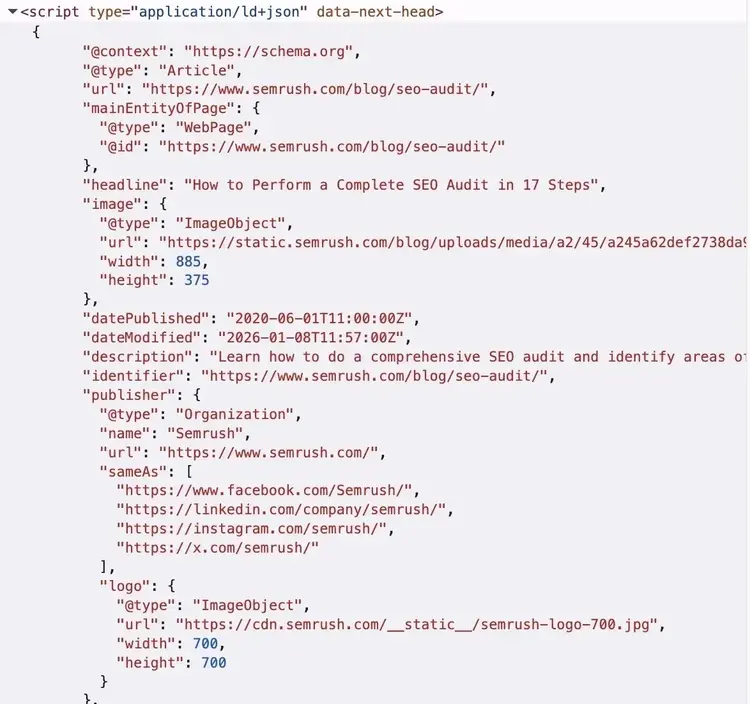
Using schema markup can improve your organic search rankings, which AI systems reference when finding trustworthy content to cite.
Prioritize using these schema markup types:
- Article: Article schema helps define the content’s author, publication date, and topic, which AI systems reference when evaluating the content’s authoritativeness and trustworthiness
- FAQ: FAQ schema maps questions directly to answers for easier AI extraction
- HowTo: HowTo schema structures content in a step-by-step format that AI systems can interpret and turn into instruction lists more easily
- Product and Review: Product and Review schema provides essential ratings information that helps your content appear in AI-generated "best of" recommendations
Quick action: Use Google’s Rich Results Test to check if your top 3-5 pages contain schema markup. If they don’t, use a tool like the Structured Data Markup Helper to add Article, FAQ, or other suitable schema markup to them.
Check out our schema markup article for detailed guidance on implementation.
11. Avoid common AI search optimization mistakes
Avoid common AI search optimization mistakes that hinder your efforts to improve AI visibility.
These mistakes include:
- Accidentally blocking AI crawlers: Open your robots.txt file and check the user agents listed in Step 1 (GPTBot, ClaudeBot, OAI-SearchBot, etc.) aren't disallowed
- Optimizing for only one AI system: Different AI systems retrieve and cite content differently, and you’ll need an optimization strategy for each one
- Failing to address user intent in your content: User intent refers to the user’s purpose for conducting the search. AI systems prioritize citing content that meets users’ needs
- Publishing thin, AI-generated content: AI systems prefer citing unique, in-depth, and well-supported content
- Letting your content become outdated: AI systems favor citing up-to-date content
- Focusing only on on-page optimization tactics: AI systems also consider off-page entity authority when citing sources
- Treating AI search optimization as a separate discipline from SEO: The fundamental tactics are the same, with an added focus on earning AI citations on top of improving organic search rankings
Tools that help you optimize for AI search
Use tools like Semrush’s Enterprise AI Optimization (AIO), AI Visibility Toolkit, and Google’s Rich Results Test to optimize for AI search.
That's because while free manual testing works when you're getting started, you can't scale this approach across dozens of topics on multiple AI platforms.
Enterprise AIO monitors your brand mentions across AI search platforms like ChatGPT, Perplexity, and Gemini. It provides comprehensive visibility into how your brand appears in AI-generated responses.
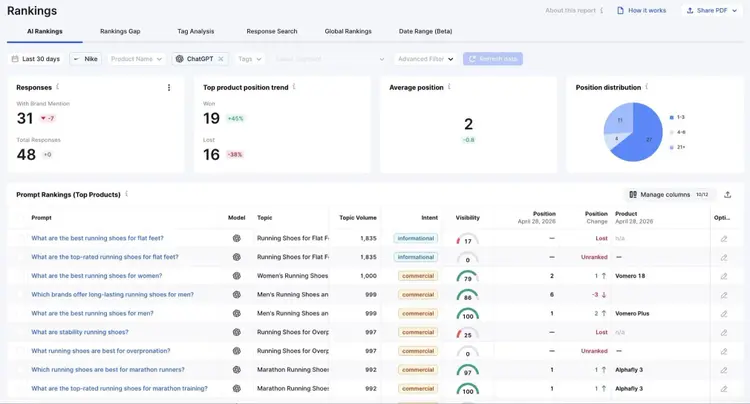
Enterprise AIO also benchmarks your AI visibility against competitors. You can track brand mentions, sentiment, and market share across AI search platforms in one place.
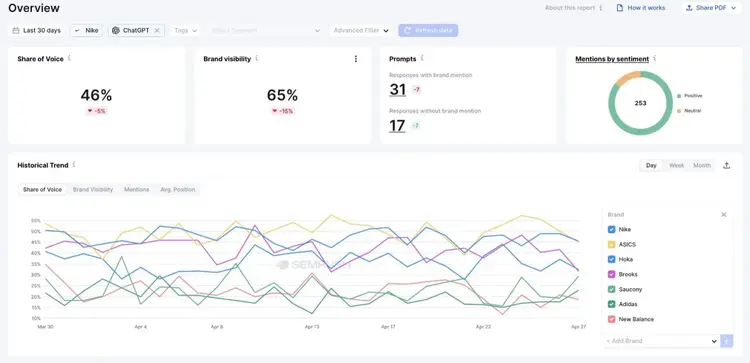
Other AI monitoring and optimization tools worth considering:
AI monitoring and optimization tools
Brand mention tracking:
- Semrush Enterprise AIO: Tracks which competitors get cited for your topics, monitors brand sentiment in AI responses, and alerts you to citation opportunities
- Semrush AI Visibility Toolkit: Tracks your brand’s visibility across top AI platforms, analyzes how you’re mentioned and recommended, and delivers strategic insights to improve your presence in AI-generated answers
Technical validation:
- Google's Rich Results Test: Verifies your structured data markup works properly
- Robots.txt checker: Confirms you're not blocking AI crawlers
A testing framework that scales
Start with free testing methods for 2-3 core topics before investing in paid tools. Then, when you need a testing framework that scales, use Enterprise AIO for:
- Automated monitoring across multiple AI platforms
- Competitor comparison and benchmarking
- Historical data and trend analysis
- Alert systems for brand mention changes
Next steps: start this week
AI search visibility isn't a separate discipline. It's where the SEO fundamentals you already practice (extractability, authority, recency, presence) land on a new set of surfaces. The brands that earn citations now build a head start that compounds as AI search keeps growing.
Start this week with the action plan below.
Today (30 minutes):
- Find 2-3 statistics for an article that could use more authority and then add them, citing your sources
- Ask ChatGPT and Perplexity one question your audience would ask about your topic, and note which competitors get cited and the language patterns the AI uses
This week:
- Rewrite 3-5 key headings in one article as questions. Then, ensure the first paragraph under each heading directly answers the question.
- Add one specific statistic, result, or case study to your author bio
- Run your top topic through an AI tool to see the sub-questions the tool generates. Check if your content covers each one. If it doesn’t, note these sub-questions as content gaps to address.
- Check the competing content that appears when you search your topics on AI platforms. Then, identify one element from the most-cited competing sources to adapt for your content.
That's it. Start with these six actions before diving deeper.
Optimize for AI search
with Semrush’s AI Visibility Toolkit

Carlos Silva leads the editorial pipeline for the English blog—coordinating writers, editors, strategy, and building AI workflows that boost content quality and AI visibility. With 10+ years of experience writing and editing across in-house and agency roles, Carlos blends content strategy, SEO, and AI to help marketers stay ahead of an evolving search landscape.
Carlos Silva
Carlos Silva leads the editorial pipeline for the English blog and builds AI workflows that boost content quality and AI visibility. 10+ years writing and editing across in-house and agency roles.
Tells Google to show you more from Semrush in AI, Search, and Discover.
Table of contents
-
- 1. Verify AI systems can access your content
- 2. Add specific statistics to your content
- 3. Test your topics on AI platforms
- 4. Structure content for direct answers
- 5. Make your content quotable
- 6. Keep your content updated
- 7. Optimize for query fan-out
- 8. Optimize differently for each AI platform
- 9. Build entity authority beyond your site
- 10. Use schema markup
- 11. Avoid common AI search optimization mistakes