
The ultimate guide to creating a content marketing strategy
Expert reviewed
Our subject matter experts have reviewed this article to ensure it meets the highest standard for accurate information and guidance. Learn more about our editorial standards and process.
Many companies still build their entire content marketing strategy around getting articles to rank on Google.
That approach can generate traffic and leads, but it’s too dependent on one source.
In this guide, you’ll learn how to create a content marketing strategy that reaches your audience across all the places they spend time online and connects every decision to a clear business goal.
Content marketing should plan for multiple discovery paths
For years, many teams built their content marketing strategy around Google Search. Keywords determined the topics, blog articles became the default format, and rankings and organic traffic defined success.
Email and social media still played a role, but mainly as places to promote articles already planned around search. They were rarely treated as places to share unique content
As a result, many brands had an SEO publishing plan with distribution added later, rather than a complete content marketing strategy.
Today, audiences move across many places as they discover a topic and compare solutions. Someone might first encounter an idea on Instagram, watch a detailed explanation on YouTube, compare options through Reddit, and ask ChatGPT for a final recommendation.
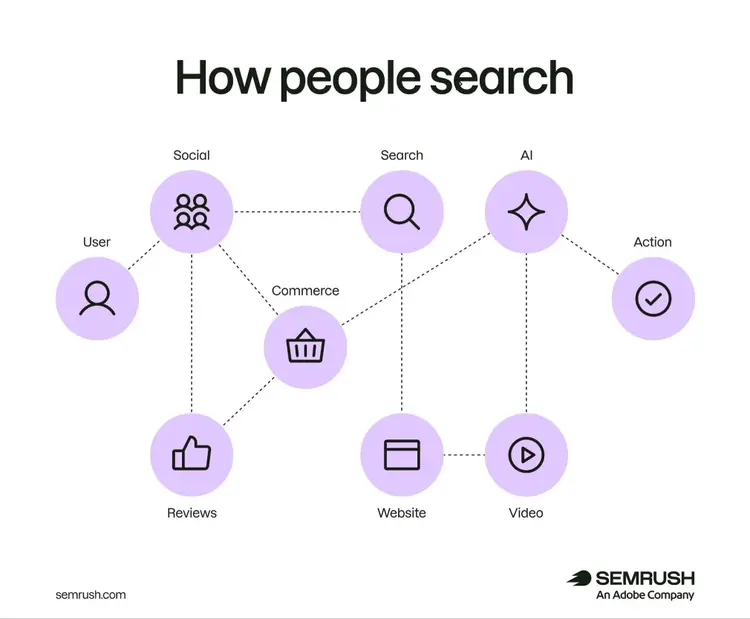
A content marketing strategy in 2026 should account for different discovery paths from the outset. It should consider where the audience spends time, how each channel works, and which formats can communicate the idea most effectively.
This means a topic shouldn’t automatically become an article just because people are actively looking for information about it. It may work better as a video, social post, email, or combination of formats.
Organic search can still play a major role. But it should inform the content marketing strategy, not dictate it.
What is a content marketing strategy?
A content marketing strategy is a structured approach to using content to attract, engage, and retain your target audience, so you can achieve defined business goals.
A good content marketing strategy identifies:
- Who you want to reach
- What you want your content to achieve
- Which topics you’ll cover
- Which formats and channels you’ll use
- How you’ll distribute content
- How you’ll measure performance
Content marketing strategy vs. content strategy vs. content plan
Here’s how a content marketing strategy, content strategy, and content plan differ:
Why have a content marketing strategy?
Having a content marketing strategy helps focus your content efforts to increase the likelihood of reaching your specific business goals.
It gives you clear ways to:
- Prioritize what matters by focusing your time and budget on the audience, topics, formats, and channels most likely to support your goals
- Simplify production by giving your team clear direction on what to create and which work to prioritize
- Evaluate performance based on the metrics that measure progress toward your goals, so decide what to continue, improve, or stop
8 steps to creating a successful content marketing strategy
Follow these eight steps to create your content marketing strategy:
1. Define your content goal
Setting a content goal focuses your strategy on the outcomes you want to achieve, so you can measure whether you’re on track to reach them.
Start with the broad business outcome you want, such as more qualified traffic, free-trial sign-ups, product use, or customer retention. Then turn that outcome into a specific, measurable, achievable, relevant, and time-bound (SMART) goal.
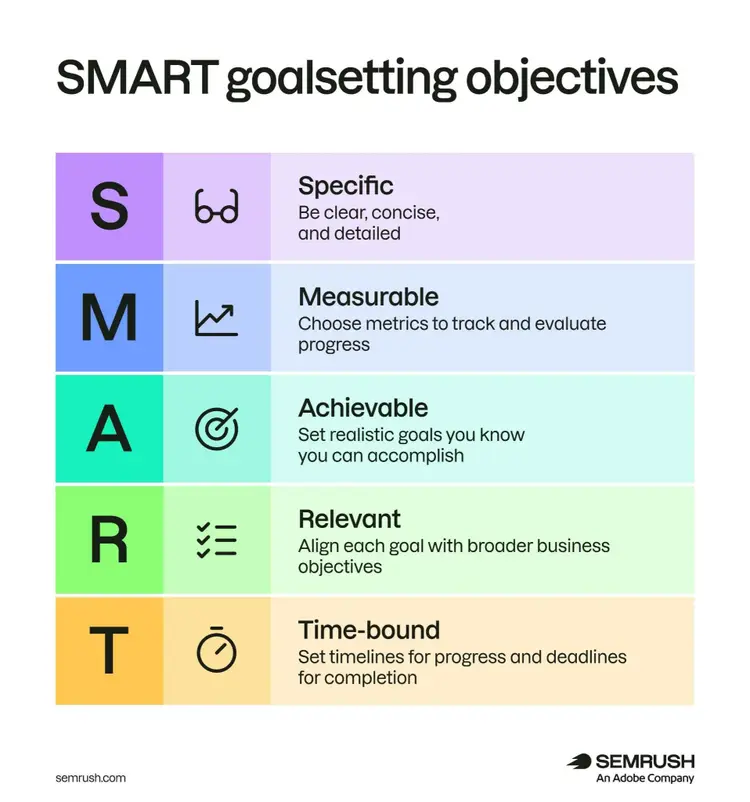
For example, a note-taking app’s desired business outcome could be to increase free-trial sign-ups. A corresponding SMART goal could be, “Generate 500 free-trial sign-ups from university students within six months.”
2. Understand your target audience
Understanding your target audience helps you choose topics, formats, and channels based on what your ideal customers need and where they spend time online.
Here’s how to do it:
Do audience research
Audience research shows you who your content should serve and what those people want.
Start with people you can already contact, such as current customers or trial users. Invite a small number to interviews, which you might have to do through email lists or by working with your sales team.
When interviewing people who already know your brand, ask questions such as:
- What are you trying to accomplish?
- What problems do you run into when trying to accomplish that?
- What information would help you make progress?
- What tools or approaches do you currently use?
To get responses from people outside your existing audience, use a survey panel or audience pool. These services can recruit participants based on criteria such as age, occupation, industry, location, and whether they use certain products or services.
Pro tip
Add an optional question in the survey asking whether respondents are willing to share their contact details to answer additional questions. This lets you follow up to hold more detailed conversations to better understand the reasons behind certain answers.
You can also review these sources to gain audience insight:
- Sales and support conversations: Find questions, concerns, and objections that appear repeatedly among prospects and customers
- Your customer reviews and feedback: Identify recurring praise, complaints, requests, and unmet needs
- Competitor reviews: See what customers praise or criticize about alternatives
- Online discussions: Study how people describe their problems, ask questions, and compare solutions in relevant communities
And Semrush’s Traffic & Market Toolkit can provide additional information about who visits your website and competing websites. Open the tool, enter your domain and some competitor domains, and click “Analyze.”
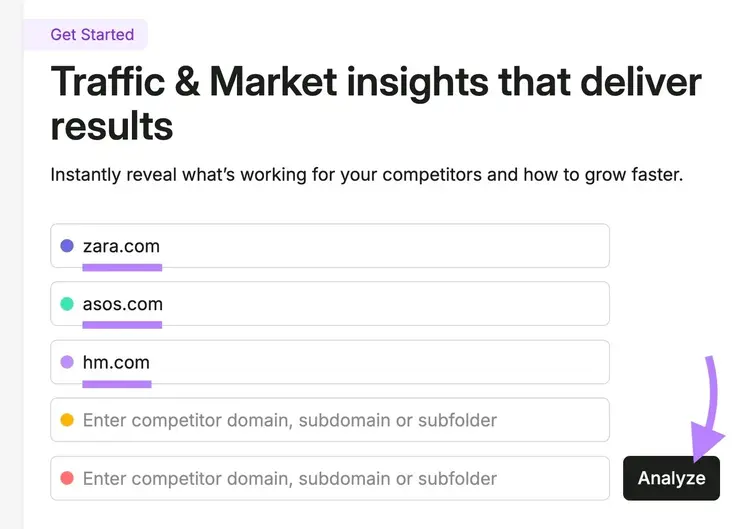
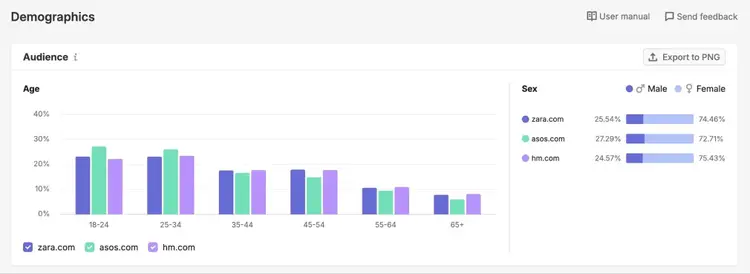
Open the Demographics dashboard to review characteristics such as age, gender, and location.
Then, go to the Socioeconomics dashboard to review factors such as household size, income, employment, and education.
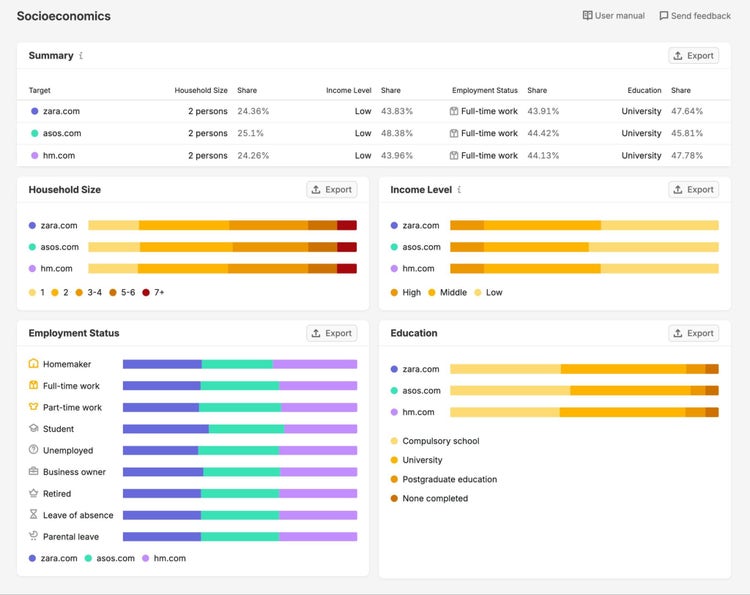
Note the audience characteristics that stand out and the goals, problems, questions, objections, and phrases that appear repeatedly.
Use these patterns to describe your target audience.
The note-taking app’s goal from step 1 already focuses on university students. Surveys and interviews with that group may show that some students regularly attend long lectures and struggle to organize their notes and turn them into useful revision materials.
The company could therefore define its target audience as university students who regularly attend long lectures and need a better way to organize and review their notes.
Find where your audience spends time
Finding where your audience spends time online helps you choose the channels where your content should appear.
Ask interviewees and survey respondents which channels they use to explore topics, find answers, compare options, and follow relevant creators or brands.
Treat the channels that your audience mentions as starting points. People may forget some of the platforms they use or describe their behavior differently from how they actually behave online.
Next, use the Traffic & Market Toolkit to compare broader audience and traffic patterns with what people told you. Open the Behavior dashboard and review the “Social Media” section to see which social platforms the selected websites’ audiences use most.
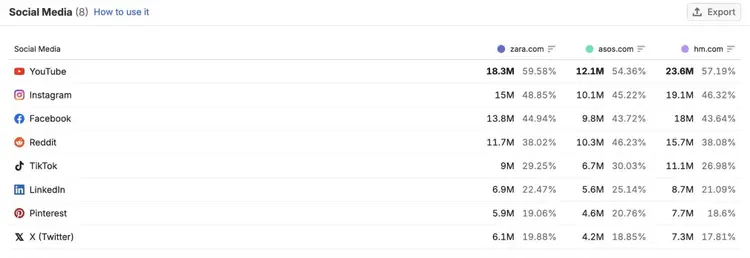
Then, open the Traffic Analytics dashboard and review the “Traffic Channel Distribution” chart. It shows the share of each website’s traffic that comes from channels such as AI, referral, organic search, and organic social.
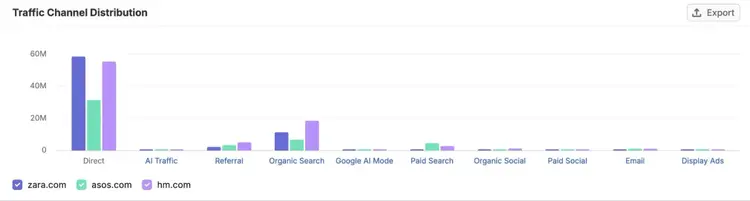
Click any channel to explore it in more detail. For example, click “AI Traffic” to see which AI tools send traffic to your site and competing sites.
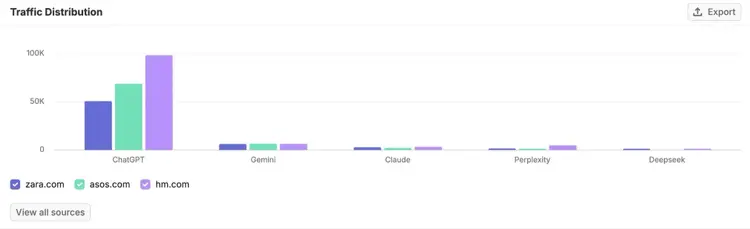
Look for channels that appear across several sources. For example, the note-taking app may find that Google Search, YouTube, Reddit, and ChatGPT appear repeatedly across its interviews, surveys, and Traffic & Market Toolkit data.
3. Choose your priority channels and content formats
Choose channels and content formats based on your audience research and what your team can produce well.
Start with the channels you identified during your audience research. Evaluate the feasibility of pursuing each one by asking:
- Did this channel appear repeatedly in your interviews, surveys, and Traffic & Market Toolkit data?
- Does the channel support the goal you set in step 1?
- Can your team publish or participate there consistently?
Prioritize the channels that meet all three conditions rather than trying to maintain a presence everywhere.
Keep in mind that AI platforms like ChatGPT cite content from platforms such as Reddit, YouTube, and LinkedIn. If your audience uses AI search, also consider the sources that appear in AI-generated answers and not just the AI tool itself.
Once you’ve shortlisted your channels, use the following guide to choose your content formats:
A single topic may benefit from several formats. An article can explain a process in detail, a video can demonstrate it, and a visual can summarize the main steps.
Finally, narrow your choices based on the time, budget, skills, and expertise available to your team. A smaller content mix that you can execute well is more useful than trying to create across more channels and formats than you can maintain.
For example, the note-taking app might prioritize Google Search, YouTube, and Reddit. Its core formats could include detailed guides, tutorial videos, and simple visuals.
4. Identify content topics
Identify content topics by using these four research methods:
Find topics for written content
Find topics for written content by researching what people enter into Google and AI tools.
Start with a broad topic connected to an audience need. Then explore how people search for it across Google and AI search to uncover specific topics, questions, and angles.
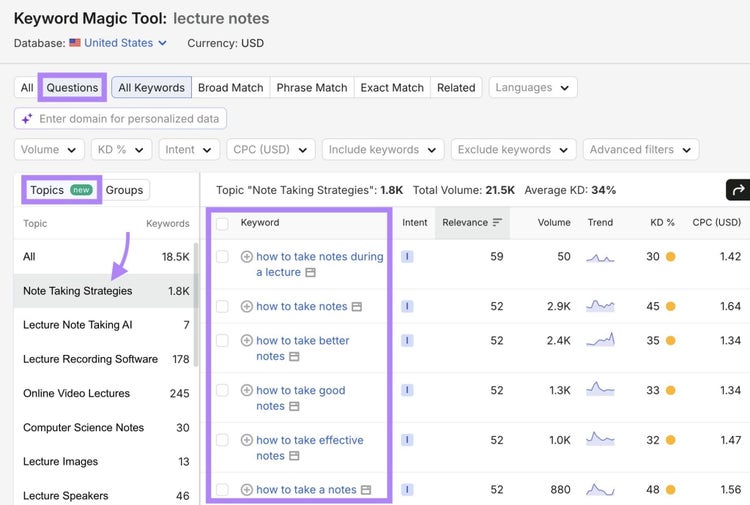
Open Semrush’s Keyword Magic Tool, enter your broad topic, choose your target location, and click “Search.”

Switch to the “Questions” tab to focus on question-based searches. Then review the topics listed on the left under the "Topics" tab. Click the topics most relevant to your audience, then review the question-based keywords within each one for potential content ideas.
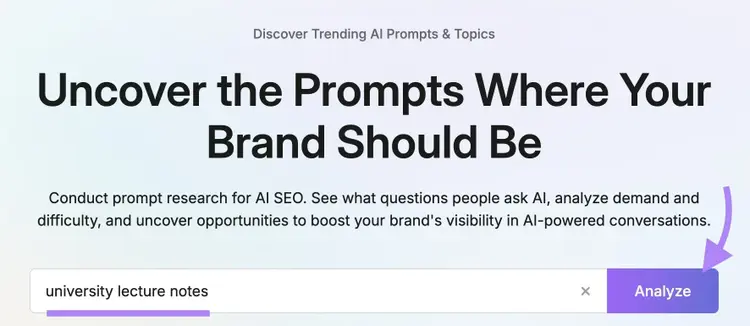
Next, use Prompt Research to find prompts people use in AI search. Open the tool, enter the same starting topic, and click “Analyze.”
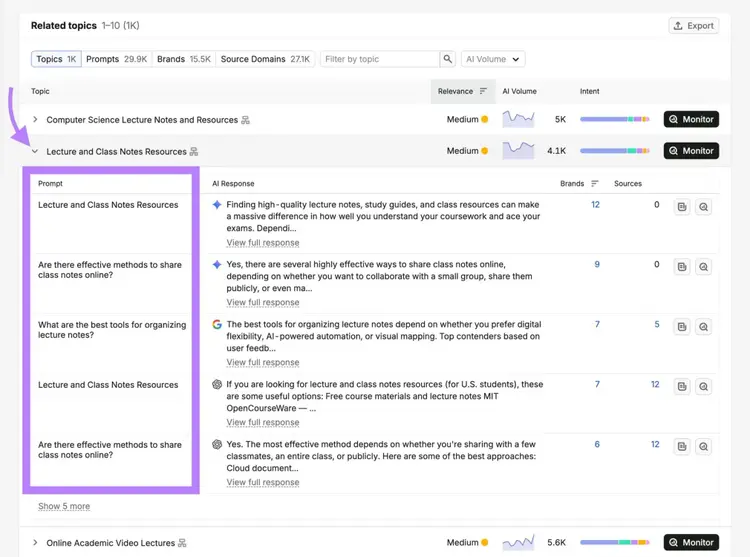
Review the related topics and click a relevant one to see the prompts associated with it.
Save the topics from the Keyword Magic Tool and Prompt Research that clearly match your audience’s wants and needs. You’ll review and prioritize them after completing the remaining research steps.
Find video topics
Find video topics by researching what people search for on YouTube.
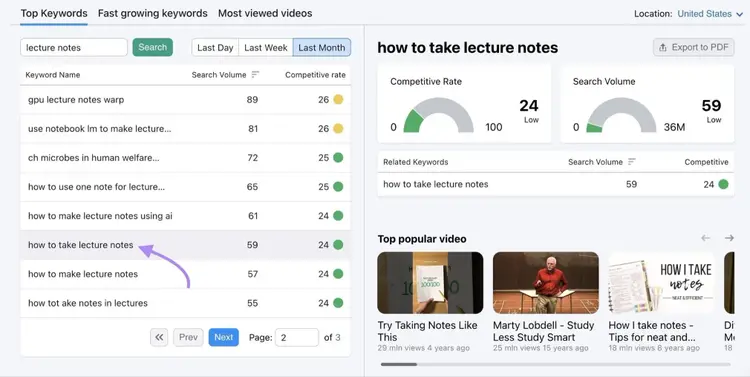
Open Keyword Analytics for YouTube and choose your target location and timeframe. Enter a topic and click “Search.”

Click a relevant keyword in the results table to view its:
- Search volume: The estimated number of YouTube searches
- Competitive rate: How competitive the keyword is
- Related keywords: Other searches connected to the same topic
- Top popular videos: Popular videos related to the keyword
Save keywords that match what your audience cares about and that could work well as video topics.
Mine communities and social platforms for real questions
Researching community and social discussions helps you find specific questions, problems, comparisons, and objections that may not appear in search data.
Use your earlier audience research to identify the communities and platforms your audience uses. Then search each one for a broad topic and review relevant posts and comments.
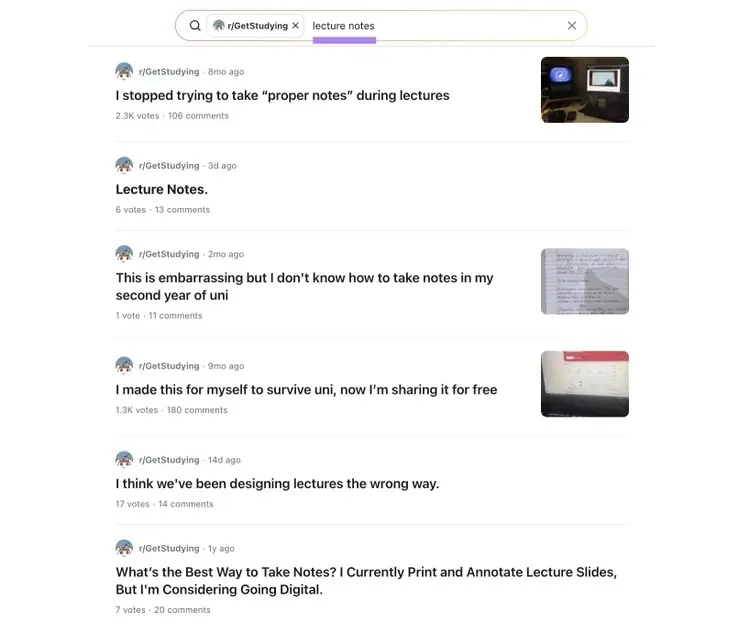
For example, the note-taking app’s audience research pointed to Reddit. Searching “lecture notes” in the student-focused r/GetStudying subreddit surfaces discussions about note-taking methods, printed versus digital notes, and difficulties taking notes during lectures.
Based on what you find, record recurring:
- Questions people ask
- Problems they describe
- Options they compare
- Concerns or objections they raise
- Words and phrases they use
These may become new topics or add more depth to topics already on your list.
Identify emerging topics
Tracking emerging topics helps you spot growing areas of interest that your content can address before they’re saturated.
Use Google Trends to see how interest in a topic changes over time. Review the “Interest over time” graph to see whether interest is growing, declining, stable, or seasonal.

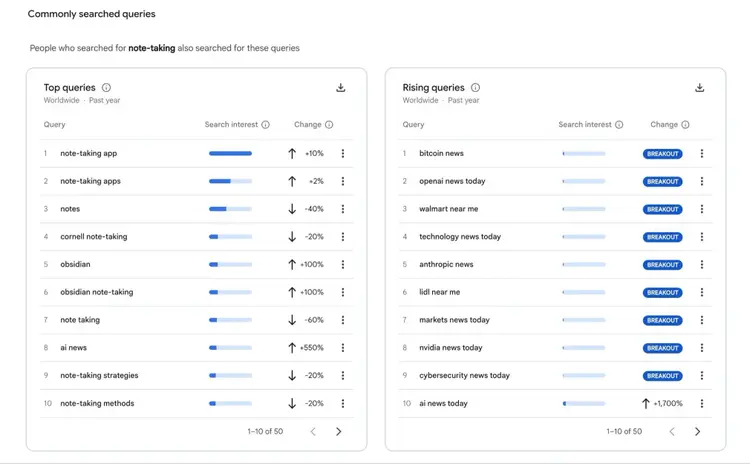
Then check “Top queries” and “Rising queries” to find popular related searches and those gaining interest.
You can also use the “Suggest search terms” feature. Enter an area of interest, and Google Trends will find and compare up to eight related search terms.
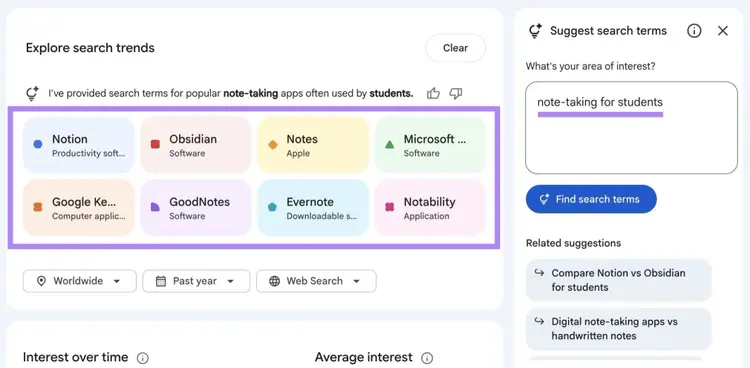
Google Trends shows relative search interest rather than exact monthly search volume, so use it to understand how interest changes over time.
To uncover more emerging topics and compare their monthly search volume and growth rate, use the Exploding Topics app.
Open “Trends Database” in the Exploding Topics app and search for a broad topic related to your audience. For example, searching for “note-taking for students” can surface growing topics such as “Plaud AI” and “UpNote.”
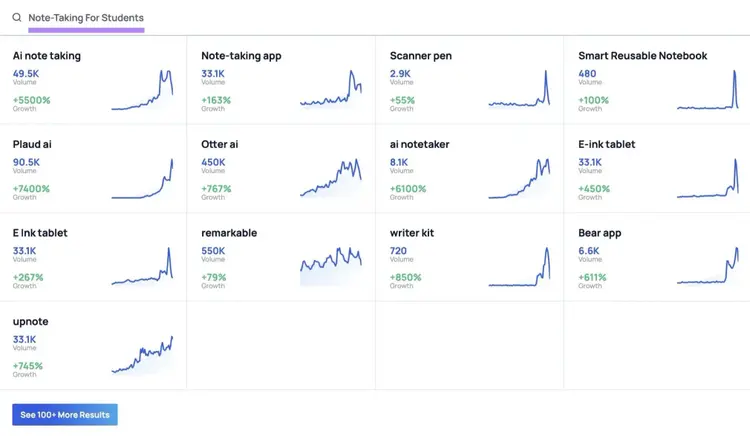
Click a relevant result to review its channel breakdown and see where the topic is receiving activity across social platforms.
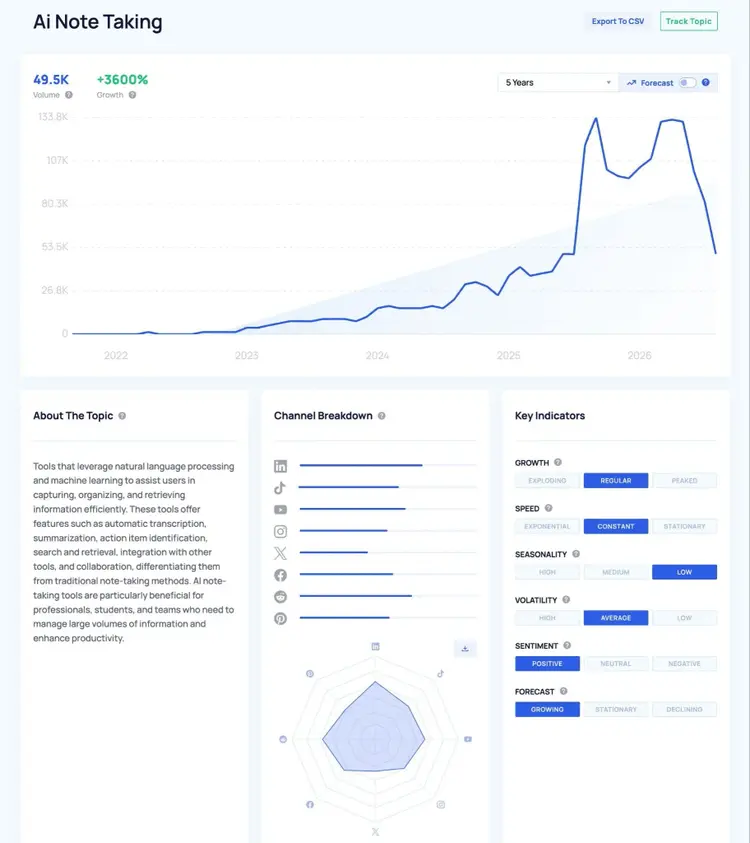
Save the emerging topics that match your audience’s needs and that your business can address with useful, credible content.
5. Build a content calendar with your priority topics
Prioritize the content topics you found, then add the highest-priority ones to a content calendar to schedule and manage production.
To decide which topics are worth covering first, look for ideas that best support the content goal you set in step 1. Then check whether your research indicates audience interest and whether your business can cover the topic accurately and usefully.
Also consider where each topic fits in the customer journey, so your selected topics support people at these different stages:
- Awareness: Potential customers first become aware of your brand
- Consideration: Potential customers learn more about your offering and compare it with alternatives
- Decision: Potential customers decide whether to choose your offering
- Retention: Existing customers decide whether to continue using your offering
Add the highest-priority topics to your content calendar. For each one, include the:
- Working title
- Channel
- Format
- Owner
- Due date
- Publish date
- Status
- Link to the brief or draft
You can manage these details in a spreadsheet or project management tool. Choose an option your team will update consistently. Here’s an example of a simple content calendar created using Google Sheets:
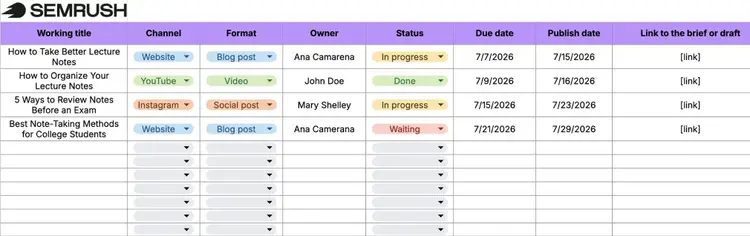
Set realistic due dates based on the work each piece requires. For example, the note-taking app may need more time to create a YouTube tutorial than a study-tip social post because the video requires scripting, recording, editing, and review.
For more detailed guidance and templates, check out our step-by-step content calendar guide.
6. Create content across formats
Create the written, video, and visual content you planned in your calendar by following these guidelines:
Create clear written content
Clear, well-structured writing helps readers quickly find and understand the information they need and makes individual passages easier for search engines and AI systems to parse.
Your written content should focus on:
- Leading with answers: Start each section by answering what the heading asks, then add the supporting details
- Covering one point at a time: Keep each section focused on one question or idea. And include enough context for that excerpt to make sense when it stands alone.
- Defining unfamiliar terms: Explain each potentially confusing term in one short sentence before discussing it further
- Naming entities clearly: Use the names of products, companies, tools, people, or concepts when words such as “it,” “they,” or “this” could be unclear
- Using a logical structure: Organize information in a clear order with descriptive headings, lists, and tables where useful. This makes the content easier for people to scan and search systems to understand.
- Supporting claims: Use credible sources, data, examples, or firsthand experience to back up your assertions
Create engaging video content
Engaging video content holds viewers’ attention by getting to the point quickly, explaining ideas clearly, and using visuals that support what’s being said.
You don’t need a studio or professional equipment. For most tutorials, interviews, and demonstrations, a phone or screen recorder is enough — as long as the audio is clear and the important details are visible.
Use this simple workflow to create engaging video content:
- Plan the script: Start with what viewers came to learn, then organize the explanation in a logical order. Use short, natural sentences that sound clear when spoken.
- Plan the visuals: Decide what viewers should see during each part of the script, such as a screen recording, demonstration, example, or on-screen text
- Record clearly: Make sure viewers can hear you clearly and easily see anything you’re demonstrating
- Edit for pace: Remove unnecessary pauses, repetition, and anything that doesn’t help viewers understand the topic
When publishing on YouTube, optimize the video to help people find it and decide whether to watch. Use relevant keywords naturally in the title and description, ensure the title clearly establishes what the video is about, and create an eye-catching thumbnail that accurately reflects the content.
For more guidance, check out our YouTube SEO guide.
Create visual content at scale
Creating reusable templates makes it easier to produce visual content repeatedly across different topics and channels without starting from scratch each time.
Review the visual formats you plan to create regularly, such as Instagram posts, LinkedIn carousels, article graphics, and YouTube thumbnails.
Note the visual elements you want to reuse across those formats, such as your colors, fonts, logo placement, image style, and basic layouts.
Create editable templates in Canva, Figma, Adobe Express, or another design tool. Then, you can easily update the copy, images, etc.
When your content calendar calls for a visual, choose the relevant template and adapt it for the topic.
7. Repurpose and distribute your content
Repurposing and distributing your content helps you reach more of your target audience without creating every asset from scratch.
Start with content you’ve already created and identify other relevant channels where you can distribute it. Use the audience research from step 2 and the channels you selected in step 3 to guide your choices.
You can distribute content through three broad types of media:
- Owned media: Content you publish through channels your brand manages, such as your website, email list, and social profiles
- Earned media: Unpaid coverage your brand or content receives from others, such as social media shares, mentions on other websites, and features in publications
- Paid media: Exposure you pay for through advertising, sponsorships, or paid partnerships
Once you know where the content will appear, adapt it to suit the channel. Keep the main ideas, research, and examples, but change the format, length, structure, visuals, or call to action as needed.
For example, the note-taking app could start with an article about taking better lecture notes, then identify other channels its audience uses and adapt the content into a suitable format for each one. It could turn the article into a YouTube tutorial and distill the main tips into an Instagram carousel.
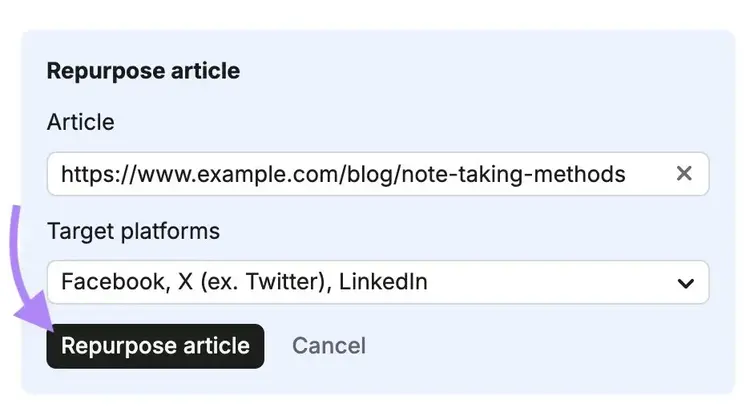
Use the Content Repurposing feature in Semrush’s Content Toolkit to repurpose an existing article into drafts for LinkedIn, Facebook, Instagram, X, Pinterest, email, and Google Business Profile. Paste the URL of the article you want to repurpose, select the channels you want to create content for, and click “Create content.”
8. Measure performance against your goal
Measuring performance against the goal you set shows whether your content marketing strategy is producing the result you wanted.
The specific metrics you track will be based on your goal and the priority channels you selected in step 3.
Here’s how this could look for the note-taking app:
Suppose the note-taking app generated 320 free-trial sign-ups instead of its target of 500. The company could compare how its priority channels contributed to those sign-ups and identify where performance was weaker. It could then use those findings when deciding which topics, formats, or channels to continue, change, or test differently in the next cycle.
You should review your content marketing strategy every three to six months. Check active campaigns and time-sensitive content more often. And use the results to guide your decisions about what to continue, change, or stop.
Build a content marketing strategy for modern discovery
The best content marketing strategies now account for the many ways people discover and evaluate brands across search engines, AI tools, social platforms, video platforms, and online communities.
Focus on the channels your audience uses and create content in formats that fit each one, while reinforcing the same expertise and brand position across them.
Semrush can support your content marketing strategy with tools for content creation, SEO, social media, and AI visibility. Start a free seven-day trial today.
Claim your free 7-day trial
and Explore our digital marketing tools

Carlos Silva leads the editorial pipeline for the English blog—coordinating writers, editors, strategy, and building AI workflows that boost content quality and AI visibility. With 10+ years of experience writing and editing across in-house and agency roles, Carlos blends content strategy, SEO, and AI to help marketers stay ahead of an evolving search landscape.
Carlos Silva
Carlos Silva leads the editorial pipeline for the English blog and builds AI workflows that boost content quality and AI visibility. 10+ years writing and editing across in-house and agency roles.

Tells Google to show you more from Semrush in AI, Search, and Discover.
Table of contents
-
8 steps to creating a successful content marketing strategy
- 1. Define your content goal
- 2. Understand your target audience
- 3. Choose your priority channels and content formats
- 4. Identify content topics
- 5. Build a content calendar with your priority topics
- 6. Create content across formats
- 7. Repurpose and distribute your content
- 8. Measure performance against your goal