
10 link building strategies that still work in 2026
Expert reviewed
Our subject matter experts have reviewed this article to ensure it meets the highest standard for accurate information and guidance. Learn more about our editorial standards and process.
Backlinks are still a strong ranking signal for search engines. The more quality links pointing to your site from relevant and authoritative sources, the better your chances of ranking for the keywords that matter to your business.
But link building now does more than influence Google rankings. AI tools like ChatGPT, Perplexity, and Google's AI Overviews understand what's authoritative in part by looking at who credible sources reference.
This guide covers 10 link building strategies you can use to boost authority and ultimately build your visibility across both traditional and agentic search.
Before we take a close look at each of these strategies, let’s understand what makes a good backlink.
What makes a good backlink?
A good backlink is one from an authoritative website in your niche that’s placed naturally within the linking site’s content.
Several things influence how much value a backlink actually has:
- Relevance: A link from a site that’s relevant to your business appears more natural to search engines and more trustworthy to AI tools
- Authority: Links from well-established sites with strong organic traffic and solid backlink profiles of their own are generally more valuable than links from new or lesser-known sites
- Placement: A link in the body of an article that’s surrounded by relevant context, is often seen as more valuable than one placed in a footer or a sidebar
- Link attributes: Links with “nofollow,” “ugc,” or “sponsored” attributes tell Google not to pass ranking signals, so a valuable backlink usually doesn’t have these attributes. But links with attributes can still provide a hint for ranking purposes. And nofollow links can still improve your AI visibility, too.
- Anchor text: Links with descriptive anchor text give search engines and AI systems more context about the linked page
Use the methods below to build high-quality backlinks to your website.
10 link building strategies to build search and AI visibility
1. Replicate competitors' backlinks
If a site has linked to a competitor that writes about similar topics, there's a reasonable chance they'd link to you as well — especially if your content is of higher quality.
Look at your competitors’ backlink profiles to find good link building prospects.
The prospects most worth targeting are those linking to multiple competitors at once. A domain that links to three or four players in your space is clearly an active linker in your niche, which makes them a warmer prospect than a site that linked to just one competitor.
Find sites that are linking to your rivals but not to you with Semrush’s Backlink Gap tool. Just enter your domain along with up to four competitors and click “Find prospects.”
For a given referring domain, click the number in any of the competitor columns to see the exact pages on that domain that are linking to your rivals, and which pages they link to.
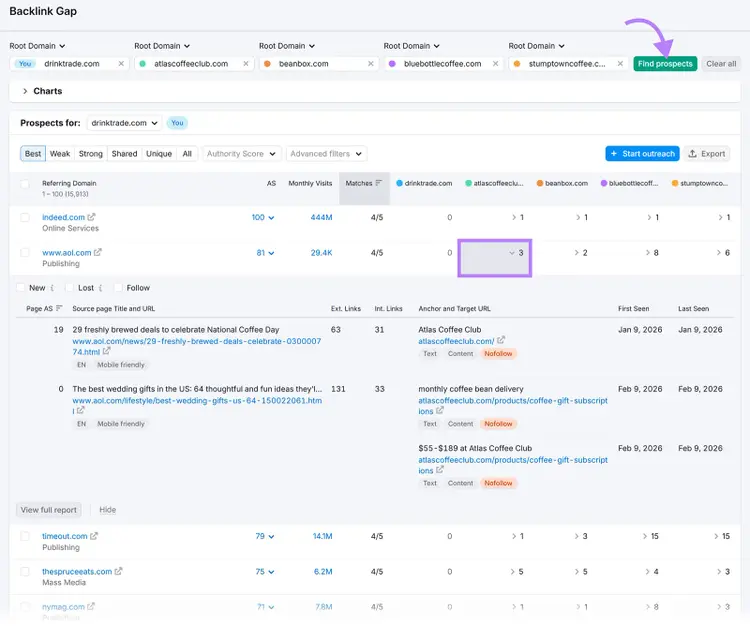
Go through the list of prospect domains and look for ones that are relevant to your business and that are linking to competitor pages that you have a suitable alternative to or could create a better version of.
Once you have your list of pages on prospects’ domains, identify where a link to your content would genuinely add value. Then pitch that specific improvement to the website owner.
Backlink gap pitch template
Here’s an email template you can use to pitch the link you want the prospect to include:
Subject: Quick note about your [topic] article
Hi [Name],
I noticed your article on [topic] links to [competitor page]. I’ve published something similar that covers [specific angle or improvement].
You can see it here: [URL]
If you think it's a useful addition for your readers, I'd love for you to consider including it in your article.
Either way, it’s a great piece.
Best,
[Your name]
2. Broken link building
Broken link building involves finding pages on websites that link to content that’s no longer live (and returns a 404 error), then offering one of your pieces as the replacement.
When a page gets deleted, any site linking to it now has a broken outbound link in their content. That's a problem for them and an opportunity for you.
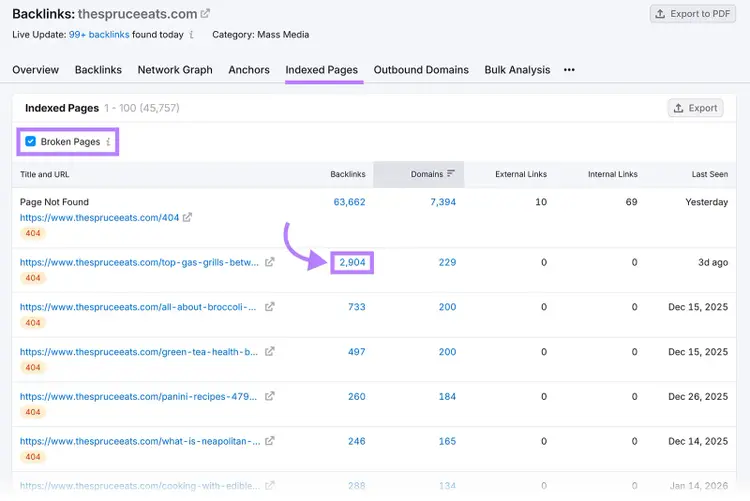
Find broken links you can replace by entering a competitor’s domain into Semrush Backlinks tool (you can also follow this workflow to find broken links pointing to your own domain). Go to the “Indexed Pages” tab and tick the box next to “Broken pages” to see dead pages on your competitor's site that other sites may still be linking to.
Just make sure the pages listed as broken on the “Indexed Pages” are actually broken by trying to access them yourself. Sometimes pages are temporarily inaccessible (often with a 403 error) but not broken.
For pages that you’ve verified are broken, click the number in the “Backlinks” column to see which domains are still linking to that broken URL.
Then select the “Active” filter to only show links that are still live.
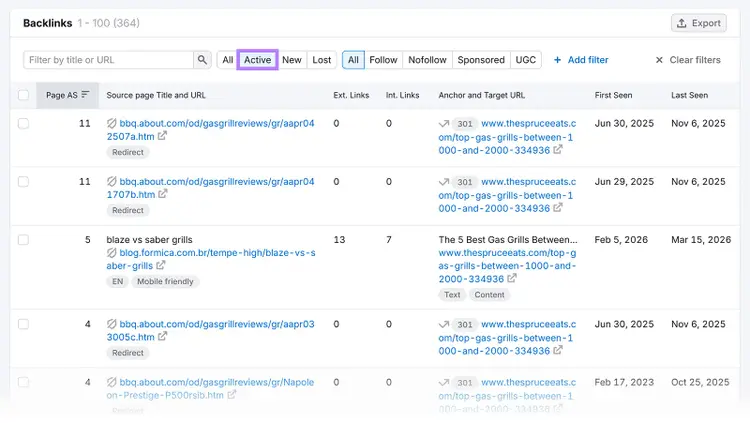
Before you add a domain to your outreach list, check two things:
- Is the linking page authoritative? Links on pages that are unlikely to pass much authority to your site aren’t worth pursuing. Use the Page Authority Score (Page AS) column to check this quickly, ideally looking for pages with a minimum Page AS of 10.
- Do you have content that could genuinely replace what the dead page covered? If you don't have a suitable replacement yet, you can create one. But only if the topic is relevant enough to be worth it.
Once you have your prospect list, the pitch is simple. Email the site owner, flag the broken link, and offer your content as a replacement.
Broken link pitch template
Here's a broken link building email template:
Subject: Broken link on your [article title] page
Hi [Name],
I noticed your article on [topic] at [URL] has a broken link on the text "[anchor text]."
If you're looking for a replacement, we recently published [Your content title] at [URL]. It covers [brief explanation of why it's a good fit], so it should work well for your readers.
Best,
[Your name]
3. Turn unlinked brand mentions into links
Unlinked brand mentions where someone has mentioned you without linking to your site are often easy to convert into backlinks since the site owner is already aware of who you are.
The pitch asking to turn a mention into a link is also much warmer than a cold outreach email. You're thanking someone for mentioning you and asking them to add a link, rather than introducing yourself for the first time.
To find your unlinked mentions with the Brand Monitoring app, enter your brand name and filter results to show mentions without a backlink by clicking the circle next to “Without backlinks” under “Mention details.”
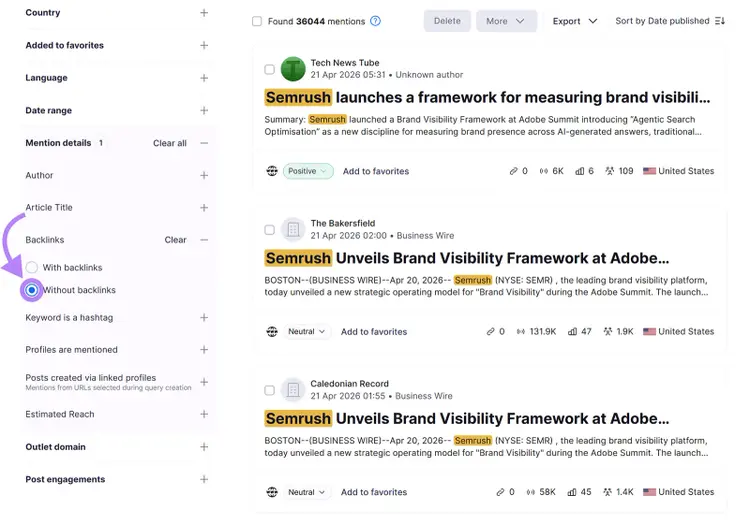
Note that not every unlinked mention will turn into a link. But even without the backlink, brand mentions can still build your authority in both search engines and AI systems anyway.
Unlinked mention pitch template
Here's a template you can use to ask website owners to turn unlinked mentions into backlinks:
Subject: Quick question about your page on [article title]
Hi [Name],
I noticed you mentioned [Your brand] in your article "[Article title]" — thanks for the reference!
Would you be open to adding a link to [URL] on that mention? It would make it easier for your readers to find us directly.
Best,
[Your name]
4. Create link bait
Link bait that attracts backlinks passively is great for getting more links because you don’t have to manually pitch prospects.
The formats that work best for link bait include original data, statistics pages, free tools, and calculators.
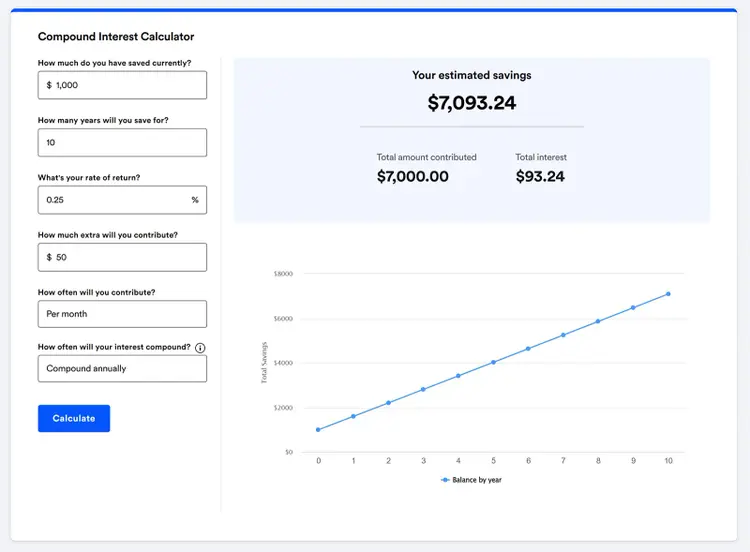
A good example of link bait is Bankrate’s compound savings calculator:
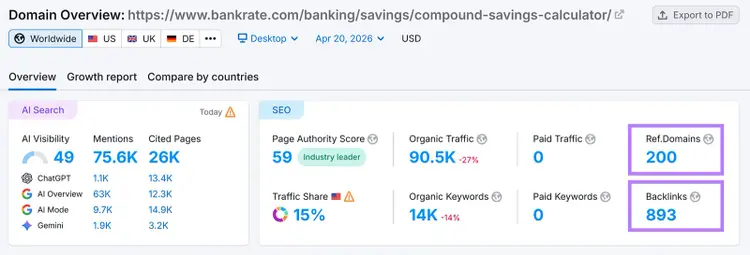
According to the Domain Overview tool, the Bankrate’s calculator page has attracted 893 backlinks from 200 referring domains.
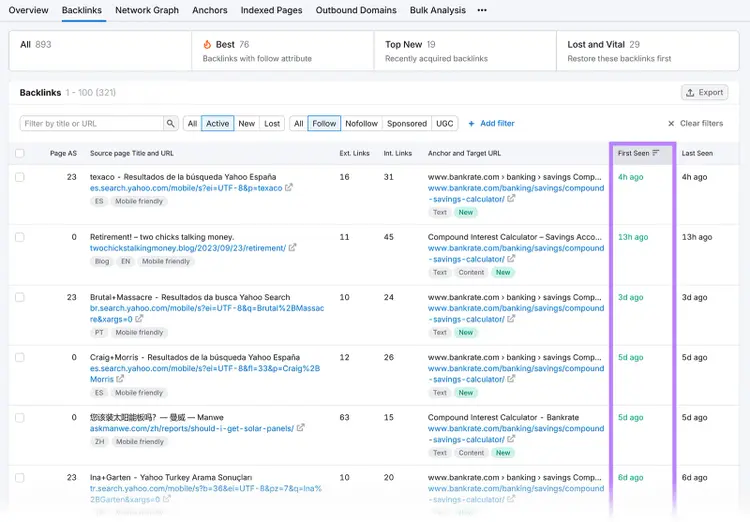
A good link bait asset doesn't just earn links in the weeks after you publish it, either. It keeps earning them over time, because new articles on the topic keep getting written and their authors keep finding and citing your resource.
The Bankrate calculator above still picks up new links on an almost daily basis.
To create your own link bait, give writers and researchers something concrete to reference. Create a page that solves a problem (like a calculator) or answers a question (like a statistics page).
For original research, you could:
- Survey your own customers
- Analyze your own first-party data
- Commission a study through a third-party panel
Then, share your link bait with your existing audience to encourage links and mentions.
Examples of link bait
An example of link bait in the form of original research is McKinsey’s state of AI report:
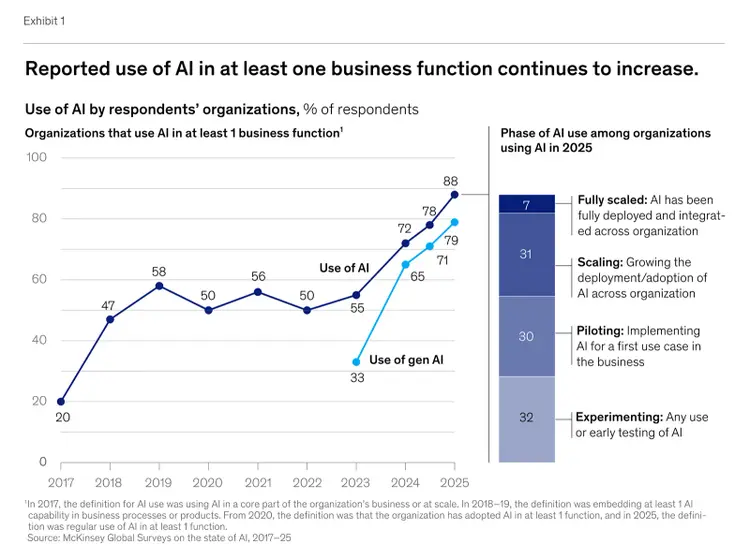
It’s generated more than 77K backlinks from 17K referring domains, according to the Domain Overview tool.
It works particularly well because it:
- Covers a relevant, timely topic (AI)
- Contains lots of graphs and other visuals that people want to cite in their own content
- Is a page McKinsey can update each year to maintain relevance, so they can continue building new links
5. Pitch your content to other publications
Pitching your content involves finding published articles where a link to your content would improve the piece, then pitching that specific improvement to the author.
The improvement a link to your content would provide could be:
- A relevant statistic they could cite
- A guide that goes deeper on a subtopic they mention briefly
- A tool that solves a problem they raise but don't resolve
- A free resource or template they could point their readers to as a next step
Use Google to find articles in your niche that rank well and cover topics adjacent to your content (exclude your competitors here). Check the page’s publish or last updated date to focus on pages that are actively maintained.
Content pitch template
Here's a template you can adapt when pitching your content to publications:
Subject: Resource suggestion for [article title]
Hi [Name],
I was reading your article on [topic] and noticed the section on [specific subtopic] doesn't link to any [data/tools/further reading] on [specific gap].
We recently published [Your content title] at [URL], which covers [brief explanation of what it adds]. It might be a useful addition for your readers, and I was wondering if you’d be open to linking to it.
Regardless, thanks for putting together such a great piece!
Best,
[Your name]
6. Write guest posts
Guest posting (writing an article for another publication) puts you in front of a relevant audience and may earn you a contextual link from a site your target audience already trusts.
Here’s an example of a guest post from a YouTube ads agency specializing in travel brands on a tour booking software website:
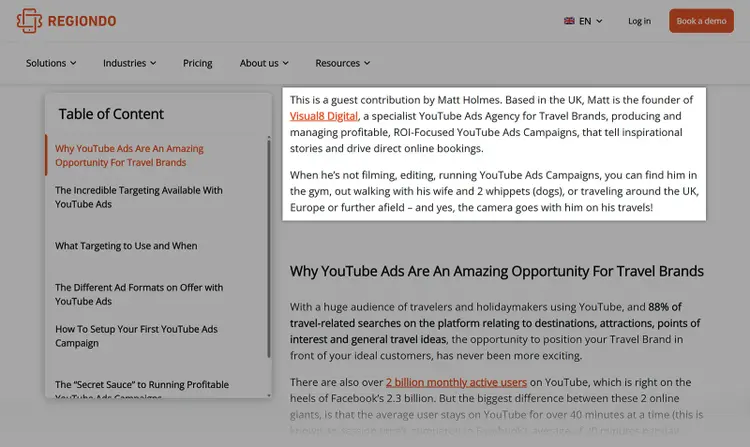
For guest posting to be a viable backlink building strategy, you need to target established publications with real editorial standards, consistent traffic, and an audience that overlaps with yours.
You can actively seek out guest posting opportunities by reaching out to people and publications in your niche. This is easier if you already have a relationship with other brands or have a good reputation in your industry.
You can also find guest post opportunities by searching Google for keywords in your niche along with modifiers like:
- “guest post”
- “write for us”
- “contribute”
- “guest contribution/contributor”
- “guest/contributing author”
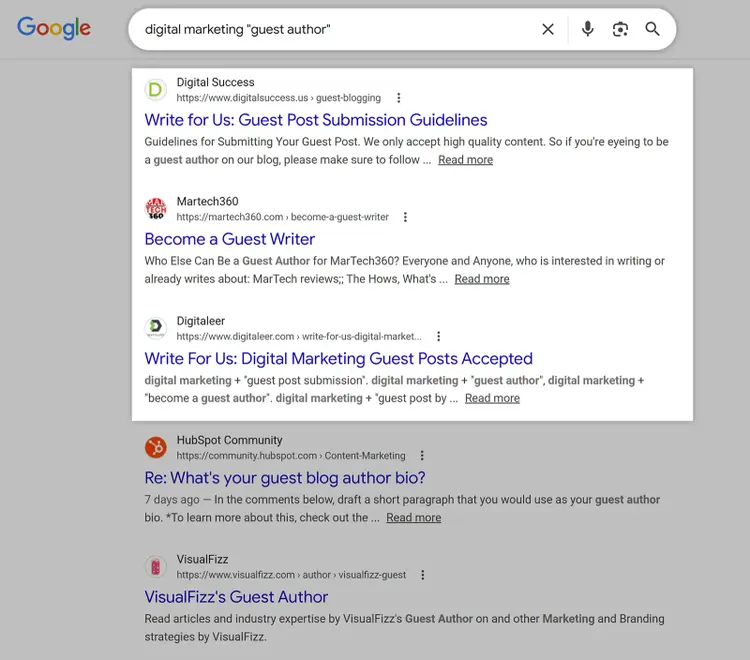
Note that many publications limit or restrict backlinks in guest posts. Some sites only allow one link, some only allow links to specific pages (like your homepage), and some will mark them nofollow.
Check the publication’s guidelines before you pitch to verify. Bear in mind that the brand visibility and audience reach you can gain still have value even without a link, and even if that link is nofollow.
Guest posting pitch template
Here's a pitch template you can use to ask a publication if they’d be willing to accept your guest post submission:
Subject: Guest post idea for [publication name]
Hi [Name],
I've been reading [Publication name] for a while. I particularly enjoyed [Article name] because [brief explanation of why you enjoyed it].
I'd love to contribute a piece for your audience on [topic]. The angle I have in mind is [one-sentence pitch], which I think would resonate with your readers because [brief reason].
Here's a recent example of my work: [URL]
Happy to adjust the angle if something else would be a better fit.
Best,
[Your name]
7. Respond to media requests
Responding to media requests for quotes from expert sources on platforms like Help a Reporter Out (HARO), Featured, and Qwoted can result in a backlink if a journalist uses your submission.
Major news sites and trade publications regularly source quotes through media request platforms. And a single well-placed link from a high-authority domain can provide significant SEO value.
That said, this approach is effort-intensive, and success rates on these platforms are often low due to high levels of competition. You can outsource responding to media requests by using an agency, but that can cost $350-$700+ per secured link.
I analyzed 10 agencies that offer media request link building services, and the average lowest cost per link they quoted was just over $300. These services also typically require a deposit or monthly/yearly commitment.
If you’re handling media responses in-house, this link building strategy tends to work best when you have a dedicated person monitoring and responding to requests daily. Journalists typically work to tight deadlines, so early responses have a higher chance of being selected.
Here are a few tips to keep in mind for pitching media requests:
- Match the journalist's request precisely. Responding to a tangentially related query (especially if it’s clearly self-serving) wastes everyone's time.
- Keep pitches short and lead with your most relevant credential or data point
- Links are not guaranteed even when your quote is used. Some publications credit sources without linking.
For more tips, read our guide on HARO link building.
Note
You can also look for requests on social media platforms like X/Twitter by searching for the #journorequest hashtag.
Media request pitch template
Here's a template you can adapt for pitching media requests:
Subject: Re: [Journalist's query topic]
Hi [Name],
I saw your request for [topic] on [Platform name] and wanted to share a quick perspective.
[Two to three sentences of genuine expert insight, specific to what they asked. Lead with the most useful point, not your credentials.]
I'm [Name], [title] at [Company], where I [one line of relevant context]. My website is [your domain]. Happy to expand on any of this or answer follow-up questions.
Best,
[Your name]
8. Do digital PR
Digital PR that involves creating newsworthy assets and pitching them to journalists to include in their coverage can earn you editorial links from high-authority publications.
The asset you create could be a:
- Piece of original research
- Survey
- Data study
- Proprietary dataset that produces findings journalists can turn into a story
(These pieces can function as link bait. But with digital PR, you’re actively pitching the content to journalists, bloggers, and online publishers in your industry.)
Pitching your newsworthy pieces works because journalists need sources, and a well-packaged asset with a clear headline gives them exactly that.
Proprietary research is particularly useful because it’s something no one else can recreate. This means it becomes a primary source that writers and researchers cite directly, yielding you a backlink.
Note
A secondary benefit of these pieces of content is that AI tools often cite original research in their responses, boosting your brand’s AI visibility.
Digital PR pitch template
Here's a template you can use for your digital PR outreach:
Subject: [Key finding in one line]
Hi [Name],
[One sentence introducing the asset and what it reveals — e.g., "We analysed X to find..." or "We've just published research showing ..."]
The headline finding: [your strongest stat or insight].
Other findings include:
- [Data point]
- [Data point]
- [Data point]
Full results here: [URL]
I thought this could make an interesting story on [specific angle relevant to their beat]. Happy to send over additional data or answer any questions.
Best, [Your name]
Further reading: What is digital PR? + how to run your first campaign
9. Reclaim lost backlinks
Lost backlinks come from sites that have already decided you're worth linking to in the past, so they’re likely more receptive to linking to you now.
Find lost links to your domain using Semrush Backlinks tool. Just enter your domain, go to the “Backlinks” report, and select the “Lost and Vital” tab.
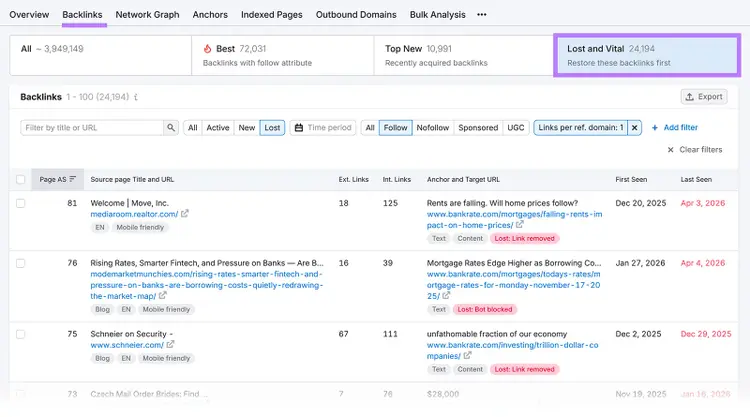
Before reaching out, do a quick check:
- Is the linking page still live and indexed?
- Does your content still match what the page is talking about?
If the page is still live and the link was simply dropped, a short, polite email is usually enough to get it restored. If you’ve recently updated the page, it could also be worth highlighting this to show the recipient that the page is current.
If the page has changed significantly and your content no longer fits the context, the link may not be worth pursuing.
Lost link pitch template
Here's a template you can use:
Subject: Link to [Your site] on [Article title]
Hi [Name],
I noticed that your article at [URL] used to include a link to [your URL], but it looks like it may have been removed.
We actually recently updated and improved this page. Would you be open to adding the link back? It was on the text "[anchor text]."
Best,
[Your name]
10. Get partner and community links
Links from relevant communities and brands you partner with show search engines and AI systems what your site is about, even if those links don’t necessarily pass much authority.
Partners and communities can include industry associations, supplier or integration partners, and other communities relevant to your niche.
To find link opportunities from your existing relationships, map out any and all technology partners, resellers, agencies you work with, and organisations you're affiliated with. Many of these sites have partner pages or resource sections where a link to your site would fit naturally. You often just have to ask.
Community links require a different approach. Reddit communities and niche Q&A sites can be places where linking to your content makes sense, but only when it genuinely answers the question being asked.
Adding links to communities without contributing to the conversation will likely get your content removed and damage your reputation. The value here comes from being a consistent, helpful presence in the right spaces.
While community and forum links typically have “nofollow” and/or “ugc” attributes, these mentions can still benefit your overall brand visibility. Especially when you consider how heavily AI tools tend to rely on these sources.
Further reading: Reddit marketing: How to do it right (+ 7 tips to get results)
Examples of partner and community links
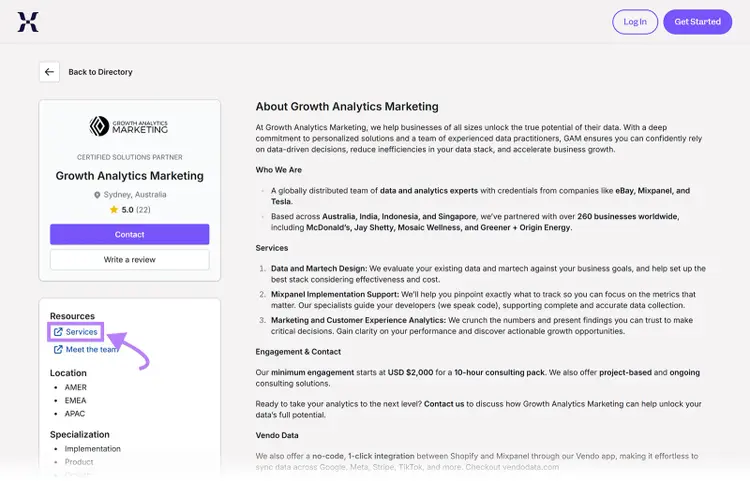
Here’s an example of a partner page from MixPanel:
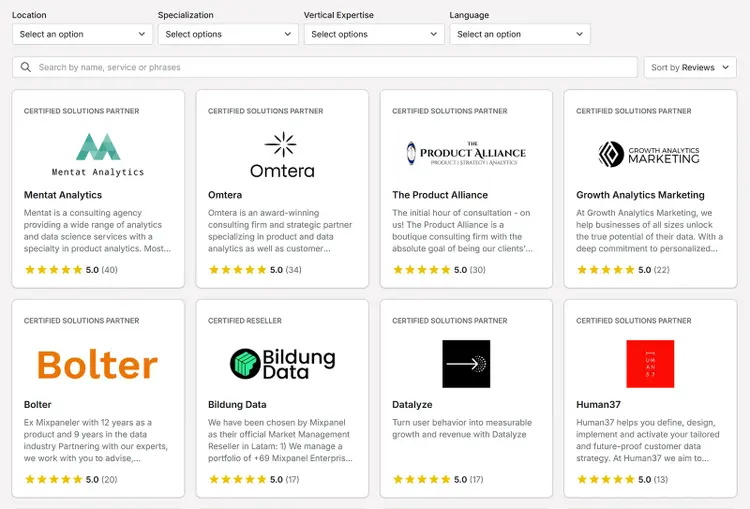
Clicking on any of the panels opens a detailed page that links to that partner’s website:
An example of a brand that builds community links in a helpful way is King Arthur Baking. The brand actively contributes to baking subreddits, but only adds links when it’s strictly relevant to the conversation. Like this example, which was in response to a complaint about their pricing:
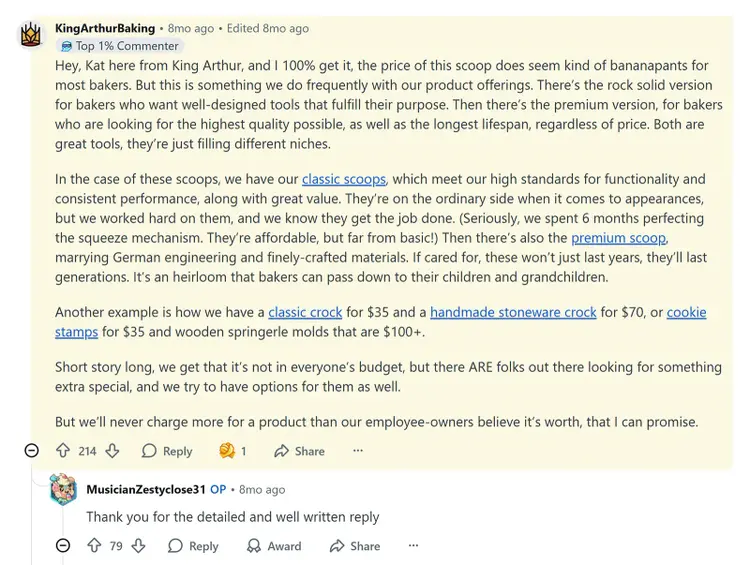
The example above contains several product links, but they’re in relevant context, and the original poster even thanked King Arthur Baking for the response.
The brand also shares links to their recipes when users specifically ask about them:
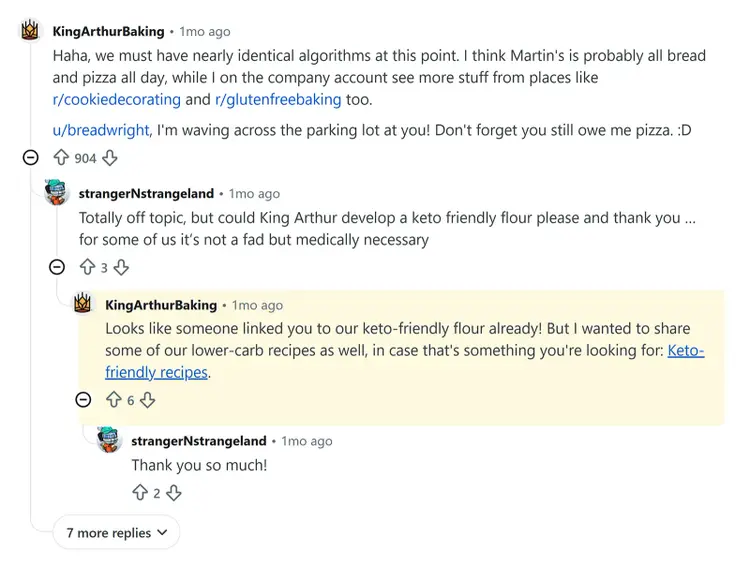
How to determine which backlink strategy is right for you
Use the framework below to decide which link building techniques are best for your brand:
Start using these link building strategies today
Effective link building requires consistent effort and usually more than one approach. If you’re just getting started, it’s a good idea to start with a mix of content-based and outreach-based strategies.
For example, start by creating link bait, and then reach out to site owners that might want to link to the resource you’ve just created.
To find and track your link building prospects, use Semrush’s Link Building Tool. It lets you add prospects to your list, reach out to them, and track your results — all within the tool.
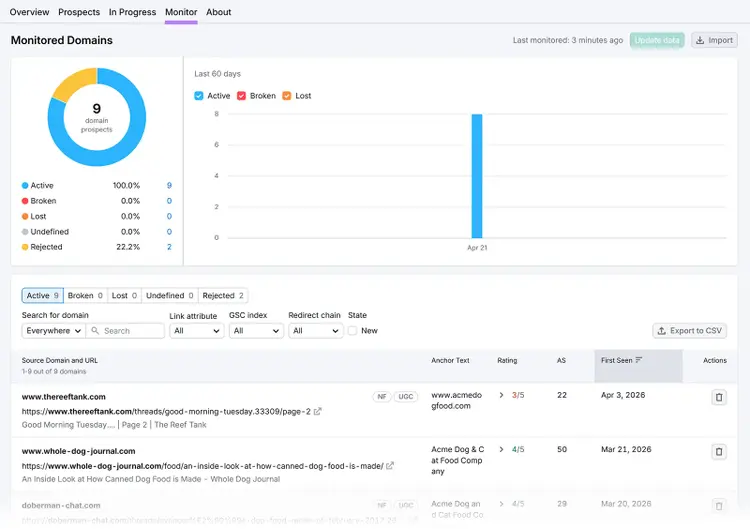
Get access to the Link Building Tool and other useful SEO tools with a Semrush SEO Toolkit subscription. Try it free for seven days.
Start building valuable links
with Semrush’s SEO Toolkit

Chris is a content writer, editor, and strategist with 6+ years of experience turning complex ideas and processes into clear, engaging content. His areas of expertise include SEO, AI-assisted content production, and building editorial workflows that scale without sacrificing quality.
Chris Hanna
Chris is a content writer, editor, and strategist with 6+ years of experience turning complex ideas and processes into clear, engaging content.
Tells Google to show you more from Semrush in AI, Search, and Discover.