
Only 22% of marketers have fully integrated AI search and SEO. They’re pulling ahead. [Study]
Most marketers now agree on the big shift: visibility extends beyond Google, AI tools influence how people discover brands, and SEO is changing fast.
What’s less clear is how much of that strategic thinking has changed the day-to-day work.
We surveyed 481 marketers, business owners, and SEO professionals to understand how AI search is affecting workflows, team structures, content operations, measurement, and performance.
The takeaway is clear: marketers have updated the strategy, but most teams are still rebuilding the operating model behind it — and the ones that have are seeing the payoff.
Methodology
We surveyed 570+ marketers, SEO professionals, and business owners working with organic growth, then filtered the responses using an attention check, leaving us with a sample of 481.
The sample included:
- Roles such as marketing managers (29%), content marketers (22%), SEO specialists (10%), and business founders (7%)
- Companies ranging from 1-10 employees (11%) to 201–1,000 employees (20%)
- Teams across SaaS, retail, agencies, professional services, media, and other industries
Key takeaways
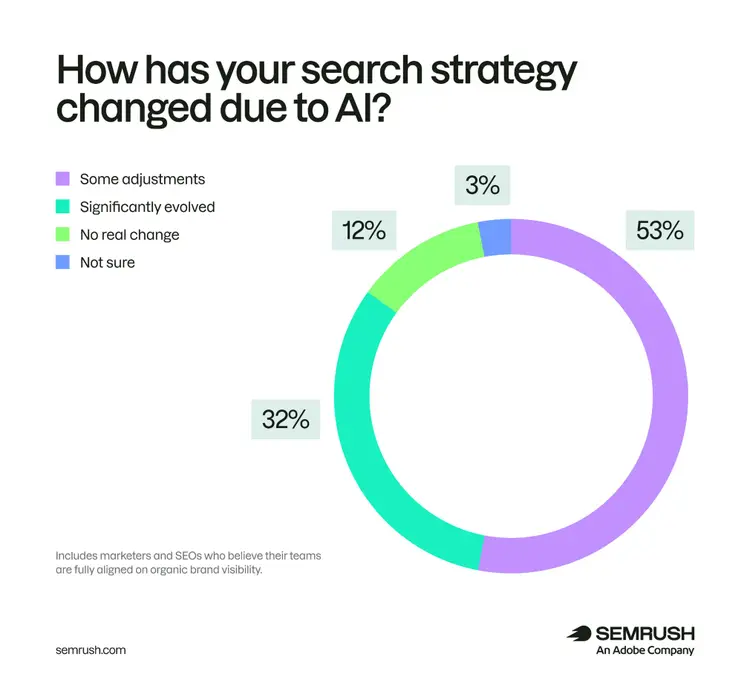
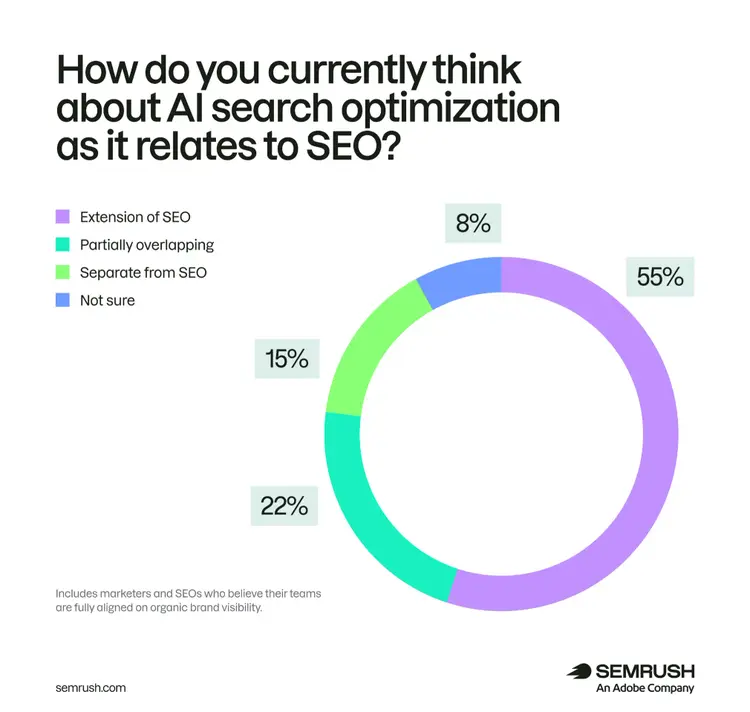
- Views on SEO and AI search have moved. 85% of marketers say AI has changed their search strategy — 32% “significantly evolved,” 53% “some adjustments.” Only 12% report “no real change.” Separately, 77% describe AI search as “an extension of SEO”; just 15% still see it as “separate.”
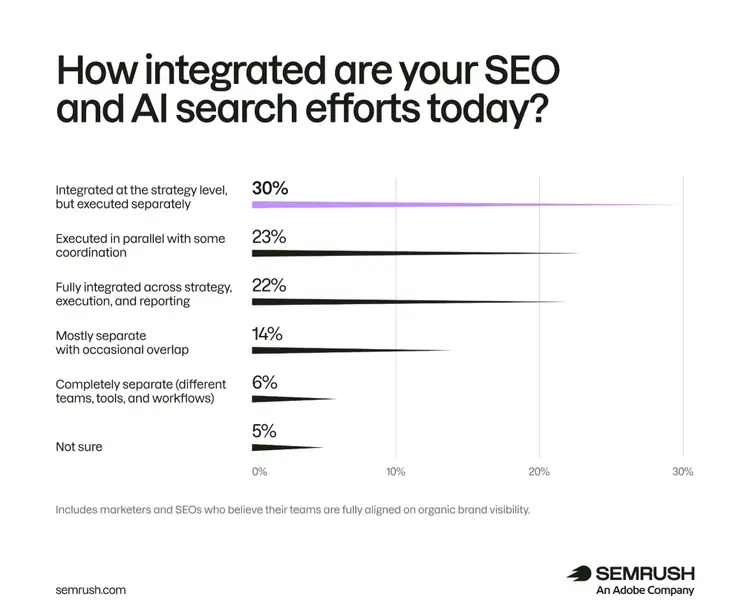
- Execution hasn’t moved as far. Only 22% of marketers say their SEO and AI search efforts are “fully integrated across strategy, execution, and reporting.” The other 78% are still getting there. Among the marketers who call AI search “an extension of SEO,” only 28% report using “one shared workflow across SEO and AI search.”
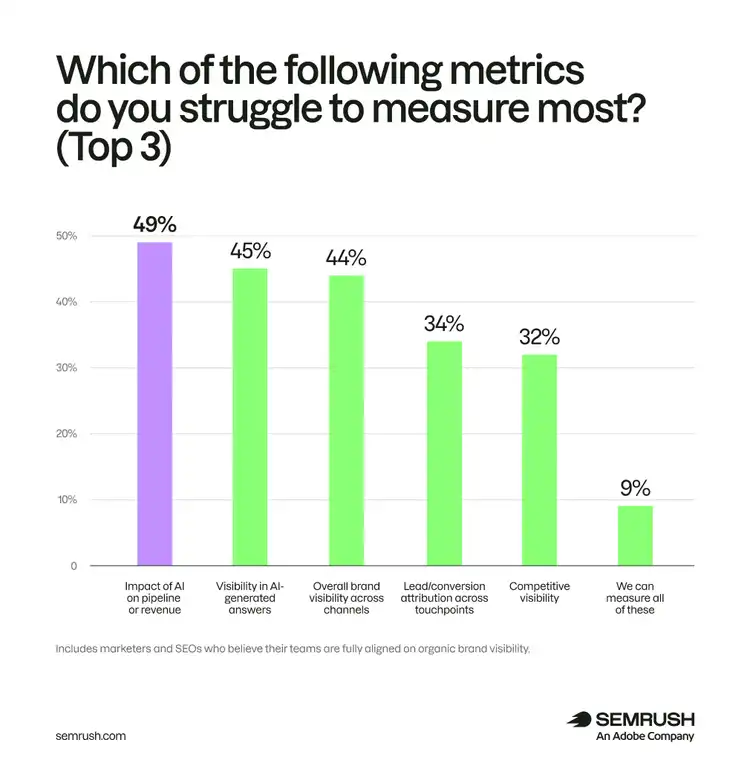
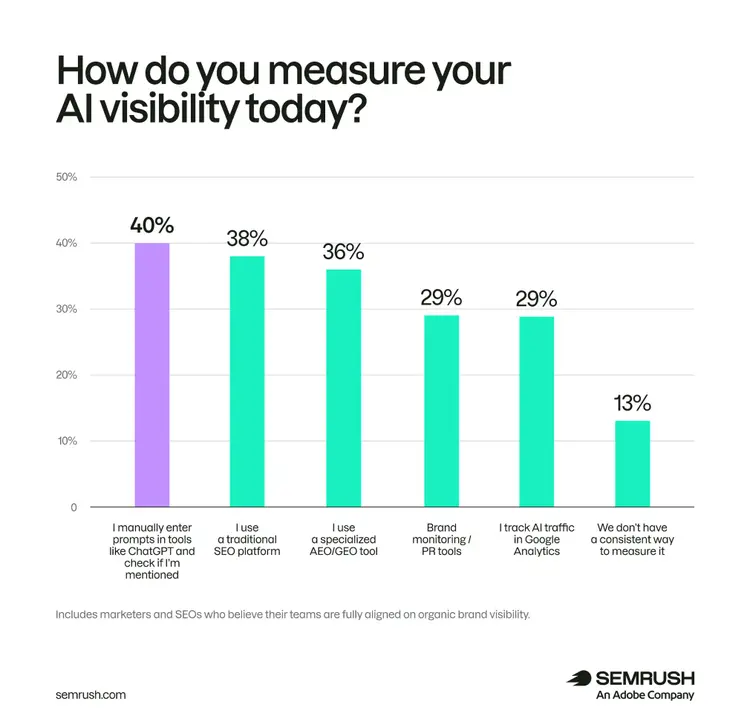
- Measurement is where the gap is widest. The most commonly cited hard-to-measure metrics are: impact of AI on pipeline or revenue (49%) and visibility in AI-generated answers (45%). At the same time, 40% of respondents use manual ChatGPT checks as their main tracking method.
- The stakes of the execution gap are visible in AI answers. 37% of marketers say “competitors are mentioned more often than us” in AI-generated answers; 30% say their brand is “described inaccurately”; 29% say their “positioning or value is unclear or generic.”
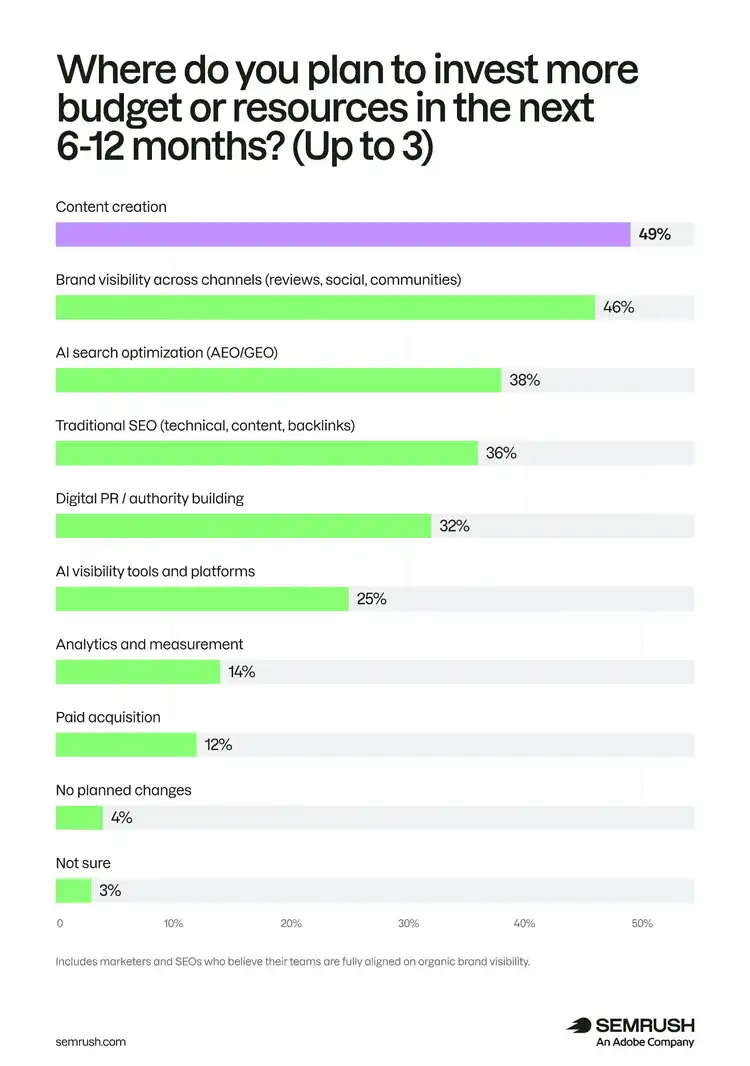
- Investment is shifting toward AI visibility and cross-platform discovery. Content creation remains the top investment area (49%), but 46% of marketers now prioritize brand visibility across channels, 38% plan to invest in AI search optimization (AEO/GEO), and 25% in AI visibility tools, alongside 36% investing in traditional SEO.
- Closing the operational gap pays off. 81% of teams with fully integrated SEO and AI search execution report seeing more traffic or leads connected to AI platforms, compared to just 36% of teams running them completely separately.
1. The view of search has shifted, but almost no one treats AI as a separate channel
AI is influencing search strategy for most marketing teams. 85% of marketers say AI has changed how they approach search, with 32% saying their strategy has significantly evolved and 53% making some adjustments.
At the same time, 12% report no real change so far.
That shift shows up in how marketers now think about AI search in relation to SEO. 77% put it inside the SEO tent, 55% see it as an extension of SEO, and 22% say it’s partially overlapping. Only 15% still treat it as a separate channel entirely.
Many teams still lack a consistent approach to AI visibility.
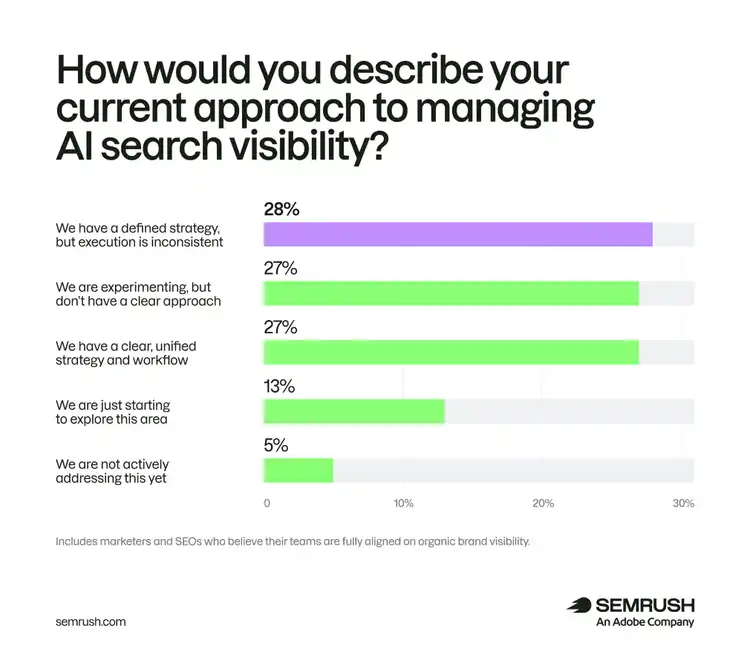
28% have a defined strategy with inconsistent execution, 27% are experimenting, and only 27% report having a clear, unified workflow.
28% have a defined strategy with inconsistent execution, 27% are experimenting, and only another 27% claim to have a clear, unified workflow.
The "AI is a different channel" framing is now a minority view. Most marketers are planning against a reality where search happens across Google and AI surfaces simultaneously.
But acting on these insights consistently — across teams, tools, and workflows — is where most are still catching up.
2. Execution hasn't caught up, yet most teams have a seam somewhere.
Only 22% of marketers say their SEO and AI search efforts are fully integrated across strategy, execution, and reporting. The other 78% describe some version of a gap.
The most common pattern — for 30% of respondents — is planning SEO and AI search together but running them as separate tracks on the ground. Another 23% execute in parallel with some coordination, and 14% are mostly separate with occasional overlap.
The gap is sharpest among the marketers whose thinking has moved the most.
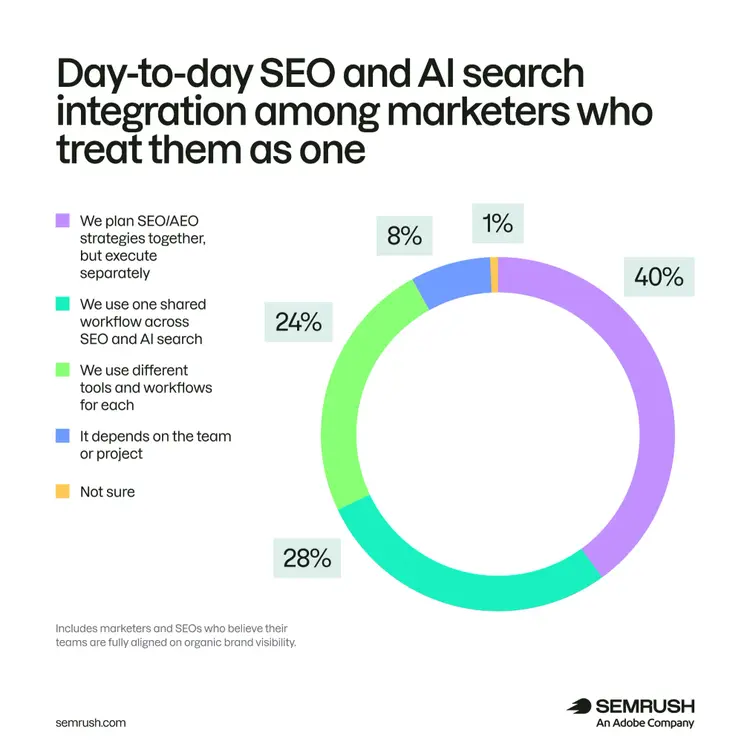
Of the 263 who describe AI search as an extension of SEO, only 28% actually use one shared workflow. 40% plan together but execute separately, and 24% use different tools and workflows for each.
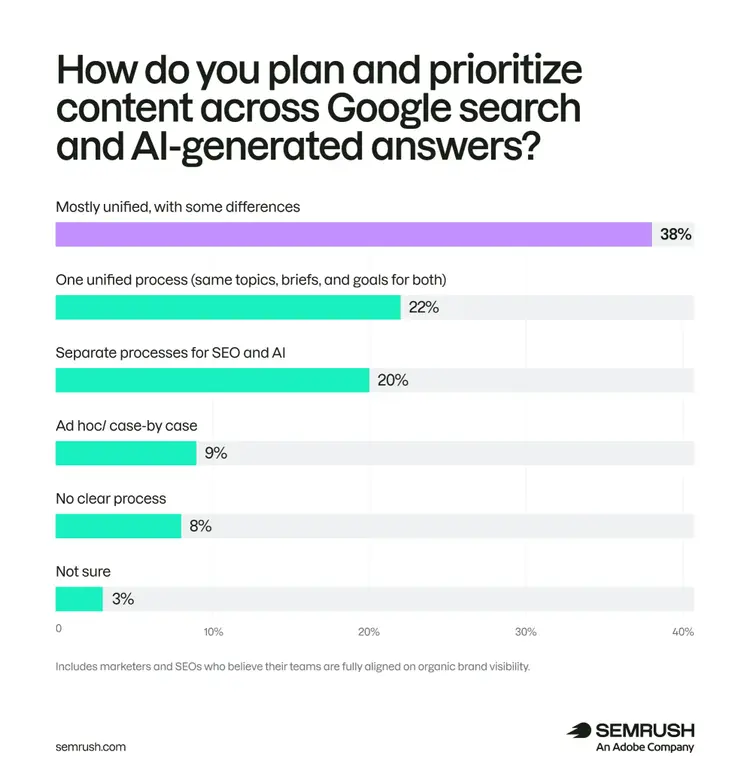
Content planning shows more alignment than other workflows, but full integration is still rare.
Only 22% of marketers use one unified content process for Google and AI search. 38% are mostly unified with some differences, and 20% run separate processes entirely.
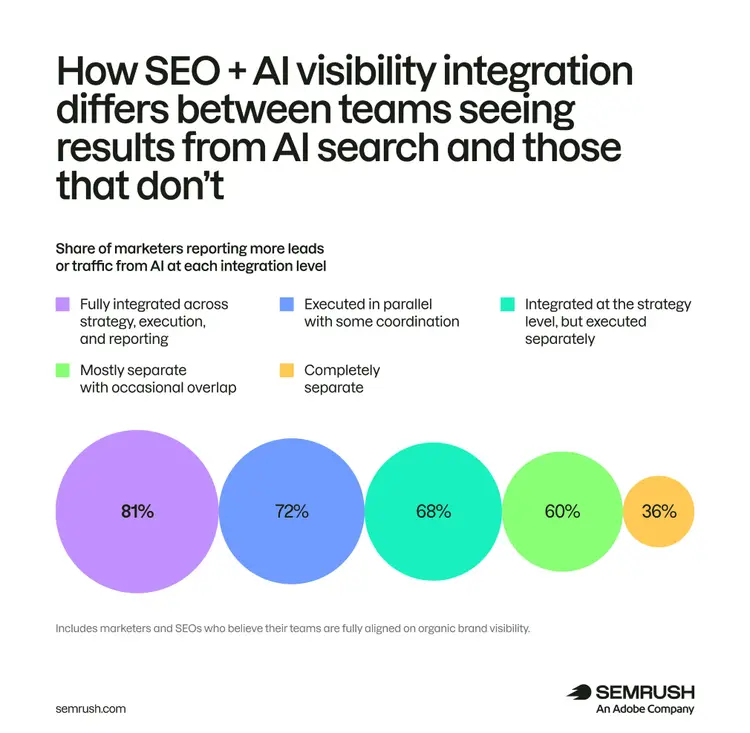
Integration depth is strongly tied to performance.
Among respondents who selected either “more traffic/leads from AI search engines” or “more leads referencing AI tools,” 81% had fully integrated SEO and AI search execution, compared to just 36% of teams with completely separate workflows.
Strategy alignment is already happening.
Execution is where most teams still struggle: shared workflows, unified briefs, and content processes that connect Google and AI search instead of treating them separately.
3. Teams feel aligned, but their workflows tell a different story
90% of marketers say their teams are at least somewhat aligned on brand and search strategy. 41% say fully aligned.
But that alignment often doesn’t carry through to execution.
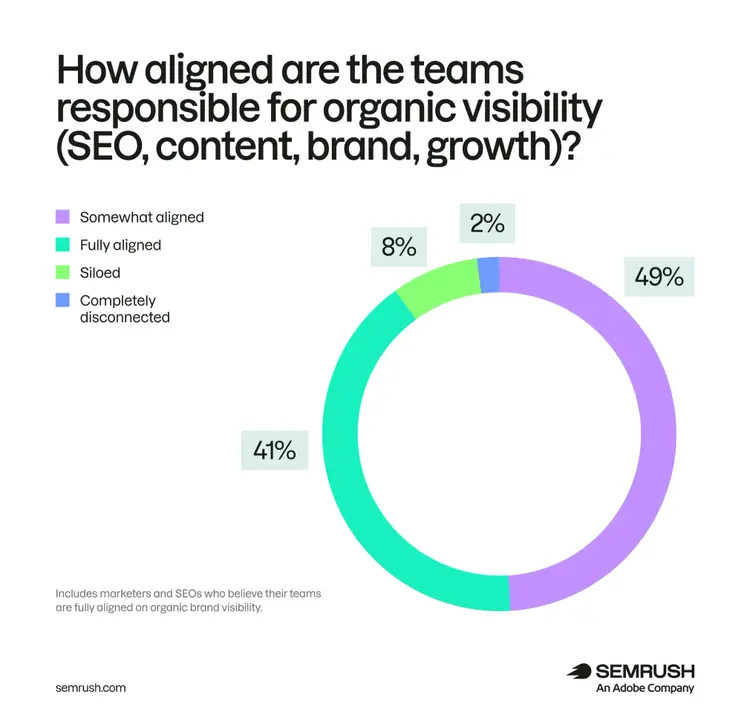
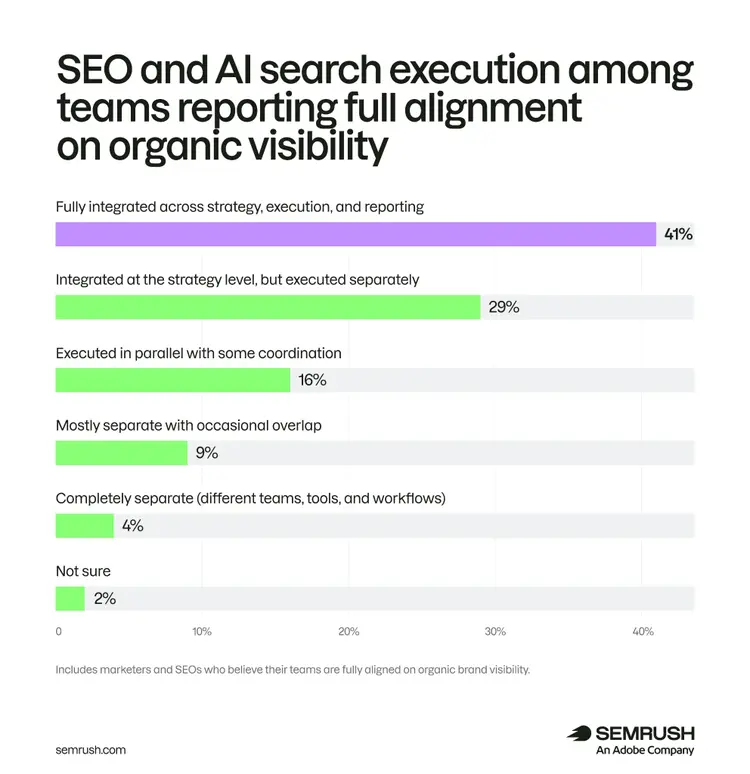
Among the 197 marketers who say their teams are fully aligned, only 41% also report fully integrated SEO and AI search execution.
The other 59% say their teams still operate with separate execution workflows, limited coordination, or only strategic alignment.
Ownership tells a similar story.
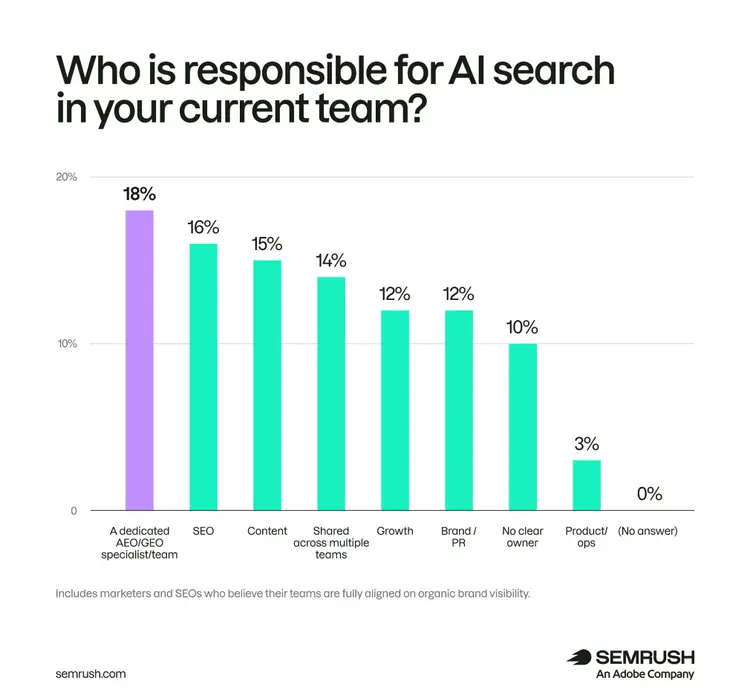
Responsibility for AI search is scattered across seven functions, with no single owner above 18%. A dedicated AEO/GEO specialist or team leads at 18%, followed by SEO at 16%, content at 15%, and shared ownership at 14%.
One in ten teams has no clear owner at all.
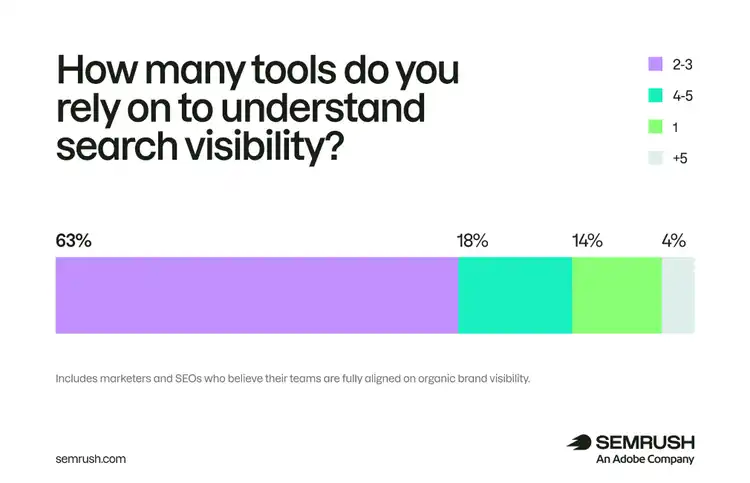
2-3 tools to understand search visibility, 18% use 4-5, and 4% are managing 5 or more.
When ownership sits across multiple teams, companies often end up using disconnected tools and workflows. That makes it harder to get a consistent view of brand visibility across Google and AI platforms.
Teams feel aligned on where they're going. But the organic visibility work now spans multiple teams, and in some organizations, nobody owns the final outcome.
Teams without clear ownership and a unified view of Google and AI visibility struggle to execute consistently.
4. The execution gap has a real cost, and it's showing up inside AI answers
This execution gap shapes how AI tools describe brands to potential customers every day.
57% of marketers say they act when their brand is missing from AI results, similar to how they treat drops in Google rankings.
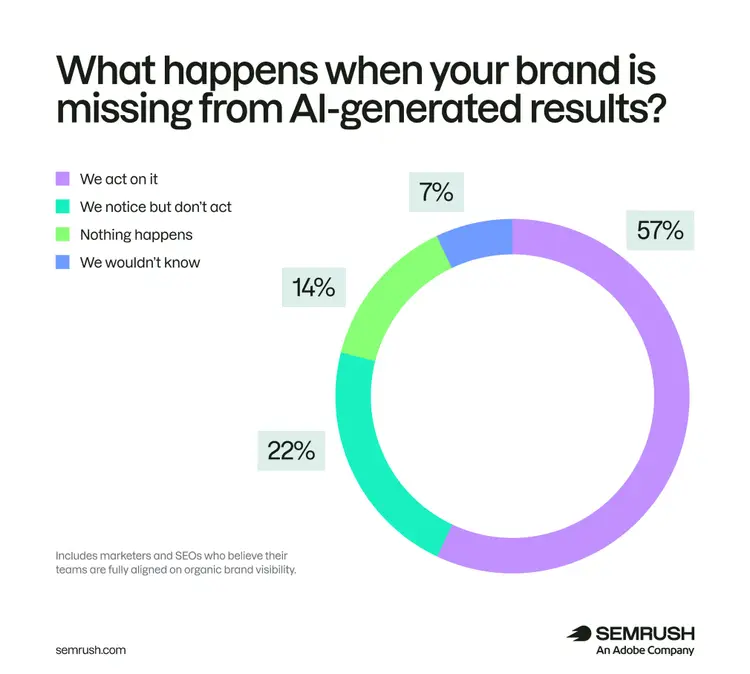
When marketers look at how their brand appears in AI answers, most find something they want to improve.
37% say competitors are mentioned more often than their brand in AI-generated answers. 30% say their brand is described inaccurately, and 29% say their positioning comes across as unclear or generic.
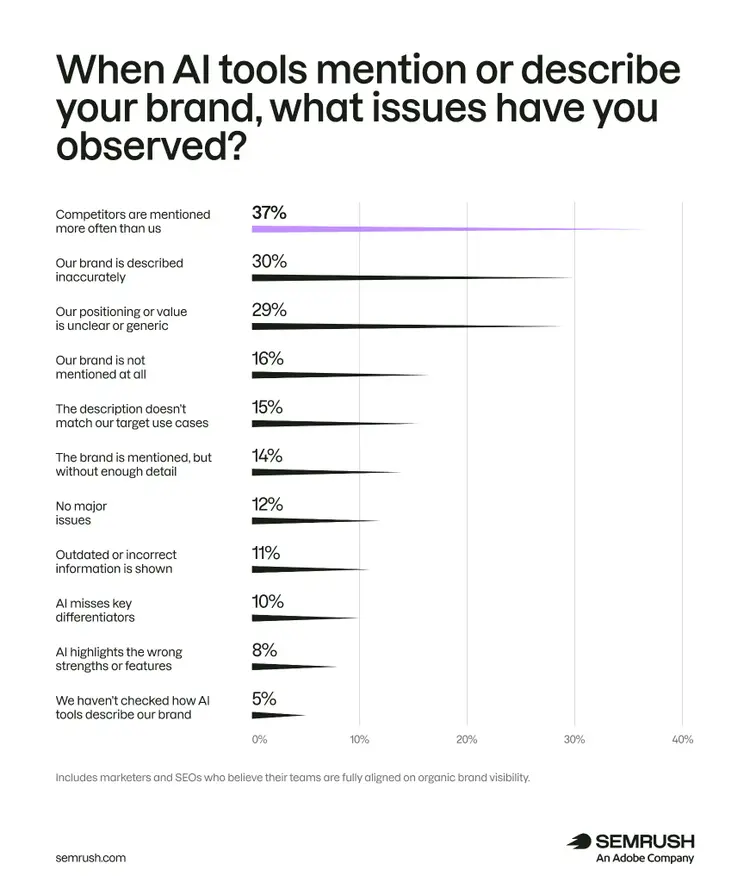
These issues are the predictable outputs of a fragmented operating model.
An AI description of your brand is assembled from many sources: your own content, third-party reviews, PR coverage, and competitor pages. When those inputs sit on different teams, nobody is responsible for what they produce together.
The fix starts with auditing how you appear in AI answers, assigning clear ownership, and aligning the teams responsible for the inputs that shape that description.
Pro tip:
Semrush’s Brand Performance report in the AI Visibility Toolkit reveals the main drivers and gaps in how AI recommends your brand. You can see overall sentiment and the specific perceptions AI associates with you vs. competitors.
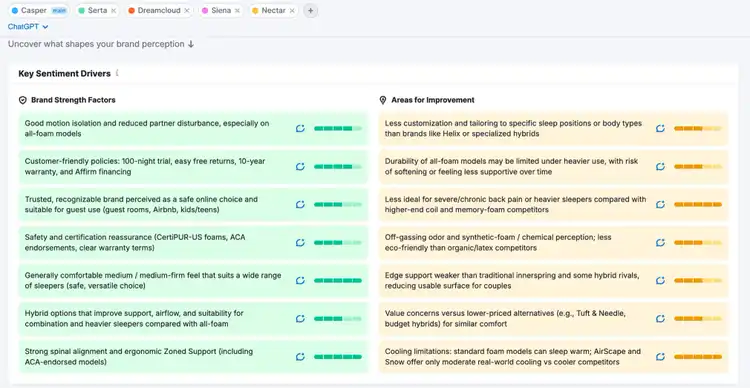
Highlight the positives and address the negatives by creating new content and shaping the narrative on third-party sites — you’ll start to see an impact quickly.
Read how one of our customers used this approach to double organic visibility and AI traffic.
5. Measurement is where the gap is widest
Measurement is the part of the operating model that has changed the least.
49% of marketers say measuring the impact of AI on pipeline or revenue is one of their top challenges. 45% struggle to measure visibility in AI-generated answers, and only 9% say they can measure all the metrics that matter.
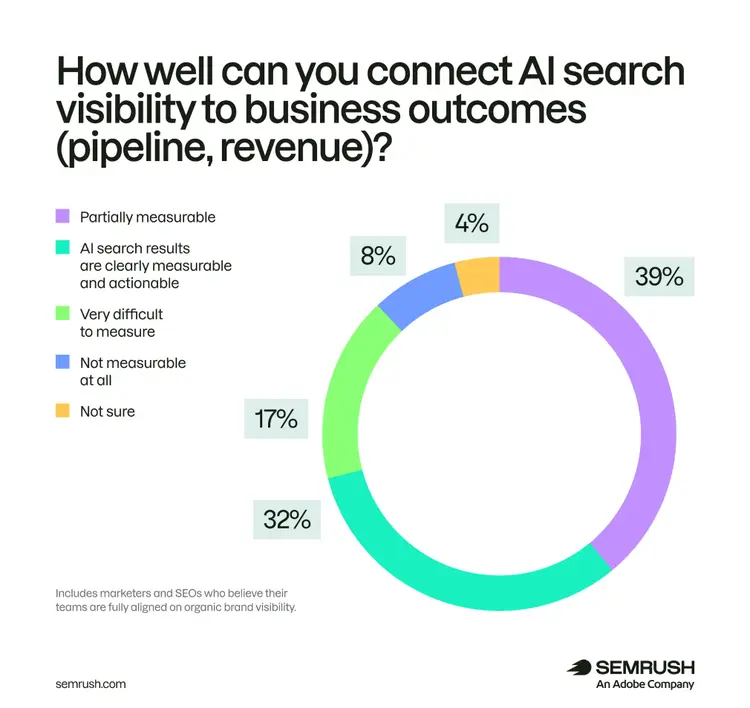
Only 32% of marketers say AI search visibility is clearly measurable and actionable in terms of business outcomes. 39% say partially measurable, 17% say very difficult, and 8% say not measurable at all.
The methods most teams are using reflect the same fragmentation as the rest of the operating model:
- 40% rely on manually typing prompts into AI tools to check if their brand appears. It works as a spot check, but it doesn't scale and produces no comparable data over time.
- 38% use a traditional SEO platform, 36% a specialized AEO/GEO tool, and 13% have no consistent approach at all.
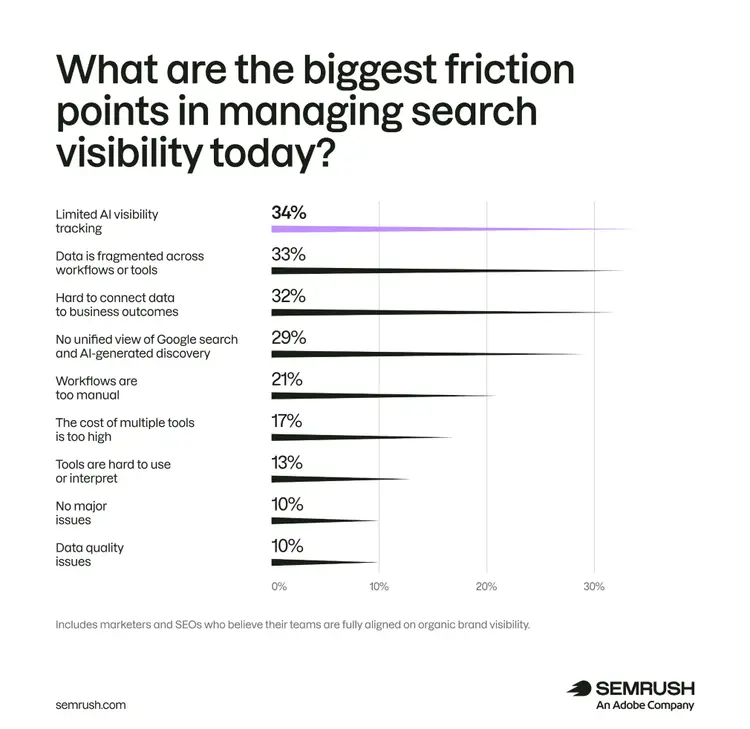
Marketers report three main friction points: limited AI visibility tracking (34%), fragmented data across tools (33%), and difficulty connecting data to business outcomes (32%).
29% also say they have no unified view of Google search and AI-generated discovery.
Without measurement infrastructure, the rest of the operating model has nothing to react to. You can't act on what you can't see, and right now, most teams are only seeing part of the picture.
The most practical first step is tracking Google search performance and AI visibility in one place using a solution like Semrush One, rather than piecing it together from disconnected tools and manual checks.
6. Investment and tactics are shifting, but major gaps remain
Marketers are starting to shift both budgets and tactics toward AI visibility and cross-platform discovery.
Content creation leads planned investment at 49%, followed by brand visibility across channels at 46% and AI search optimization at 38%, all ahead of traditional SEO at 36%.
Two other numbers stand out:
- Brand visibility across channels now ranks ahead of traditional SEO as a planned investment, showing that marketers increasingly treat search visibility as a cross-platform problem.
- 25% are planning dedicated spend on AI visibility tools, a budget line that barely existed a few years ago.
But the investment pattern follows the narrative more closely than it follows the diagnosed gaps. Only 14% plan to invest in analytics and measurement, even though measurement is where teams struggle the most.
The tactics picture tells a similar story.
Most of what marketers are doing to improve AI visibility is content-focused: 54% are creating structured, well-organized content, 43% are improving product and service pages, and 37% are publishing more authoritative content. These are the right foundations.
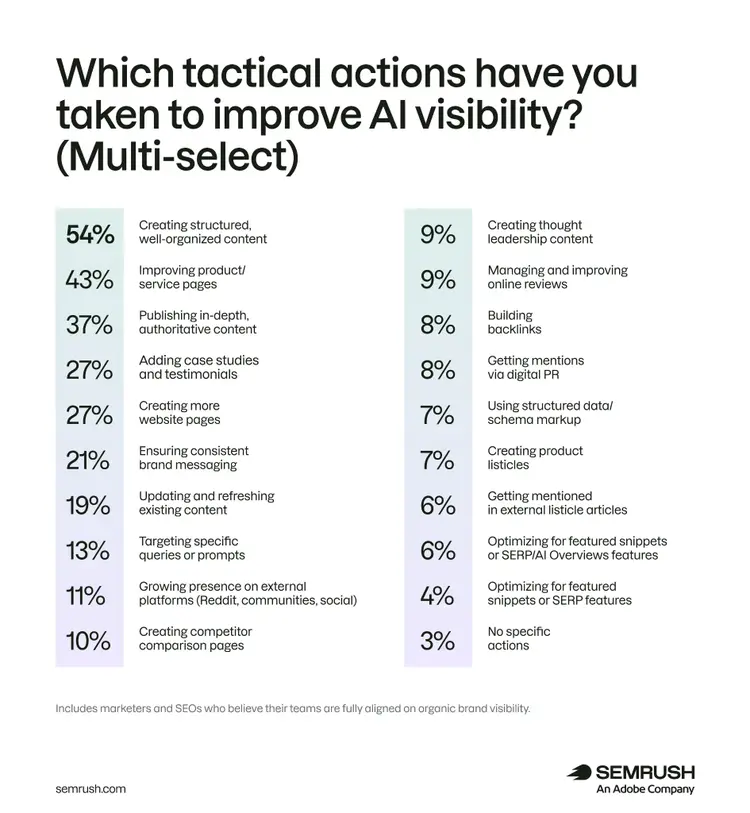
But some important AI visibility tactics still see relatively low adoption. Only 8% of marketers report using digital PR, 9% manage online reviews, and 11% actively build external mentions through communities and social platforms.
7. The operating model is the work left to do
The marketers already seeing AI-driven growth have one thing in common: their operating model matches their strategy. They own the work, they measure it, and they execute it consistently.
The more integrated the operating model, the more likely a team is to see real results from AI search.
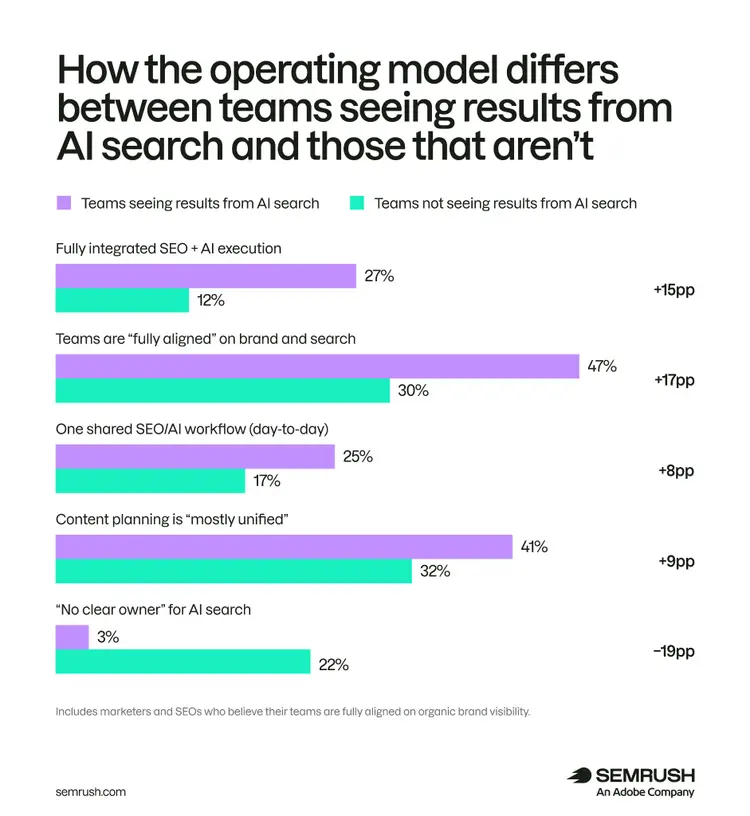
Among respondents reporting either more traffic/leads from AI search engines or more leads referencing AI tools, 27% had fully integrated SEO and AI execution, compared to just 12% of teams not seeing those results.
Only 3% of teams seeing results from AI search report having no clear owner for AI visibility, compared to 22% of teams that are not seeing results.
Measurement stands out as one of the strongest differentiators.
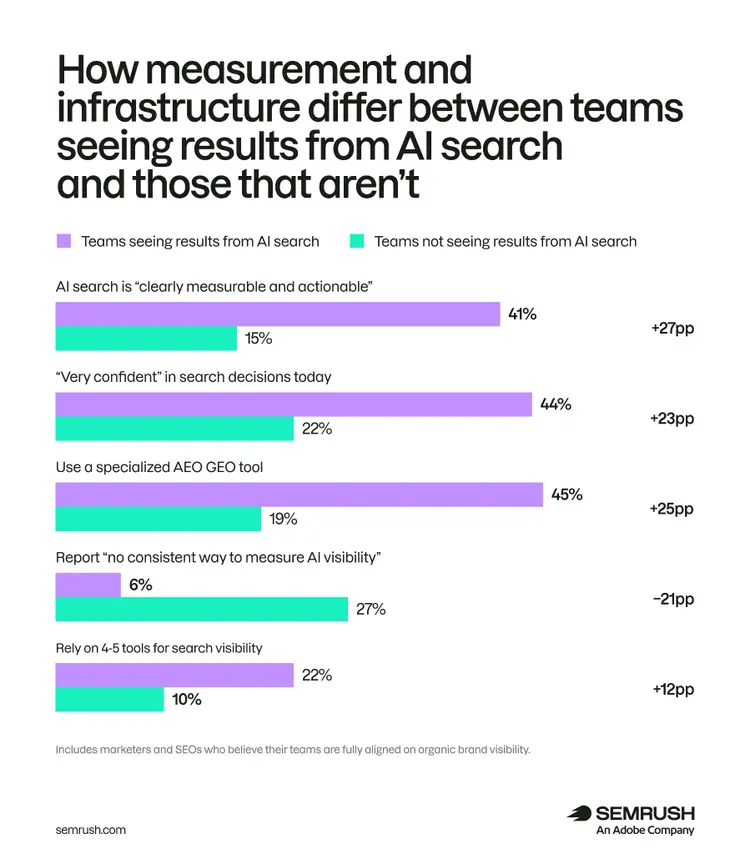
41% of teams seeing results from AI search say AI visibility is clearly measurable and actionable, compared to just 15% of teams that are not. 45% use a dedicated AEO/GEO tool, versus 19% of the rest.
At the same time, 27% of teams not yet seeing results say they have no consistent way to measure AI visibility. Among teams already seeing results, that number drops to 6%.
One counterintuitive finding we saw: teams already seeing results report more friction, not less.
38% say their data is fragmented across tools, versus 25% of the rest. Teams managing visibility across more surfaces and workflows are more exposed to the limitations of disconnected systems.
But the overall pattern is consistent — teams with integrated workflows, clear ownership, and measurable AI visibility are much more likely to report results from AI search.
The bottom line: How to close the operational gap
85% of marketers say AI has changed their search strategy. But only 22% have fully integrated execution, and 9% can measure the metrics that matter. The gap is in execution, ownership, and measurement.
For the teams still building up their processes:
- Merge SEO and AI search ownership on the execution level. These aren't separate workstreams anymore. One function needs to own both, with clear accountability for the output, clear processes, and defined KPIs.
- Break down team silos. Content, SEO, PR, and brand teams all shape AI visibility, and the teams seeing results align those functions around shared goals.
- Build a unified view of Google and AI performance. A single platform that tracks both traditional search and AI visibility turns observation into action. Disconnected tools and manual prompt-checking make consistent execution nearly impossible.
- Ensure brand consistency across every channel. How AI describes your brand is assembled from your website, reviews, third-party mentions, and PR coverage. Inconsistent messaging across those sources produces inconsistent AI descriptions.
Semrush One helps teams connect the dots and integrate their visibility efforts. It brings your Google search performance, AI visibility, and AI brand positioning into one place, so your team can see the full picture and act on it consistently.
Track and grow your digital brand visibility
with Semrush One

Margarita is a passionate Content Marketer with over 6 years of experience in various tech industries and 3 countries. She also holds two MBA degrees in Marketing.
Tells Google to show you more from Semrush in AI, Search, and Discover.
Table of contents
- Methodology
- Key takeaways
- 1. The view of search has shifted, but almost no one treats AI as a separate channel
- 2. Execution hasn't caught up, yet most teams have a seam somewhere.
- 3. Teams feel aligned, but their workflows tell a different story
- 4. The execution gap has a real cost, and it's showing up inside AI answers
- 5. Measurement is where the gap is widest
- 6. Investment and tactics are shifting, but major gaps remain
- 7. The operating model is the work left to do
- The bottom line: How to close the operational gap