
AI SEO Tips: How to Earn Citations & Mentions in AI Search
AI search tools like Google’s AI Mode, Perplexity, and ChatGPT are changing how people find information. Instead of clicking through to websites, users get synthesized answers that may or may not include citations.
Luckily, you can appear in AI search without completely overhauling your content.
Below, you'll learn seven practical AI SEO tips to earn citations and mentions in AI search results. Plus a simple way to track what's working.
What Is AI SEO?
AI SEO is the practice of optimizing your content so it appears in AI-powered search results as citations or mentions.
Traditional SEO focuses on ranking in the top 10 organic results. Whereas AI SEO focuses on showing up as in AI systems.
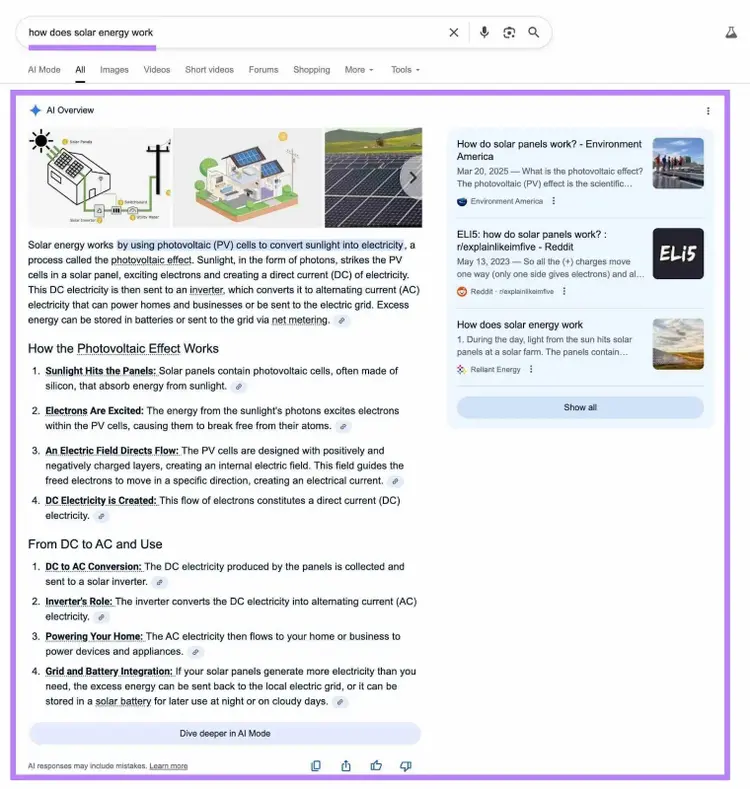
Examples of successful AI SEO include being mentioned in a response from a large language model-based tool (LLM) like ChatGPT. Or appearing in AI Overviews (AI-generated summaries that appear at the top of search results).
Why Does AI SEO Matter?
AI SEO matters because AI search is rapidly growing.
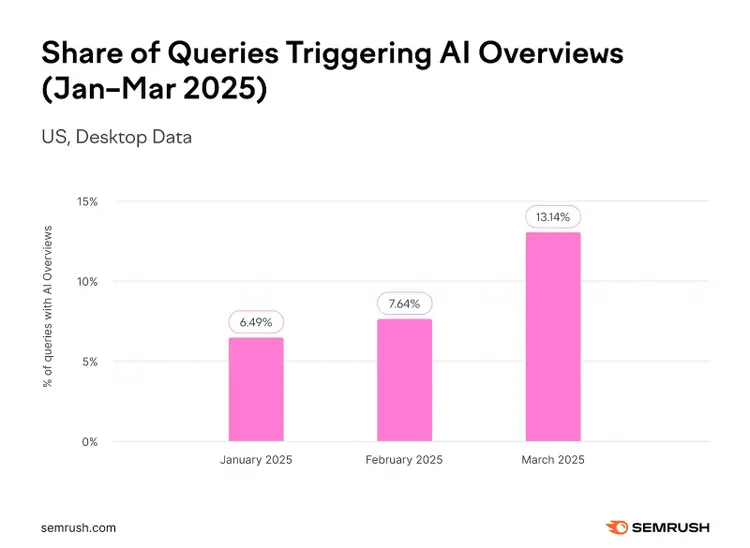
Google now shows AI Overviews on billions of queries. Semrush looked at 10M+ keywords and found that as of March 2025, Google triggered AI Overviews for 13.14% of U.S. desktop searches.
And a poll from the Associated Press-NORC Center for Public Affairs Research reveals that 60% of Americans use AI to find information at least some of the time.
So, getting your brand to show in AI search can help you stay in front of your audience when they enter questions into AI systems.
7 AI SEO Tips to Earn Visibility
Most AI SEO best practices are extensions of what already works in traditional SEO, according to Microsoft's guidelines for optimizing content for generative search.
Here are seven AI SEO tips to help you build brand visibility in AI search.
1. Front-Load Sections with Clear Answers
Front-loading content to make your core answer the first sentence of every section can help LLMs and search engines easily find answers and potentially extract them for use in responses.
Microsoft highlights this as essential for AI search: content structured to answer real questions directly performs better than content requiring interpretation.
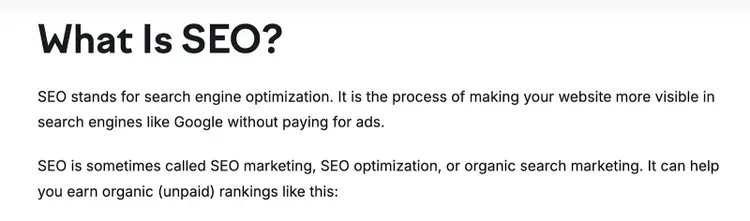
This section from one of our blog posts is a good example of front-loading sections. We answer the header question within the first sentence.
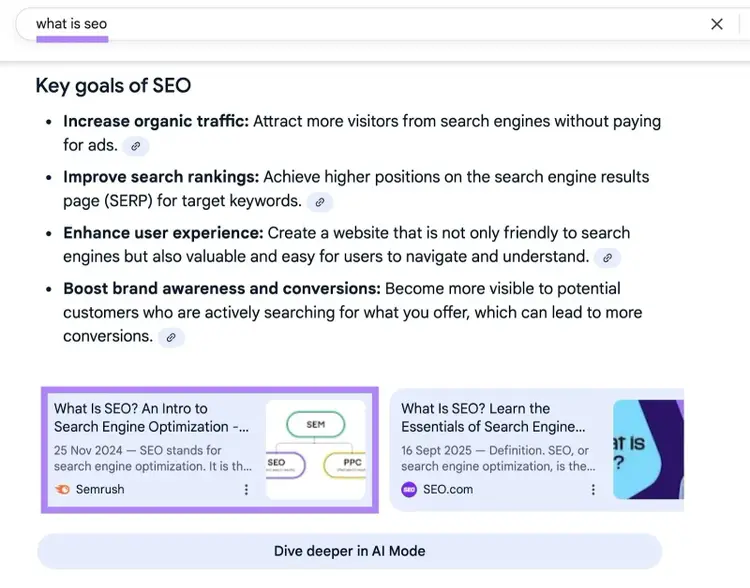
And an AI Overview cites the same blog post when someone searches “what is seo.”
Apply this pattern consistently by:
- Opening every section with a definition or core answer
- Using the exact terminology from your heading in the first sentence (i.e., “What is SEO?” → “SEO is …”)
- Keep definitions to two sentences maximum
- Add clarifying context (like examples) in the sentences that follow
2. Improve Your Site’s Technical Foundation
Websites with strong technical foundations have minimal errors and can be easier for AI systems to crawl (access and read your content).
Here are some tips for improving the technical aspects of your site:
- Fix and fix any broken links
- Improve page speed
- Make your site mobile-friendly
- Avoid duplicate pages
- Keep your site easy to navigate
Run a free SEO check to spot quick wins like page speed and mobile-friendliness issues.
For a deeper site-wide audit, use the Semrush Site Audit tool. It lists all the errors on your site, along with tips for fixing each one.
Start by configuring your site audit. Then open your project.
You’ll get an overview of your site’s health. Locate “AI Search Health” and click “# issues.”
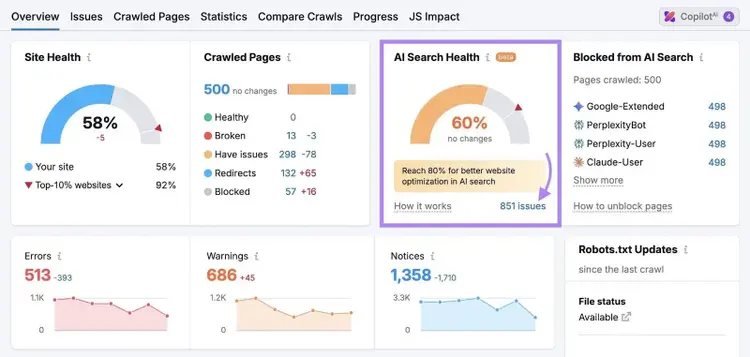
You’ll see a list of issues to fix. Click each issue for more details. And click “Why and how to fix it” for tips.
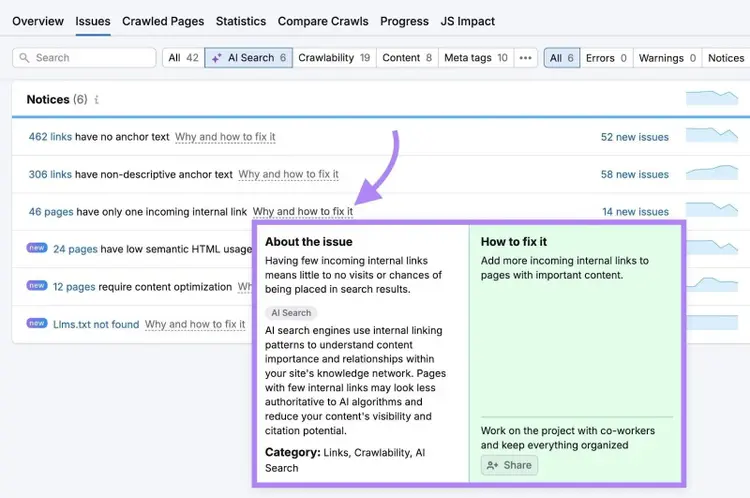
Go through and fix each issue.
3. Structure Your Pages for Easy Extraction
Breaking content into scannable sections with clear headings, short paragraphs, and self-contained chunks can help AI systems extract answers from your content.
Here’s why: AI tools parse content in segments—not full pages. And when you structure content with a clear hierarchy and independent sections, you make it easy for AI to identify, extract, and attribute specific information.
Start with basic structural elements:
- Use descriptive headings (H2, H3, etc.) that match likely user queries
- Keep paragraphs to three sentences maximum
- Use bulleted or numbered lists to group related points
- Make each section understandable without reading previous sections
Then, apply technical writing patterns that improve machine readability:
- Keep the subject and verb close together. AI analyzes sentence structure by identifying subject-verb relationships. Minimize the distance between them.
- Use clear antecedents for pronouns. When you use "it," "this," or "they," make sure the reference is obvious. Repeat the noun if needed.
- Keep entity names consistent. If you call something "Google Business Profile" in one paragraph, don't randomly switch to "GBP" or "Business Profile" later. Inconsistent entity naming confuses the connections.
4. Keep Content Updated
AI search favors fresh content over outdated pages, so updating your content with current information (like new examples and research) can signal to AI systems that your website is current.
A page last updated in 2022 may be less likely to be cited in AI search than one updated in 2025. Even if the 2022 page ranks higher in traditional; search.
Prioritize updating pages that are most important for your business.
Here are some tips for updating content:
- Add a "Last updated" date using dateModified schema markup that clearly indicates when your content was revised
- Replace outdated examples, quotes, or statistics
- Replace broken or outdated links, and link to new and authoritative sources
5. Build Brand Signals
Strengthening your brand’s identity and authority by ensuring information about you is consistent, accurate, and abundant improves your likelihood of appearing in LLM responses.
SEO expert Charles Floate describes how his link building company ranks without keywords like “link building company” in the content, simply because of strong brand signals.
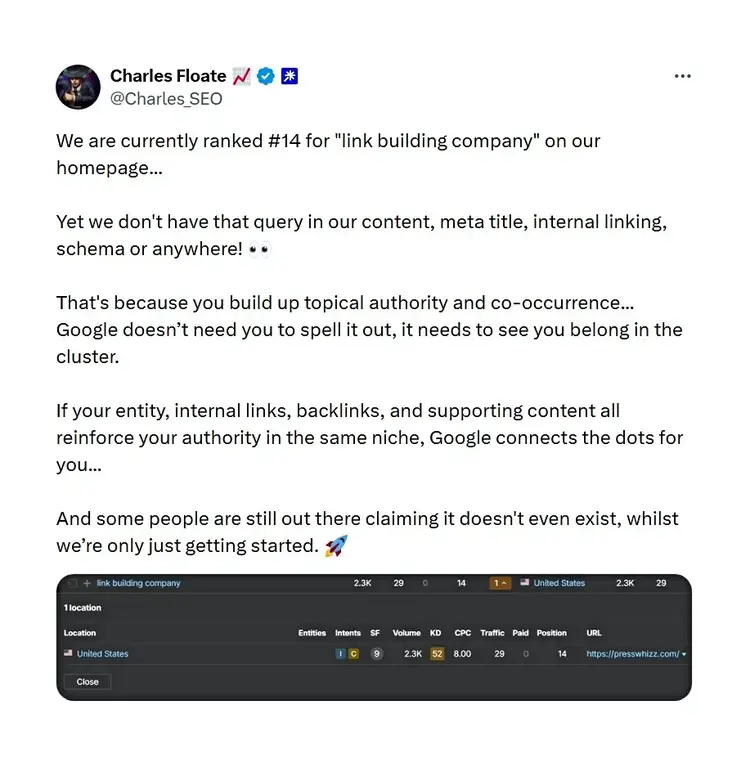
Start by ensuring brand and product names are consistently mentioned across your site and other places like LinkedIn and your Google Business Profile.
Then, build backlinks and brand mentions from authoritative third-party sources, as mentions in industry publications, news sites, and expert roundups can strengthen your authority signals.
Here are some additional tips for building brand signals:
- Publishing original research, and data studies, and useful tools that others will naturally want to reference
- Contributing expert commentary to journalists (use services like Qwoted or HARO)
- Guest post on established, relevant industry publications
- Speak at conferences and get listed in speaker directories
- Ask clients/customers to leave your business reviews on relevant platforms (like your Google Business Profile page)
- Participate in relevant forum discussion on places that LLMs source (like Reddit or Quora)
6. Differentiate with Original Information
Adding original information like proprietary research, first-hand examples, and unique perspectives improves your chances of being cited by AI systems that tend to prioritize content with information beyond what’s already widely available.
Original content can include:
- Proprietary data and research: Run surveys, benchmark studies, or analyze anonymized customer data to uncover insights others haven’t published
- First-hand case studies: Share measurable results from your own projects or clients, explaining what worked, what didn’t, and why
- Unique frameworks or methodologies: Document processes or mental models that show how you approach a problem differently that others
- Expert analysis: Combine data or perspectives from multiple sources and add your own interpretation to reveal patterns or implications others have missed
When your page is the only source with specific data or insights, AI tools may be more incentivized to cite you.
7. Build Topic Clusters with Strategic Internal Links
Connecting relevant pages through topic clusters that group related pages may help AI systems understand the relationship between your pages to build topical authority and increase your visibility.
You can build topic clusters by creating a main page on a broad topic and creating subpages that dive into specific subtopics—then interlinking those pages.
Here’s an example of a topic cluster that includes a main page about LLMs and subpages covering specific AI tools.
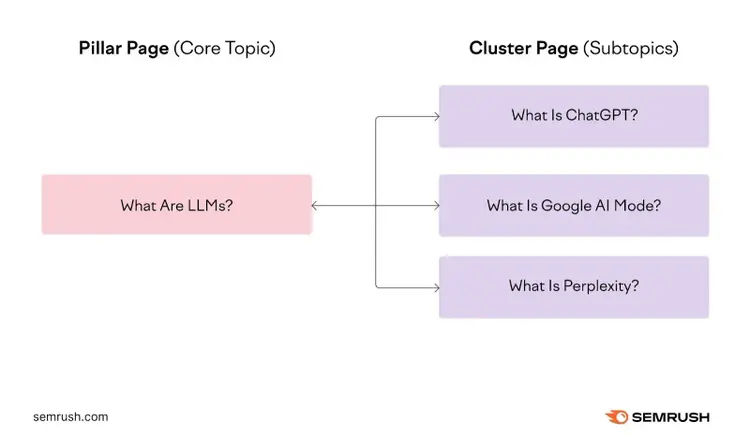
By using internal links to link pillar and subpages, AI systems can easily access your content for query fan out (an AI system search process that collects all relevant information for a query and its sub-queries). This makes your content more likely to be included in the final output.
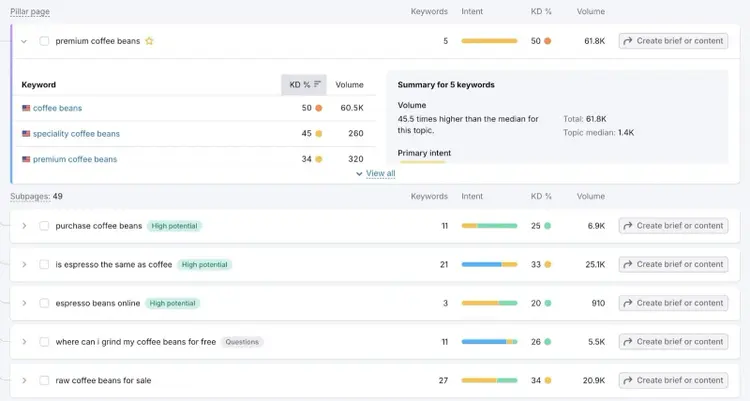
Use Semrush's Keyword Strategy Builder to discover topics and subtopics to create content around. Simply enter one or more terms related to your business, and the tool gives you ideas for pillar pages and subpages.
Here’s an example from the topic “coffee bean types.” There’s one pillar page (premium coffee beans) with ideas for subpages.
AI SEO Case Study
Baruch Labunski, Founder of Rank Secure, increased AI citations by 40% in 90 days through many of the above AI SEO tips, like updating pages to include direct answers and incorporating first-hand case studies for original data.
The work took Baruch six to eight weeks. He added roughly 120 pages and revised around 15 pages.
“In the span of 90 days, there was close to a 40% growth in brand citations within the AI-generated outcomes. We particularly observed AI-generated overviews capturing a larger share of impressions for branded queries, especially for the ‘how-to’ and ‘comparison’ keywords.”
Track and Optimize with AI Visibility Tools
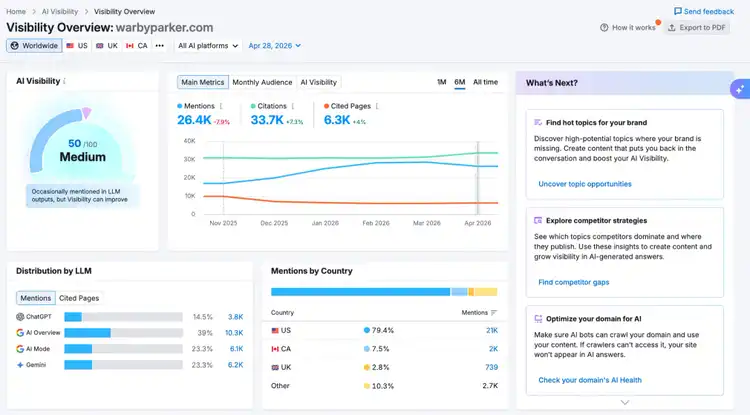
You can track your AI visibility with Semrush’s AI Visibility Toolkit.
Open the Visibility Overview dashboard, enter your domain, and click “Check AI Visibility." The top half of the resulting report gives you an overview of your visibility across different AI platforms.
Scroll down to see your mentions. Along with source opportunities (query responses that cite competing domains but not you) that can give you content ideas.
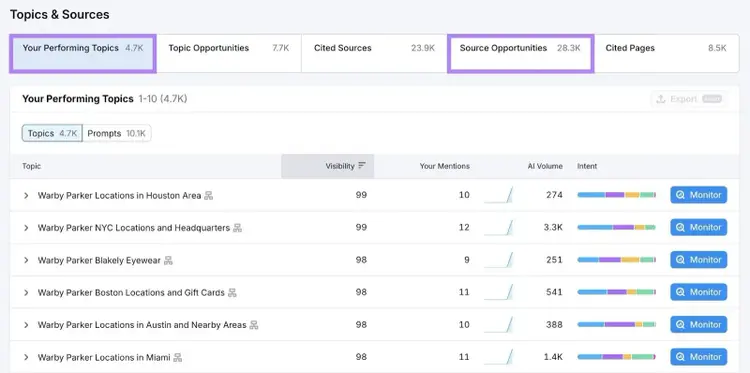
Check your site after applying the above tips to see how your citations and mentions grow.
Ready to see how your site appears in AI? Try the AI Visibility Toolkit.
Beat Your Competition in LLMs
with the Semrush AI Visibility Toolkit
FAQs: AI Content, Penalties, and Best Practices
Does Google Penalize AI-Generated Content?
No—Google doesn’t specifically penalize AI-generated content. Google evaluates content quality and user value. It doesn’t matter exactly how the content was created.
AI-generated content that meets Google's helpful content standards can rank and appear in AI Overviews just like human-written content.
Do You Need to Rewrite All Your Content for AI Search?
No. You don’t need to rewrite all your content to optimize it specifically for AI search. Start by optimizing your most important pages.
Front-load clear answers, keep your paragraphs self-contained, and differentiate with original information.
Once you see results, apply the same patterns to additional content. Focus on pages targeting high-value queries where AI Overviews appear frequently.
What's the Difference Between Optimizing for Google AI Overviews vs. ChatGPT?
There are differences in how you can optimize content for Google AI Overviews and ChatGPT, but the core principles remain, and clear structure, brand authority, and extractable content can improve visibility in both.

Zach Paruch is a data-driven SEO strategist with 10+ years of experience driving organic growth through smart, scalable search strategies. His expertise includes on-page and technical SEO, AI search optimization, and content strategy—with a special focus on ideating and implementing AI-driven processes. By leveraging in-depth search intent analysis, refined information architecture, and user-centered design, Zach consistently delivers high-impact content that drives business outcomes.
Zach Paruch
Zach Paruch is a data-driven SEO strategist with 10+ years of experience driving organic growth through scalable search strategies. He specializes in on-page and technical SEO, content strategy, AI search optimization, and AI-driven processes.
Tells Google to show you more from Semrush in AI, Search, and Discover.