
Article writing is the process of crafting content to inform, educate, entertain, and/or persuade a reader.
And writing an article from scratch doesn’t have to be overwhelming.
We’ll explain how to write an article in seven steps.
Whether you want to grow your blog, land your first freelance client, or write an article for school, this guide will help.
How to Write an Article in 7 Steps
Writing an article boils down to seven steps:
1. Learn About Your Audience
To write an article that resonates, you must understand what your audience wants to know, how they think, what they struggle with, and even the exact words they use.
Here’s how to learn about your target audience:
- Go where they hang out. Search for your niche on social media or perform a Google search for things like “[niche] reddit” or “[niche] forum” to find places where your audience spends time (subreddits, Facebook groups, LinkedIn communities, etc.)
- Talk to them. If you have customers, friends, or co-workers who fit your target audience, ask them directly. What do they care about? What questions do they have? What do they struggle with? The more you can learn about them, the better.
- Ask an AI tool. AI tools like ChatGPT can help gather insights about your target audience’s behavior and needs
For example, one of our target audiences at Semrush is marketing professionals—SEO specialists, content marketers, and PPC managers. People who create and promote content for a living.
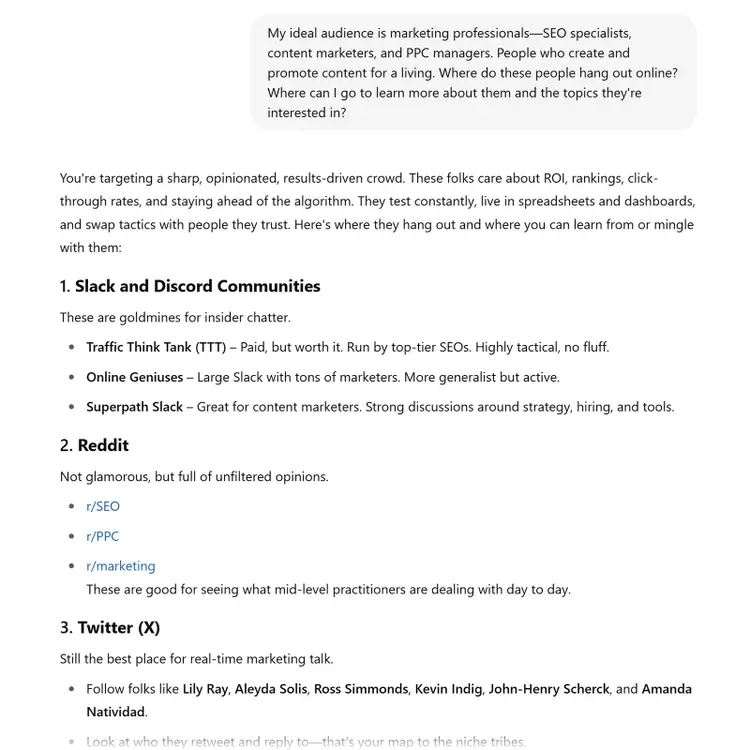
So, we asked ChatGPT to tell us where these people hang out online. We gave it the following prompt:
“My ideal audience is marketing professionals—SEO specialists, content marketers, and PPC managers. People who create and promote content for a living. Where do these people hang out online? Where can I go to learn more about them and the topics they're interested in?”
Here was the output:
Do the same for your audience. Go to the places ChatGPT suggests and peruse the posts and comments.
As you’re browsing, try to find the answers to the following questions:
- What questions do they have?
- What are they struggling with?
- What do they care about right now?
- What specific words do they use to describe their pain and desires?
Use these insights to guide you throughout the rest of this article. And remember that AI is a supporting tool—not a replacement for in-depth research.
2. Choose a Relevant Topic
Ideally, write about something in your area of expertise that will interest your audience.
So, how do you choose the right topic?
Start by asking yourself why you’re writing the article. This will guide your choice:
- For website traffic, choose a keyword people are searching for—you can figure this out by conducting keyword research
- To educate or inform, pick a common question or pain point your audience has (This may overlap with finding a keyword to get more traffic.)
- To build thought leadership, share your unique insights or experience on a niche subject
- To sell something, focus on problems your product or service solves
Here’s an example:
Let’s say you’re a coach who helps entrepreneurs grow their businesses. And your goal is to get more clients.
You know many of your clients struggle with productivity when no one’s holding them accountable. So, you might write about a topic with a headline like “How to Get Things Done When You Don’t Feel Like It.”
Your content should educate readers on the problem (lack of accountability as a solopreneur) and present your service (coaching) as the solution.
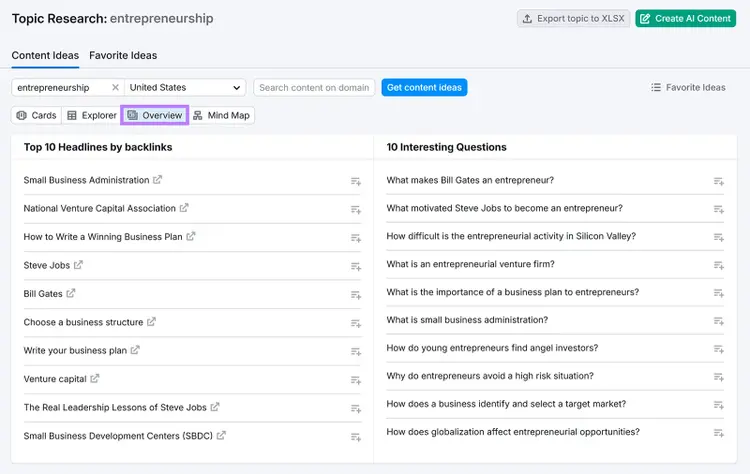
Still stuck? Use Semrush’s Topic Research tool.
- Enter a broad topic related to your area of expertise
- Explore article headlines and questions people are searching for
- Choose one that seems like a fit and build your article around it
3. Research Your Topic
Take time to gather information before you start writing to make your article more accurate, more useful, and easier to write.
Here's how:
Head to Google and search for the topic like a reader would.
For example, while researching this article, we searched for keywords like “article writing” and “how to write an article” to see what already exists.
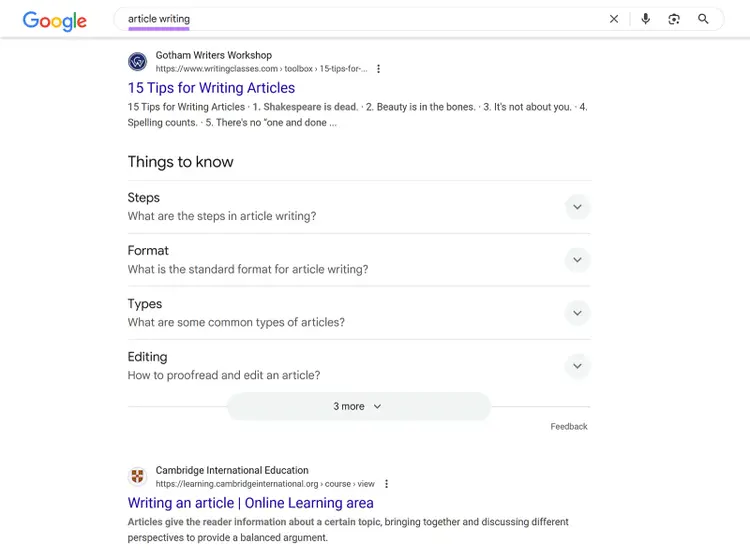
Read through the top 10 articles on the search engine results page (SERP). Note each article’s angle, suggested tips, and format. And see if there’s anything missing from those articles that you can add.
But don’t stop there.
Continue your search on YouTube, Instagram, and even TikTok. Read forum posts. Reach out to industry experts. Read data studies and industry reports.
You’re looking for trends, data points, and expert insights to support your writing.
4. Create Your Outline
A content outline is a document that details what an article should include. Creating an outline helps you clarify your ideas, organize them into a logical flow, and write faster and with more focus.
Here’s how to create an outline:
- Come up with a working title that summarizes the content and entices your audience. For example, “How to Write an Article Audiences Want to Read (7 Steps)” is better than just “How to Write An Article.” Use Semrush’s Title Generator tool to come up with better title ideas.
- Add the main sections and subsections of the article in a logical format. Your title should be the only H1, then you can have H2s as your main sections and H3+ as your subsections that further break down/explain your main sections
- Break down what key points will be included in each section. You can use bullet points to show important information.
- Gather supporting evidence and examples. Add any links you want to use in the article, such as data studies, supporting articles, or even forum posts with other people’s personal experience
One easy way to create an outline is to use AI tools like ChatGPT.
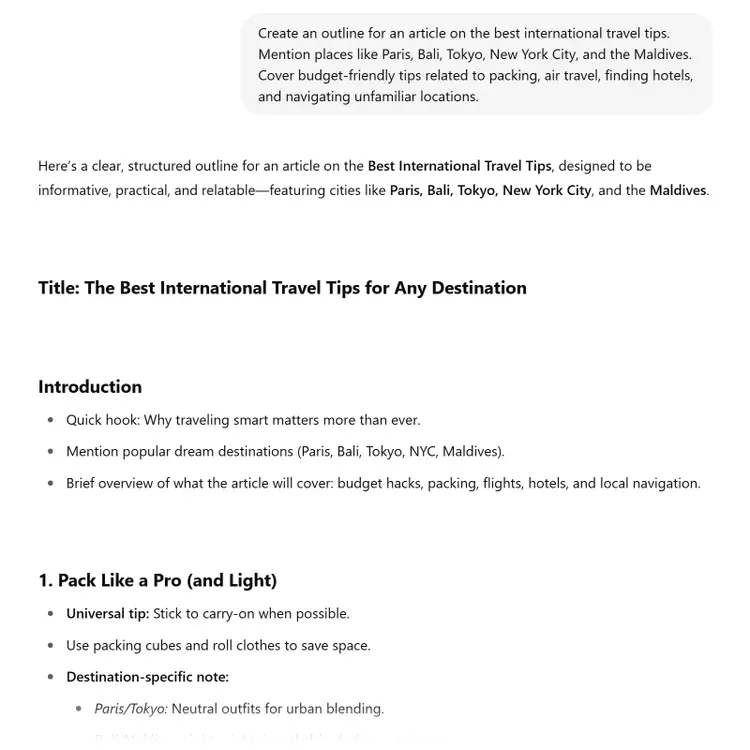
Enter a prompt like this:
“Create an outline for an article on the best international travel tips. Mention places like Paris, Bali, Tokyo, New York City, and the Maldives. Cover budget-friendly tips related to packing, air travel, finding hotels, and navigating unfamiliar locations.”
It will generate an outline for you:
Then, make adjustments as needed. Feel free to add or remove any sections or key points based on your research.
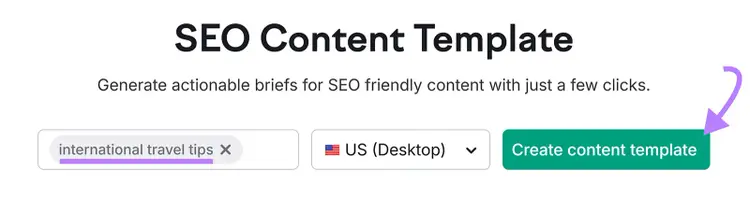
If you’re writing a blog post for your website, use Semrush’s SEO Content Template. It will give you a content brief that’s optimized for search engines to increase your chances of showing up in search results.
Enter your topic keyword and click “Create content template.”
When the tool is done, you’ll see recommendations related to word count, semantically related terms to include, and more.
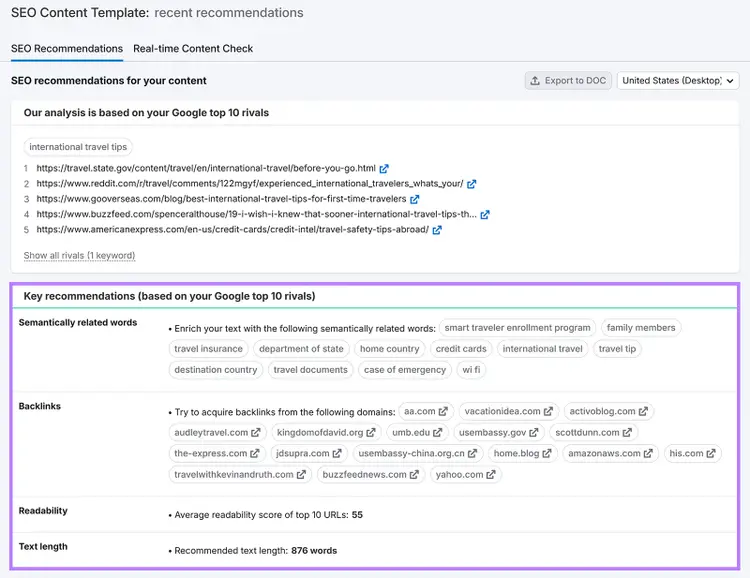
Use these insights to update your outline.
Get Ideas for Your Outline
with the SEO Content Template Tool
5. Write Your First Draft
Finally, it’s time to write. Follow your outline and your research to make the process smoother and faster (that’s what you did all that work for).
And remember:
Your first draft doesn’t need to be perfect. In fact, it shouldn’t be.
Your job right now is to get words on the page—you can fix awkward phrasing, grammar issues, and weak word choices later.
Here’s how to approach it:
- Start with a strong introduction. Grab your readers' attention from the very beginning. Consider using an interesting fact, a thought-provoking question, or a compelling statement to draw them in.
- Write in a clear, conversational tone. Unless you're writing for a highly technical audience, aim for a style that's easy to read and understand. Imagine you're explaining the topic to a friend.
- Use short paragraphs and sentences. This makes your content more digestible and less intimidating to readers.
- Incorporate visuals. Where appropriate, include images or video to illustrate your points and break up text.
- Write a compelling conclusion. Summarize your main points and leave the reader with something to think about or act upon. Try to use only one call to action (CTA) at the end to avoid confusing the reader.
Pro tip
Set a timer for 25 minutes to focus exclusively on writing. You can edit later. Right now, you just have to get words on the page.
If you’re struggling to write your article, you can use an AI content generator for help. ChatGPT can write an entire article for you in seconds based on a single sentence.
But here’s the catch:
If you just say “write an article about XYZ,” what you get will be generic and bland. Because it lacks things like personal experience, expertise, and details that matter to your audience.
The key is to craft better prompts and approach it as a back-and-forth conversation—refine the input to improve the output.
And remember that AI isn’t a replacement for your own voice. So, edit the output and make adjustments to ensure the article is up to your standards.
6. Optimize Your Article for Search Engines (Optional)
Using search engine optimization (SEO) best practices increases the odds that your article will show in search results users see after entering related queries—which can drive more readers to your article.
Plus, learning SEO is a fantastic way to earn money from writing articles.
You can promote your own products and services in articles that drive traffic from Google. Or you can offer SEO article writing as a service for clients.
Here are some simple ways to optimize your article for search engines:
- Include your keyword in the title. For instance, if you’re writing about "international travel tips," it’s natural to include that phrase in the title.
- Include the keyword in the title tag. The title tag is an HTML title that can appear in search engine results. And it should match or be very similar to your article title.
- Craft a compelling meta description. A meta description is a brief article summary that can show in search results. And while it doesn’t directly influence rankings, a good one can entice users to click on your article when it appears in search results.
- Use a short, descriptive URL. Clear URLs help readers understand what your post is about at a glance. The simplest approach is to make the URL slug reflect your topic.
- Add alt text to your images. Google relies on the brief descriptions that appear as alt textto interpret images. Ensure each image has concise and accurate alt text.
You can use the SEO Writing Assistant to help you optimize your article.
Open the tool and add at least two keywords (one should be your primary keyword). From here, copy-paste the content you’ve already written for your article.
Click the “SEO” tab to see recommendations to optimize your article, like additional keywords to include and any issues your article has.
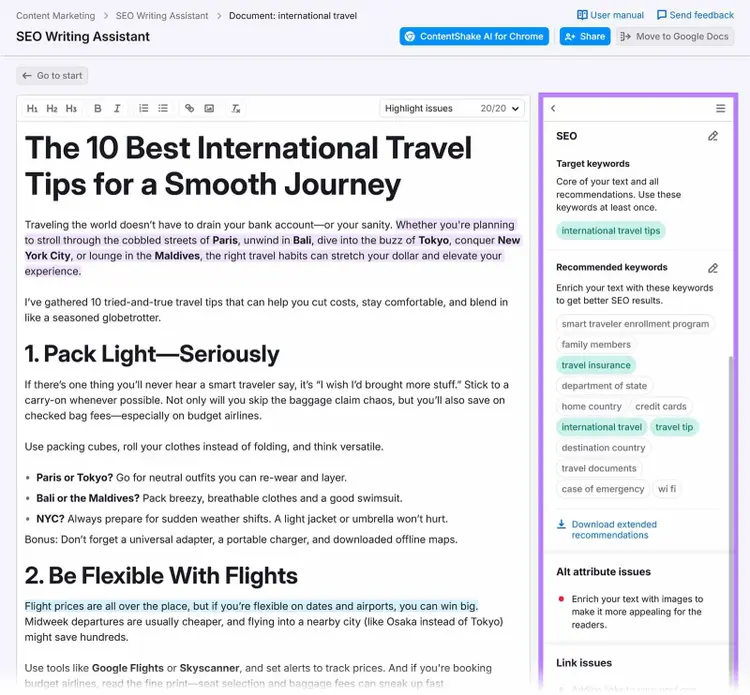
Make the suggested changes to improve your article's overall score and increase your chances of showing up higher in search results.
7. Revise and Get Feedback (If Possible)
The editing and revision process is crucial to cut fluff, ensure everything makes sense, and tighten up your word choices.
Step away from your draft for a few hours (or even a day), so you can come back with fresh eyes.
When you sit down to edit, start by reading the article out loud. This is one of the easiest ways to catch awkward phrasing, run-on sentences, or areas where your tone feels off.
If you can, get feedback from someone else.
At Semrush, we have a team of editors who thoroughly review our content. They give feedback on:
- Sections that could be restructured for better flow
- Grammar and usage mistakes
- Parts that could be removed to avoid redundancy
- Sentences that could be written more clearly
- Points that need more explanation
Here’s an example:
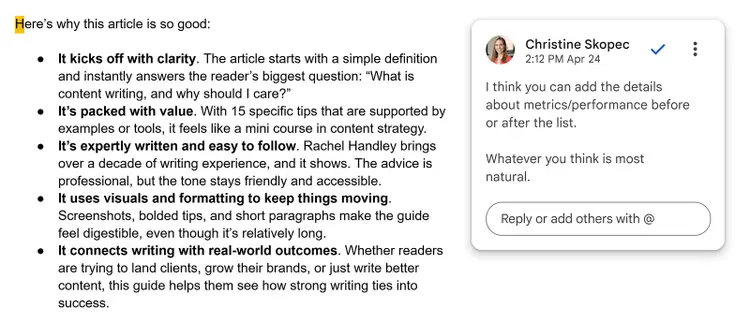
Feedback and input like this typically leads to improvements.
3 Good Article Writing Examples
Here are a few specific articles that stand out from the competition:
1. Content Writing: What It Is + 15 Tips for Success
Our content writing article is a must-read for anyone ready to level up their content writing skills.
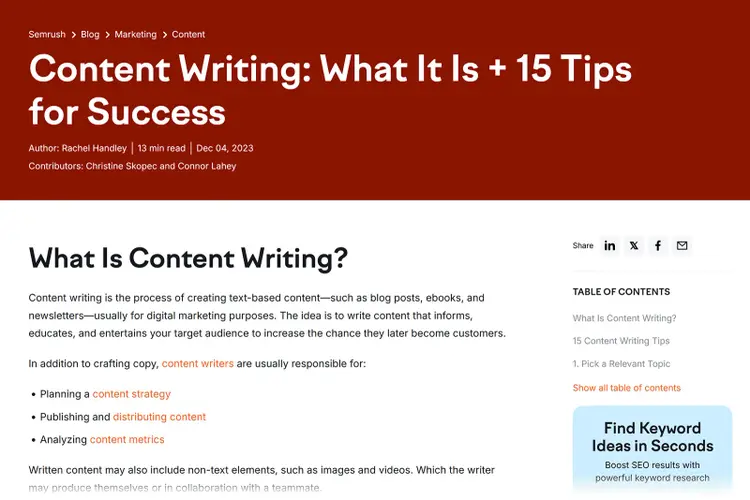
Here’s why this article is so good:
- It kicks off with clarity. The article starts with a simple definition and instantly answers the reader’s biggest question: “What is content writing, and why should I care?”
- It’s packed with value. With 15 specific tips that are supported by examples or tools, it feels like a mini course in content strategy.
- It’s expertly written and easy to follow. Rachel Handley brings over a decade of writing experience, and it shows. The advice is professional, but the tone stays friendly and accessible.
- It uses visuals and formatting to keep things moving. Screenshots, bolded tips, and short paragraphs make the guide feel digestible, even though it’s relatively long.
- It connects writing with real-world outcomes. Whether readers are trying to land clients, grow their brands, or just write better content, this guide helps them see how strong writing ties into success.
We noticed it has 124 backlinks (links pointing to it from other sites) from 65 different domains when we studied it using the Backlink Checker.
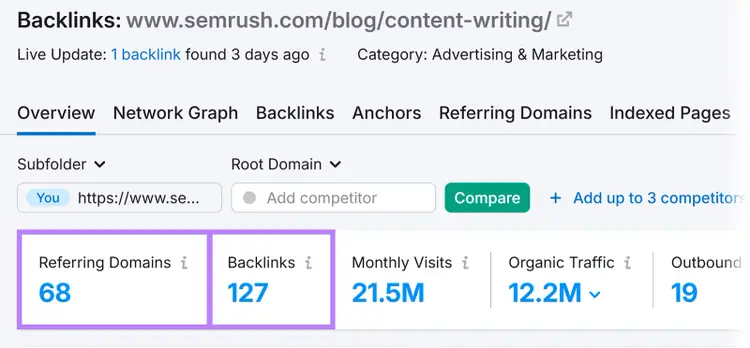
This means others see the article as a valuable resource.
2. Video Marketing 101: How to Build a Successful Strategy in 2025 (+ Examples & Pro Tips)
This comprehensive video marketing guide is a great example of writing articles for complete beginners.

Here’s why this article is so good:
- It meets beginners where they are. The guide doesn’t assume prior knowledge. It breaks down the entire video marketing process into easy-to-follow steps.
- It has a step-by-step framework. Each section flows naturally into the next, helping readers go from zero to published video without getting stuck in decision fatigue.
- It includes practical advice readers can apply. From choosing the right camera to knowing where to post content, it tells readers exactly what to do.
- It’s relatable and modern. By spotlighting real creators and current tools, it makes the idea of starting a video strategy feel achievable.
We chose this article as an example because Organic Rankings shows there was a massive increase in keyword rankings in April 2025.
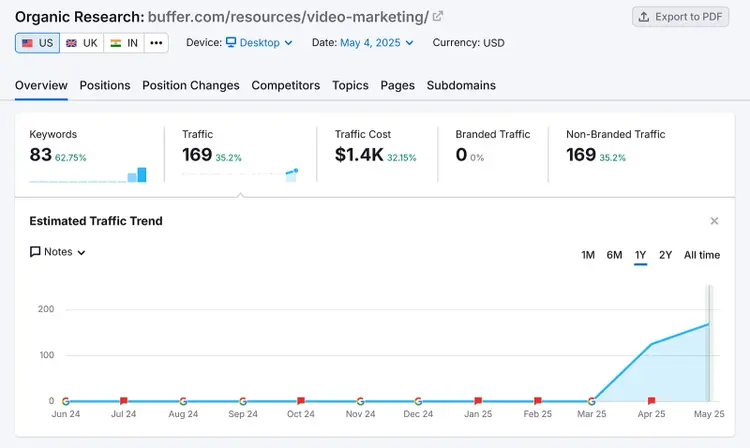
The piece was updated in April 2025. So, the uptick in rankings suggests that it’s on the cusp of getting a lot more traffic from search engines now that it's been refreshed.
3. How Creative Writing Can Increase Students’ Resilience
This creative writing-focused article is a great example of how to connect with the audience and deliver value.
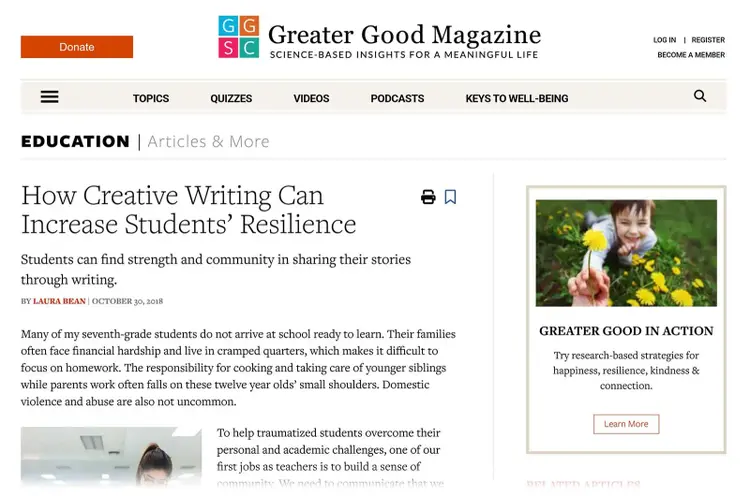
Here’s why this article is so good:
- It’s on a topic the audience cares about. The piece addresses a real challenge students face—resilience—and uses creative writing as the lens to explore it. It’s a perfect example of choosing a topic based on the reader’s struggles and desires.
- It uses the proper tone. It speaks directly to educators, students, and mental health advocates in a way that’s empathetic, clear, and encouraging—without being too academic or too casual.
- It’s supported by research and real stories. The article blends emotional storytelling with cited studies and expert commentary, making it both credible and engaging.
- It follows a logical structure. The flow of the article is easy to follow, with well-formatted sections and clear transitions between ideas.
- It ends with a clear takeaway. The final section ties everything together and reinforces the article’s main message: that writing can be a powerful tool for growth and healing.
We chose this article as an example because Organic Rankings shows it performed well on the SERPs in 2020, shortly after it was written. But it had a traffic dip shortly after that:
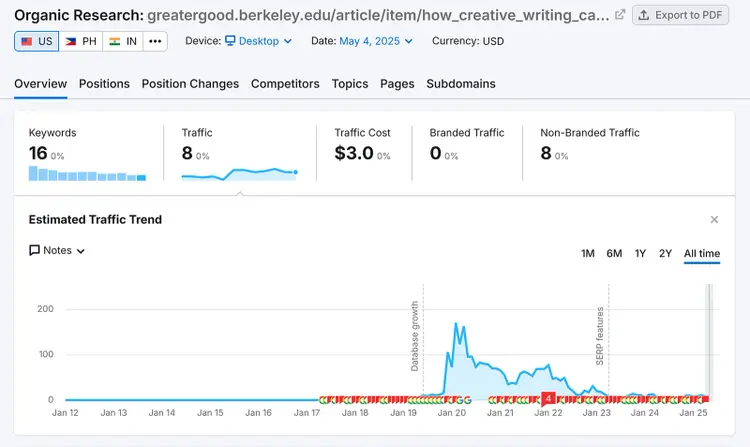
This is a sign that this article would be a great candidate for a refresh, similar to the Buffer example we gave above.
Write Your First Article Today
Now that you know the steps, there’s only one thing left to do:
Write.
And if you want to make the process easier and faster, try the tools mentioned in this guide with a free trial of Semrush.
Write Your First Article Today
with a Semrush Subscription

Carlos Silva leads the editorial pipeline for the English blog—coordinating writers, editors, strategy, and building AI workflows that boost content quality and AI visibility. With 10+ years of experience writing and editing across in-house and agency roles, Carlos blends content strategy, SEO, and AI to help marketers stay ahead of an evolving search landscape.
Carlos Silva
Carlos Silva leads the editorial pipeline for the English blog and builds AI workflows that boost content quality and AI visibility. 10+ years writing and editing across in-house and agency roles.

Tells Google to show you more from Semrush in AI, Search, and Discover.