
Search engine optimization (SEO) best practices are trusted ways to improve your visibility in search engines and AI systems.
Today, we’re sharing nine SEO best practices to help you succeed.
Modern SEO Best Practices
Here’s a quick list of effective SEO tactics, including what you need to do to stay competitive in AI search.
- Use Semrush Keyword Magic Tool
- Study results to determine intent
- Use Semrush Keyword Strategy Builder
- Link related articles together
- Use logical headings, short paragraphs, and schema markup
- Check markup with Google’s Rich Results Test
- Use Semrush SEO Audit tool
- Ensure speed, mobile usability, security, and crawlability
- Add author bios
- Cite reputable sources
- Include real examples or data
- Use descriptive file names and add alt text
- Compress files
- Enable lazy loading
- Use Semrush Backlinks tool
- Create useful content and use direct outreach to build links
- Write in a conversational tone
- Read your writing out loud while editing
- Use Semrush Position Tracking tool
- Track changes over time
All of these tactics are either the same as or extensions of traditional SEO best practices. Because they’re just as important for gaining visibility in AI systems as they are for gaining search engine visibility.
Now let’s cover these best practices in more detail.
1. Understand What Your Audience Wants
To appear prominently in search engines and AI systems, your page needs to match what people are hoping to find.
This is called search intent—the main goal a user has when they enter a query into a search engine or AI tool.
So how do you understand intent? One way is to manually review the results for each query. Look at what’s showing up to get an understanding of what people are looking for.
For example, someone searching for the “best SEO tools” is likely looking to compare software before purchasing. To check the intent, first look at the search results on Google:
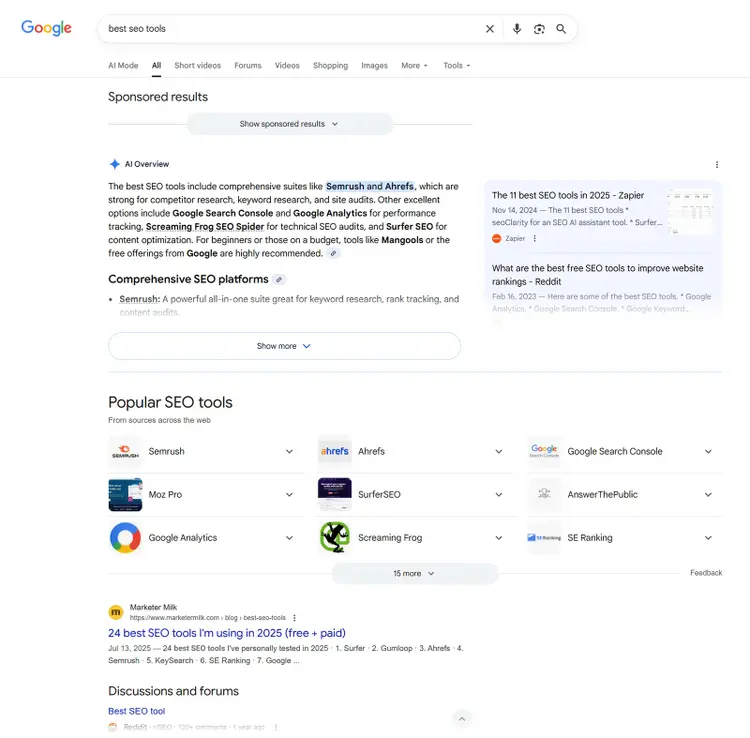
Then compare those results to the results given by an AI tool like ChatGPT:
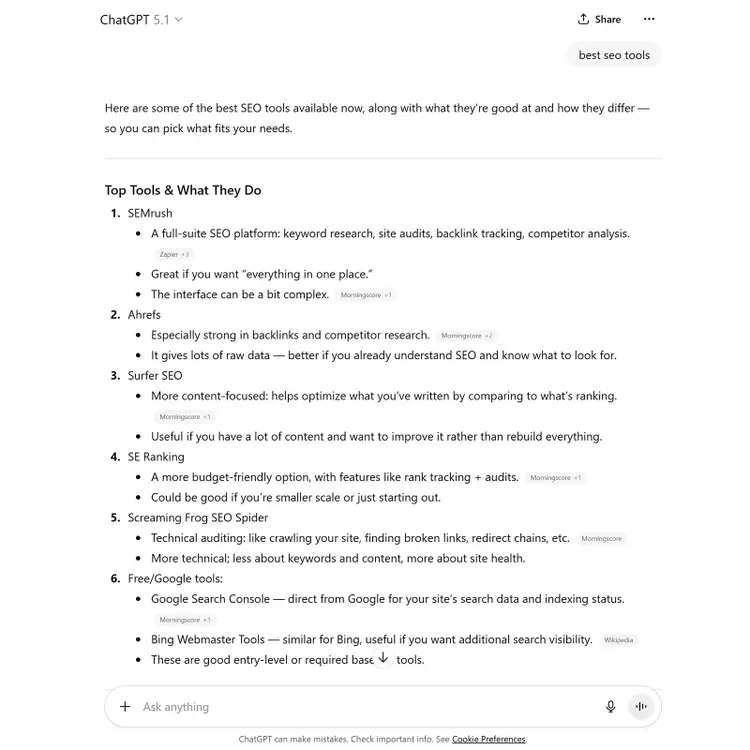
We’ve confirmed that this particular keyword has commercial intent—there’s an intent to research products before making a purchase.
To learn about search intent while also discovering valuable terms people enter into search engines, use our keyword research tool. It provides search intent type (transactional, commercial, informational, or navigational) for every keyword.
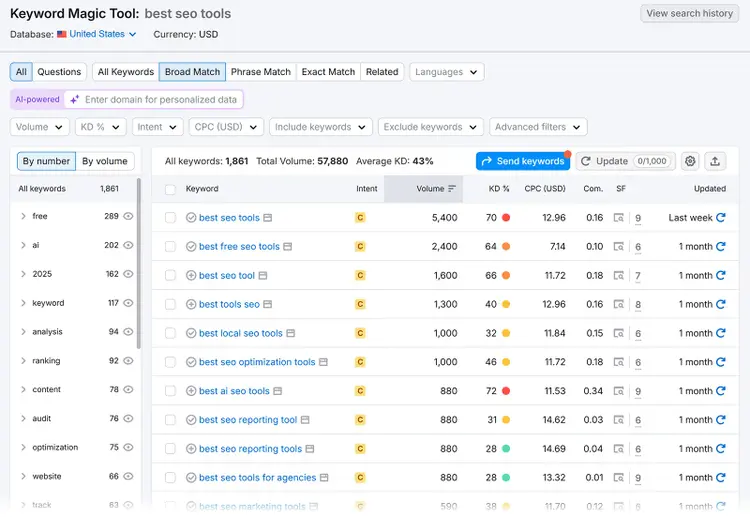
You can also use the Prompt Research tool to analyze intent for the prompts users are typing into various AI tools.
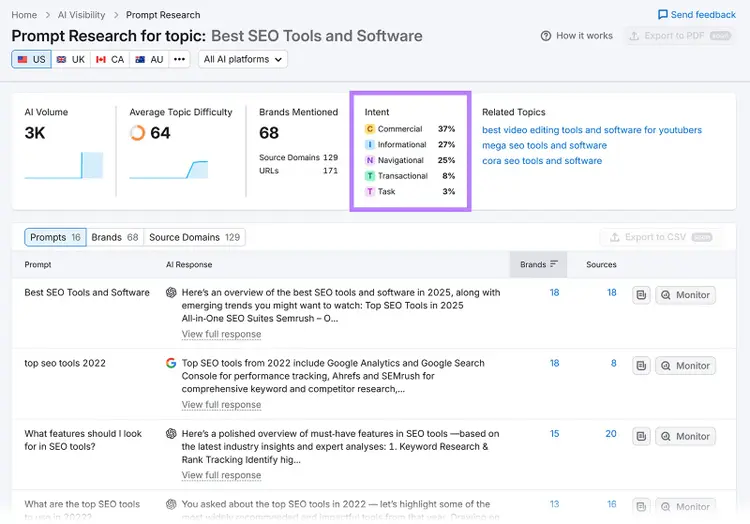
Keep in mind that intent is more than just a label like “commercial.” It’s also about the way the information is displayed (such as in a list or table versus a blog post vs a video or image) and the type of information included.
The best way to truly understand intent is to research queries and review the content that shows for those queries. You can then use that information to inform the content you create to ensure it matches what Google and AI tools believe users are looking for.
2. Focus on Topical Authority
Building topical authority on one or more subjects through quality content helps Google and AI tools recognize you as an expert in your niche to improve more of your content’s search visibility.
And Google’s December 2025 update seems to reward topical authority. "This [update] is yet another iteration to reward specialization, expertise and showcase more commercially oriented content from brands or specialized retailers, rather than generic ecommerce platforms or publications,” says SEO expert Aleyda Solís in a recent LinkedIn post.
Establishing topical authority involves creating a group of connected, high-quality pages that explore a topic from multiple angles.
Topical Authority Example
Trello has become a leading authority on project management. You can see this when you enter “project management” and their domain (“trello.com”) in Keyword Overview.
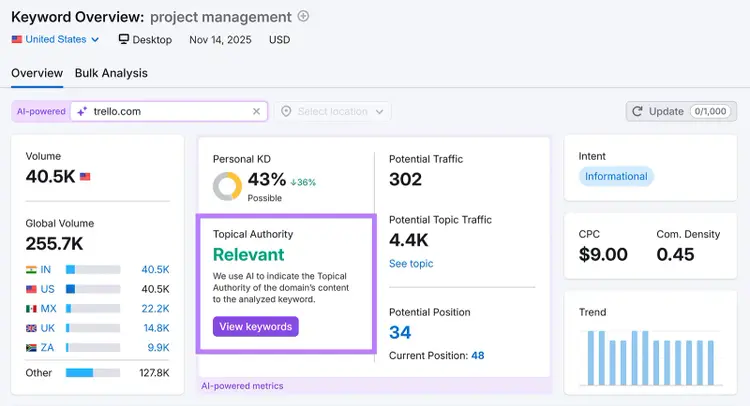
To build topical authority, first pick a core topic related to your business. For Trello, one of their core topics is how to manage a remote workforce to help build your company.
Next, create a pillar page (main page) that gives a broad overview of the topic. Trello created this pillar page, which links out to subtopics about remote work tools and best practices. And it ranks for 30 keywords, while the supporting pages rank for another 34 keywords.
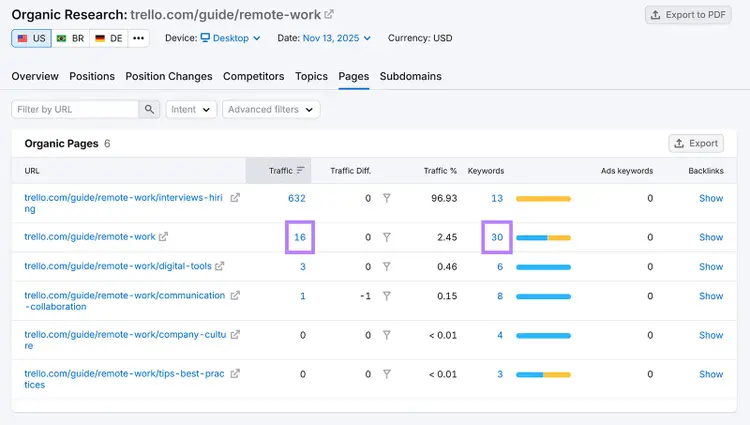
Then, write supporting cluster pages (subpages) that cover related subtopics. And consider if your website allows you to nest the URLs to further clarify the structure as Trello does.
For example, the URL for Trello’s pillar page is “trello.com/guide/remote-work,” while the subpages have URLs like “trello.com/guide/remote-work/communication-collaboration.”
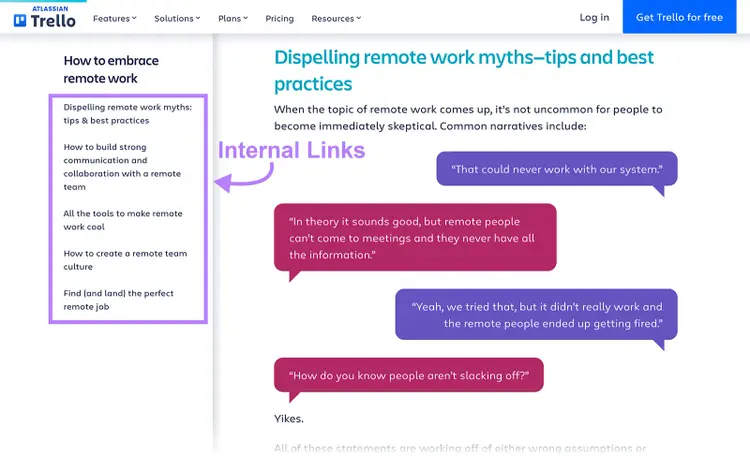
Next, use internal links to connect your pillar page and cluster pages to help readers, search engines, and AI tools navigate your content and understand how it’s related.
Trello’s remote work page links out to each of the subpages, and each of the subpages links back to the main remote work guide. Think of it like a book with links to each of its chapters.
Finally, regularly update your content with new insights, data, and examples to show Google and AI systems that your content is still relevant. Trello updates their remote work pillar page and subpages about every year.
How You Can Build Topical Authority
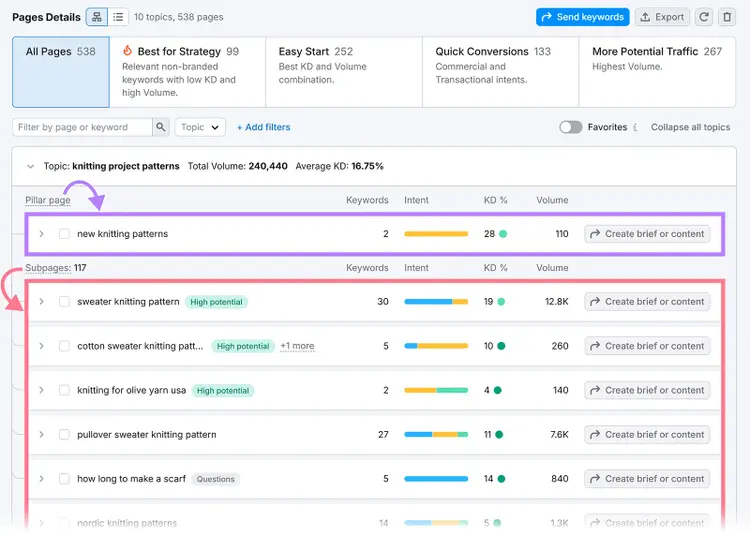
How do you figure out what your pillar content and subpages should cover? The fastest way to build groups of closely related content ideas is to use Semrush’s AI-powered Keyword Strategy Builder.
Start by entering a few seed keywords—broad terms related to your business—then choose your target location and click “Create.”
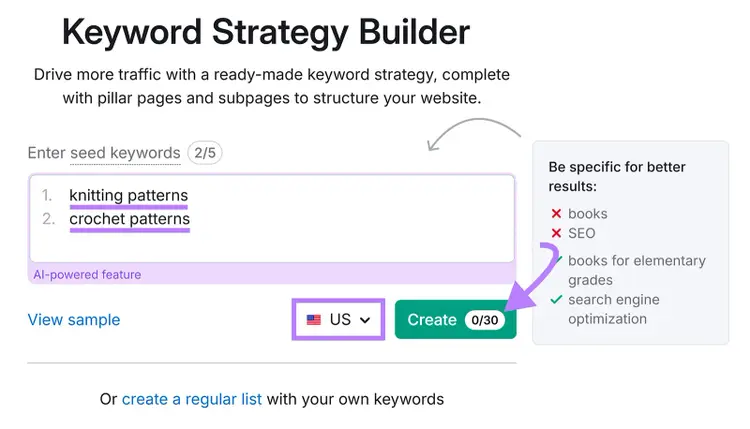
Keyword Strategy Builder will generate ideas for pillar pages and subpages.
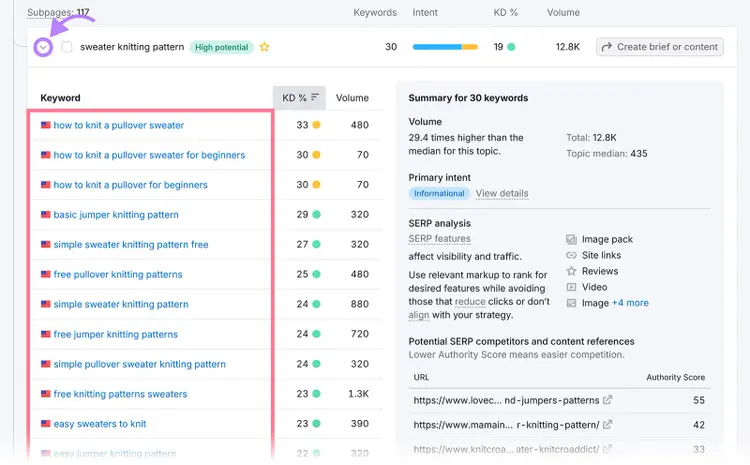
Click the arrow next to any page to expand it. You’ll see a keyword cluster—a group of keywords that share the same search intent that you can target within that single page.
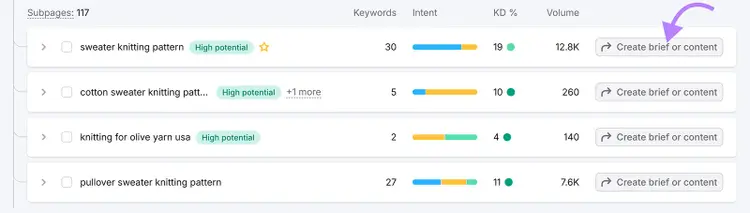
Now you’re ready to start creating content.
Click “Create brief or content” to the right of any pillar page or subpage, select the circle next to “Article in Content Toolkit,” and click “Apply.” This will send that page idea and all its target terms to the AI Article Generator, where you can generate and refine your content.
Generate Quality Content with Ease
with the AI Article Generator
3. Structure Content for Search Engines & AI Platforms
Google and AI systems look for content that’s clear, well-organized, and easy to follow. So, structure your pages accordingly by:
- Using headings (H1, H2, H3, etc.) logically. Your H1 should describe the main topic, H2s break it into sections, H3s cover supporting details, and so on.
- Ensure your paragraphs can stand on their own. This makes your writing easier to understand and increases the likelihood of your content being extracted for use in AI answers.
- Directly answer the question of each section immediately after the heading. This helps search systems identify direct answers.
- Include lists and tables. They make it easy for readers, search engines, and AI to understand information.
- Add schema markup. Use FAQPage, HowTo, Article, and other types of schema to provide extra context about your pages.
For example, in our guide to brand identity, we structure headings logically and have a direct answer to the heading immediately in the first sentence:
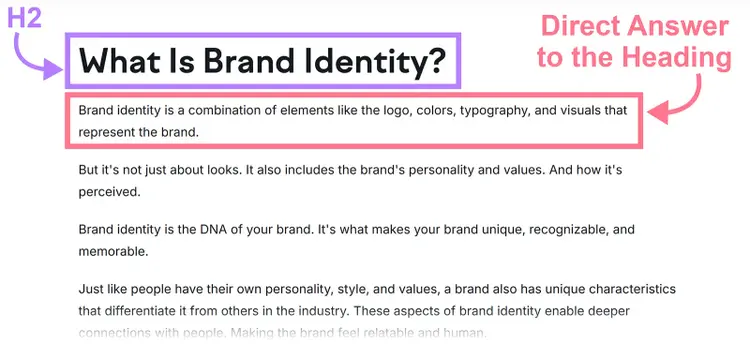
Additionally, most of the paragraphs can stand on their own.
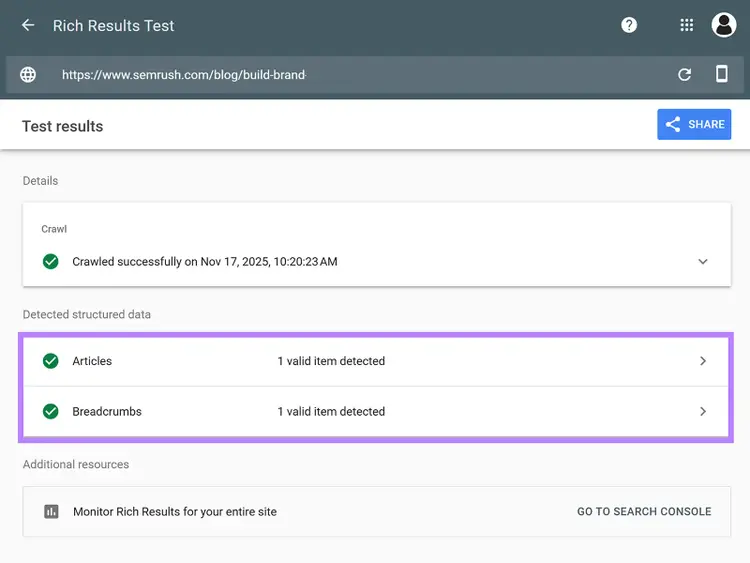
We also include Article schema markup to help Google more easily understand the content. You can test schema markup with Google’s Rich Results Test.
4. Do Technical SEO
Technical SEO techniques are mainly about helping Google and AI systems find, understand, and display your pages correctly—that means technical SEO is sort of like a precursor to gaining visibility.
In fact, ChatGPT and other AI models seem to rely heavily on Google’s index.
Get a fast technical read on a page with our free website SEO checker.
For site-wide coverage, the easiest way to find numerous technical SEO problems worth fixing is with Semrush Site Audit.
- Slow-loading pages that frustrate users
- Mobile usability errors
- Broken links and redirects
- HTTPS and security problems
- Crawlability or indexing issues (pages that are difficult to access)
The Site Audit tool flags these issues and helps you resolve them with clear, prioritized steps.
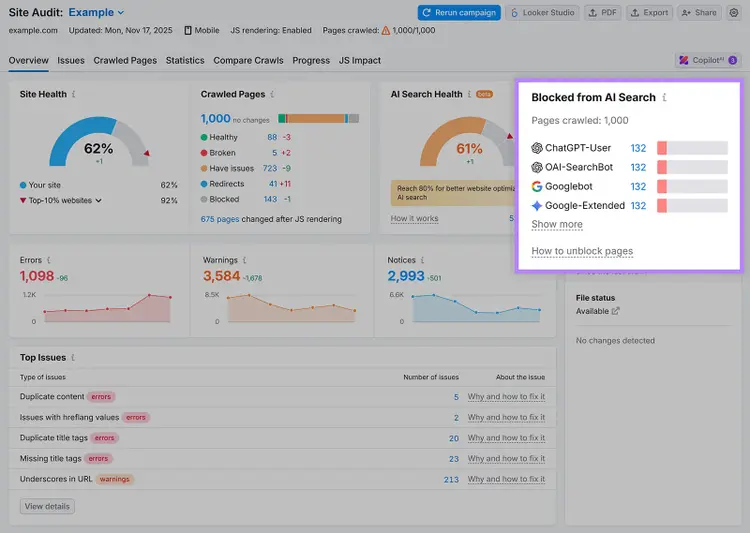
For example, in the “Overview” report, you can view the “Blocked from AI Search” module to see which pages are inaccessible to AI crawlers due to robots.txt rules or other technical barriers. This makes it easy to see which parts of your site might be invisible to both Google and AI engines.
5. Showcase Experience, Expertise, Authority, and Trustworthiness
Google’s Experience, Expertise, Authority, and Trustworthiness (E-E-A-T) framework in its Quality Rater Guidelines outlines the kind of high-quality, reputable content that Google aims to show in search results.
You can think of E-E-A-T as a way to assess your content to ensure it’s likely to show in search results.
Here’s how to demonstrate E-E-A-T:
- Experience: Share firsthand tips, real examples, or stories from your own work or customers
- Expertise: Add short author bios explaining why you and your team are qualified to write about the topics you cover
- Authority: Link to credible sources (like studies, official organizations, or well-known sites) and earn backlinks from trusted websites in your niche
- Trustworthiness: Keep your site secure with HTTPS, make your contact information easy to find, and be transparent about who you are
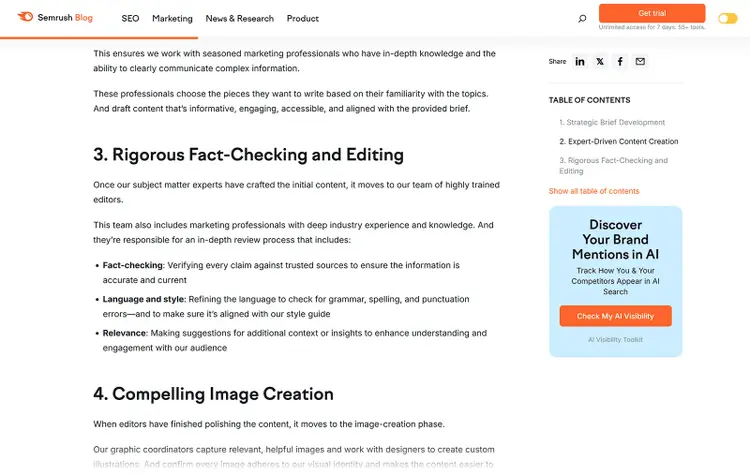
On the Semrush blog, we showcase E-E-A-T in many ways. Including having a published page that details our strict editorial process involving professional marketers and editors.
6. Optimize Images for Search
Image optimization is a best practice for SEO because it can make your images appear in more search experiences.
Here’s how to optimize your images for SEO:
- Choose the right file format. Use JPEG for most photos, PNG for graphics or transparent images, and WebP when possible for the best compression and quality.
- Give each file a descriptive file name. Instead of uploading “image1234.png,” rename it to something meaningful like “seo-best-practices-checklist.png” to ensure search engines and AI systems have more context.
- Add descriptive alt text (HTML image descriptions). To help search systems and readers using screen readers understand what the image depicts.
- Enable lazy loading. Lazy loading tells the browser to load images only when a visitor scrolls to them. This improves your Largest Contentful Paint (LCP), a Core Web Vital metric that impacts the user experience. Many content management systems and page builders support lazy loading automatically. Or, you can enable it with a plugin.
- Add image schema if it’s relevant. If you’re using important visuals like infographics, product images, or logos, then structured data (ImageObject schema) can help them appear in rich results to boost visibility.
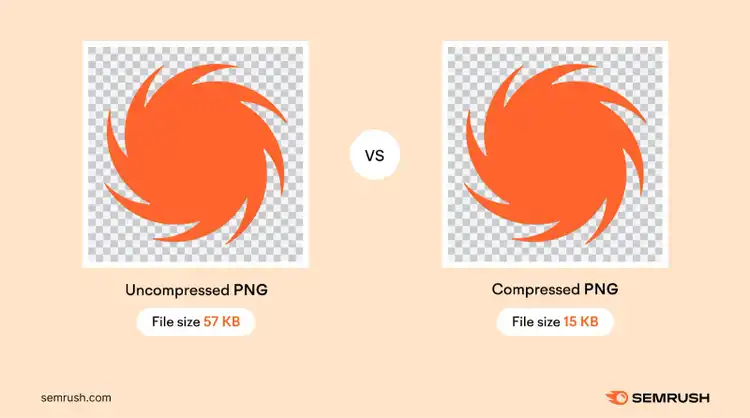
Compress your images. Use a compression tool like TinyPNG or ShortPixel to reduce file size without losing quality.
7. Earn Backlinks from High-Quality Sources
Backlinks are links to your site from other sites, and some are good for SEO because they indicate that other people find your content useful.
Getting backlinks and mentions from other brands is especially powerful for gaining AI visibility. In fact, research from AirOps shows that 85% of AI mentions come from third-party content.
However, certain forms of links are bad for SEO. SEO expert Lily Ray notes that because of AI, some people have gone back to reciprocal link building (a spammy technique where websites agree to link to one another):
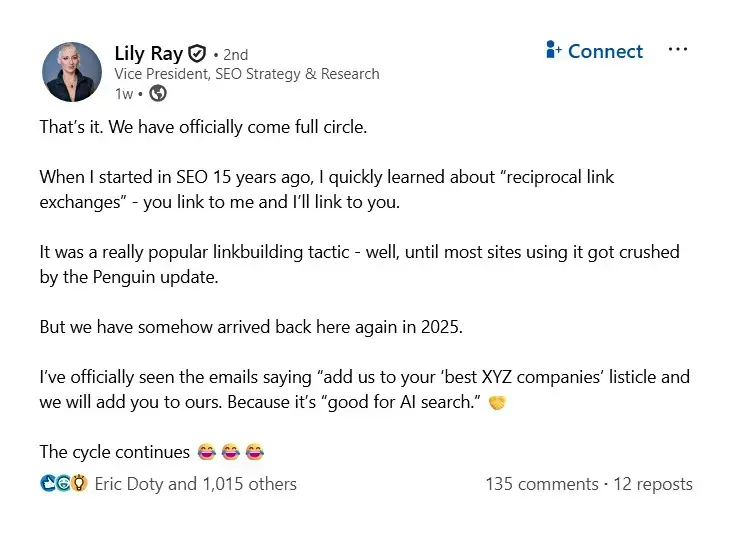
Reciprocal link building can hurt your SEO and should be avoided.
The best kinds of backlinks come from reputable websites and webpages that are relevant to you. So, focus on trying to acquire links from authoritative sites in your niche or a closely related niche.
Here’s a quick summary of some link building tactics you can use to get more high-quality links pointing to your site:
- Link baiting: Publish high-quality content that writers in your niche can refer to as a helpful resource
- Skyscraper technique: Create a better version of a widely linked-to piece of content in your niche, and encourage websites to link to your version instead
- Brand mentions: Use a tool like Brand Monitoring to find unlinked references to your brand on the web, then ask the publisher to add a link to a relevant page on your site. But keep in mind that unlinked brand mentions can still be helpful.
- Broken link building: Find broken backlinks to your own site or competitors’ sites, then persuade admins to replace them with working links to your site
Semrush’s Backlinks tool helps you find broken backlinks. Simply enter a competitor’s domain and click “Analyze.” Then click the “Indexed Pages” tab and select “Broken Pages.”
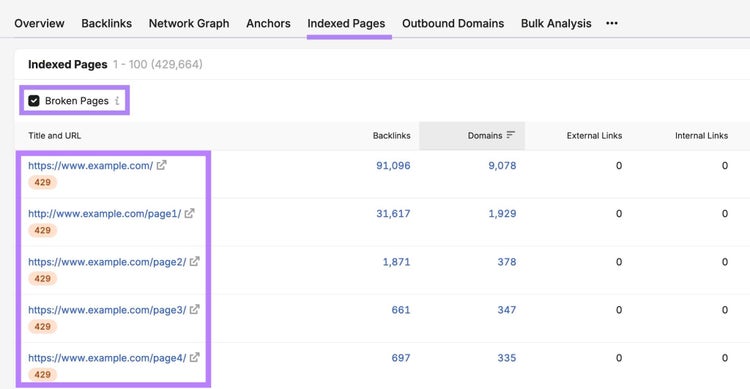
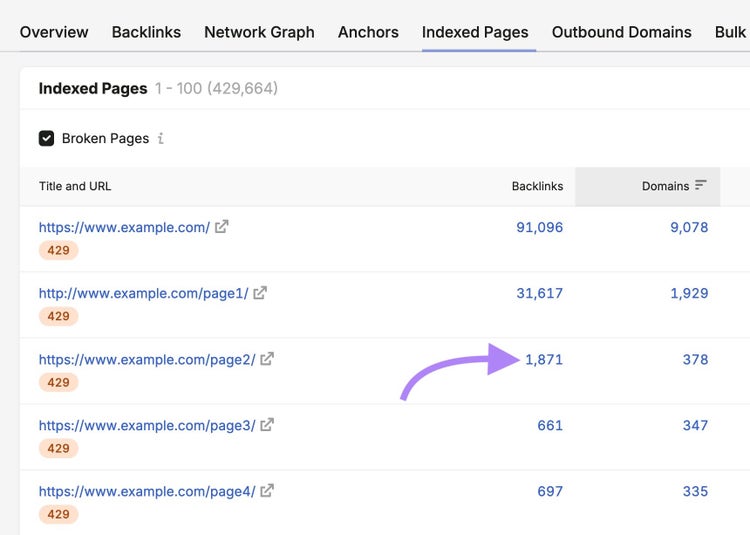
Review the list of URLs and look for pages similar to ones you have (or ones you can create). Once you find a suitable page, click its number of backlinks.
The next page shows every backlinks pointing to the broken page. Click “Best” to filter active backlinks with a follow attribute.
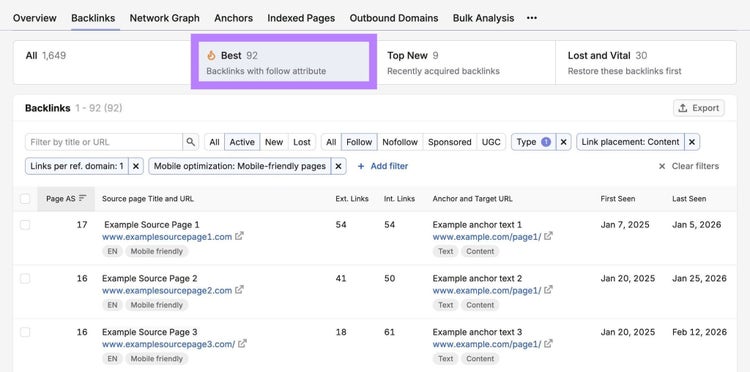
Go through the list and pick out sites that are high-quality and relevant to your content. Then reach out to each one directly, letting them know their current link is broken and asking if they'd be willing to swap it for a link to your working page instead.
Use this template in your outreach:
Subject: Quick question about your [topic] article
Hi [Name],
I was reading your article on [specific topic] while researching [related subject], and I noticed that the link to [broken resource/page name] in your section about [relevant section] appears to be broken.
I thought I’d let you know so you can keep your resource up to date.
I recently published a [type of content] about [your topic] that covers [unique value proposition: original research, updated information, comprehensive guide, etc.]. If you’re looking for a replacement, it may be a helpful alternative for your readers:
[URL]
Either way, thanks for creating such a useful resource. I hope this helps you keep the page updated!
Best,
[Your name]
8. Optimize for Voice Search & AI Conversations
Optimizing for conversational queries increases your chances of showing in answers from voice assistants like Siri or Alexa as well as in AI tools like ChatGPT and Perplexity.
People don’t say, “best CRM software small business”—they ask, “what’s the best CRM for a growing business that doesn’t cost a fortune?”
If your content sounds like a helpful expert explaining something to a friend, you’re far more likely to be quoted or summarized in AI responses.
Here’s how to write conversationally:
- Mirror real conversations. Study how your audience talks on Reddit, Quora, YouTube comments, etc. Use their actual words and phrasing to match how people think and speak.
- Sound human. Write with contractions (“you’ll,” “it’s,” etc.), short sentences, and natural rhythm. If it sounds robotic when you read it out loud, rewrite it.
- Guide the reader with dialogue cues. Use phrases like “Let’s break it down,” or “Think of it like this” to signal where your content is headed.
- Anticipate and address questions. Acknowledge doubts with lines like “You might be wondering why this matters.”
- Test for flow. Read your copy out loud. If it sounds like a smooth conversation rather than a script, you’ve nailed it.
9. Monitor Your SEO Performance
Tracking your visibility across both Google and AI search platforms reveals whether your SEO strategy is actually working and where to focus next.
You can use free tools like Google Analytics to see basic traffic trends.
Semrush’s Position Tracking tool gives you a full picture of visibility in traditional and AI search, allowing you to:
- Track your top keywords. See the terms that drive traffic, leads, or conversions.
- Compare performance on different search models. See how rankings differ between standard Google results, Google AI Mode, ChatGPT, and more.
- Spot trends over time. Monitor performance regularly to catch changes early, so you can adapt.
Position Tracking even includes a summary to help you quickly spot the most important changes.
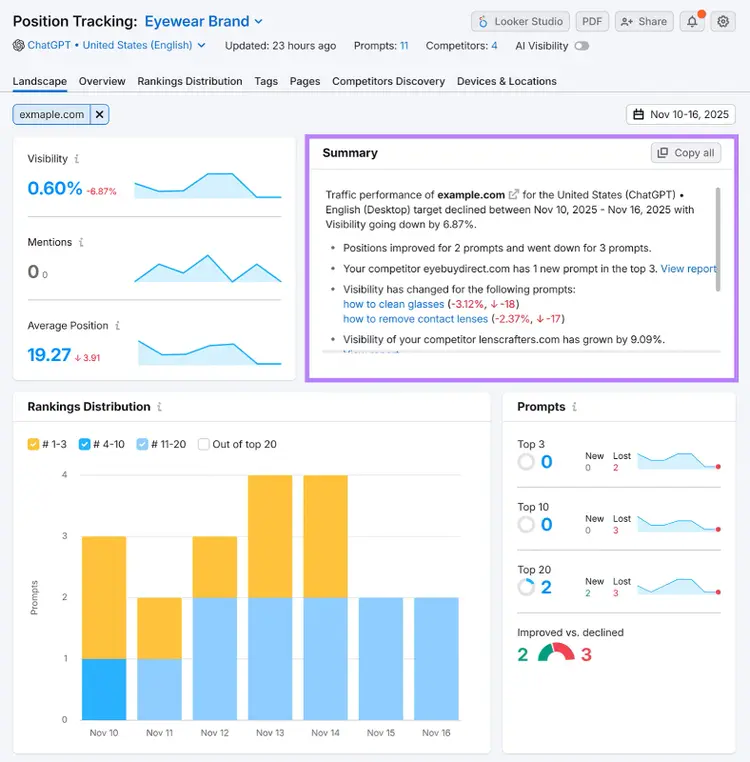
Try Position Tracking today to monitor your performance over time as you implement these SEO best practices.
Monitor Your SEO Performance
with the Position Tracking Tool

Carlos Silva leads the editorial pipeline for the English blog—coordinating writers, editors, strategy, and building AI workflows that boost content quality and AI visibility. With 10+ years of experience writing and editing across in-house and agency roles, Carlos blends content strategy, SEO, and AI to help marketers stay ahead of an evolving search landscape.
Carlos Silva
Carlos Silva leads the editorial pipeline for the English blog and builds AI workflows that boost content quality and AI visibility. 10+ years writing and editing across in-house and agency roles.
Tells Google to show you more from Semrush in AI, Search, and Discover.
Table of contents
-
- 1. Understand What Your Audience Wants
- 2. Focus on Topical Authority
- 3. Structure Content for Search Engines & AI Platforms
- 4. Do Technical SEO
- 5. Showcase Experience, Expertise, Authority, and Trustworthiness
- 6. Optimize Images for Search
- 7. Earn Backlinks from High-Quality Sources
- 8. Optimize for Voice Search & AI Conversations
- 9. Monitor Your SEO Performance