
ChatGPT Is Not Replacing Google—It’s Expanding Search [Study]
As ChatGPT and other generative AI tools continue to accelerate in popularity, one question looms large for marketers: Is ChatGPT replacing Google Search?
To explore this question, we analyzed how people interacted with Google Search after their first ChatGPT interaction.
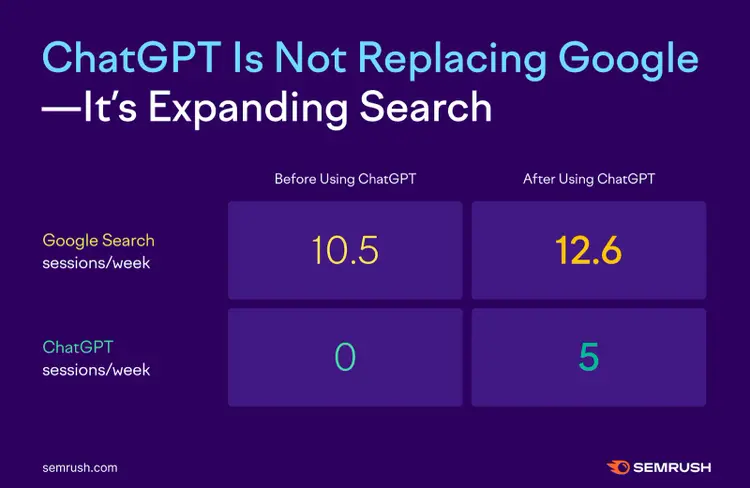
Our findings revealed an interesting pattern: ChatGPT adoption isn’t lowering Google usage—it’s expanding the way people search.
Two Hypotheses: Substitution vs. Expansion
The study was planned to confirm one of two theories that could explain what’s happening now:
- Substitution Hypothesis: ChatGPT adoption pulls users away from Google Search. People “substitute” ChatGPT for how they previously used Google.
- Expansion Hypothesis: ChatGPT adoption does not reduce Google usage. In other words, it simply expands overall information-seeking behavior.
Methodology
We analyzed 260 billion rows of clickstream data between January 2024 and June 2025 to study the Google Search behavior of users before and after their first interaction with ChatGPT.
Note: This clickstream data set is based on an anonymized sample of unique users (panelists) who opted in to share their browsing behavior. This method lets us understand online trends at scale—while keeping individual privacy fully protected.
To understand if (and how much) Google Search activity changed after people started using ChatGPT, we monitored the number of search sessions from each user three months before and after their first ChatGPT session.
- Study group: U.S. users who began using ChatGPT in Q1 2025, with no prior ChatGPT activity in 2024.
- Control group: Users who never used ChatGPT during 2024–2025. This was our baseline for understanding how Google usage might change naturally over time (without ChatGPT adoption).
- Platform & location: Desktop devices in the U.S. only, allowing for consistent session tracking.
- What was measured: Google Search sessions 90 days pre- and post-ChatGPT adoption.
This approach helped us assess whether ChatGPT adoption leads to a change in traditional search behavior, or whether it corresponds with stable or even growing search activity.
Total Search Behavior Expands with ChatGPT Usage
Based on the data, ChatGPT adoption did not reduce Google Search usage.
This supports the expansion hypotheses, meaning people did not substitute their typical Googling with ChatGPT-ing.
In fact, there was even a slight increase in average Google Search usage after ChatGPT adoption.
Google Search Holds Steady
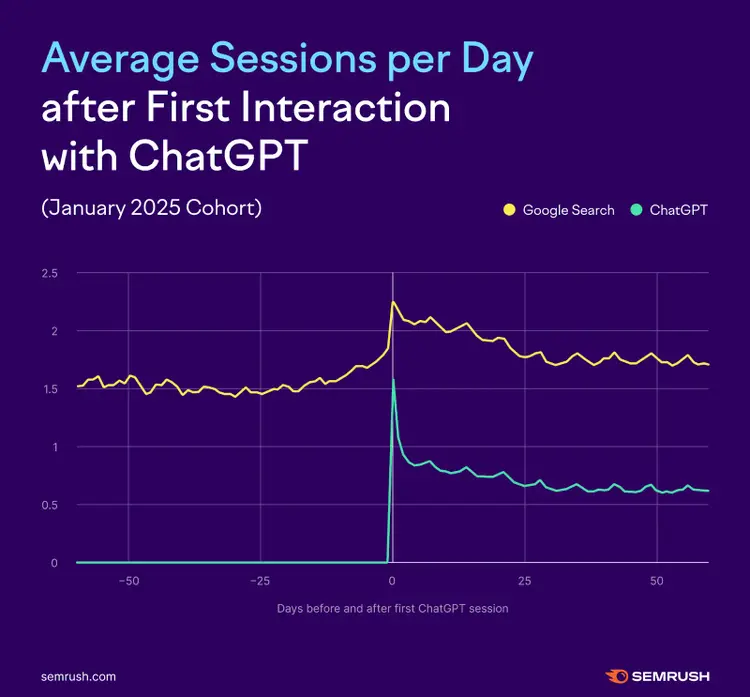
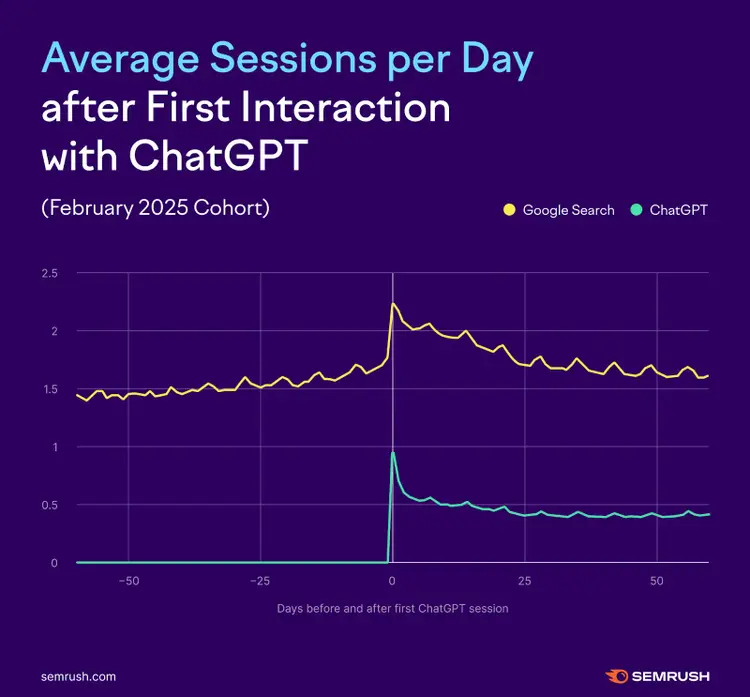
The graphs below illustrate each cohort from the study: those who adopted ChatGPT in January, February, or March of 2025.
The red spike indicates the day of the first ChatGPT session, and the line indicates daily sessions afterwards.
The blue lines represent sessions on Google (before and after the date of ChatGPT adoption).
January 2025 Cohort
February 2025 Cohort
March 2025 Cohort
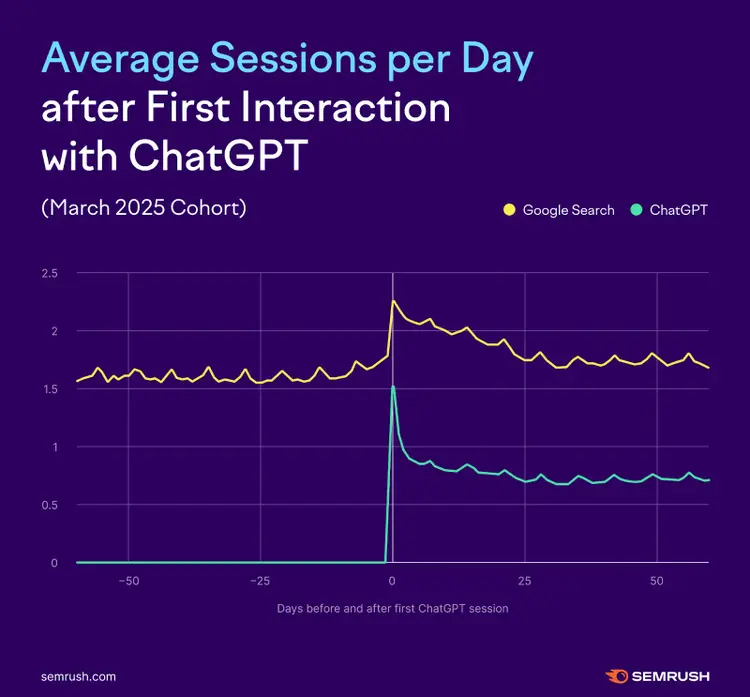
This shows no statistically significant change in daily Google Search sessions once people start using ChatGPT for the first time.
This pattern of steady Google Search usage also held for:
- New ChatGPT users (Q1 2025)
- Long-term ChatGPT users (from January 2024, tracked over 500+ days)
- Users who never used ChatGPT (control group)
Even despite sustained ChatGPT usage after adoption, Google Search usage remained constant.
January 2024 Cohort
These conclusions were also true for a longer cohort: those who started using ChatGPT in January 2024.
For this cohort, we tracked their behavior for 500 days and saw a similar pattern of sustained Google usage, along with stable ChatGPT usage after adoption.
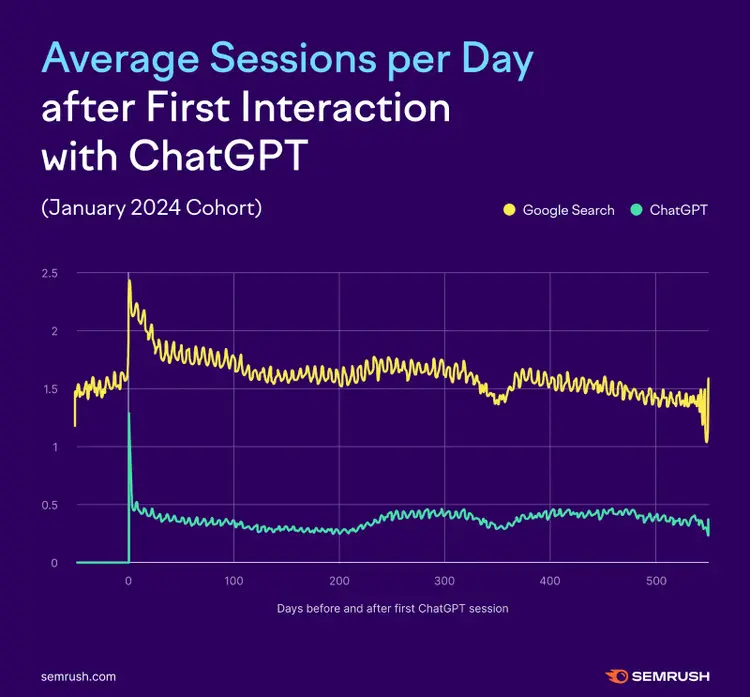
And to confirm that there was no natural variation in Google Search behavior over the same time period, we looked at the control group (people who had no ChatGPT sessions in 2024 or 2025).
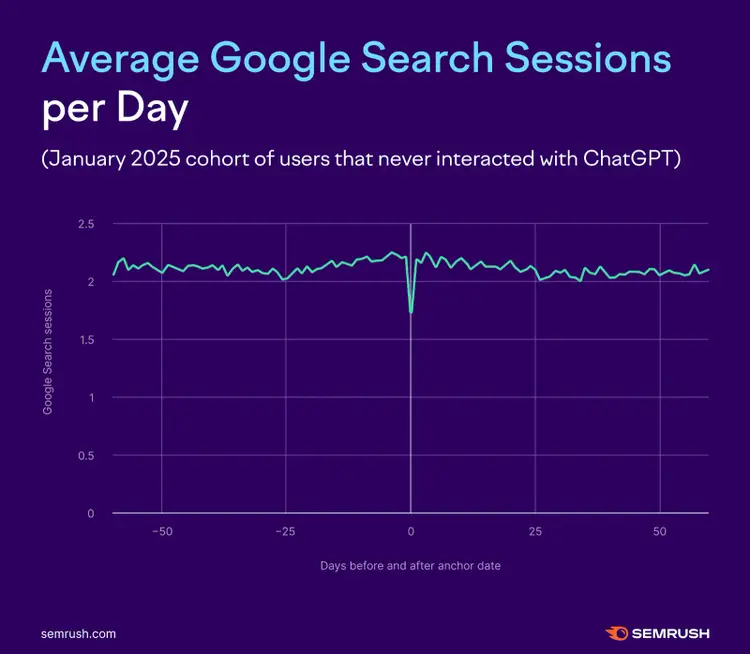
This confirms that Google Search behavior also remained stable for those who never used ChatGPT.
What This Means for Marketing Leaders
It’s still early, but this study supports the Expansion Hypothesis: ChatGPT is not replacing traditional search. But it’s expanding the way people seek information.
For CMOs, the implications are practical and immediate:
- Google is not getting overtaken by ChatGPT. You can invest in both traditional SEO and GEO / AI SEO without fear of one cannibalizing the other.
- Customer journeys are becoming multi-modal. Users accept both ChatGPT and Google, likely switching between them depending on intent and context.
- Generative AI adds new real estate. It’s not replacing old search tools—it’s expanding online exploration and creating more ways to reach people with information.
So, What Should CMOs Do Next?
- Keep investing in SEO. Google Search remains a pillar of digital behavior, despite ChatGPT and AI Overviews.
- Add AI SEO to your content strategy. Marketing efforts for ChatGPT and other AI engines should complement, not substitute, your traditional SEO efforts.
- Monitor channel mix quarterly. Benchmark AI adoption in your specific market. Different audiences adopt ChatGPT and AI engines at different rates. It may be more important in your industry.
The future isn’t zero-sum. Search isn’t dying, and ChatGPT isn’t replacing Google.
They’re coexisting and giving marketers more tools to connect with customers.
Boost Your SEO & AI Performance
with Semrush Enterprise AIO

Luke has over ten years of experience in digital marketing, writing about SEO, AI search, and how to get the most out of Semrush. He spent years building Semrush‘s Knowledge Base, working directly with product teams to explain every tool and feature on the platform so marketers can find the right tools and do better work.
Luke Harsel
Luke leads content for Semrush‘s product-led growth team, creating guides and research that show marketers what‘s possible with Semrush‘s tools.
Tells Google to show you more from Semrush in AI, Search, and Discover.