
How Long Should a Blog Post Be? A Data-Driven Guide for 2024
How Long Should a Blog Post Be?
A blog post should be about 1,500 and 2,500 words long, ideally. This range allows you to cover topics in depth, provide valuable information, and optimize your content for SEO. But, the truth is, the optimal length of a blog post depends on your content goals, audience needs, and search intent.
Longer articles can be effective for in-depth topics.
Shorter articles can work for how-to guides or press releases.
A good content strategy will address both short- and long-form content needs. Let’s examine these factors in more detail and determine the best blog post length for each.
Does the Length of a Blog Post Really Matter?
Yes—but that doesn’t mean longer posts are always better. In reality, your decision on the length of your blog post should primarily depend on the search intent.
That is, you should provide the blog post length that best serves your audience’s needs.
Your main objective is to answer your audience’s questions. This means investing time to understand them and the amount of information they need.
The Optimal Blog Post Length for Various Content Types
Our research suggests that articles with 3,000+ words generate the most organic traffic. However, other metrics, such as social shares, follow a different logic.
Let's look at the suggested blog post length based on specific blog post types and formats.
Is There an Ideal Blog Post Length?
In reality, success is mostly down to the quality of your content and how comprehensively you cover your topic, not necessarily a specific length.
By way of illustration, if we enter "how to scale a startup" as a keyword phrase into our Keyword Checker, we see that a blog post by Integrio ranks at the top of the list.
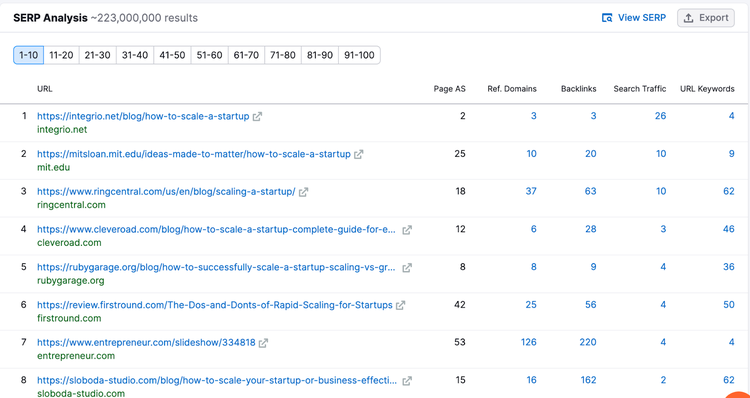
If we run a word count on the post, we can see that it is 1,997 words.
However, the second one in the list, published by the Sloan School of MIT Management, is almost 75% shorter at 554 words.
The third, from RingCentral, is much longer: over 3,200 words.
This illustrates the extent to which the length of your blog post can vary but still be highly ranked by search engines.
How To Determine Your Blog Post Length in 3 Steps
As we mentioned above, the ideal length for your blog post is determined by a number of factors. This section explains the steps you should take to get there.
1. Establish your goal
Great content marketers don’t simply start writing blog posts; they first invest time in strategy and planning.
Start with establishing your goal for writing the blog post and assess how it helps you achieve your bigger business objectives.
If you don’t have a clear goal, you might end up writing content just for the sake of writing, without generating any meaningful business results.
Different types of goals for blog posts can include:
- Ranking highly in search engine results
- Getting shared on social media
- Generating leads and conversions
- Getting trials after communicating a new product launch
Eventually, knowing the goal of your blog post will help you make initial considerations about the content length.
For example, ranking on Google might require a detailed answer to a question, while a product-announcement article should get straight to the point.
2. Define your audience
Your understanding of the intended audience is another factor that can help decide how long your blog post should be.
Different audiences consume content in different ways and require different depths of knowledge.
Think about the following questions:
- Are you writing for experts who require no introduction or context to understand your topic?
- Or are you writing for amateurs who need to get the bigger picture before going into advanced details?
For instance, if you are writing for a buyer persona who is perennially short on time, consider making your articles as concise and focused on one idea as possible.
In the example below, we used Semrush’s free Buyer Persona tool to create a fictional buyer persona profile for “Alma,” a graphic designer who wants to make a career shift.
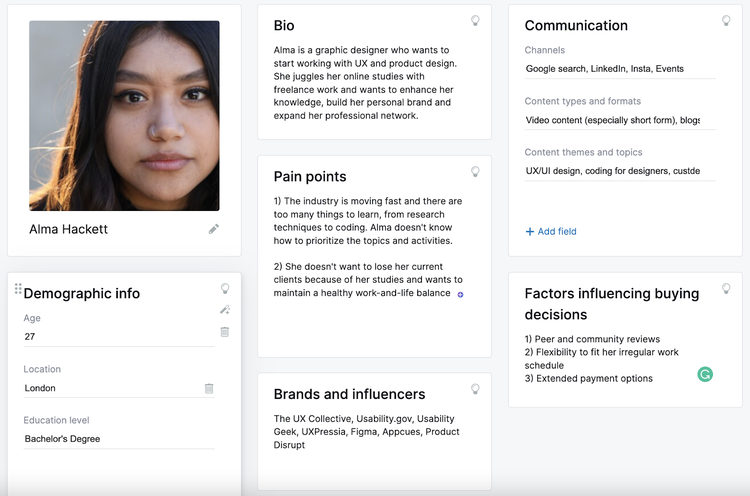
In Alma’s case, we can see that she prefers visual and shorter-form content, so you’d make sure to include graphics and distribute your content on platforms such as Instagram.
3. Focus on search intent, not word count
Search intent refers to the primary objective someone has when they type a keyword into a search engine or look for something online.
In the same way that every blog post should have a clearly defined goal, each piece of content should correspond with specific search intent.
The principal categories of search intent are:
However, there's more to it.
Analyzing search intent should also involve assessing the main characteristics of content ranking for your target keyword. This includes the following:
- The length of the blog post
- The tone of voice used in the article
- The questions and subtopics addressed in the article
- The structure of the blog post (e.g., blog format, heading depth, and presence of lists)
- The visuals and other elements on the page
Here's how to analyze search intent:
For instance, imagine you want to create an article targeting “revenue operations."
1. First, Google your target keyword and analyze content ranking on page one.

2. Then, analyze the elements you see on the SERP (search engine results page). Look at the Featured Snippet and the "people also ask" section, and examine the titles of the top-ranking blog posts.
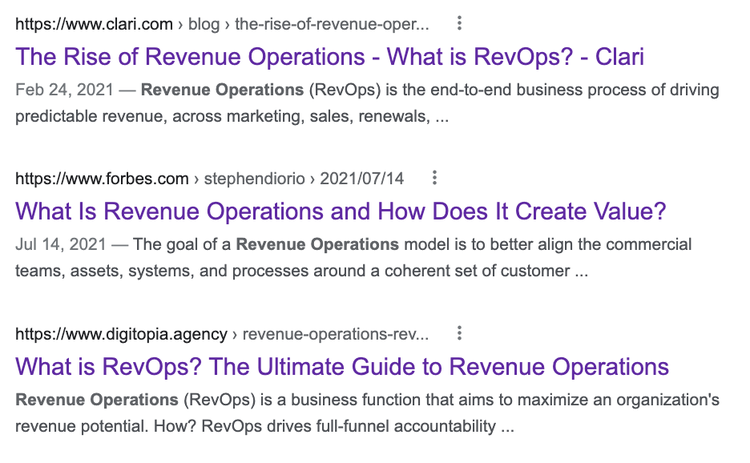
3. Finally, manually inspect 5-10 articles ranking on page one. Try to identify common patterns, such as subtopics mentioned in the blog posts, their structure, visuals, and average length.
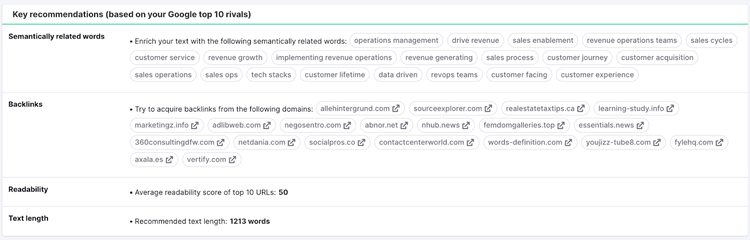
Identifying the optimal blog post length based on your top 10 rivals
If you’d like to partially automate this process and get more data-driven insights, use the SEO Content Template tool.
First, enter your target keyword and select the target geographical area (up to the city level) and device type.
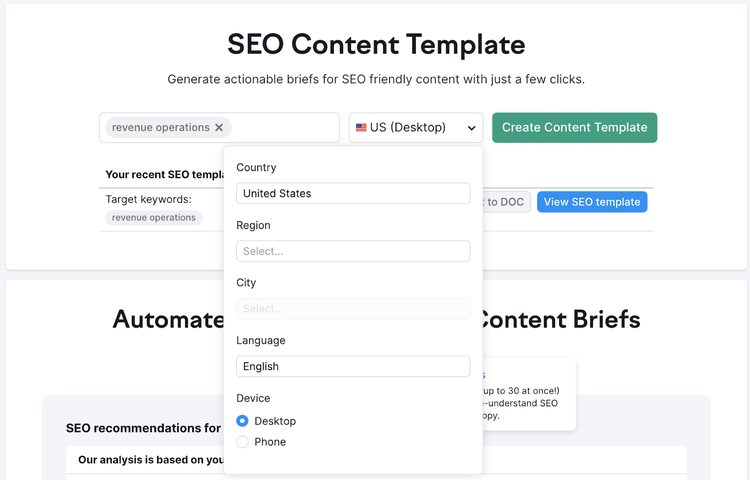
Next, you will see a list of recommendations for your content based on your top 10 organic rivals. These include the content length, readability level, and semantically related content.
What Is the Ideal Blog Post Length for SEO?
Our research from the State of Content Marketing Global Report 2022 finds that length does correlate positively with organic views.
As you can see from the table below, posts with 3,000+ words get 138% more page views than those with less than 500 on average. Longer-form content also tends to generate more backlinks.
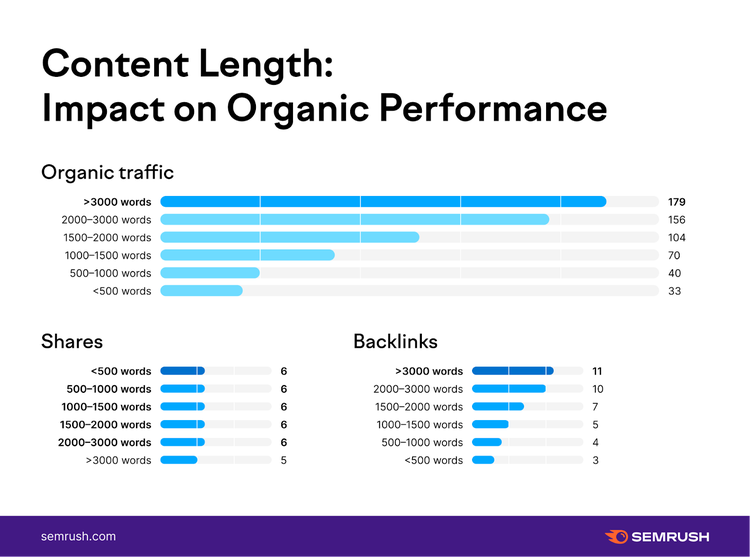
This is usually connected to the long-form content being more comprehensive and sharing multiple valuable details.
However, as we saw earlier, making your content longer only makes sense when it’s necessary to cover the topic fully.
The Pros and Cons of Long-Form Blog Posts
So, what are the main advantages and disadvantages of writing long-form content? Explore the table below to find out.
Final Words
How long should a blog post be in 2024?
The most constructive response is, “As long as it needs to be.”
The primary objective of writing blog posts is to answer your readers' questions and help them solve their problems.
So, the optimal length of your blog posts should be determined by the needs of your audience and their search intent.
Download Your Free Blog Post Quality Checklist
Explore actionable tips for consistently producing content that is relevant and engaging.

Margarita is a passionate Content Marketer with over 6 years of experience in various tech industries and 3 countries. She also holds two MBA degrees in Marketing.
Tells Google to show you more from Semrush in AI, Search, and Discover.
Table of contents
- How Long Should a Blog Post Be?
- Does the Length of a Blog Post Really Matter?
- The Optimal Blog Post Length for Various Content Types
- How To Determine Your Blog Post Length in 3 Steps
- 1. Establish your goal
- 2. Define your audience
- 3. Focus on search intent, not word count
- What Is the Ideal Blog Post Length for SEO?
- The Pros and Cons of Long-Form Blog Posts
- Final Words