
What Are Google AI Overviews?
Google AI Overviews are AI-generated summaries that show for certain queries to help users get quick and concise answers to their questions. And they often show at the top of search results.
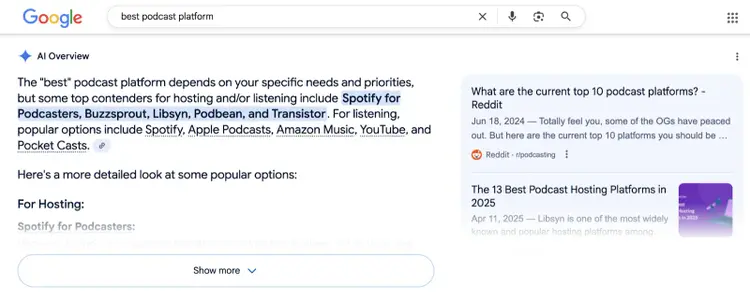
AI Overviews pull information from multiple web sources and usually include:
- A short answer to the user’s query
- A more detailed explanation users can read by clicking on a “Show more” button
- Links to sources for the information provided
AI Overviews are particularly common for informational queries users enter when they’re trying to learn more about a topic.
Why Ranking in AI Overviews Matters for SEO
Ranking in AI Overviews matters for SEO because getting your site’s content featured within AI Overviews can result in significant exposure for your brand.
It can help establish you as a trusted industry source. And this can result in more backlinks (links from other sites that point to your site), an increase in branded searches, and improved overall credibility.
As Google continues prioritizing AI-powered results, getting your site included in AI Overviews can also help you future-proof your SEO strategy and may help to preserve some of your organic traffic.
How to Rank in Google AI Overviews
To rank in Google’s AI Overviews, follow these steps:
1. Focus on Long-Tail Informational Queries & Semantic Relevance
AI Overviews can use something called the query fan-out technique that involves submitting numerous related queries at once, which means it’s a good idea to focus on long-tail terms and associated subtopics.
Gaetano DiNardi, Growth Advisor and Principal Consultant at Marketing Advice, puts it this way:
The AI system expands the query behind the scenes and looks for semantically relevant passages that match a range of intents—not just keyword matches.
Here are a few examples of complex and multi-part questions that AI Overviews usually try to answer:
- “Why is my cat suddenly hiding and not eating?”
- “How do you stop Chrome from automatically translating websites?”
- “Can you take melatonin and magnesium at the same time?”
You can use Semrush's Prompt Research report to identify these types of queries.
Simply type in a broad term related to your business, choose a suggested topic, and click “Analyze.”
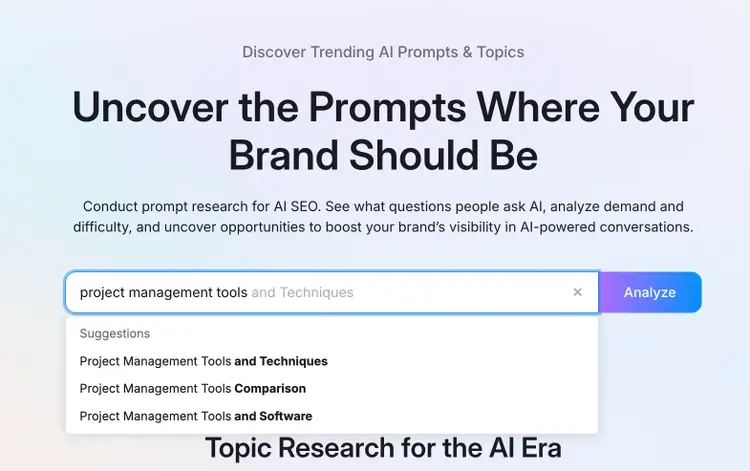
At the top of the report, switch the filter from “All AI Platforms” to Google AI Overviews for platform-specific insights.
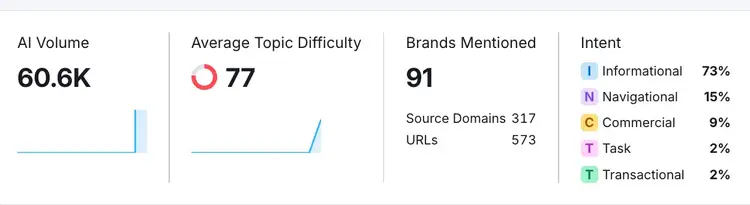
For the broad topic, you’ll find the:
- Total AI Volume: The estimated demand for the topic.
- Average Topic Difficulty: How competitive it is to gain visibility in that topic.
- Brands Mentioned: The number of brands cited in AI responses.
- Intent Breakdown: The distribution of user queries by purpose. For example, for example, looking for information (informational), comparing options (commercial), or ready to buy (transactional).
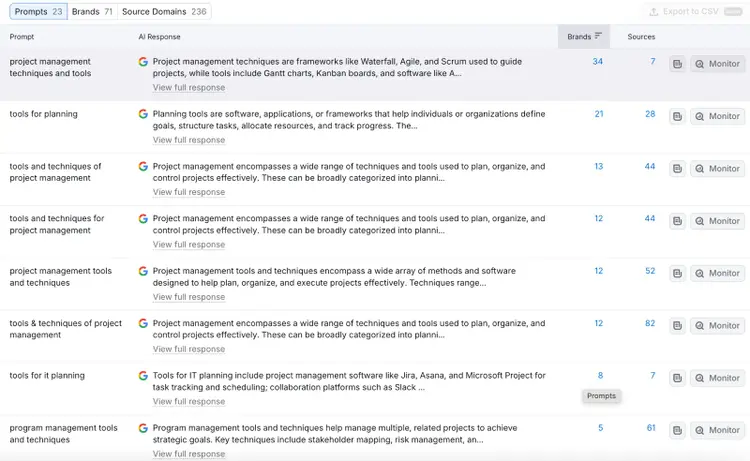
Scroll down to find a detailed breakdown of prompts related to your topic. Each row shows:
- Prompt: The exact question users asked.
- AI Response: A preview of how the platform answered the prompt.
- Brands: The number of brands mentioned in that response.
- Sources: The domains or URLs cited as evidence.
Keep in mind that you don’t need to create a separate page to target each question-based prompt.
Instead, group related prompts into a single page. For example, a page on “Project Management Tools and Techniques” might include answers to the following question-related prompts from Prompt Research:
- What are the most effective project management tools for team collaboration?
- How do project management techniques vary across different industries?
- Can you recommend some project planning techniques for beginners?
2. Structure Your Content Thoughtfully
Structuring your content well and making the information easier to extract will increase your chances of getting featured in AI Overviews.
To present information in a way that’s clear and scannable, you can:
- Break up your content into logical, scannable sections. Structure your content so that every major idea has its own section, ideally with an H2 or H3 heading about every 200 words.
- Start each section with a concise summary paragraph. Every H2 or H3 section on your page should start with a short paragraph that answers the question posed in the heading or offers the most important information upfront.
- Make each block of text self-contained. AI Overviews often include references to a single paragraph from a page, so make sure each block of text can stand on its own when isolated from the rest of the page.
Gaetano elaborates on why self-contained passages are so important:
The query fan-out expands on the original search by triggering related, implicit, and expansive queries to dig for the most semantically relevant chunks—passages—from an array of different webpages to build a comprehensive answer.
3. Implement Relevant Schema Markup
Implementing structured data helps Google understand your content, and that can help Google better match your content to relevant queries that trigger AI Overviews.
Use structured data markup that accurately reflects what’s on the page to give yourself the best chance of being cited.
Here are a few common schema types you should consider implementing:
- FAQPage: Used for properly formatted FAQ sections. FAQPage schema allows Google to identify question-answer pairs.
- Article: Provides context about an article’s content, author, and publication date
- Product: Helps to highlight details like availability, pricing, and reviews on product-focused pages
- Review: Used to indicate ratings or reviews
4. Create Unique, High-Quality Content
Google’s AI Overviews favor content that’s trustworthy, credible, and genuinely useful.
You need to offer insights or perspectives that can’t be found elsewhere, such as:
- Original research or analysis: Add your own take on trends, data, or comparisons
- Expert commentary: Include quotes or insights from subject matter experts
- Personal experiences: Share observations or stories that show you have first-hand experience with the topic
When you’re including third-party information, cite trusted external sources.
A study on generative engine optimization from the Indian Institute of Technology Delhi and Princeton University found that citing authoritative sources can improve visibility in AI-generated answers.
Give preference to government websites, educational institutions, and industry-leading publishers (e.g., Harvard Business Review).
And make it easy for Google to understand where the information is coming from by including both the source name and a link.
5. Prioritize Crawlability
Making your content crawlable is crucial for appearing in AI Overviews. Because Google needs to be able to access your content to cite it.
Here’s how to ensure your site’s content is crawlable:
- Avoid blocking important pages. Make sure you’re not accidentally blocking important pages using your robots.txt file or noindex tags.
- Don’t use JavaScript to render critical content. Content that’s hidden behind JavaScript can be more difficult for crawlers to access.
- Fix broken links and redirect chains. Having broken links and redirect chains on your site and disrupt crawling and signal to Google that your site is poorly maintained, so prioritize fixing them.
- Submit and maintain a sitemap. A sitemap helps Google and other search engines find all the pages on your site more easily. Submit your sitemap via Google Search Console to help Google crawl your content more quickly.
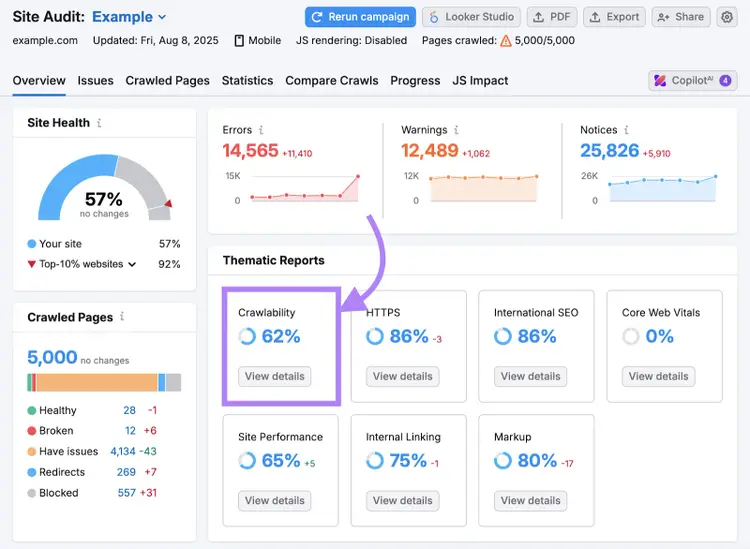
A free SEO audit flags basic crawl signals like robots.txt or noindex tags. To check your full site for crawlability and indexability issues, use Semrush Site Audit.
Simply visit the Crawlability report by clicking on “View details” in the appropriate section under “Thematic Reports.”
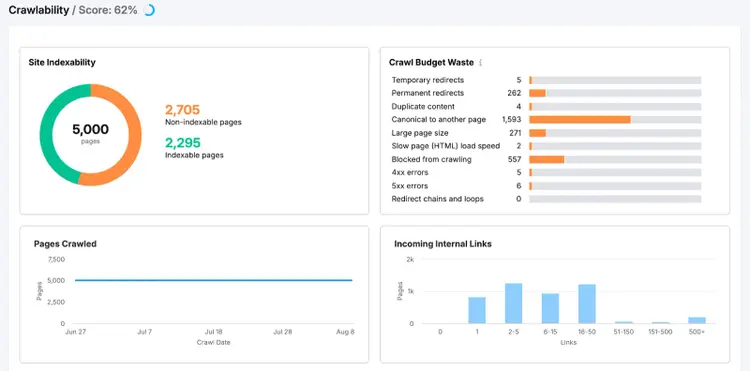
Here, you’ll be able to see a list of issues that could decrease your visibility in search results and AI Overviews. You can then click on each one to see a list of pages containing that issue.
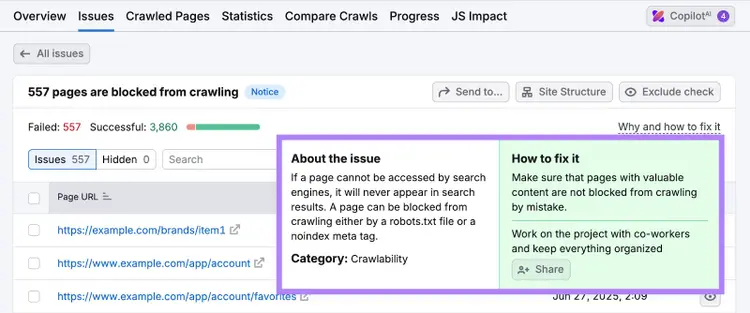
From the list of pages, you can click on the “Why and how to fix it” link to learn more about the issue.
6. Refresh Outdated Content
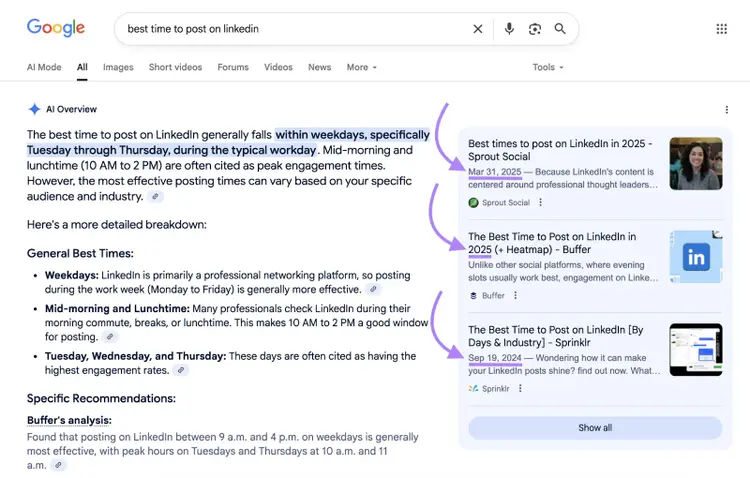
Google’s AI seems to favor recent information, so refreshing your content regularly is crucial.
When updating content, prioritize any pages that already rank in the top 10 search results for informational keywords. According to our recent AI-focused study, about 67% of URLs that appear in AI Overviews also appear in the top 10 Google Search results.
This means URLs on the first page of search results currently have the highest potential of being featured in AI Overviews.
Jeremy Moser, CEO at uSERP, confirms seeing this first-hand with his agency’s clients:
The biggest focus should always be looking at your current best-performing content. Content is rarely to never featured in AI Overviews if it doesn’t rank first page.
Here’s how to update these pages:
- Replace outdated statistics. Check for any outdated statistics and replace them with newer ones (ideally, no older than 12 months).
- Add new subtopics. Expand your content by covering relevant subtopics, especially if these subtopics are based on any trending queries.
- Update the publish date or indicate recent modifications. Show Google that your content is fresh by also updating the publish date (or the “Last Modified” date if you display one) whenever you make any meaningful changes.
7. Build Your Authority
Demonstrating you’re an authority on the subject will increase your chances of getting featured in an AI Overview.
For Google, one of the biggest signs of authority is having your website linked to from other trusted sites. And simply having your brand mentioned (without a link) matters for gaining visibility in AI Overviews, according to Jeremy:
AI Overviews still pull from trusted, well-cited sources. If your brand isn’t mentioned in forums, communities, or round-up articles, it’s unlikely to be recommended by AI.
Here’s how you can build more links and brand mentions for your site:
- Write guest posts. Reach out to reputable sites in your industry and offer to write guest posts for them. You’ll certainly be mentioned, and you might also be able to get backlinks.
- Publish original research. Do a study on a relevant topic your audience cares about and publish a report discussing your findings to naturally attract links and mentions.
- Contribute to expert roundups. Find opportunities to be featured in articles that compile expert opinions on a topic related to your industry
- Be a guest on podcasts. Find popular industry podcasts and reach out to the hosts to see if they might be interested in interviewing you
- Serve as an expert source for journalists. Connect with journalists looking for expert insights and quotes through platforms like Qwoted and Featured. This can help you earn media mentions in high-quality publications.
How to Measure Your AI Overview Performance
You can measure your AI Overview performance by monitoring overall visibility shifts and tracking your AI Overview rankings.
Some brands have noticed that ranking in AI Overviews caused a decrease in their site traffic.
Like how Glenn Gabe, an SEO and AI search consultant, notes how Wikipedia has seen an 8% decline in traffic compared to the same months in 2024. Due to generative AI (like AI Overviews).

But other important metrics like brand awareness and visibility can increase for brands that appear in AI Overviews. So, you can still reach your audience by ranking in AI Overviews.
Here are two ways to measure your AI Overview performance:
Monitor Overall Visibility Shifts
You can track indirect signals like impressions, average position, and clicks in Google Search Console to get a better idea of your site’s performance in AI Overviews.
Here’s how:
- Impressions and clicks: If you’re seeing increased impressions in Google Search Console but no increase in clicks, your content is potentially being cited in AI Overviews. Especially if you see this happening for informational queries (e.g., “how to,” “what is,” etc.).
- Average position: If your search engine rankings are stable or improving while clicks through decrease, there’s a chance your content is being cited in AI Overviews without users clicking through to your site
Keep in mind that Google Search Console doesn’t differentiate between traditional search and AI Overview data, so you’ll have to spend some time analyzing results.
Track Your AI Overview Rankings
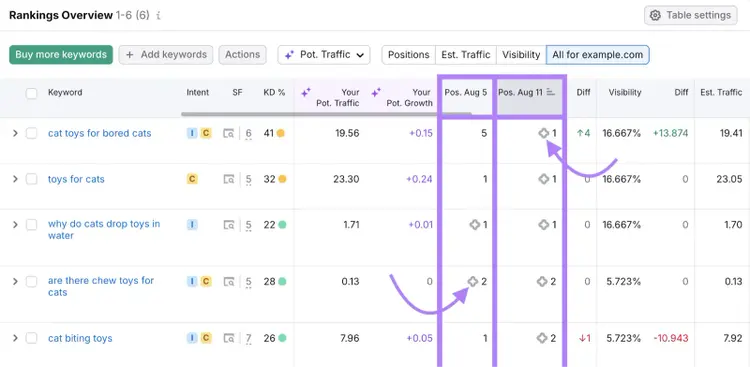
Use Semrush’s Position Tracking tool to see whether your content is appearing in AI Overviews and how that visibility changes over time.
After adding the keywords you’d like to track, visit the “Overview” tab and use the “SERP Features” drop-down filter to select the circle next to “[domain] ranks” and then “AI Overview.”
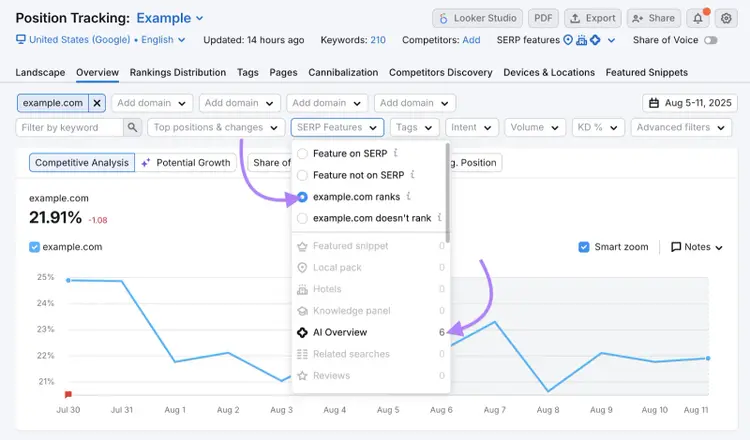
This will filter the list to only show keywords you’re tracking that are currently triggering AI Overviews you appear in.
Future-Proof Your SEO Strategy
AI Overviews are changing how people discover online content.
While SEO fundamentals still apply, ranking for AI Overviews requires a mindset shift. The goal is now to improve structure, relevance, and credibility to increase the chances of getting cited.
Want to see where your site stands?
Use Semrush’s Position Tracking tool to see whether you’re appearing in AI Overviews for relevant queries.
Track Your AI Overview Visibility
with the Position Tracking Tool

Zach Paruch is a data-driven SEO strategist with 10+ years of experience driving organic growth through smart, scalable search strategies. His expertise includes on-page and technical SEO, AI search optimization, and content strategy—with a special focus on ideating and implementing AI-driven processes. By leveraging in-depth search intent analysis, refined information architecture, and user-centered design, Zach consistently delivers high-impact content that drives business outcomes.
Zach Paruch
Zach Paruch is a data-driven SEO strategist with 10+ years of experience driving organic growth through scalable search strategies. He specializes in on-page and technical SEO, content strategy, AI search optimization, and AI-driven processes.
Tells Google to show you more from Semrush in AI, Search, and Discover.