
Marketers can’t track AI prompts the same way they track rankings.
AI systems give probabilistic responses that change even when users enter the same prompt. So, you’ll need a different tracking approach.
We'll define prompt tracking, show why it matters for buying decisions (not just visibility), and walk through how to build a focused prompt portfolio that maps to real business outcomes.
What is prompt tracking?
Prompt tracking is the process of monitoring the prompts users enter into AI systems and the responses those systems generate. Sometimes called search prompt monitoring, it differs from rank tracking, which monitors a site's organic listing positions on search engine results pages.
AI systems rarely say things the same way twice, which makes tracking exact wording futile. But the substance of these responses — which brands get mentioned, which sources get cited — trends in patterns over time. Those patterns are what's worth tracking.
To set up prompt tracking for your brand, follow our LLM prompt tracking guide.
Further reading: How to do prompt research for AI SEO
Why prompt tracking matters
Prompt tracking shows you how AI systems represent your brand at the moments customers are deciding what to buy, so you can shape that representation to win the sale. It differs from AI visibility tracking, which measures your brand's overall prominence in AI responses without distinguishing between high-value and low-value mentions.
Let’s say you manage prompt tracking for running shoe brand ACME Shoes. You discover that users have been typing two prompts: “how to prevent injury while running” and “where to buy acme shoes.”
Of the two prompts, "where to buy acme shoes" has greater conversion potential and is worth tracking more closely. Users have decided to get your shoes and just want to know where to buy them. Give them this information (by publishing your stores' locations on your site, for example) and you're well positioned to close the sale.
In contrast, "how to prevent injury while running" has much lower conversion potential. People asking "how to prevent injury while running" are still looking for a solution that might not involve buying running shoes at all, much less yours. If you're prioritizing prompts with high business weight, this one is a low-priority track.
The prompt portfolio framework
Your prompt portfolio is a small, focused set of prompts organized by business impact, not vanity visibility. It covers four types: revenue, reputation, competitor, and gap prompts. Each captures a different signal that maps to growth. Tracking 25 well-chosen prompts beats tracking 500 random ones.
Here’s an example of a prompt portfolio for a hypothetical software-as-a-service company:
Now, let’s look at the four prompt types in more detail.
Revenue prompts
Revenue prompts capture moments when users are deciding what to buy and your brand's offerings could be the answer.
Prioritize revenue prompts because they directly impact your bottom line, especially when they mention your brand or offerings by name. That's a signal the user is considering you specifically over competitors.
Examples of revenue prompts are:
- “best [product] for [problem]”
- “[your product] vs [competing product]”
- “is [your product] worth it”
Tracking revenue prompts shows you what AI systems say about your brand at the buying moment, so you can refine that narrative to drive conversions.
Reputation prompts
Reputation prompts reveal the AI narrative about your brand — the story users encounter when they ask AI systems about your reputation, pricing, or quality.
Examples of reputation prompts are:
- “what do people think about [your brand]”
- “is [your product] overpriced”
- “what makes [your product] so effective”
Tracking reputation prompts lets you monitor the AI narrative about your brand and take action when it doesn't reflect reality.
For instance, if an AI system describes your brand negatively when users ask "what do people think about [your brand]," those users will form a poor impression and likely move on to competitors.
To address this, find the sources AI systems cite for the negative information and respond on those platforms with accurate context. You can also publish a corrective on your own site that AI systems may pick up over time.
Competitor prompts
Competitor prompts mirror revenue prompts but center on your competitors. They reveal whether AI systems present your brand as a relevant alternative when users research competing products.
Examples of competitor prompts are:
- “[competing product] vs [your product]”
- “is [competing product] or [your product] better for [problem]”
- “alternatives to [competing product]”
By tracking competitor prompts, you'll identify the areas where your brand loses out, so you can sharpen your positioning to grow market share.
Gap prompts
Gap prompts surface conversations where your competitors get mentioned and your brand doesn't. Each gap is an opportunity to grow brand awareness and capture new sales.
Unlike revenue prompts and competitor prompts, where your brand is already part of sales conversations, gap prompts indicate conversations you’re entirely absent from.
What makes a prompt a "gap" isn't always the wording itself but the AI response: your brand is missing.
Examples include:
- "[competing product] vs [another competing product]"
- "affordable [product] for [problem]"
- "switch from [competing product]"
Identify gap prompts so you can invest in content and channels that influence buying decisions.
When prompt tracking is (and isn’t) worth it
Prompt tracking is a tool, not a KPI. It's worth doing only if you can collect meaningful data, interpret it, and act on it.
For example, prompt tracking is worth it if:
- You curate a representative prompt portfolio. Your prompts should reflect how users typically use AI systems to get information about your brand and offerings.
- You're actively producing content. An active content engine lets you publish quickly to fill the gaps prompt tracking uncovers.
- You can publish where AI systems look. Open web pages, public forums, third-party review sites, and social media are all fair game. Content locked behind logins or paywalls won't influence AI responses.
In contrast, prompt tracking isn’t worth doing (yet) if:
- You want a single reporting number. Effective prompt tracking involves tracking multiple metrics, and you’ll need to interpret them holistically to get useful insights.
- You expect week-to-week stability. AI system responses are non-deterministic. Trying to figure out why they're worded differently each time (even when they feature your brand) is a waste of resources.
- Your site doesn't have SEO fundamentals in place. AI systems often cite sites with strong organic search visibility, so a site that isn't ranking well in search will struggle to appear in AI responses. Address SEO basics first before optimizing for AI systems.
How to read prompt data
To read prompt data, look for three signals that show whether your brand is gaining authority: more frequent mentions, mentions that progress to citations, and citations that hold up over time.
Here’s more information on each signal:
- Mention frequency: How often user prompts and AI responses mention your brand. This is the baseline for whether your brand is top of mind in relevant buying decisions. Observe the long-term trend rather than fixed snapshots, and remember that frequency alone doesn't indicate sentiment.
- Movement from mentions to citations: Whether AI systems are citing your brand, not just mentioning it. As your authority grows, your brand progresses from being named to being a source worth citing. Check that those citations come from sources that influence buying decisions, not just any high-traffic site.
- Citation frequency: How often AI systems cite your brand across multiple runs of similar prompts. This signal shows how durable your citations are despite the probabilistic nature of AI responses. Durability alone doesn't tell you why you're being cited, though. The reason could be your authority, or it could be a lack of authoritative competitors.
Turning prompt data into action
Turn prompt data into action by executing on- and off-site content strategies that position your brand as one worth mentioning, citing, and buying from.
These content strategies fall into one of three types:
- Source strategy: Identify the platforms AI systems source from when responding to prompts in your category. Then build a credible presence on those platforms. Not as brand promotion, but as genuine participation. For example, if AI systems often cite Reddit, contribute substantive answers to industry threads (with affiliations disclosed), publish on Quora or Stack Exchange, or earn coverage on the third-party review sites that show up in your tracked responses.
- Gap closure: Once you've identified prompts where competitors appear and you don't, insert your brand into the conversation. If your brand rarely appears in prompts about alternatives to a specific competitor, create comparison content that positions your offering as a viable alternative.
- Narrative correction: When the AI narrative about your brand is inaccurate or missing context, address it at the source. For example, if AI responses cite negative Google reviews about a recent price hike but don't include your reasoning for it, reply to those reviews with the context. As AI systems incorporate that context, their descriptions of your pricing become more complete and accurate.
To research and track prompts, use Semrush’s AI Visibility Toolkit.
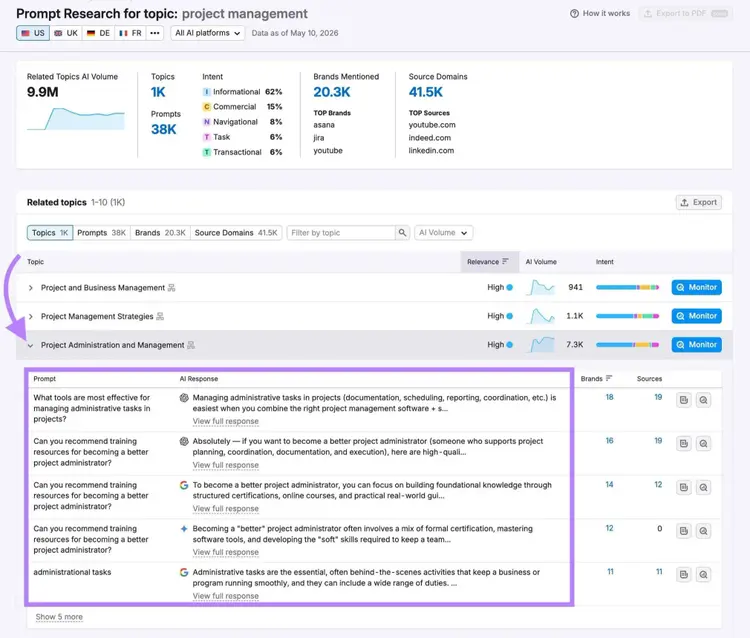
First, use the toolkit’s Prompt Research tool to research and shortlist prompts based on the prompt portfolio framework.
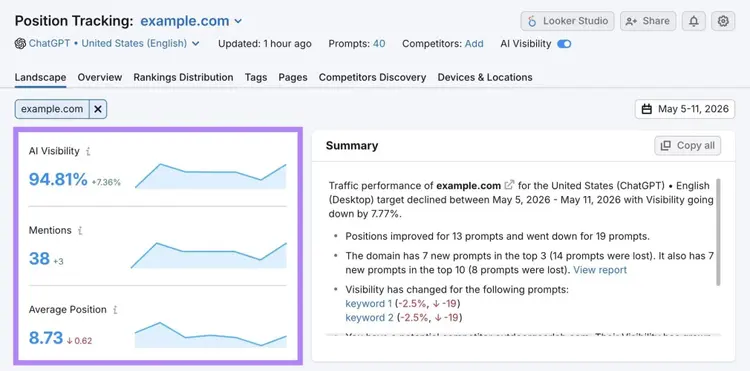
Once you’ve identified these prompts, set up the AI Visibility Toolkit’s Prompt Tracking tool to automatically track them over time.
Try AI Visibility Toolkit for free:
Track AI prompts effortlessly
with the AI Visibility Toolkit

Zach Paruch is a data-driven SEO strategist with 10+ years of experience driving organic growth through smart, scalable search strategies. His expertise includes on-page and technical SEO, AI search optimization, and content strategy—with a special focus on ideating and implementing AI-driven processes. By leveraging in-depth search intent analysis, refined information architecture, and user-centered design, Zach consistently delivers high-impact content that drives business outcomes.
Zach Paruch
Zach Paruch is a data-driven SEO strategist with 10+ years of experience driving organic growth through scalable search strategies. He specializes in on-page and technical SEO, content strategy, AI search optimization, and AI-driven processes.
Tells Google to show you more from Semrush in AI, Search, and Discover.