
How to track AI Overviews with Semrush
AI Overviews now appear prominently in Google’s search results for over 50% of queries in Semrush Sensor. Tracking what that does to your traffic and SEO performance requires a system.
Since Google Search Console rolls AI Overview clicks and impressions into your overall performance data, there's no easy way to pull that data out. Semrush changes that.
It tracks AI Overviews in five key areas.
You’ll see:
- Where AI Overviews appear for keywords you already rank for
- Which AI Overview keywords you're missing
- How often Google mentions or cites your brand in AI Overviews, broken out by topic
- How your AI Overview visibility stacks up against competitors
- Whether your visibility is improving or declining day to day
Step 1: Assess AI Overviews’ impact on your search visibility
To assess AI Overviews' impact on your search visibility, start by identifying how often they appear for keywords your site already ranks for.
This establishes your current AI Overview exposure: the portion of your organic keyword footprint where an AI-generated answer could affect what searchers see and click.
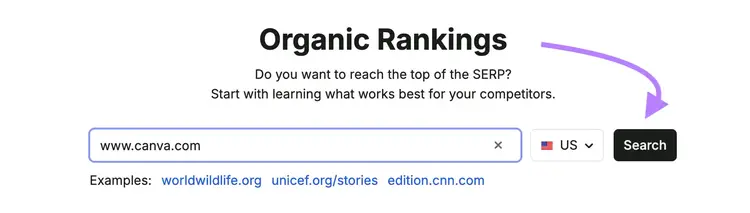
Open Organic Rankings and enter your domain.
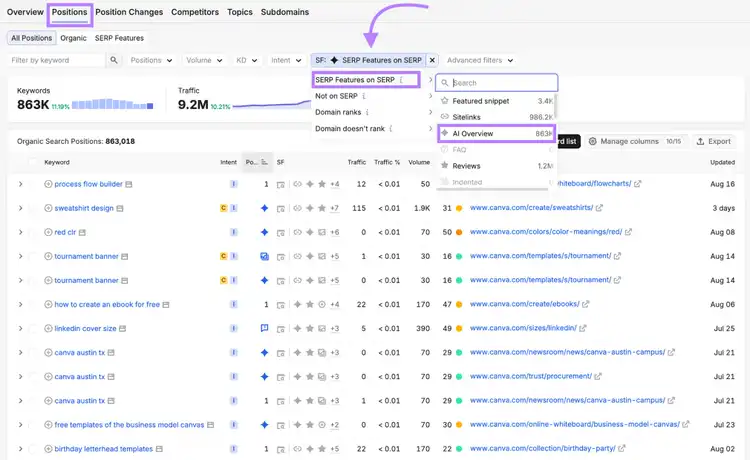
Go to the “Positions” tab. Then click the “SERP Features” drop-down and select “SERP Features on SERP > AI Overview.”
The report will show all the keywords your domain ranks for where an AI Overview also appears on the results page.
In this case, canva.com ranks for a total of 863K keywords (as of August 2026) that feature an AI Overview in Google’s results.
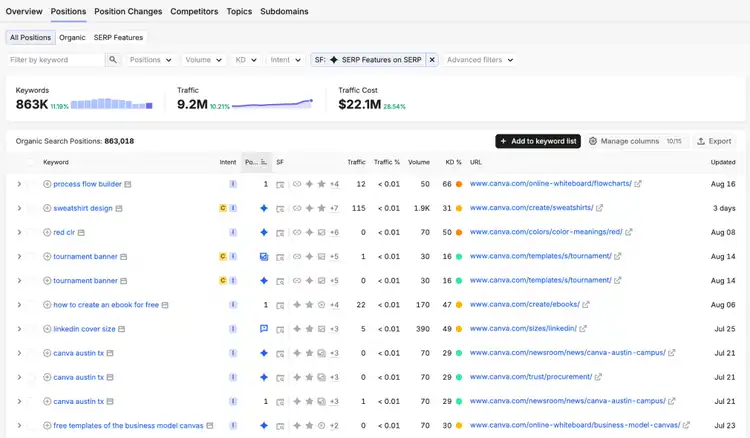
This doesn’t mean your site is featured in those AI Overviews. It just shows you how many AI Overviews appear for searches where you already have some organic rankings.
To see the number of searches where your site is featured in AI Overviews, click the “SERP Features” drop-down and select “Domain ranks”>“AI Overview.”
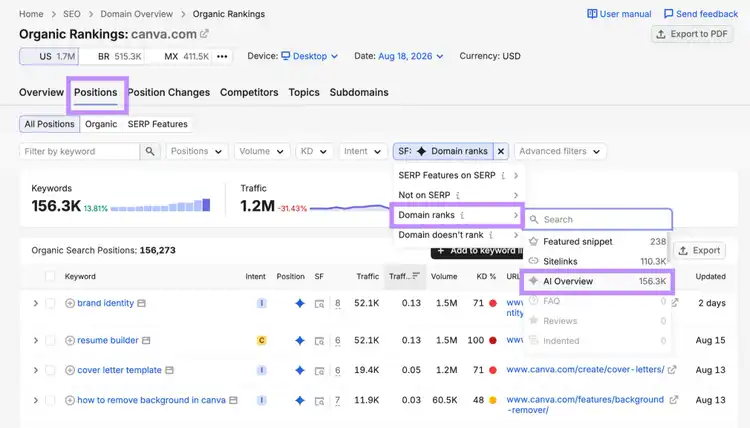
From here we can see that canva.com ranks within 156.3K AI Overviews. There’s also an option to filter specifically for “Domain doesn’t rank” >“AI Overviews.”
Use these filters to identify:
- Queries where you rank prominently but aren’t cited in the AI-generated response
- High-volume keywords you rank for where an AI Overview may affect your organic clicks
- Your commercial keyword rankings where losing visibility could have a greater business impact
- Pages associated with multiple AI Overview-triggering keywords
You can filter the table by metrics such as search volume, traffic, and position to identify the keywords that matter most to your business. For those keywords, save them so you can track daily AI Overview visibility with Position Tracking.
Export this list to a file or send a selection of keywords directly to Position Tracking or Keyword Strategy Builder to save the list within Semrush.
Track AI overviews
with Semrush Organic Rankings
Step 2: Find additional keywords that trigger AI Overviews in your market
To find additional keywords that trigger AI Overviews in your market, expand your research beyond the keywords your site already ranks for. Those keywords are new visibility opportunities for your brand.
Identify related keywords with AI Overviews using the Keyword Magic Tool
Open the Keyword Magic Tool and enter a broad seed term related to your business.
Click “Advanced filters,” open the “SERP Features” drop-down, and select “AI Overview.” Then, click “Apply.”
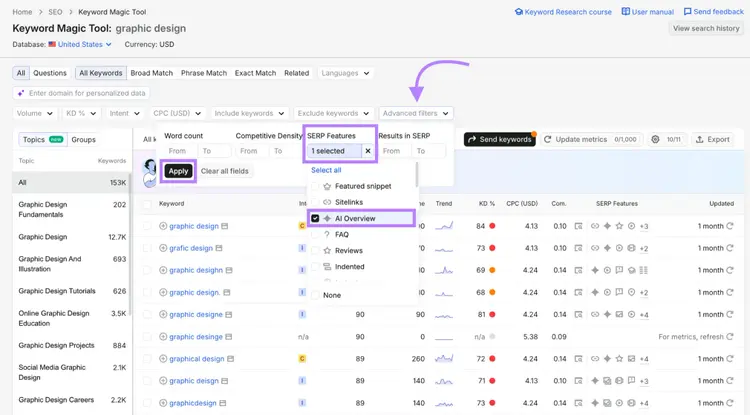
The report will show related keywords that currently trigger AI Overviews, along with metrics such as:
Focus on keywords that are highly relevant to your business, match your audience’s commercial intent, and have a realistic difficulty level for your site.
Note: Our research shows that AI Overviews are expanding into commercial searches.
To inspect a result more closely, click the SERP icon beside the keyword.
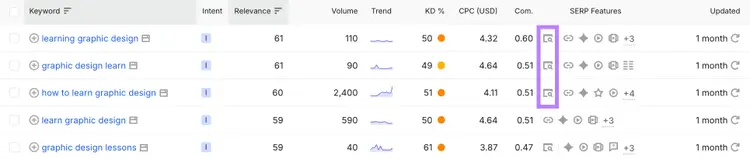
You’ll see a snapshot of the search results, including the pages currently cited in the AI Overview.
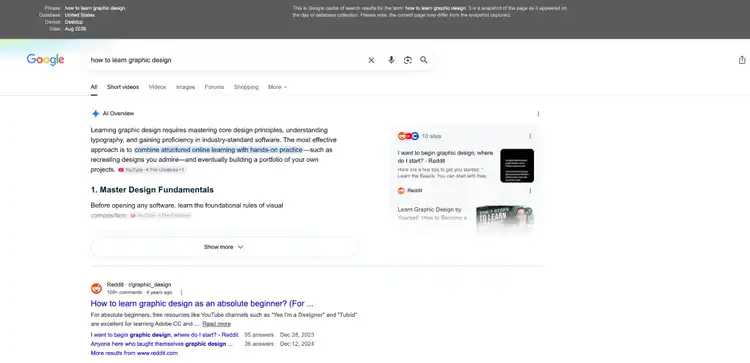
Review those pages to understand:
- Which domains Google cites
- What types of content earn visibility
- Which parts of the query the AI Overview addresses
- Whether your existing content offers a more useful or differentiated answer
Add the most promising keywords to a list.
Find AI Overviews featuring UGC sites like Reddit, YouTube, or LinkedIn
To find AI Overview opportunities on platforms like Reddit, YouTube, and LinkedIn, start by querying each platform’s keyword rankings, then filter for AI Overviews.
For example, open “Organic Rankings” and enter “reddit.com.” Then, filter for “Domain ranks” > “AI Overview.”
This shows you the keywords for which that platform appears in an AI Overview.
Add a keyword filter for your topic, such as “graphic design,” to narrow the results.
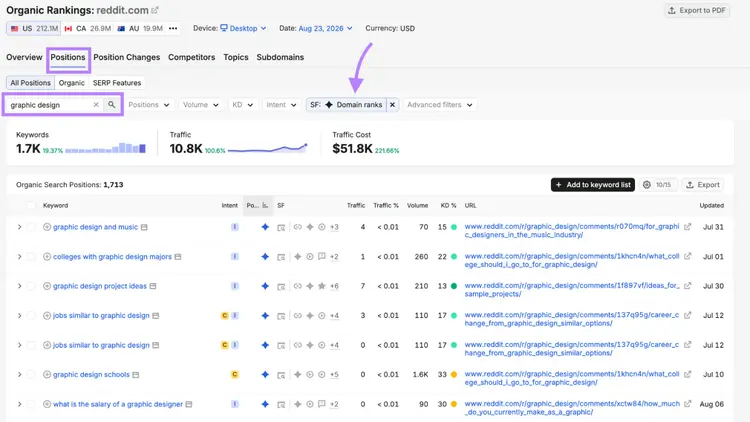
In this example, Reddit appears in AI Overviews for 1.7K keywords containing “graphic design.”
This approach is worth exploring becauseSemrush research has found Reddit and Quora among the most-cited domains in Google’s AI Overviews, with platforms like LinkedIn and YouTube also appearing prominently.
Review these keywords to find topics and questions you could address with useful, relevant content on that platform. Repeat the process with quora.com, youtube.com, or linkedin.com to uncover additional opportunities.
Publishing on a platform Google already cites for a topic may give your brand another route into an AI Overview — even when your own website isn’t ranking yet.
But avoid being overly promotional. Reddit and other online communities are famously skeptical of marketing.
Instead, focus on social listening and contributing genuinely useful answers, discussions, or videos that fit the platform and help its audience.
Explore the AI Overview keywords related to graphic design for Reddit, YouTube, and LinkedIn.
Step 3: Measure your overall AI Overview visibility
To measure your AI Overview visibility, launchVisibility Overview from the AI Visibility Toolkit.
Enter your domain and click “Get started.”

At the top of the report, click the “All AI platforms” drop-down and select “AI Overview.”
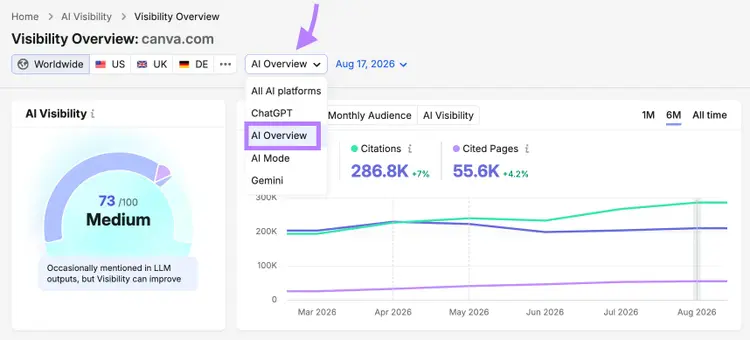
Take note of four baseline AI visibility metrics:
- AI visibility score: A score out of 100 that summarizes your brand’s presence in AI Overviews. It helps you assess the overall strength of your visibility and benchmark it over time.
- Mentions: The number of AI Overviews in Semrush’s AI Visibility database that mention your brand. This shows how often Google recognizes and includes your brand in the AI-generated summary, even when it doesn’t link to your site.
- Citations: The number of AI Overviews that cite your domain as a source. This is the brand-level view of what you filtered for in step 1.
- Cited pages: The number of individual pages from your site cited across those AI Overview responses. This shows the breadth of your citation footprint and whether your AI Overview citations are spread across your site or concentrated on a few pages.
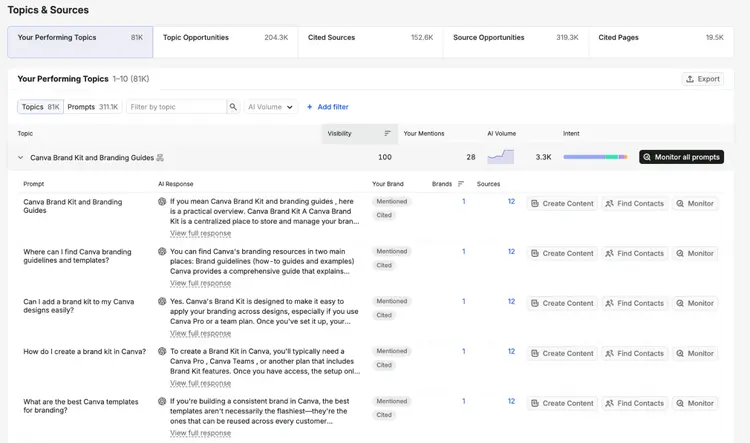
Next, scroll down to the “Topics & Sources” section.
The “Your Performing Topics” tab indicates topics and prompts where your brand already appears.
Look for topics with high visibility or AI search volume to understand where your brand has the strongest presence.
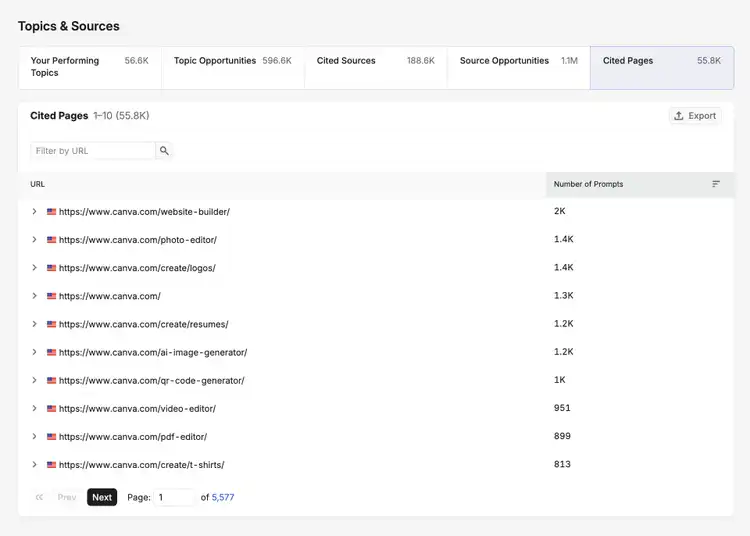
Then, open “Cited Pages” to identify the URLs Google uses as sources. This reveals:
- Pages earning citations across multiple topics
- Content formats Google cites most often
- High-value pages that receive few or no citations
- Whether your visibility depends on only a small number of URLs
Together, these reports give you a broad benchmark of your current AI Overview coverage.
Step 4: See where competitors outperform you in AI Overviews
Comparing your AI Overview visibility with competitors helps you see who leads your market, where they outperform you, and which topics, prompts, and content types offer the best opportunities to close the gap.
Benchmark competitors across AI Overviews
Start by entering a competitor’s domain into Visibility Overview.
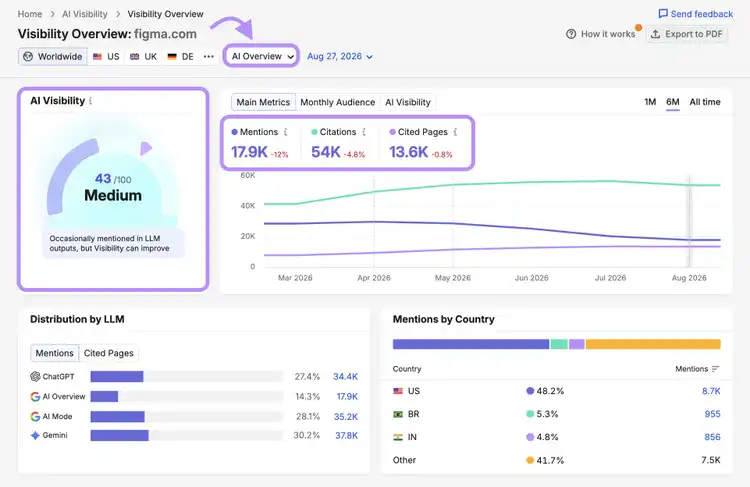
Select “AI Overview” from the platform drop-down. Then, record the same metrics you collected for your site:
- AI Visibility
- Mentions
- Citations
- Cited pages
Repeat this process for a few direct competitors.
This comparison shows which brands have the strongest overall presence in your market.
You may find that a competitor earns more brand mentions, has a larger citation footprint, or depends on fewer pages to generate its visibility.
Scroll to “Topics & Sources” and open “Cited Pages” to see which competitor URLs Google references most often.
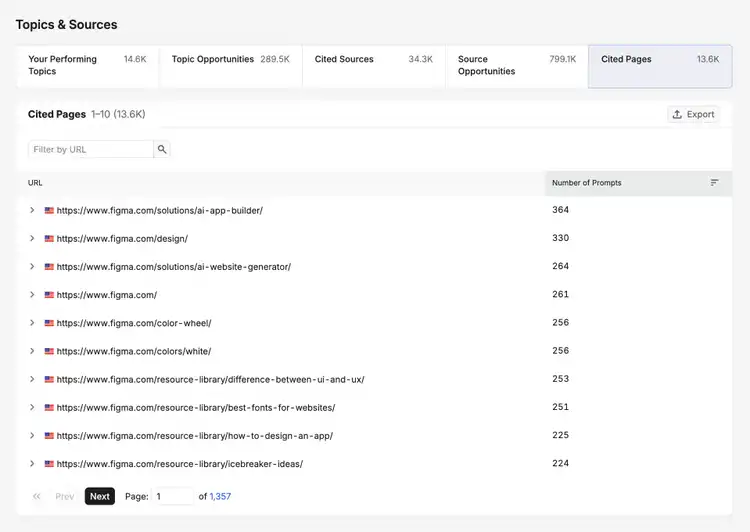
Look for patterns in the pages earning citations.
For example, your competitor may be gaining AI Overview citations through solution pages, resource libraries, comparison articles, original research, product documentation, or detailed how-to guides. Review this list to understand how their content impacts their visibility across AI Overviews.
Find missing and weak topics
For a direct side-by-side comparison, open Competitor Research inside the AI Visibility Toolkit.
Enter your domain and up to four competitor domains. Then, click “Run Competitor Analysis.”
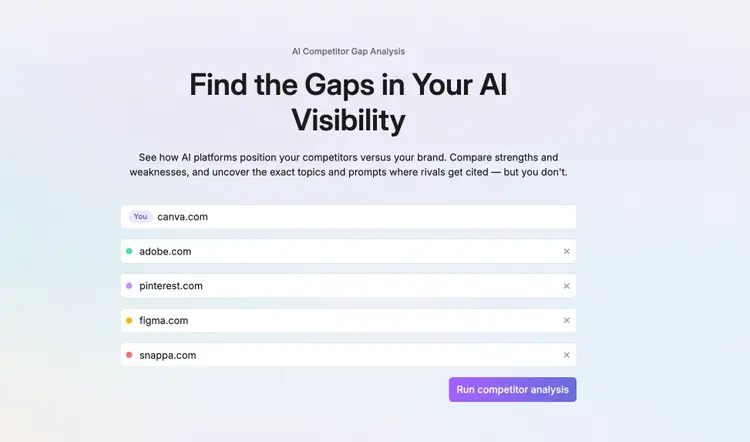
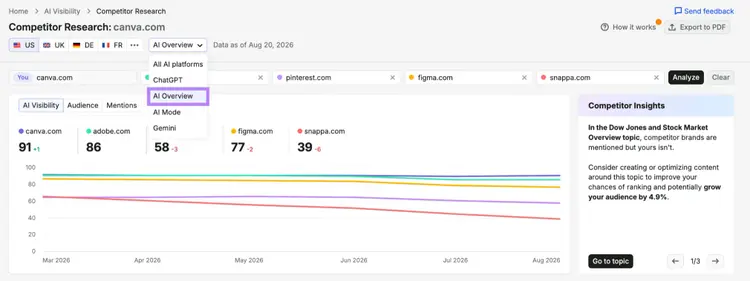
Select “AI Overview” from the platform drop-down.
Scroll to the “Topics & Prompts” table and use these filters:
- Missing: Topics or prompts where competitors appear but your brand doesn’t
- Weak: Topics or prompts where competitors have greater visibility than your brand
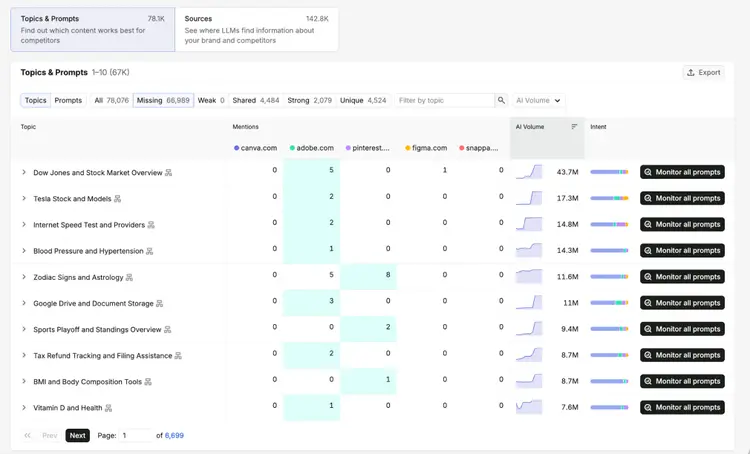
Use the AI Volume filter to prioritize topics with greater estimated demand.
But don’t treat every competitive gap as an opportunity. Focus on topics that are relevant to your products, expertise, and audience.
Expand a topic to see its individual prompts.
For each one, review:
- Which competitors are mentioned
- Which domains and pages are cited
- Whether your brand is entirely absent or simply mentioned less often
- How the AI Overview frames the topic
- Whether you already have content that could address the query
This tells you whether you need to improve an existing page, create new content, or strengthen your brand’s presence on the sources Google already trusts.
Step 5: Set up daily AI Overview tracking with Position Tracking
To set up daily AI Overview tracking, add your priority keywords to a Position Tracking campaign.
The tool updates every day, so you can see when AI Overviews appear, whether your domain is cited, and how that visibility changes right away.
Start a new Position Tracking campaign or open an existing one.
Select Google as your search engine, choose your target location and device, and add the priority keywords you identified in the previous steps.
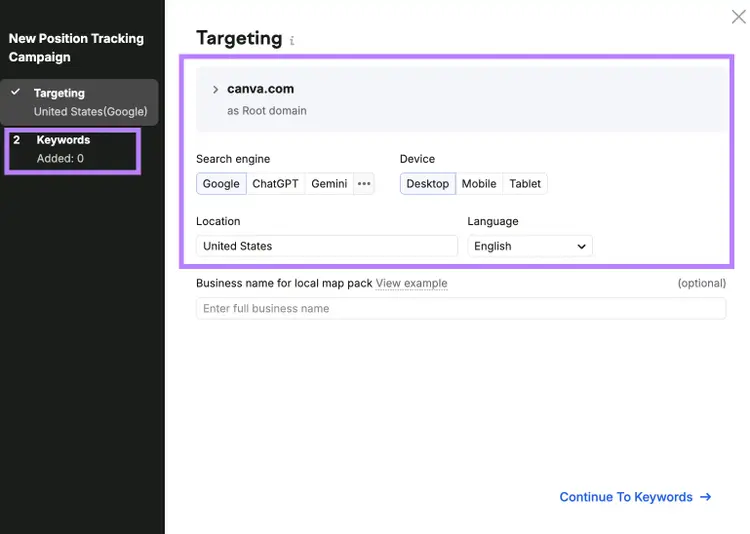
Consider tagging keywords by topic, funnel stage, or priority. This makes it easier to identify where your visibility is improving and where gaps remain.
Once your campaign is ready, open the “Overview” tab and click the “SERP Features” drop-down.
Select “[Domain] ranks” >“AI Overview.”
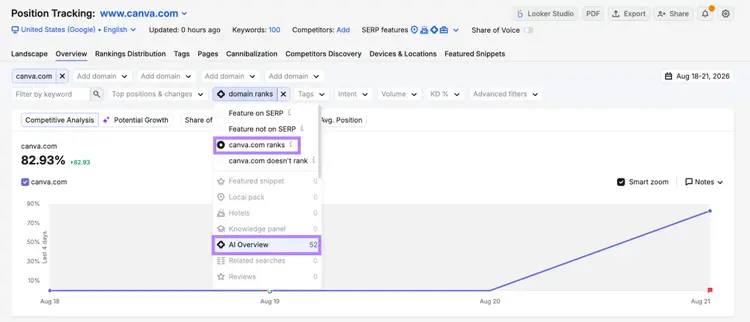
This filters the report to keywords that trigger an AI Overview and include your domain as a cited source.
Use the trend chart to monitor changes in metrics such as visibility, Share of Voice, and estimated traffic across your tracked keyword set.
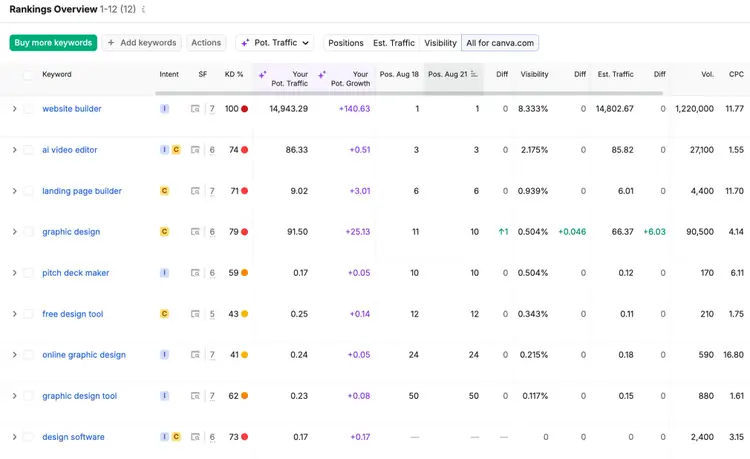
Then, scroll to the “Rankings Overview” table to track your daily AI Overview visibility across every keyword.
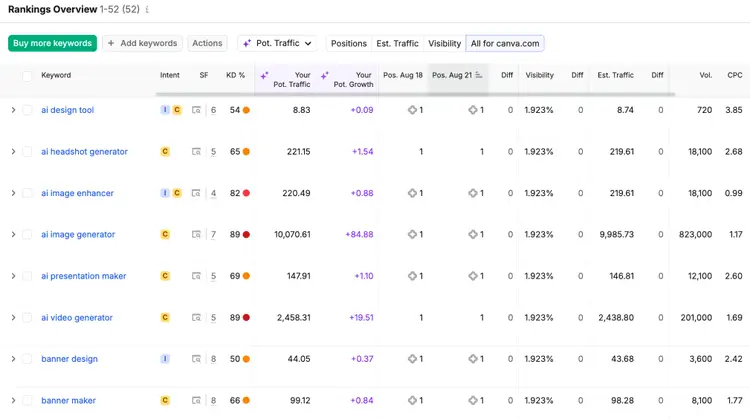
You can see:
- Which keywords currently cite your domain in the AI Overview
- Which page from your site is cited
- Whether your visibility has changed over the set time period
Click the SERP icon beside a keyword to inspect the AI Overview and the other sources Google currently cites.
You can also filter for “[Domain] doesn’t rank”> “AI Overview.”
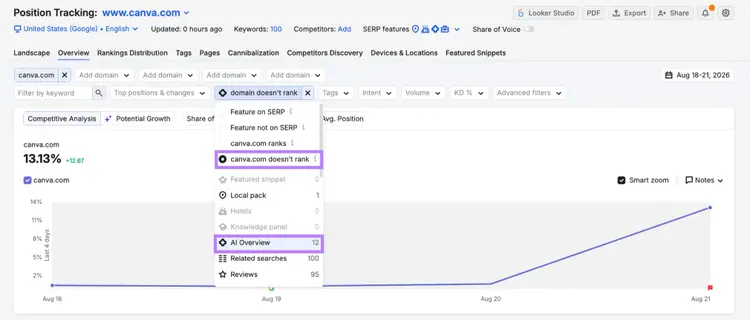
This shows tracked keywords that trigger AI Overviews but don’t cite your content.
Use this list to identify pages that may need updating or relevant topics where you still need content.
For a simple measurement framework, track two rates:
- AI Overview trigger rate: The percentage of your tracked keywords that generate an AI Overview
- AI Overview citation rate: The percentage of those AI Overview-triggering keywords that cite your domain
Review the campaign at least weekly to identify meaningful changes without reacting to daily fluctuations.
Signs of progress include:
- New citations for priority keywords
- A higher citation rate across your tracked set
- More topics where your domain appears consistently
- Fewer high-value keywords where competitors are cited and you aren’t
This turns AI Overview tracking into an ongoing workflow rather than a series of manual searches.
Strategic actions to take from AI Overview tracking
Identifying keywords that trigger AI Overviews is valuable, but it’s how you respond that makes the difference.
So, it’s best to prioritize the right opportunities. Like:
- Keywords with business value: Check search intent, traffic estimations, and cost per click (CPC) to identify high-value terms connected to your products or services that generate AI Overviews
- Queries where you already rank organically: If your page ranks within the top 10 organic results but isn’t cited in the AI Overview, updating it may be a faster opportunity than targeting a new keyword from scratch
- Gaps with weak competition: Look for AI Overviews that cite outdated, generic, or less authoritative content where you can offer better information
- Existing mentions and citations: Strengthen pages already earning visibility and expand their coverage of closely related questions
For more optimization tactics, see our guide onhow to rank in Google’s AI Overviews.
Tracking AI Overviews in 5 easy steps
To make AI Overview tracking part of your regular SEO workflow, use Semrush to:
- Assess your current exposure. Use the AI Overview filter in Organic Rankings to find keywords your site already ranks for where an AI Overview appears.
- Find additional keyword opportunities. Use Keyword Magic Tool to discover relevant AI Overview-triggering searches you don’t currently target or rank for.
- Measure your brand visibility. Use Visibility Overview to track your AI visibility score, brand mentions, citations, cited pages, and strongest topics.
- Find competitive gaps. Compare your visibility against competitors and use Competitor Research to identify missing or weak topics.
- Track citations over time. Add your priority keywords to Position Tracking and monitor AI Overview trigger rate, citation rate, gains, and losses.
Together, these steps show where AI Overviews affect your existing search visibility, where your brand appears, and which opportunities deserve attention.
Review your broad visibility regularly and check your Position Tracking campaign at least weekly. This gives you a repeatable way to measure progress without manually searching every target keyword.
Frequently asked questions (FAQs)
Can Google Search Console track AI Overviews?
Yes, but with some limitations.
Google Search Console added a generative AI performance report in July 2026 that shows how many impressions your pages get from Google’s generative AI features (like AI Overviews and AI Mode). The report is still rolling out, so not all properties have access yet.
The report lets you see which pages receive generative AI impressions and break that data down by date, country, and device. But it combines AI Overview and AI Mode impressions, so you can’t isolate AI Overview performance specifically.
Google also counts clicks from AI Overviews and AI Mode in the regular Search performance report. But those clicks are included with other Web search activity rather than broken out by generative AI feature.
This means you can measure your overall generative AI visibility in Search Console, but you can’t get much granular detail. You can’t isolate AI Overview clicks, see which specific search terms trigger AI Overviews, or track when your brand name is mentioned in any AI generated text.
Google explains what’s included in its Generative AI performance report documentation.
How often should I check my AI Overview visibility?
Check your priority keyword campaign at least weekly. This is frequent enough to identify meaningful citation gains or losses without overreacting to normal daily fluctuations.
Review your broader visibility, competitor benchmarks, and topic-level gaps monthly. You may want to check more frequently after publishing or substantially updating content targeting an important AI Overview.
Because Position Tracking updates daily, you don’t need to manually search every keyword each time.
What’s the difference between an AI Overview mention and a citation?
An AI Overview mention occurs when Google names your brand in the generated response. An AI Overview citation occurs when Google links to a page from your domain as a source for the response.
A brand can be mentioned without receiving a link. And a page can be cited without the response explicitly naming the brand.
Track both metrics to understand whether Google recognizes your brand, relies on your content, or both.
How do I track AI Overview citations over time?
Add your priority keywords to a Position Tracking campaign and filter for “[Domain] ranks” > “AI Overview.”
Position Tracking updates daily, so you can see which keywords cite your domain, which pages earn those citations, and whether your visibility changes over time.
Track your AI Overview citation rate (the percentage of AI Overview-triggering keywords that cite your domain) to measure whether your citation coverage is improving.
Track AI overviews
with a free trial of Semrush

Luke has over ten years of experience in digital marketing, writing about SEO, AI search, and how to get the most out of Semrush. He spent years building Semrush‘s Knowledge Base, working directly with product teams to explain every tool and feature on the platform so marketers can find the right tools and do better work.
Luke Harsel
Luke leads content for Semrush‘s product-led growth team, creating guides and research that show marketers what‘s possible with Semrush‘s tools.
Tells Google to show you more from Semrush in AI, Search, and Discover.