
12 SEO Techniques to Boost Your Visibility and Traffic [2026]
Expert reviewed
Our subject matter experts have reviewed this article to ensure it meets the highest standard for accurate information and guidance. Learn more about our editorial standards and process.
The way people find information is changing fast.
Google’s AI Overviews now reach over 2 billion users each month, and AI Mode is available in more than 200 countries.
While the core principles of SEO still apply, new techniques have emerged around structuring content for AI systems, earning brand mentions across the web, and optimizing for AI-generated results alongside traditional rankings.
In this guide, we’ll cover 12 SEO techniques that can help you improve both your search rankings and your visibility in AI-powered search in 2026.
What Are SEO Techniques And Why Do They Matter?
SEO techniques are specific tactics that improve your website's visibility and rankings in search engines.
This is important because:
- Better visibility builds credibility and trust with your target audience
- Better visibility also means increased click-through rates (CTRs) and more organic traffic
- Once you're optimized for SEO, you have a higher chance of appearing in AI assistants like ChatGPT, Perplexity, and Claude
- Visibility and traffic you get is completely free (no advertising costs involved)
- SEO results compound and remain consistent month after month
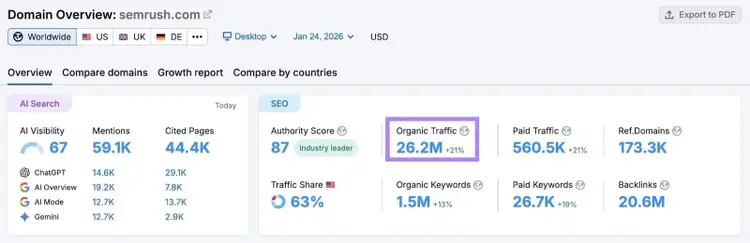
At Semrush, we use the same SEO techniques we recommend to our users on our own website. The result is nearly 27 million monthly visits from search engines. These techniques work when applied consistently.
How to Prioritize SEO Techniques
Here's how to prioritize the techniques we’ll share based on where you are in your SEO journey:
Start here (Essential foundation)
If you're just getting started, focus on these techniques first:
- Make sure your website is technically sound: Without a solid technical foundation, other efforts won't deliver results
- Fix duplicate content: This prevents search engines from getting confused about which pages to show in search results
- Use internal linking: A strong internal structure helps search engines discover and understand your content
Do next (High-impact optimizations)
Once your foundation is solid, these techniques typically deliver the strongest results:
- Structure your content for AI retrieval: Helps you get cited in AI Overviews and AI Mode, and makes content more scannable for users
- Optimize content around different angles of the search query: Increases your chances of ranking and being referenced by AI systems
- Refresh outdated content: Often the fastest way to regain lost traffic and improve your chances of being cited in AI-generated results
- Win featured snippets: Can boost click-through rates for keywords you already rank for
Advanced tactics (When you're ready to scale)
These techniques work best once you've nailed the fundamentals:
- Improve E-E-A-T by working with experts: Particularly important for YMYL (Your Money, Your Life) topics
- Get mentioned on other websites: Builds long-term authority but takes consistent effort
- Use schema markup: Enhances how your pages appear in search results
- Improve Core Web Vitals: Important for user experience, though technical expertise may be required
- Do programmatic SEO: Best for businesses with large databases and development resources
Now, let's dive into each technique in detail.
12 SEO Techniques to Boost Your Traffic
1. Make Sure Your Website Is Technically Sound
Technical SEO is the foundation of every other optimization effort on this list.
If search engines can't properly crawl, index, and understand your website, even the best content won’t rank. The same applies to AI systems like Google’s AI Overviews and AI Mode, which retrieve and cite content for their generative responses.
Most technical issues are easier to fix than you think.
Run a fast technical assessment with our free SEO checker.
For more comprehensive coverage, use Semrush Site Audit. It crawls your entire website automatically, scanning every page for problems that could hurt your performance.
Once the audit is complete, go to the “Issues” tab and you’ll see all the issues that the tool found on your site.
The tool categorizes issues by severity:
- Errors: Serious issues that need to be fixed right away
- Warnings: Less critical issues to tackle after resolving errors
- Notices: Recommendations to review and then decide if they're worth pursuing
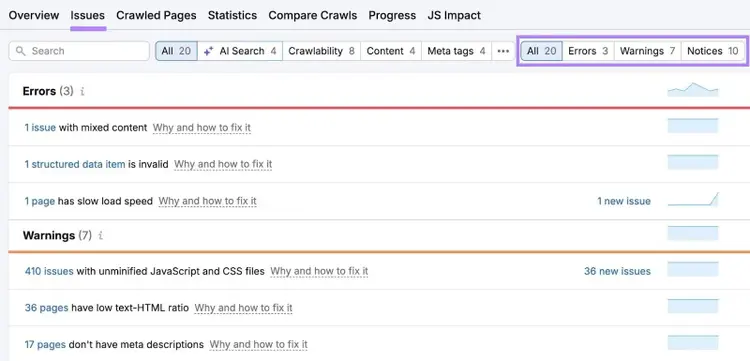
Start with “Errors” first to fix the problems that have the biggest impact on your SEO.
For each issue, the tool provides a clear explanation of what’s wrong, why it matters for SEO, and step-by-step instructions on how to fix it.
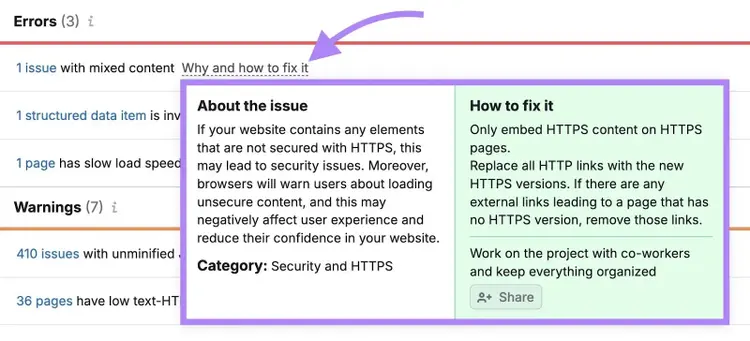
You can easily share the report with your developer or technical team so they can apply the recommended fixes quickly and accurately.
2. Fix Duplicate Content
Duplicate content confuses search engines about which version of your pages to show in results, often causing all versions to get deprioritized.
Duplicate content is when identical or very similar content appears on multiple URLs, either within your site or across different websites.
Look for these common duplicate content problems on your site:
- HTTP vs HTTPS versions of the same page
- WWW vs non-WWW URLs
- Multiple URL parameters showing identical content
- Multiple blog posts that cover the same topic with overlapping or near-identical text
The most common culprit is accidental duplication during site setup or migrations—like leaving both HTTP and HTTPS versions accessible, or having both WWW and non-WWW versions live.
When this happens, your rankings strength gets diluted across multiple URLs instead of being consolidated into one strong page, ultimately reducing your visibility and traffic.
Use Site Audit to quickly find out if you have duplicate content issues across your website. Go to the “Issues” tab and search for specific problems. For example, to find if you have “WWW vs. non-WWW” duplicates, search “www” and you'll see if any pages on your site have this common duplication problem.
Or, if you want to find duplicate blog posts, just search for “duplicate” and you’ll see if issues exist.
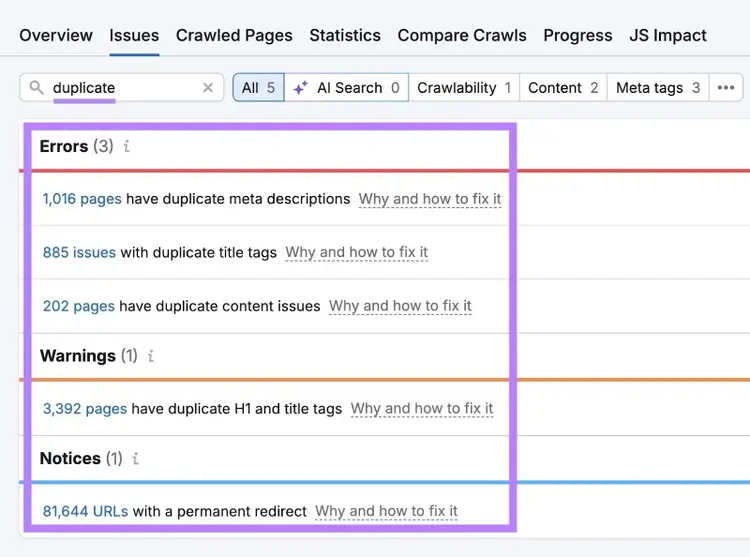
The tool also provides guidance on how to resolve each issue.
3. Use Internal Linking
Internal linking is when you link from one page on your website to another page on the same website.
This practice helps search engines understand the structure of your site and discover all your important pages. It also distributes authority across your website, helping pages rank better in search results.
Strong internal linking can also increase your chances of being featured in AI Overviews, as it signals to Google which pages are most important on your site.
Here's how to build out an effective internal linking structure:
- Link to your most important pages: Identify the pages that need a ranking boost—key service pages, product pages, or cornerstone content—and prioritize getting internal links pointing to them. This concentrates authority where it matters most for your business.
- Use descriptive anchor text: Instead of generic phrases like "click here" or "read more," use anchor text that clearly describes what the linked page is about. For example, "learn about technical SEO audits" tells both readers and search engines what to expect on the other end, which improves relevance signals for that page.
- Link from high-authority pages: Pages that already rank well pass more authority through their internal links. If you have a blog post that gets 10,000 monthly visits, adding a contextual link from that post to a newer article can significantly accelerate the newer page's ability to rank.
- Keep links contextually relevant: Only add internal links when they genuinely help the reader find related information. Forced or irrelevant links hurt user experience and can dilute the authority you're trying to pass.
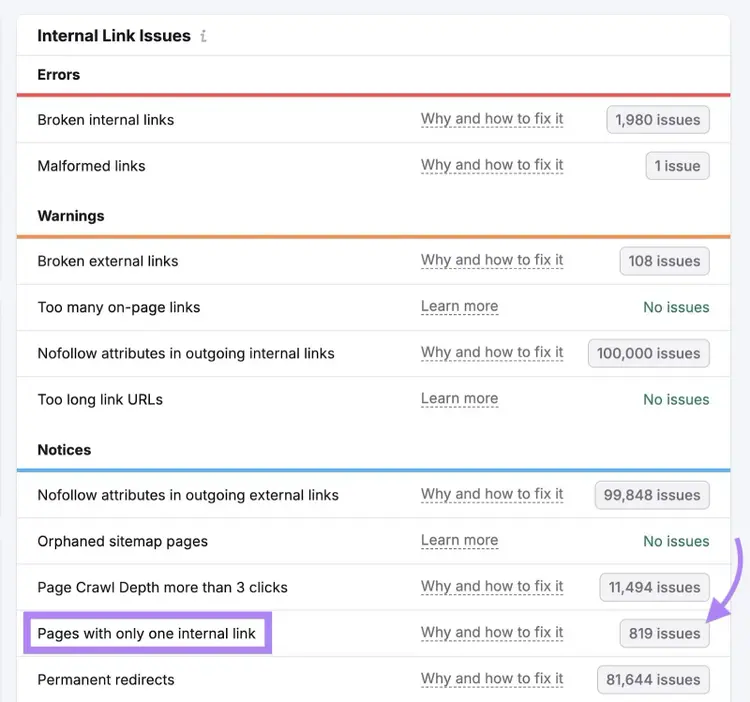
You can find internal linking opportunities using Semrush Site Audit tool. Navigate to the "Internal Linking" report to see which pages have too few internal links pointing to them and identify opportunities to strengthen your site's link structure.
4. Structure Your Content for AI Retrieval
Structuring your content for AI retrieval increases your chances of being cited in in AI-generated results like Google’s AI Overviews and AI Mode.
Being cited matters: Research from Seer Interactive found that sites appearing as sources in AI Overviews saw their organic click-through rate rise from 0.6% to 1.08%. And while overall organic CTR tends to drop when AI Overviews appear on a search results page, sites that earn a citation within the overview capture a disproportionate share of the remaining clicks.
Here’s how to format your content effectively:
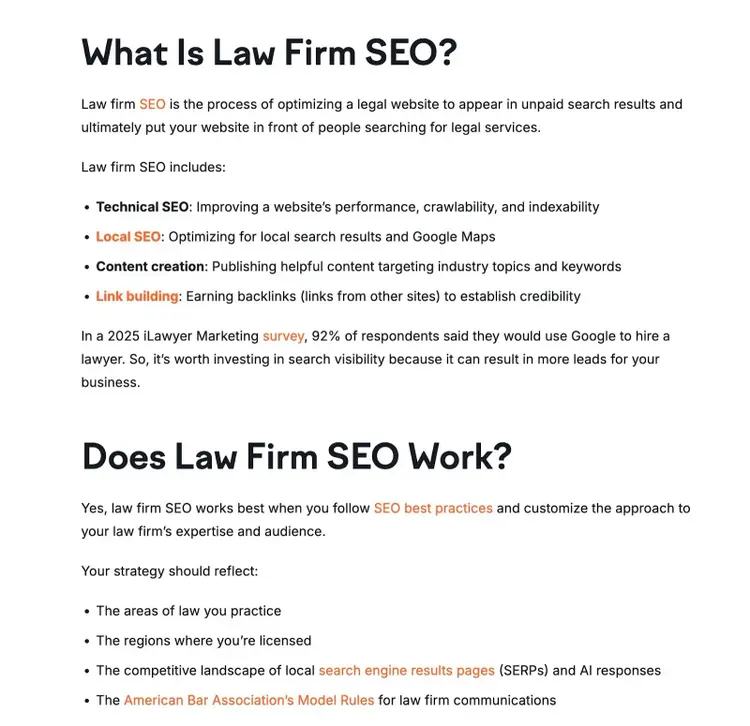
- Use descriptive headings: Break your content into focused sections with H2 or H3 headings. Each heading should clearly indicate what information follows. This makes it obvious to AI what each section is about.
- Lead with key information. Content under those headings should provide a direct answer or summarize the most crucial points upfront. This helps both readers and AI systems quickly identify relevant information.
- Write self-sufficient paragraphs. Since AI tools often extract individual paragraphs, ensure each block of text can be understood without context from surrounding paragraphs. This means making sure each paragraph conveys a complete thought.
These formatting principles apply to all AI-powered search features, including Google’s AI Mode. AI Mode processes queries that are nearly three times longer than traditional searches, and it synthesizes answers from multiple sources. Content that’s clearly structured and self-contained is more likely to be selected as a source.
Here is what well-formatted content looks like:
5. Optimize Your Content Around Different Angles of the Main Search Query
Covering multiple angles of a search query increases your chances of ranking and being cited in AI-generated results.
If your content addresses all the angles, you can increase your chances of being used as a reference in AI Overviews.
For example, say you want to rank for "email marketing."
Users searching for this keyword will likely want to know:
- What email marketing is
- What goals they can achieve with email marketing
- How to create effective email campaigns
- What are the advantages and disadvantages of email marketing
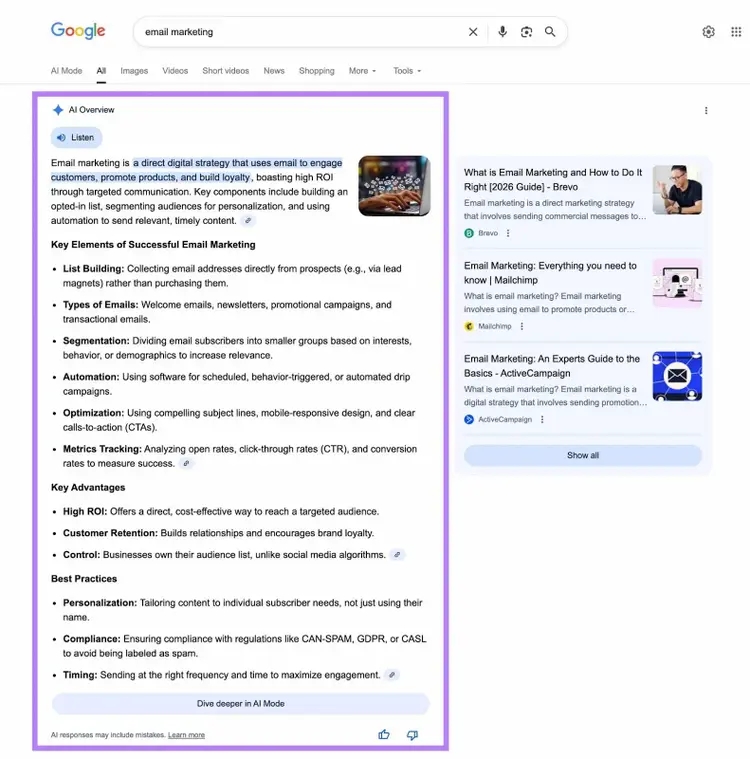
This is exactly why Google gives a complete, well-rounded answer in its AI Overview:
As an SEO technique, use this rule of thumb for any keyword before you actually start writing content:
- Google your keyword to see what subtopics are being included in the AI Overview. Make sure you cover those in your own content.
- Additionally, check the "People Also Ask" section for common questions users have about the topic
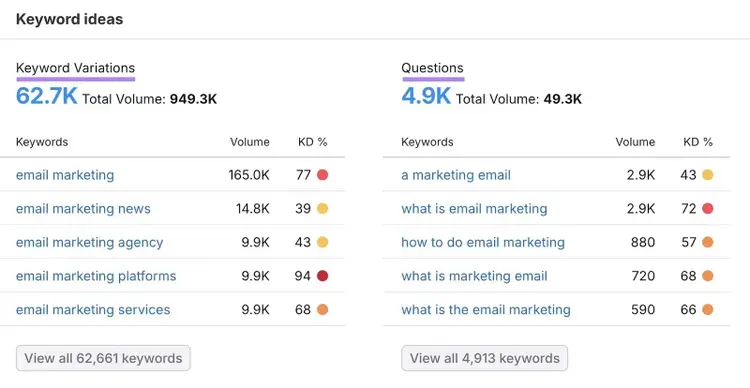
You can find even more subtopics using Semrush Keyword Overview tool. Just plug in your main keyword and you'll see all the related searches and questions people are actually typing into Google. Make sure your content addresses these.
6. Refresh Outdated Content
Refreshing outdated content is one of the fastest ways to regain lost rankings and improve your chances of being cited in AI Overviews. AI systems prioritize fresh, accurate information, so pages with outdated stats, advice, or screenshots are less likely to be referenced.
Here’s how to update your existing pages:
- Identify pages that were published more than a year ago: Check your CMS or Google Analytics to find older content that may need refreshing, particularly high-performing pages that have seen declining traffic.
- Replace outdated information: Review the content carefully and identify any stats, tools, screenshots, or advice that might be outdated or irrelevant. Replace them with the latest, most helpful information for your audience.
- Expand with new subtopics: Add new subtopics and sections that cover recent developments in the subject matter area
- Refresh the publish date: Whenever you make substantial updates, adjust the publish date or display a “Last Modified” timestamp to signal freshness to Google
7. Win Featured Snippets
Featured snippets are text excerpts that answer user questions directly and appear near the top of the search engine results page (SERPs).
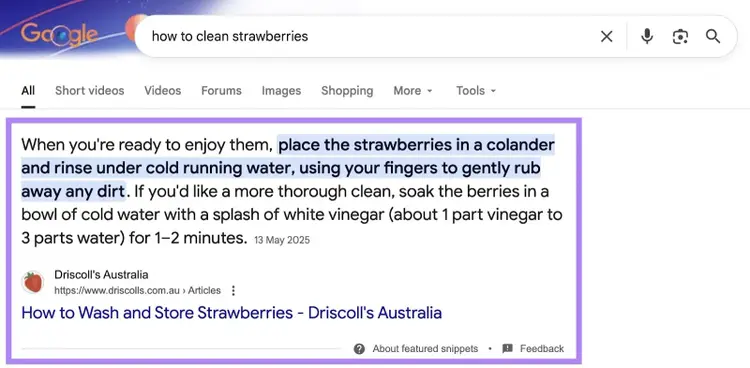
They can significantly boost your website's visibility and click-through rates.
Finding featured snippet opportunities is pretty easy. Open an incognito browser window and search your target keywords one by one to see which queries currently trigger featured snippets.
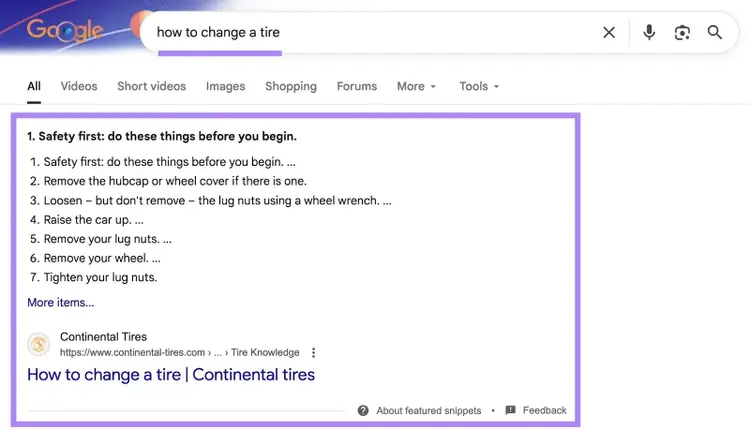
The only downside is that manually finding featured snippet opportunities like this will take a lot of time when you have hundreds or thousands of keywords to check.
A better approach is to use an SEO tool like Semrush's Organic Research. Enter your domain, navigate to the "Positions" tab, then apply the "SERP Features" filter and select "Featured snippet" under "Domain doesn't rank."
This shows you all keywords where you rank but don’t own featured snippets.
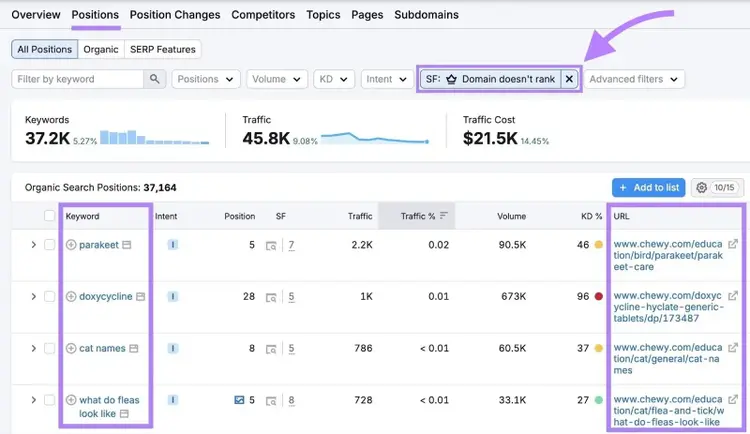
Once you've identified opportunities, go to the relevant pages and edit their content like this:
- Use a clear, keyword-rich heading that directly addresses the search query
- Match the format of the current featured snippet (paragraph, list, or table). For example, if a query triggers a paragraph snippet, write a concise, complete answer within 40-60 words immediately after your heading. This will make it easier to pull your content into the snippet.
Note that you typically need to rank on the first page (positions 1-10) to have a realistic chance of winning featured snippets.
8. Improve E-E-A-T by Working with Experts
Working with subject-matter experts is one of the most effective ways to improve your content’s rankings and AI visibility.
Google evaluates content quality through its E-E-A-T framework—Experience, Expertise, Authoritativeness, and Trustworthiness. Content written or reviewed by someone with demonstrable expertise signals quality to both Google’s ranking systems and the AI models that decide which sources to cite. Generic content written without relevant experience tends to get outranked by content that clearly comes from someone who knows the topic firsthand.
Generic content that has been written by someone without relevant expertise or experience is less likely to perform well in Google.
But if the content demonstrates deep knowledge and real-world experience, it's far more likely to rank well (and be featured in AI Overviews).
For example, check this article about money management written by a financial journalist with more than 11 years of experience and reviewed by an experienced investor and financial planner.

Google can detect these expertise signals through author bios, credentials mentioned in the content, and how the advice is framed (generic tips vs. specific, experience-based insights).
Here's how to go about working with experts to create your content:
- Find relevant experts: Look for people with demonstrable knowledge and experience in your content's topic area. Their involvement adds credibility that both readers and search systems can evaluate.
- Get them involved in the content: Reach out for interviews, direct quotes, or ideally have them write or formally review the piece. Content with expert input tends to include the specific, experience-based insights that generic articles miss, which is exactly what makes it more rankable.
- Make their expertise visible: Add detailed author bios with credentials, and clearly attribute any contributed quotes or insights. This gives Google's quality raters (and AI systems) concrete signals to assess the content's trustworthiness.
9. Get Mentioned On Other Websites
Earning mentions on other websites improves your search rankings and increases the likelihood that AI systems will reference your brand in their responses.
Mentions come in two forms:
- Linked mentions (backlink): Another website references your brand and includes a hyperlink back to your site. These directly improve your domain authority and rankings.
- Unlinked mentions: References to your brand without a hyperlink, like a news article saying "according to Semrush" without linking. AI systems use these signals to determine which brands are authorities on a given topic.
Both matter. Backlinks remain a core ranking factor, but unlinked mentions are increasingly important for AI visibility, where systems like Google's AI Overviews and ChatGPT decide which brands to recommend based on how often they're referenced across the web.
If you're just starting out, earning mentions might seem daunting, but there are realistic first steps you can take.
Start with partnerships in your network: collaborate with complementary businesses on content, co-host webinars, or contribute guest posts to industry blogs. These low-effort tactics can generate your first mentions without needing a PR budget.
Here are some effective ways to earn more mentions:
- Get media to talk about your brand: Generate a positive buzz about your brand. This can be done by capitalizing on trending cultural moments or launching creative PR stunts. For example, Heinz (a food company) launched a limited-edition “Barbiecue” ketchup to tap into the Barbie movie hype. This earned them a lot of media attention and brand mentions across the web.
- Create mention-worthy content: Create content that other people naturally want to reference—e.g., original studies that uncover new trends, surveys that reveal industry insights, and research that offers contrarian viewpoints.
- Leverage speaking opportunities: Participate in industry conferences, podcasts, and expert panels. When you establish yourself as a knowledgeable voice, mentions often follow naturally.
10. Use Schema Markup
Schema markup is a type of code that gives Google extra context about the content on your page.
In turn, this allows your pages to appear as rich results—those enhanced search listings that show additional information like star ratings, prices, and images.
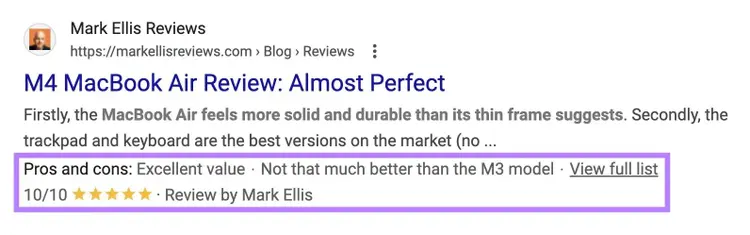
These visually enhanced results stand out in search and typically see higher click-through rates compared to standard listings.
For e-commerce sites, recipe blogs, review sites, or local businesses, schema is worth prioritizing early since it directly impacts how many people click your results. For informational blogs or simple service pages, it's more optional and nice to have.
Note that schema itself is not a direct ranking factor. Its value comes from improving how your existing rankings perform by attracting more clicks.
There are two main ways to add schema to your site:
- Through your CMS using an SEO plugin: Plugins like Yoast and Rank Math allow you to add schema markup without touching any code. You fill out a form, and the plugin generates and adds the code. You fill out a form, and the plugin generates and adds the code automatically. This is the easiest option for most site owners.
- Using a schema generator tool: Free tools like Schema.dev's Schema Builder (a Chrome extension) or Merkle's Schema Markup Generator let you create JSON-LD markup by filling out a form, then copy the generated code into your site's HTML. You can also use Google's Structured Data Markup Helper, though the tool hasn't been updated in several years and supports fewer schema types than newer alternatives.
Whichever method you use, always validate your schema to make sure it’s implemented correctly.
For individual pages, you can use Google’s Rich Results Test tool to see if your implementation is successful.
You can also run a free SEO check for a quick schema validation. If you're a Semrush user, use Semrush Site Audit tool to scan for schema issues across your entire website.
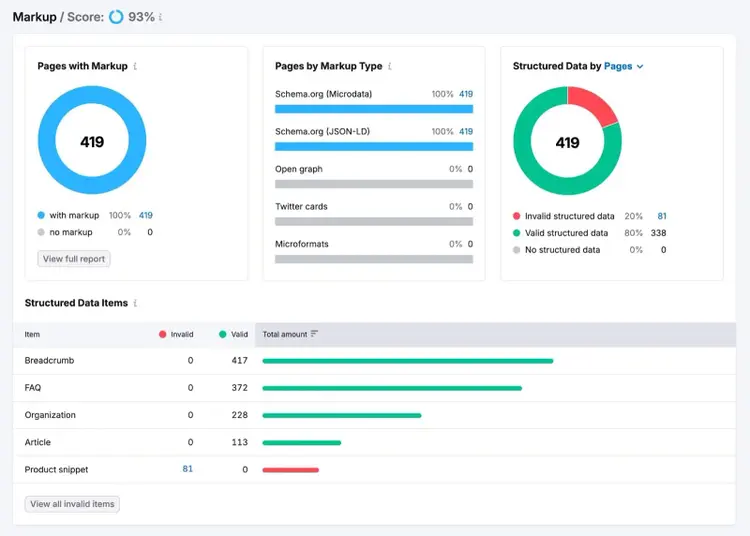
Navigate to the "Markup" report to see which pages have structured data, what types are implemented, and whether any errors need fixing.
11. Improve Core Web Vitals
Improving your Core Web Vitals metrics can lead to a better experience for your website visitors—and better SEO results.
When your pages load quickly and remain stable, users stay longer and engage more with your content.
Google tracks these engagement signals, and sites with better Core Web Vitals performance tend to rank higher because they signal a quality user experience. This also increases their chances of being featured in AI-generated responses.
The three main Core Web Vitals metrics are:
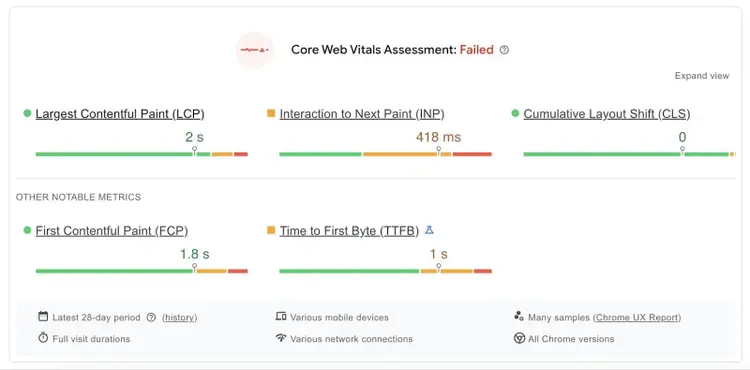
- Largest Contentful Paint (LCP): Measures how quickly the main content of your page loads. This should happen within 2.5 seconds or faster.
- Interaction to Next Paint (INP): Measures how responsive your page is to user interactions like clicks and taps. A page should respond in less than 200 milliseconds for a good experience.
- Cumulative Layout Shift (CLS): Measures visual stability by tracking unexpected layout changes as your page loads. Keep this below 0.1 to avoid frustrating users.
In our internal study of 50K domains for our technical SEO checklist, we found that 96% of websites had at least one page that failed the Core Web Vitals assessment test, so there's a good chance your site needs improvement, too.
You can use Google’s PageSpeed Insights to measure Core Web Vitals performance for individual pages.
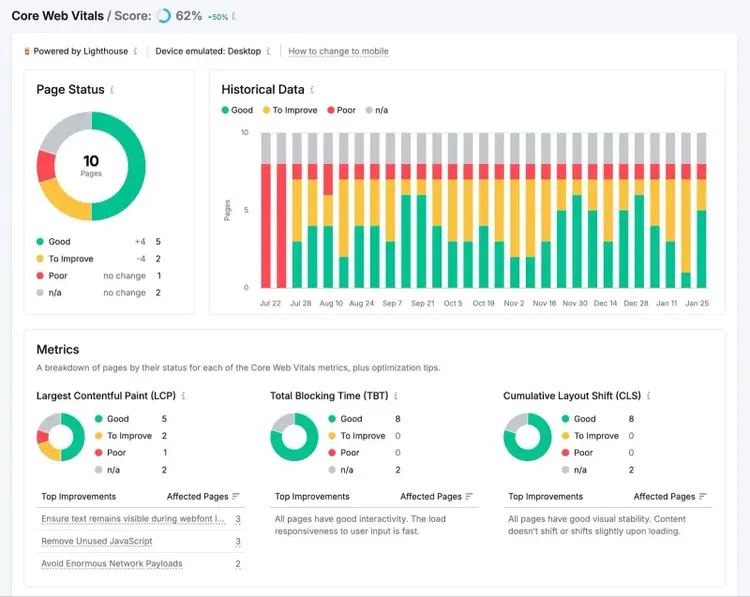
For a comprehensive site-wide analysis, use Semrush's Site Audit tool.
Navigate to the "Core Web Vitals" section to see how your entire website performs across these metrics and get actionable recommendations for the pages that need the most attention.
12. Do Programmatic SEO
Programmatic SEO is a technique for creating large numbers of keyword-targeted pages using templates and structured data, driving traffic at scale.
This is an advanced tactic that works best for businesses with unique datasets and development resources—think job boards, real estate sites, or e-commerce platforms with thousands of product variations. If that doesn't describe your situation, the other 11 techniques above will deliver more impact for your time.
Let’s walk through a simple example to see how you might do programmatic SEO. Let’s say you're running a job board. You might have a database of job listings across different locations and industries.
There are lots of people searching for specific combinations like "software engineer jobs in Austin.”
You can identify programmatic SEO opportunities using our free keyword tool. Enter a broad keyword related to your business, then look for search query patterns that repeat with different variations.
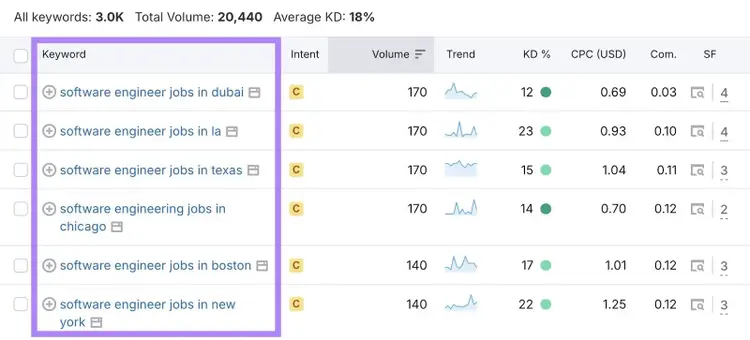
Once you’ve spotted an opportunity, work with your developer to create programmatic pages. Here are some tips to keep in mind when creating these pages:
- Add unique value beyond raw data: Don't just display database information. Include helpful context, analysis, or insights specific to each variation. This will help satisfy search intent.
- Build internal links: Connect related programmatic pages to help users discover similar variations and strengthen your site's structure
- Avoid thin content: Each programmatic page should offer substantial value—not just a slightly modified version of the same template with minimal differences.
Frequently Asked Questions About SEO Techniques
What Is the Most Effective SEO Technique in 2026?
There's no single "most effective" SEO technique because results depend on your website's current state, your industry, and how competitive your target keywords are.
That said, AI-powered search features are now a significant factor. Google's AI Overviews reach over 2 billion monthly users, and AI Mode is available in more than 200 countries. Optimizing for these features alongside traditional search is no longer optional for most websites.
Given the scale of AI-powered search, there are a few AI-focused techniques that should be a top priority for most websites:
- Structuring website content clearly so AI systems can extract key information
- Covering all the angles around your target blog post topic to increase your chances of being referenced in AI Overviews
- Earning brand mentions, as AI systems use these signals to determine which sources to recommend
Can I Do SEO Without Buying Tools?
Yes, you can do SEO using free tools, but you can only go so far—and eventually, you’ll need paid tools to access valuable data, employ comprehensive tracking, and stay competitive.
Free tools like Google Search Console, Google Keyword Planner, and Semrush’s free plan can help you:
- Find limited keyword opportunities
- Check site performance at a high level
- Identify technical issues
However, paid tools can help you take your SEO to the next level by giving you access to:
- Billions of keyword opportunities, along with detailed metrics like search volume, keyword difficulty, and search intent data
- Complete site audits that scan your entire website for 100+ technical issues
- Competitor analysis data that reveal what's working for others in your industry and help you identify gaps
- Advanced tracking solutions for monitoring visibility in AI Overviews, Google AI Mode, and ChatGPT
For example, Semrush One combines SEO tools and AI visibility tracking in a single platform, giving you keyword research, site audits, competitor analysis, rank tracking, and AI search monitoring in one subscription.
In short, free tools are great for learning and getting started, but paid tools become essential once you’re serious about growth or competing in high-difficulty niches.
How Do I Know If My SEO Is Working?
You can track several key metrics to determine if your SEO efforts are paying off:
- Organic traffic growth: Check Google Analytics to see if you're getting more visitors from search engines over time. Consistent growth is a strong indicator that your SEO is working.
- Keyword rankings: Monitor whether your target pages are ranking higher for important keywords. Tools like Google Search Console (free) or Semrush's Position Tracking (paid) can show you ranking improvements.
- AI visibility: Track how often your brand and content are cited in AI Overviews, Google AI Mode, and ChatGPT. Being referenced in AI-generated answers signals growing authority in your space. Semrush'sAI Visibility Toolkit lets you monitor mentions, track prompt-level visibility, and benchmark your AI presence against competitors.
- Conversions from organic traffic: Ultimately, SEO should drive business results. Track whether your organic visitors are completing desired actions like signing up, making purchases, or filling out contact forms.
Keep in mind that SEO takes time. You typically won't see significant results for 3-6 months after implementing changes. Be patient and consistently monitor these metrics to gauge your progress.
Start Improving Your SEO Today
The SEO techniques that drive results in 2026 span both traditional search optimization and AI visibility. Technical fixes, content structure, and brand mentions all play a role in how search engines and AI systems evaluate your website.
You don't need to implement everything at once. Pick two or three techniques from this list based on where your site is right now, apply them consistently, and track the results.
If you're not sure where to start, run a free site audit with Semrush to identify the technical issues and SEO opportunities that will have the biggest impact on your site's performance.
Find and Fix Website Issues
with the Site Audit Tool

Tushar has been involved in SEO for the past six years, specializing in content strategy and technical SEO. He gained his experience in agencies, where he worked on various ecommerce and B2B clients. On the Semrush blog, he writes about SEO and marketing based on experience drawn from his client work, focusing on sharing practical and effective strategies. His goal is to turn Semrush blog into the ultimate destination for learning SEO and web marketing.
Tushar Pol
Tushar is an SEO expert with over six years of experience in content strategy and technical SEO. Having worked with various ecommerce and B2B clients at agencies, he now writes for the Semrush blog, sharing practical and effective SEO strategies.
Tells Google to show you more from Semrush in AI, Search, and Discover.
Table of contents
-
12 SEO Techniques to Boost Your Traffic
- 1. Make Sure Your Website Is Technically Sound
- 2. Fix Duplicate Content
- 3. Use Internal Linking
- 4. Structure Your Content for AI Retrieval
- 5. Optimize Your Content Around Different Angles of the Main Search Query
- 6. Refresh Outdated Content
- 7. Win Featured Snippets
- 8. Improve E-E-A-T by Working with Experts
- 9. Get Mentioned On Other Websites
- 10. Use Schema Markup
- 11. Improve Core Web Vitals
- 12. Do Programmatic SEO