Most teams evaluate their AI search strategies the only way they know — by tracking more. Keyword lists grew into prompt lists. Every new platform got its own dashboard.
And yet, we struggle to confidently answer the one question that matters: When a buyer asks about your space, is your brand part of the answer?
The problem is in the mindset. We plan against prompts and keywords and measure individual questions, one at a time. But that's no longer how search works. Buyers now spread their research across search engines, AI assistants, and communities, and the platforms assemble each answer from many related queries.
This calls for a new approach: go one level up to plan and measure at the topic level.
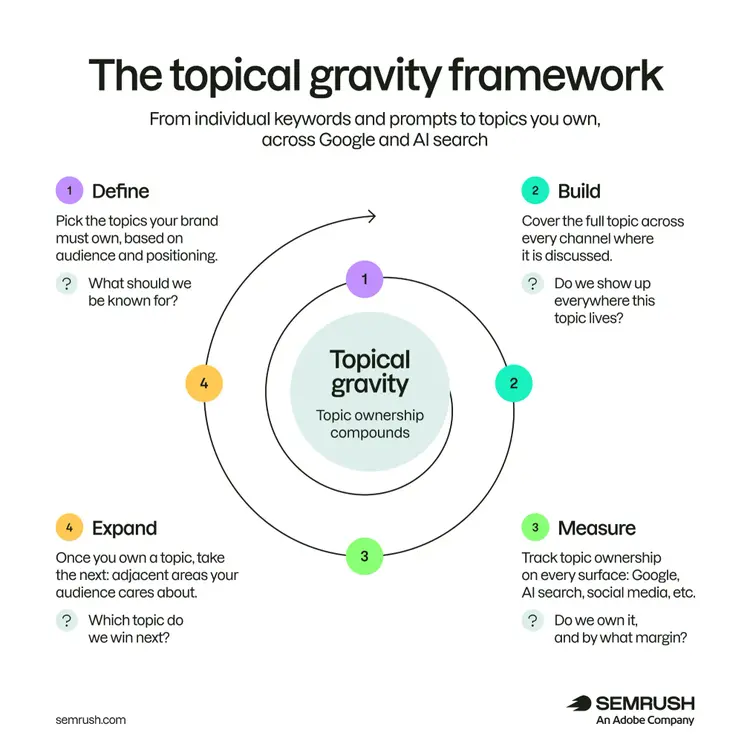
We call this Topical Gravity: define the topics your brand needs to own, build authority across them, measure your share of each against competitors, and expand into the next one.
Below is the framework we put together, the evidence behind it, and the sequence to run it with the resources you already have.
Why the future of search is topic-first
As search platforms now build their answers from dozens of related questions at once, visibility is won or lost across a topic, not on a single query.
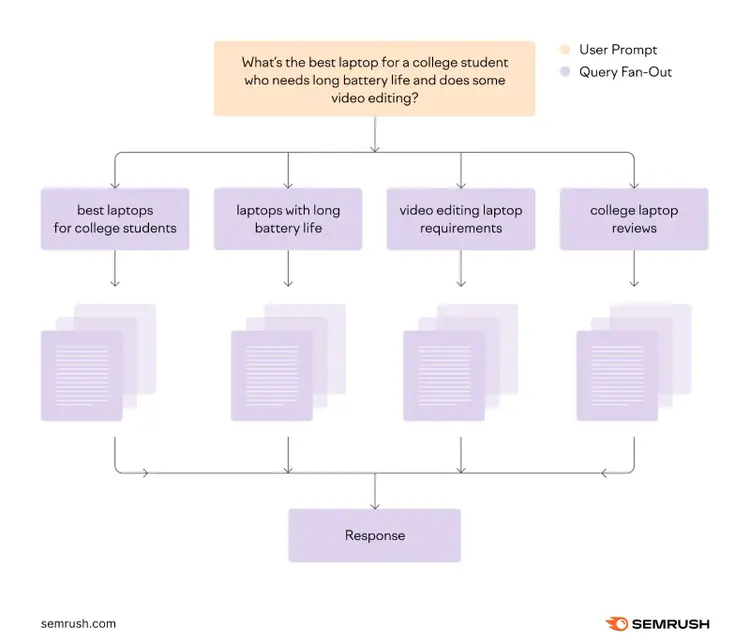
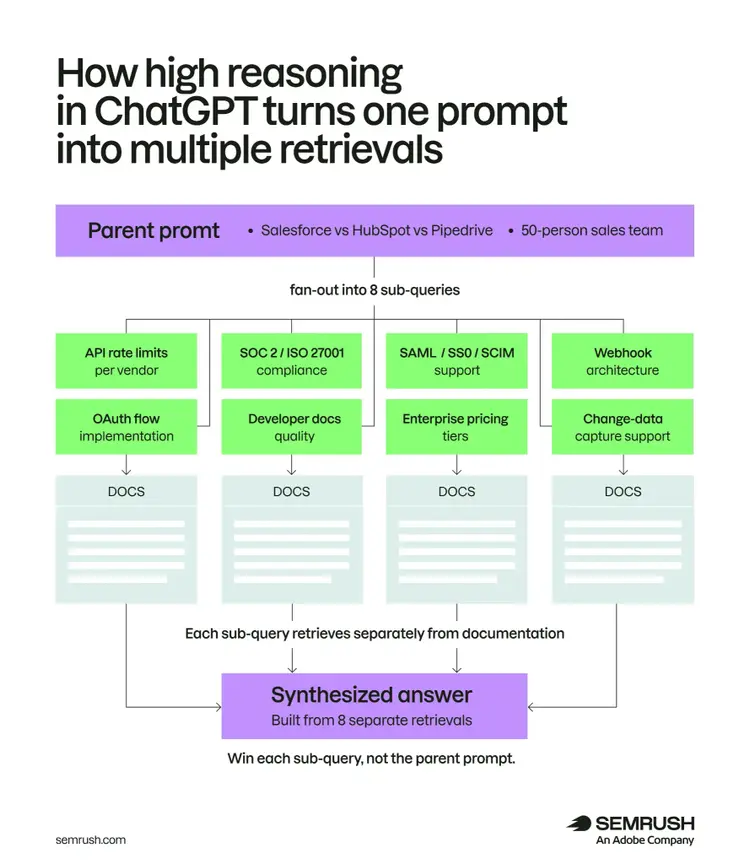
Google's documentation describes a “query fan-out” technique behind AI Overviews and AI Mode: The system breaks a question into subtopics and runs multiple related searches to build a single response.
OpenAI describes ChatGPT search in similar terms: A request becomes one or more search queries, and the answer is grounded in the retrieved sources. Especially when the high-reasoning mode is on.
Consider what that means for measurement.
If one question fans out into a dozen related searches, your rank on any single query captures a fragment of the inputs behind the answer. You can be perfectly optimized for the query you track yet absent from the surrounding searches.
The data backs this up:
What wins a topic isn'tjustoverall site strength. In nearly half of the topics we analyzed across 50,000 brands, the runner-up brands had the stronger domains — higher Authority Score, more traffic, or more branded searches — and still lost. What also matters is topical authority.
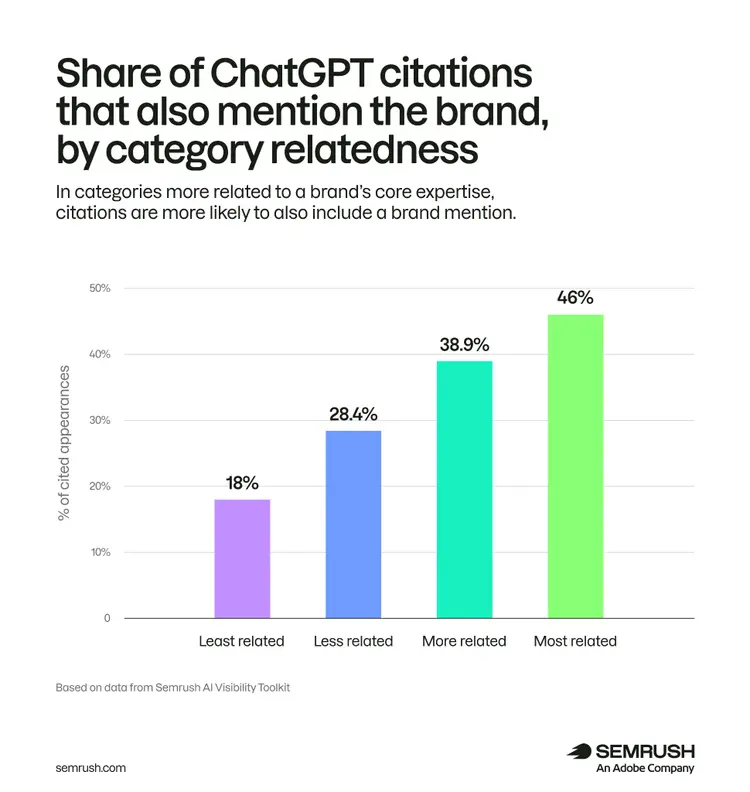
AI names brands it already associates with the topic.In our data, ChatGPT turned citations into actual brand mentions 46% of the time in topics where the brand was already established, and only 18% elsewhere.
Even the sources AI pulls from change with the topic.Kevin Indig's research found AI engines lean on a mostly different mix of sources depending on the subject of the question.
To be clear, topic-based content planning isn't new. Topic clusters and pillar pages have been standard practice for years. But we have yet to start treating topical authority as a metric.
The Topical Gravity framework
Topical Gravity is a framework for building and measuring topical authority across Google, AI search, and every other channel where your buyers look for answers.
It runs as a loop: define the topics your brand must own, build authority across them, measure your share against competitors, and expand into the next topic.
Here’s how each stage works:
01 Define: Explore where you already show up and decide which topics your brand has to own. A short set of subject areas where three things overlap: what your audience asks about, what your positioning credibly covers, and what drives revenue.
02 Build: Create real coverage of each topic, on your site and beyond it. That means the full question space (subtopics, comparisons, use cases, buying questions) plus presence in the places answer engines pull from: review platforms, industry press, communities, expert commentary.
03 Measure: Track your share of each topic against direct and indirect competitors across surfaces (Google, AI search, social media, and more), then look for gaps and opportunities (no period on this one)
04 Expand: As topics become consistently yours, extend into the adjacent ones: the next subjects your buyers ask about. Expansion works from strength; in our data, authority carried into closely related topics and faded fast in distant ones.
💡
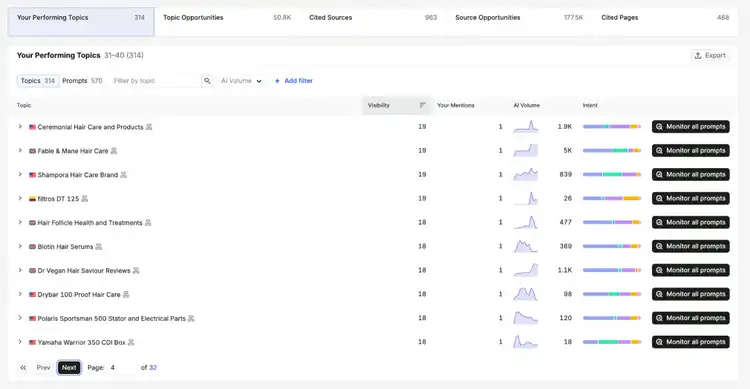
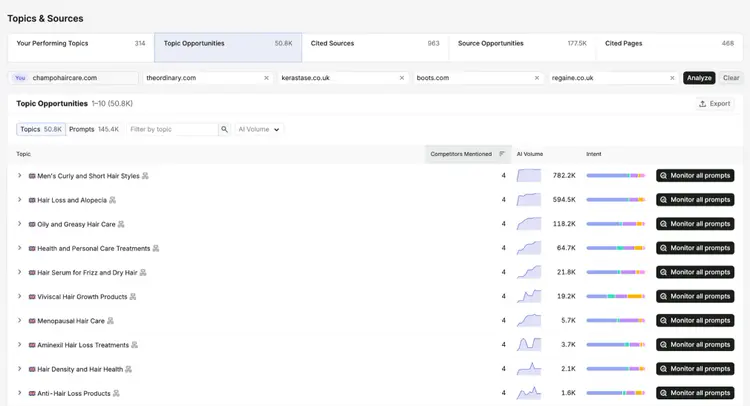
For example, the champohaircare.com brand consistently appears across several topics that are fundamental to its niche, including Ceremonial Hair Care and Products, Hair Follicle Health and Treatments, and Biotin Hair Serums (according to data from the AI Visibility Toolkit).
But it's still missing visibility across several closely related topic categories, including Hair Loss and Alopecia, Menopausal Hair Care, Hair Density and Hair Health, and others.
Creating content and building an external presence (e.g., Reddit, industry publications, forums, etc.) around these topics is the natural next step to increase the brand's visibility in AI recommendations. Measuring brand mentions across these topics over time helps determine whether the brand is gaining ground in each of them.
We also call it gravity because ownership compounds. Consistent presence across a topic doesn't just win you a few mentions; it ties your brand to the subject itself.
The more consistently you show up across your target topic, the more likely you’ll be mentioned and cited. Our data shows how strong this effect is: When a brand led a topic by a comfortable margin, it was still the leader a month later in 90% of cases.
What this means in practice
The Topical Gravity approach changes three things: how you plan, how you grow authority, and how you measure it.
Planning starts from a short list of topics that matter to your business instead of a long list of random keywords. Pick the subjects where your customers' questions, your positioning, and your revenue overlap. The focus is the strategy: In our research, depth in one relevant topic did more for brand recognition than presence scattered across 20 unrelated ones.
Then, grow your topical authority by showing up consistently:
Create content to tackle each topic: from detailed website pages to comparison content, customer proof, original research, and more
Earn mentions in the sources AI answers cite for your topic: review platforms, industry publications, and the communities where your buyers compare options
Keep your brand naming and positioning consistent everywhere, and prioritize addressing relevant positive and negative AI perceptions of your brand
Finally, the missing piece: measurement. Most teams still track search visibility the old way — rankings for individual keywords or prompt checks one platform at a time. Useful signals, but they never answer the bigger question: How much of the topic do you own across Google, ChatGPT, and everywhere else your buyers ask?
And how do you compare to your competitors?
That's exactly the gap we're closing at Semrush.
How Semrush helps
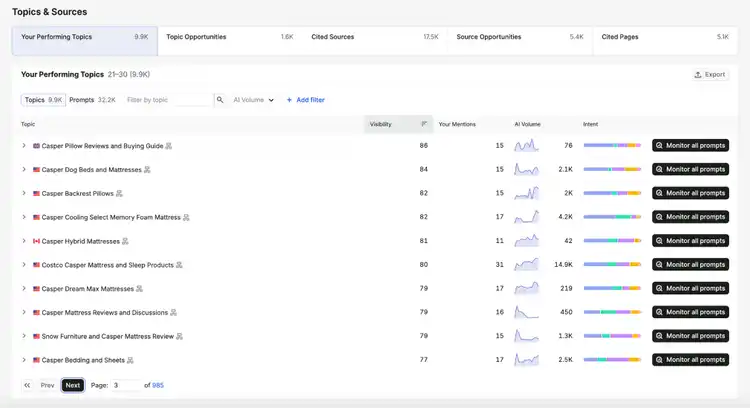
In Semrush, you can already see the topics where you win and the ones you’re missing.
Head to Visibility Overview in the AI Visibility Toolkit to see where you consistently appear in ChatGPT, Google AI, and Gemini answers.
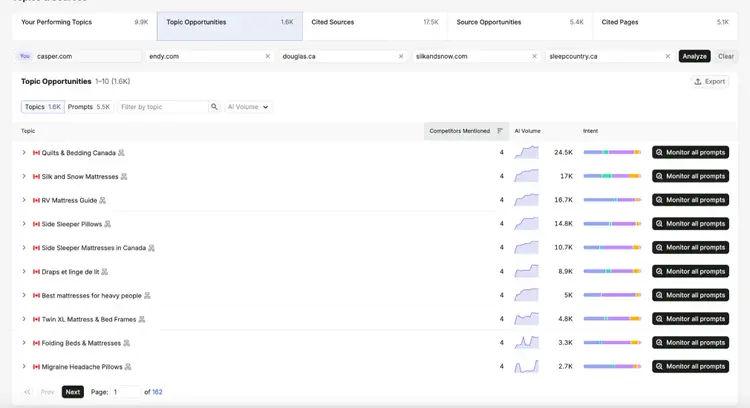
Then, switch to the "Topic Opportunities" tab, add your key competitors, and explore the areas where you have the most room to grow. Prioritize the topics with the greatest potential that also align with the criteria from stage one.
But hey — this is just the beginning. 🔥
Stay tuned: We're bringing a completely new way to track and grow topical authority across AI search.
The window is open
The shift underneath all of this is simple. Search has become a topic-level game, and topic ownership is the metric that matters across traditional and AI-powered search. Your share of a topic, your competitors' share, and the gap between them.
And the window is open. In our research, 85% of topics in ChatGPT still had no established owner, but the ones that do get taken tend to stay taken: a comfortable lead held in 90% of months.
The brands that start treating topics as the unit of their strategy will be the ones best positioned to build and defend brand visibility over time.
Margarita is a passionate Content Marketer with over 6 years of experience in various tech industries and 3 countries. She also holds two MBA degrees in Marketing.
Subscribe to learn more about General SEO
Subscribe
By clicking “Subscribe” you agree to Semrush Privacy Policy and consent to Semrush using your contact data for newsletter purposes
Share
Tells Google to show you more from Semrush in AI, Search, and Discover.