
Blog SEO used to mean one thing: rank in Google. That's no longer enough.
More people are turning to AI tools like ChatGPT and Perplexity to find answers, and the blogs these platforms cite aren't always the ones ranking No. 1 in traditional search. They're the ones written clearly, structured well, and backed by genuine expertise.
We'll cover what blog SEO means today, why it still matters, and 11 practical tips you can apply to your next post.
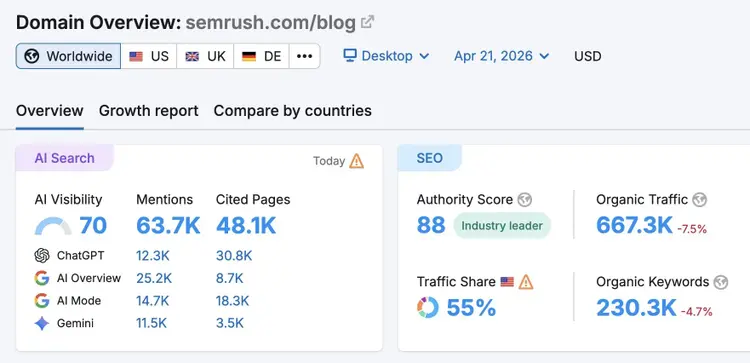
What is blog SEO?
Blog SEO is the process of creating, structuring, and optimizing blog content so it’s easy to find, understand, and trust, both in traditional search results and in AI-generated answers.
It includes:
- Choosing the right topics and keywords
- Structuring posts so AI tools can summarize them
- Writing clearly for human readers
- Adding authority signals that build trust
- Updating your content for accuracy and freshness
In the past, a well-optimized SEO blog post meant targeting the right keywords and earning a few backlinks. Today, it also means writing in a way that's easy for AI systems to parse, extract, and cite.
The good news: these aren't separate strategies. A post written well for readers is usually a post written well for AI.
That means focusing on these four things:
- Trustworthiness: Demonstrate experience, expertise, authority, and credibility (E-E-A-T)
- Machine readability: Use a clear structure and schema so AI tools can parse and summarize your content
- Answer-first writing: Lead with direct answers early, before elaborating
- Topical authority: Build connected content clusters, not isolated posts
Why is blog SEO important?
Blog SEO is important because it turns your content into a compounding source of organic traffic, leads, and visibility without paying for every click.
Unlike social media or ads, a well-optimized blog post can drive consistent traffic for years after it's published.
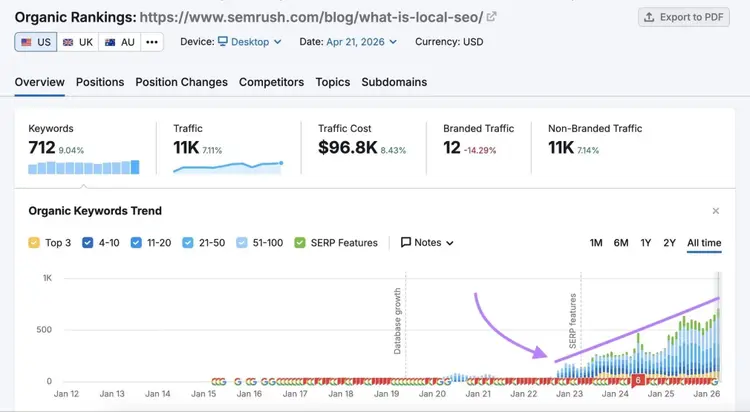
Over time, a strong blog builds topical authority, which signals to both search engines and AI tools that your site is a trusted, go-to resource in your space.
The business case is straightforward:
- Traffic: Posts that rank pull in readers who are already searching for your topic, month after month
- Leads and revenue: That search-driven traffic converts better than cold audiences from ads or social, because intent is already there
- AI visibility: Blogs that are well-structured and authoritative are more likely to be cited by AI
- Brand authority: Appearing in search and AI results builds your brand’s credibility and trust
- Cost efficiency: Unlike paid channels, organic traffic doesn't stop the moment your budget does
The results compound over time. Well-optimized blog posts earn traffic for years after publication, and in the AI era, structured content also earns AI citations. According to AirOps research analyzing 12,000 URLs, pages with properly sequenced headings (a single H1 followed by H2s and H3s in order) are 2.8x more likely to be cited in ChatGPT than pages with disorganized heading structures.
11 SEO blog tips to improve search and AI visibility
The following tips cover the full blogging workflow, but you don't need to apply all of them at once. Start with the ones most relevant to where your content is right now, and build from there.
Pick topics people search for and where AI answers leave gaps
The best blog topics for SEO target search demand.
You can uncover these with our free keyword research tool. Enter your main keyword or topic and click “Search.” For example, if you run a health and fitness blog, you could search for “exercise.”
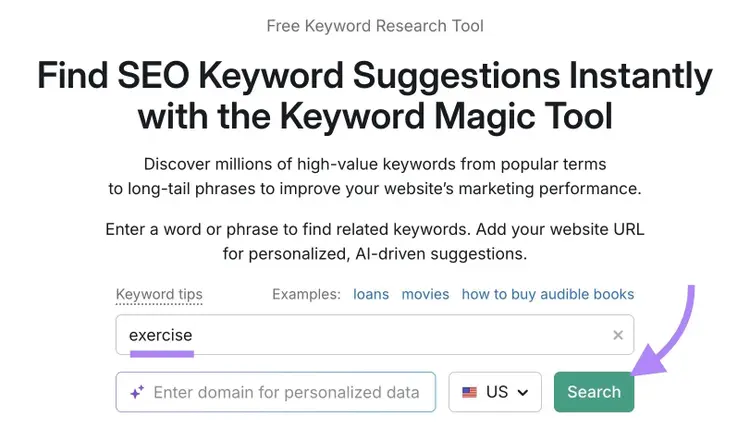
You’ll then get a list of keywords about the topic, along with metrics for how popular and competitive they are.
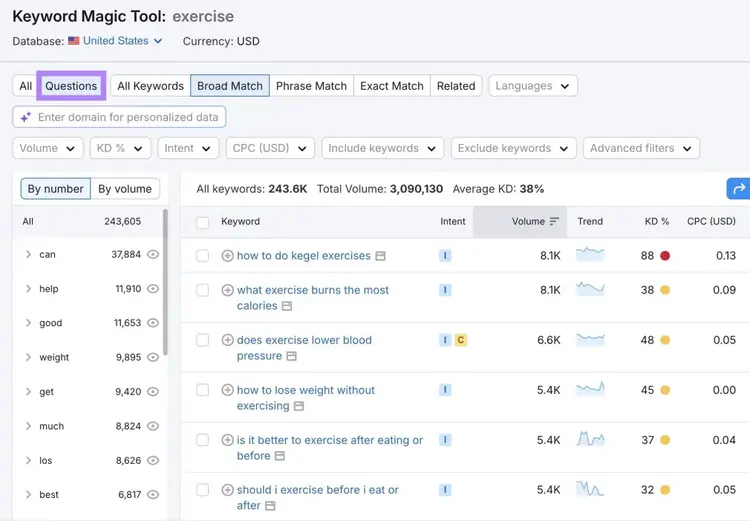
Search volume is the average number of times a keyword is searched for each month.
Keyword difficulty tells you how hard it would be to rank organically in the top 10 search engine results.
High-volume, low-difficulty keywords are the best place to start. Even new websites can find quick-win opportunities they can realistically rank for.
Go through these and build a list of keywords that are relevant to your website.
Once you have a shortlist, run your top candidates through AI search platforms like ChatGPT, Perplexity, or Google's AI Mode and check out the AI-generated answers.
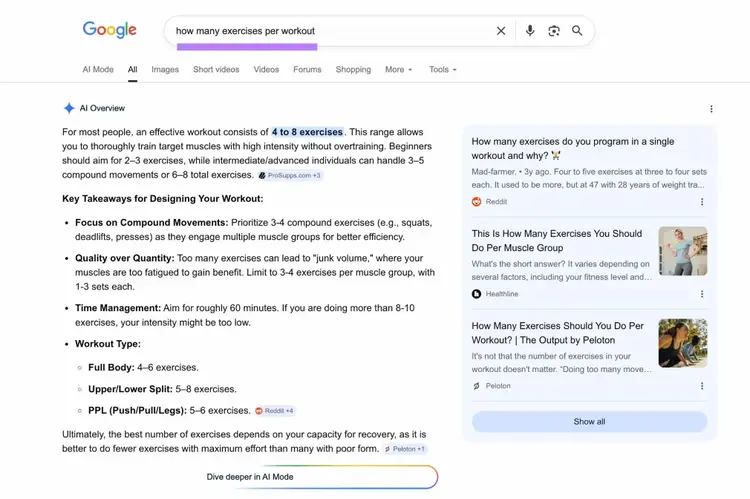
Pay attention to three things:
- What questions get answered well
- What sources get cited most prominently
- What formats the responses take
This tells you whether a topic has enough substance for AI tools, and where the gaps are that you could fill in.
If the AI answer is thin, misses an angle, or relies on weak sources, you've found an opportunity. You can outperform it with better examples, original data, or clearer steps.
The strongest topics for blog SEO today are ones with proven search volume and an AI answer you can improve on.
2. Match your content format to search intent
Search intent is what someone actually wants when they type a query, not just the words they used. And it applies the same way whether they're searching Google or prompting ChatGPT.
There are four main types of search intent:
- Informational: The reader wants to learn something (e.g., "what is anchor text")
- Navigational:The reader is trying to find a specific page or website (e.g., “Semrush login”)
- Commercial: The reader is weighing options (e.g., "best SEO tools for beginners")
- Transactional: The reader is ready to act (e.g., "Semrush pricing")
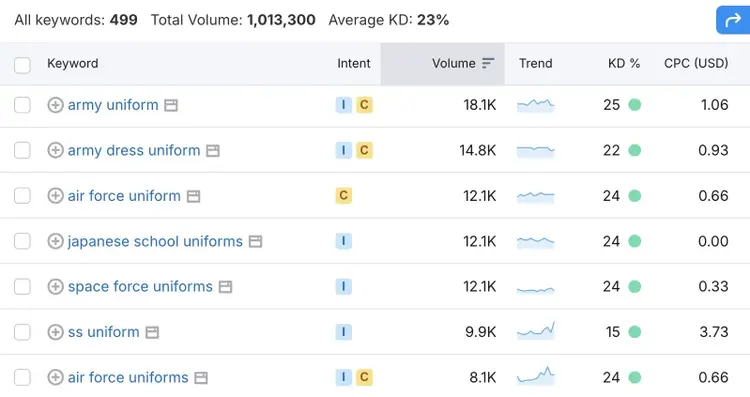
Blog posts rank well for informational and commercial queries. Transactional queries usually return ecommerce pages instead, where searchers can buy the product directly.
For example, someone searching for a work uniform already knows what they need to buy. They don't have follow-up questions a blog post could help answer.
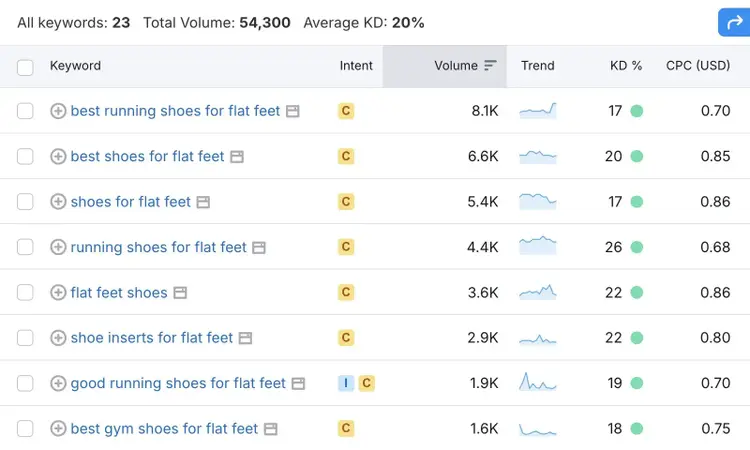
Compare that to someone with flat feet looking for running shoes. They have questions to work through before they're ready to buy.
These searchers want recommendations, comparisons, and explanations that a blog post handles better than a product page does.
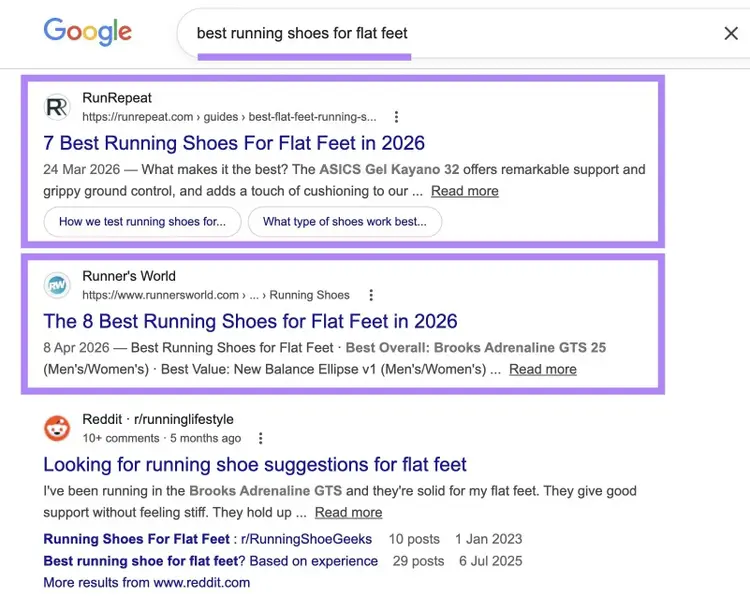
If you’re unsure whether a keyword fits your blog strategy, try searching it on Google to see if many blog posts rank:
You can also search it on AI platforms like ChatGPT or Perplexity and see if they cite blog posts in their responses.
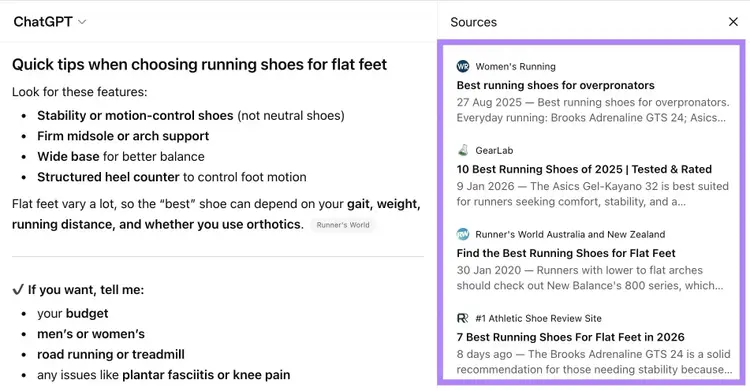
If you want your blog content to rank well, you’ll need to deliver information in the format that searchers are interested in, like:
- How-to guide: Walks readers through a process, step-by-step
- Listicle: Shows a range of options so readers can compare
- Definition post: Explains a topic to readers who are new to it
- Comparison post: Helps readers choose between options before they buy
In the example of running shoes, most of the ranking pages are listicles. To rank for this keyword, you’ll have to use the same format.
3. Build a question map before you outline
A question map is a list of the specific questions your target reader is likely to ask about a topic.
It becomes your heading outline before you write, so your post's structure is driven by actual reader needs instead of guesswork.
For example, if someone is looking for an injury lawyer, several questions come up as they decide whether they need an attorney.
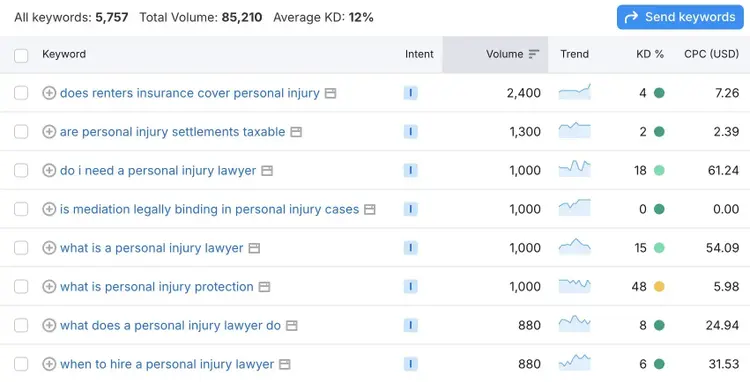
Your blog content can help answer the questions your target audience is asking before they’re ready to buy. If you're not answering what they ask Google or ChatGPT, your competitors will be the ones who show up instead.
To find these questions, try searching for your main keyword on Google and checking the "People Also Ask (PAA)" section.
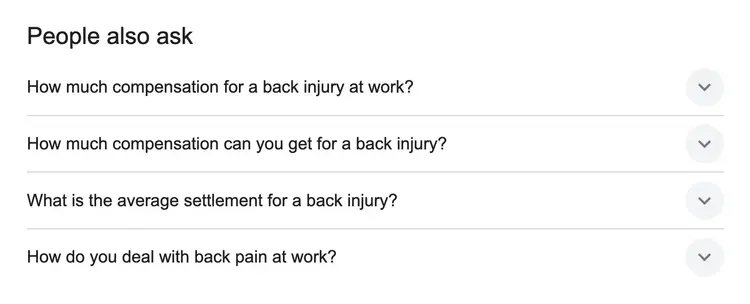
You can also prompt an AI tool and watch what follow-up questions it asks or what reasoning steps it takes. Both reveal what readers expect your content to cover.
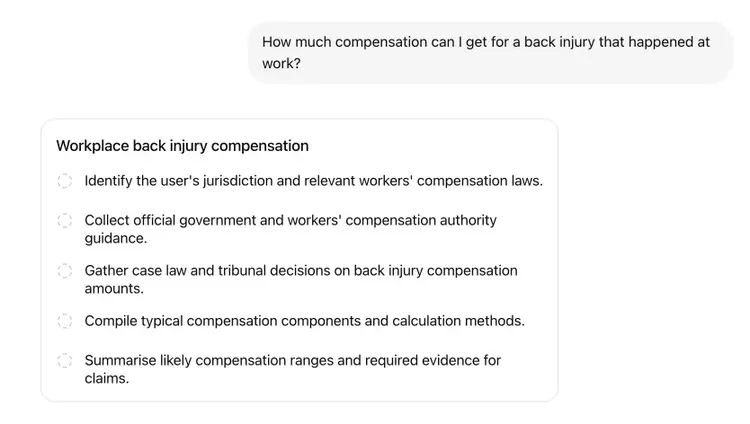
Both of these methods will give you a handful of related questions people may have. But if you want a more in-depth list, check out the “Questions” report in Semrush Keyword Magic Tool.
Enter your main topic and segment the keyword list to questions only.
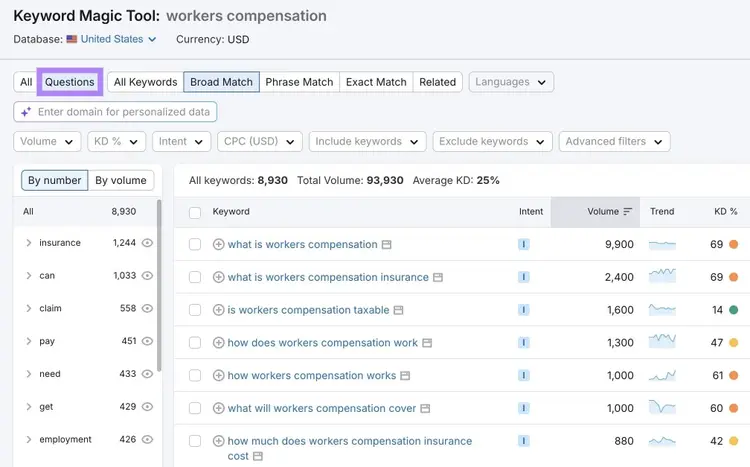
Make a list of all the relevant questions for your audience. You’ll need these when structuring your content, as they can serve as subheadings in blog posts or as stand-alone FAQ sections.
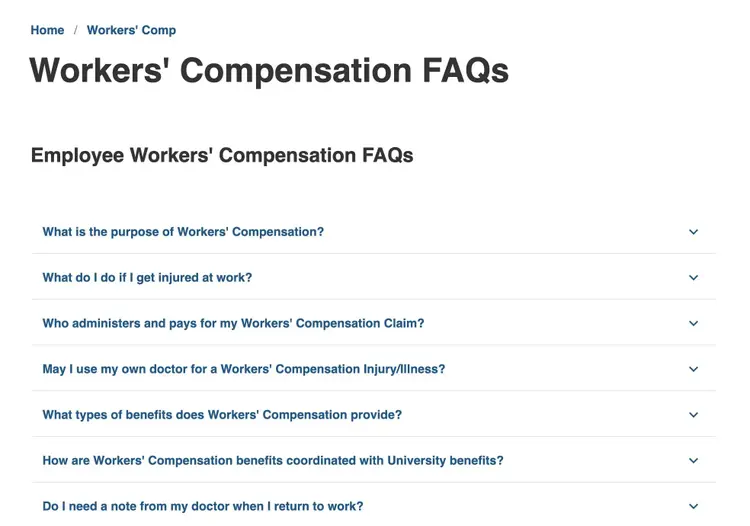
Once you have your list, map each question to a role in your post’s structure. Primary questions are those with the highest search volume or the broadest relevance. They become H2 headings. Related follow-up questions become H3 headings beneath them or get grouped into an FAQ section at the end.
For example, if you’re writing about personal injury lawyer costs, your blog post’s structure might include relevant questions like this:
- H2: How much does a personal injury lawyer cost?
- H3: Do personal injury lawyers charge upfront?
- H3: What does “no win, no fee” mean for personal injury law?
- FAQ: What happens if I lose my case? Do I still pay?"
The question map becomes your content brief. Before you write a word, you already know your heading structure, the order in which topics should appear, and where an FAQ section adds value.
4. Structure your content for traditional and AI search engines
A clear content structure does three things at once: it helps readers skim, helps search engines index specific passages, and helps AI tools extract clean, quotable answers from your post.
For example, subheadings turn a long post into scannable chunks that readers can navigate in seconds.
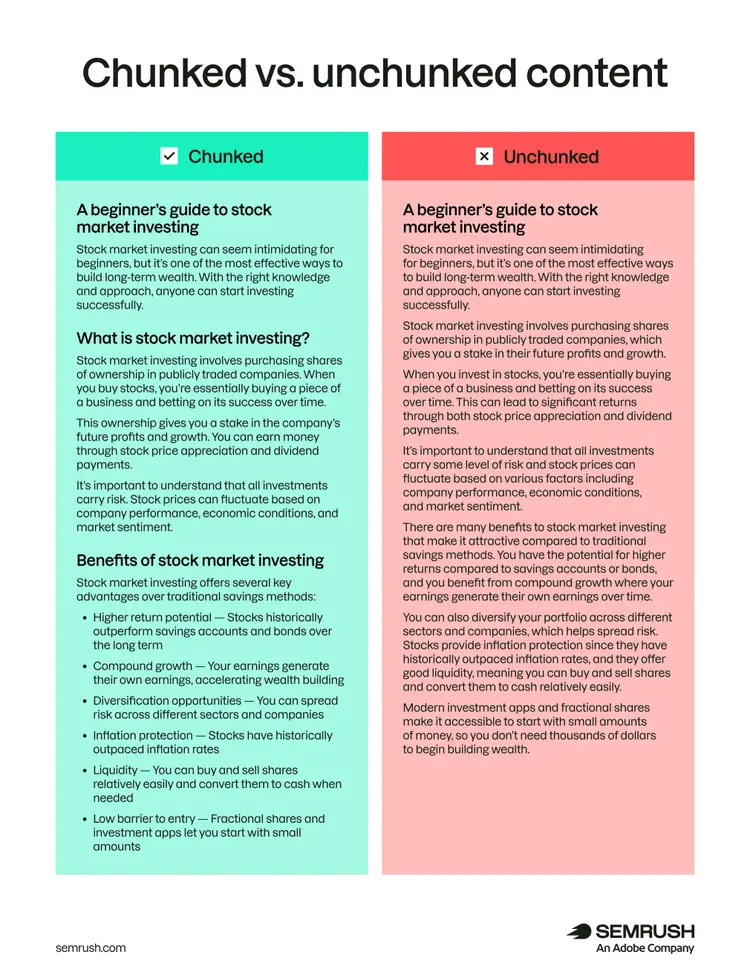
It's also what search engines and AI tools rely on to extract specific passages. Google uses passage-based ranking to display direct answers in search results, and AI platforms use the same structural cues (clear headings, self-contained sections) to pull quotable content into their responses.
Here's what that looks like in practice. For a 'People Also Ask' question, Google pulls text directly from a section in the ranking article, and the same passage can serve as both a PAA answer and an AI citation:
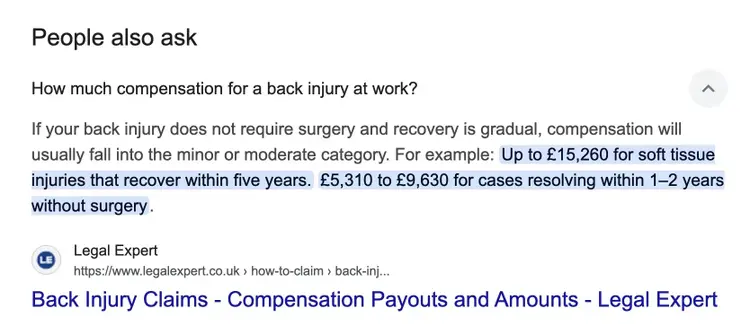
Google takes text directly from sections in the ranking article:
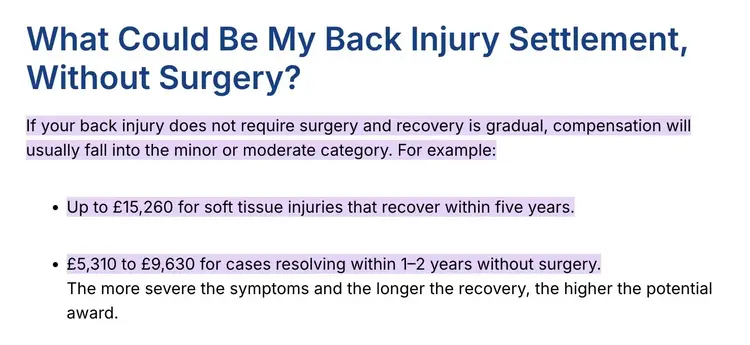
To structure your content in a human and machine-friendly way, add H2 and H3 subheadings throughout. Heading tags help search engines and AI systems understand your content’s structure and which sections to prioritize.
They also keep distinct ideas in their own sections, which makes each section independently extractable by AI tools.

Long posts benefit from a table of contents at the top, which lets readers jump straight to the section that answers their question.

5. Lead with the answer in every section
Lead with the direct answer in the first sentence of every section. Context, examples, and caveats come after.
This has always been a principle of good writing. It's now also what gets content cited by AI. A direct opening answer gives AI tools something clean to extract, and lets human readers grasp the section while skimming, without needing context from what came before.
For example, Healthline’s content cuts to the chase and directly answers the question posed in each heading.
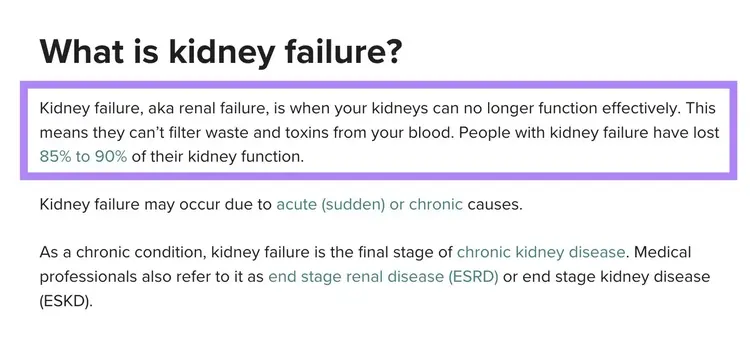
AI tools are built to find the most direct, self-contained answer to a question.
Posts that bury the answer after three paragraphs of background are harder to extract from, so they're less likely to be cited.
The fix is simple: write your heading, then answer it in the very next sentence. Everything that follows should support or expand on that answer, not lead up to it.
6. Show your expertise and back up your claims
Trust signals tell search engines and AI tools that your content is credible, accurate, and worth citing. Google's E-E-A-T framework (Experience, Expertise, Authoritativeness, and Trustworthiness) is the benchmark for both.
The same signals that earn search rankings now earn AI citations: genuine expertise, credible sourcing, and visible authorship.
In practice, that means:
- Show first-hand experience: Screenshots, walkthroughs, and real examples signal that the author has actually done what they're describing, not just summarized other posts.
- Cite your claims: When you state a statistic or make a strong claim, link to the original source. This builds credibility with readers and gives AI tools a chain of attribution to follow.
- Make authorship clear: An author bio that explains who wrote the post and why they're qualified to write it adds a layer of trust that generic, unattributed content can't replicate.
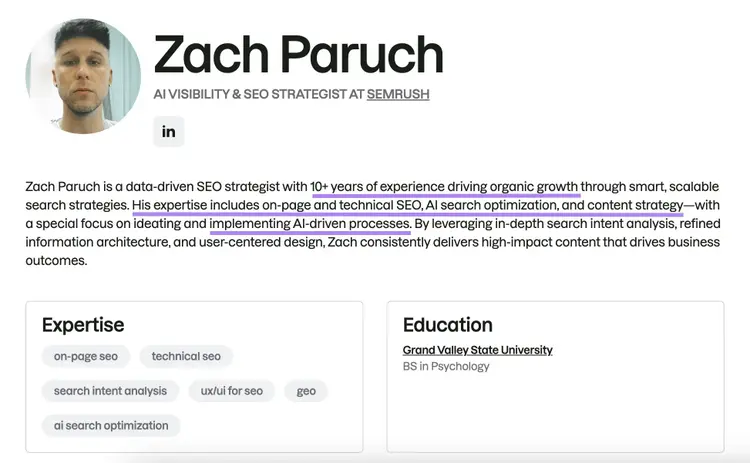
For example, the content you see on our blog is created by SEOs and marketers with years of experience in the field.
Our AI Visibility & SEO Strategist, Zach Paruch, has more than 10 years of experience driving organic growth, with a focus on AI search optimization and AI-driven processes. His author bio and body of work reflect that expertise.
7. Write clearly for both readers and AI tools
If your content is difficult to follow, readers leave early, which signals to search engines that your post isn’t delivering what they’re looking for. AI tools have the same problem. Content that’s dense, meandering, or poorly structured is harder to extract from and less likely to be cited.
Here's how to keep your writing clean:
- Use subheadings (H2 to H6): Subheadings break down a lengthy post and guide readers through what to expect from each section
- Break up long passages: Pull-quotes, lists, and short paragraphs give the eye places to rest in dense sections
- Use short sentences and paragraphs: This helps you avoid “walls of text”
- Use bullet points and numbered lists: This helps you provide information succinctly
- Read your writing out loud: This helps you identify and fix areas where your writing doesn’t flow well
- Use plain language: If a simpler word works, use it. Write for the least-experienced reader in your audience.
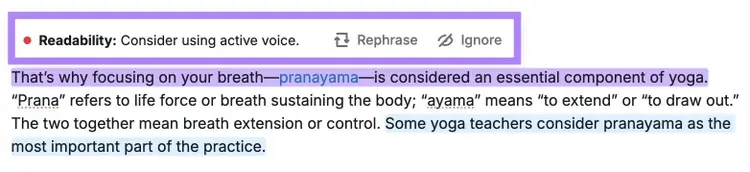
- Write in active voice: "Semrush found that..." is cleaner and more direct than "It was found by Semrush that..."
After you write your blog post, Semrush’s SEO Writing Assistant can check its readability score and SEO performance, flagging overly long sentences, tone inconsistencies, and keyword usage in one view.
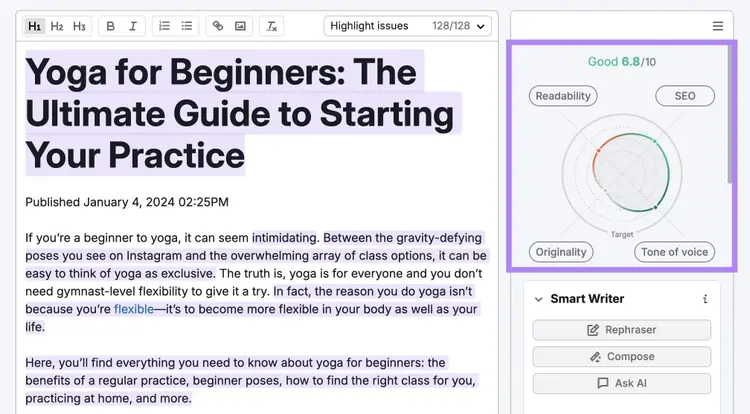
If your content has readability issues, the tool shows which sentences or words to rewrite.
8. Add images and videos (not just text)
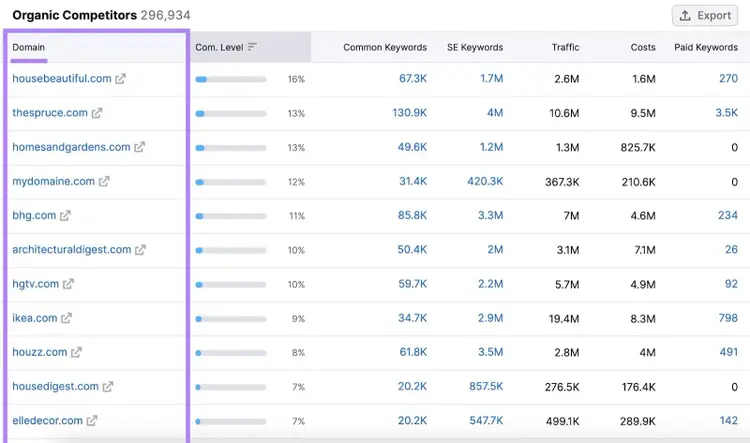
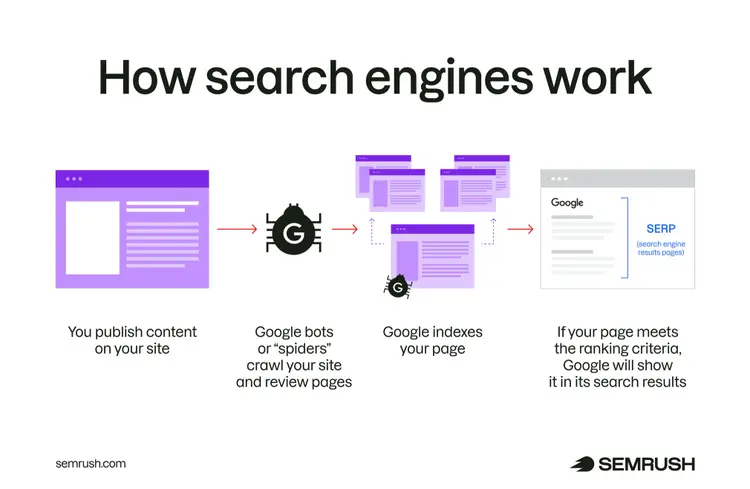
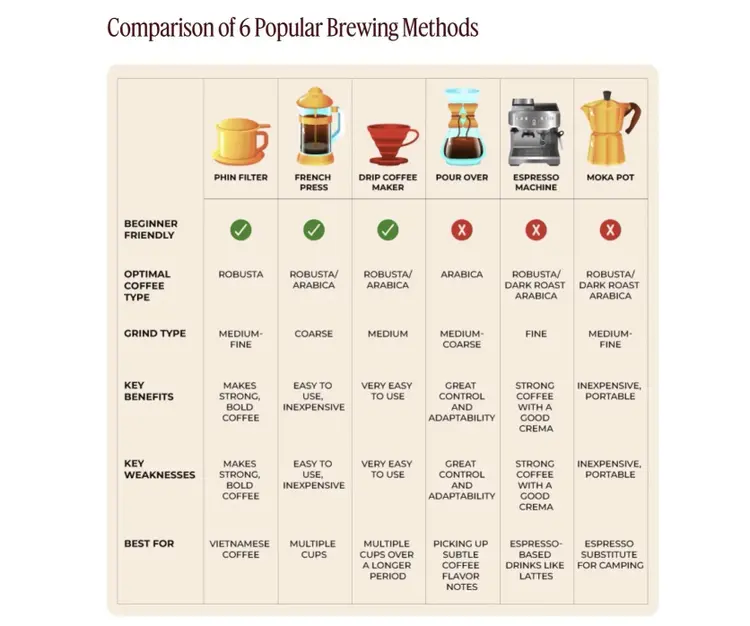
Images, videos, and diagrams aren't decoration. They're essential to how readers learn, how search engines evaluate content quality, and how AI tools understand and contextualize what your post is about.
The rule of thumb: include a visual when it makes something clearer than text alone could. AI tools increasingly surface contextual image and video results alongside text. Content with properly labeled visuals is more likely to appear across all of these formats.
For example, screenshots of tools in action:
Step-by-step diagrams:
And comparison tables all pass this test. Each one teaches something text alone can't.
Stock photos and decorative graphics don't. They're built to be reusable across many contexts, which is exactly why they teach your reader nothing specific.
Aim for at least one visual break (an image, video, bulleted list, blockquote, or diagram) per screen of content. No matter where a reader is in your post, they should be able to see a visual break without scrolling.
When you include visuals, make them searchable:
- Write descriptive alt text that explains what the image shows (not "screenshot of dashboard" or left blank)
- Use keyword-relevant file names before uploading
- Add captions where context would help a reader who's skimming
- Include transcripts or step summaries for any video content
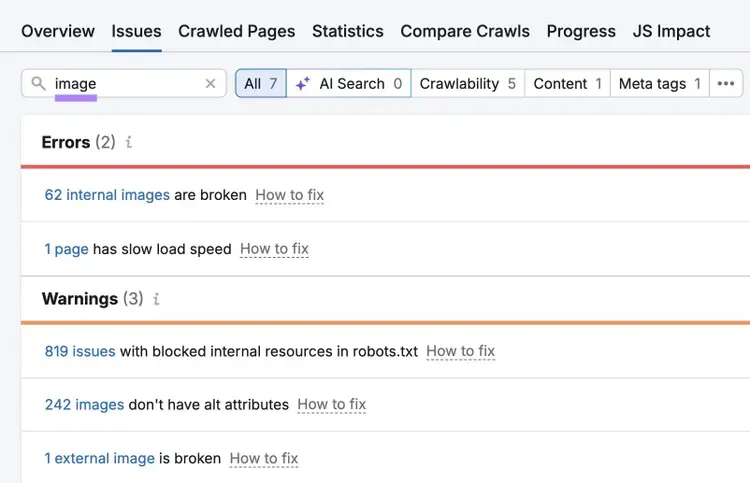
You can audit your image optimization in Semrush’s Site Audit. Run a crawl and check the reports for image issues, such as missing alt text or large file sizes.
9. Nail the on-page SEO that earns clicks and citations
On-page SEO covers the elements on your post that help search engines understand it and that convince readers to click. These are the fundamentals you apply while writing, not after.
Apply these foundations to every blog post for better visibility in search and AI results:
- Include your target keyword in the title tag: This helps demonstrate to searchers and Google that your blog post is the most relevant result for a particular query
- Write a compelling meta description: Lead with the benefit or value the reader gets, not just the keyword. "Learn how to lose weight" tells the reader nothing while "Lose weight without cutting the foods you love" gives them a reason to click.
- Use short, descriptive URLs: This lets searchers know what to expect from a blog. (e.g., domain.com/blog/weight-loss-tips/ is clearly a post about “weight loss tips”)
- Include your target keyword in the H1 tag: This will help your page rank for the term
- Include your target keywords in the body: This shows Google that your content is relevant for specific queries. But don’t add them in unnaturally.
- Link to relevant internal resources: Internal links help users find related content and build topical clusters that signal to search engines and AI tools that your site covers a subject in depth, not just in isolation
- Add alt text to images: Google uses alt text to rank images in Google Images
Most website builders offer SEO plugins that handle these optimizations automatically.
Then, use Semrush’s On Page SEO Checker tool to cross-check whether your posts are optimized for their target keywords.
First, configure the tool for your site. After the setup is complete, click the “Optimization Ideas” tab.
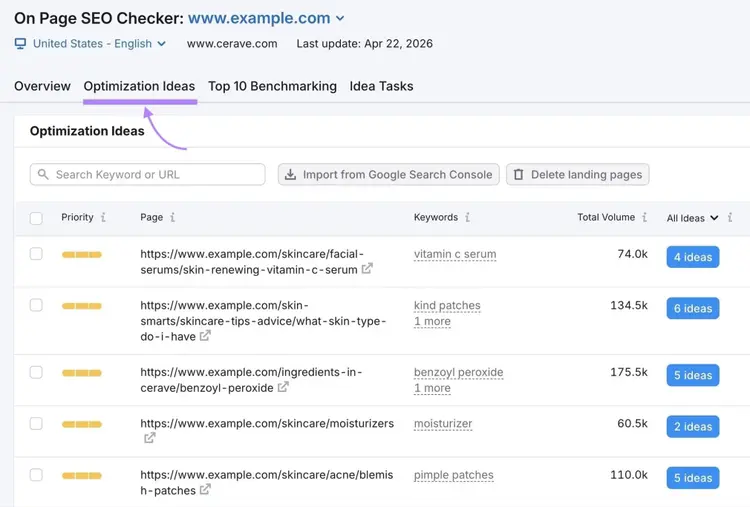
Here, you'll see a list of your posts and the number of optimization ideas for each.
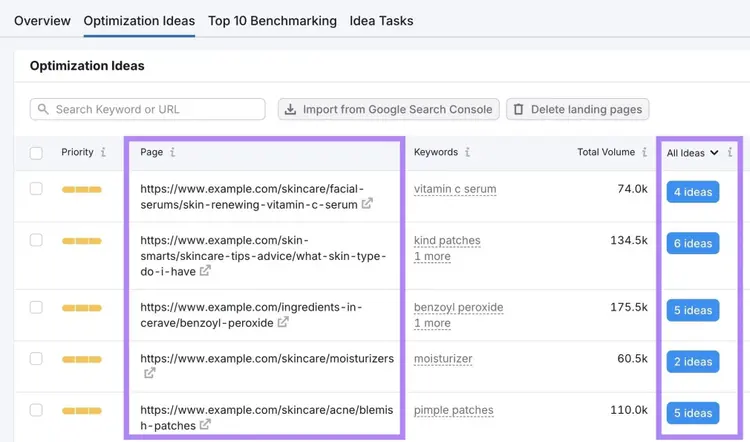
Click on “X ideas.”
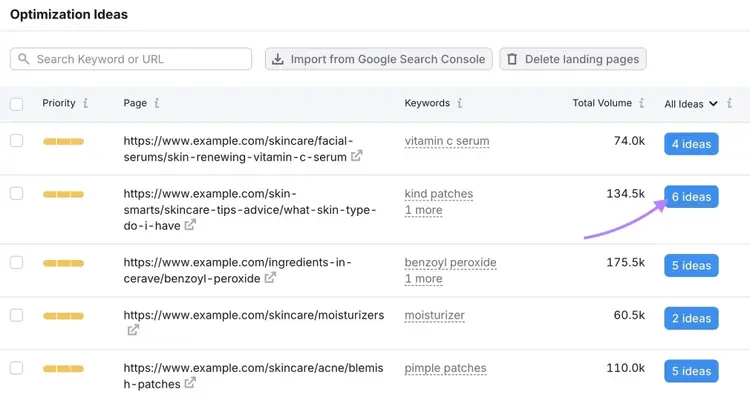
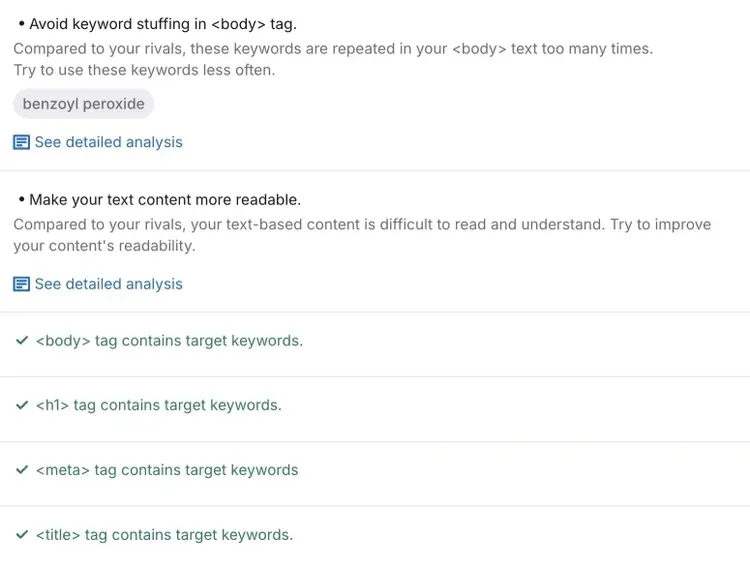
The content section shows you whether each post is optimized for on-page SEO.
10. Get the technical foundations right (indexing, speed, schema)
If Google can’t crawl and index your blogs, nothing else in this list matters. Your content is invisible to Google's ranking algorithm and to the AI platforms that lean on web search to ground their answers, whether that's through Google's index, Bing's, or their own crawlers.
The technical fundamentals that matter most for blog content include:
- Indexing: Confirm your posts are indexed in Google Search Console and flag any crawl errors. If a post isn't indexed, it won't rank.
- Page speed: Slow pages lose readers before they start reading. Compress images, avoid bloated scripts, and test load time with Google's PageSpeed Insights.
- Schema markup: Adding Article, FAQ, or HowTo schema helps search engines understand your content type and can unlock rich results on the SERP
For a quick check, run a free SEO audit on your site.
For a full crawl across all your pages, use the Semrush Site Audit tool.
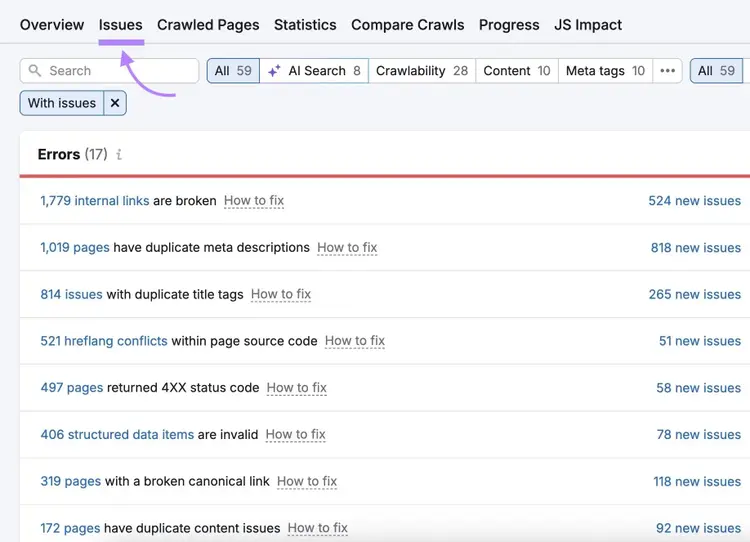
Once the crawl is complete, navigate to the “Issues” tab. You’ll see the technical issues detected for your site.
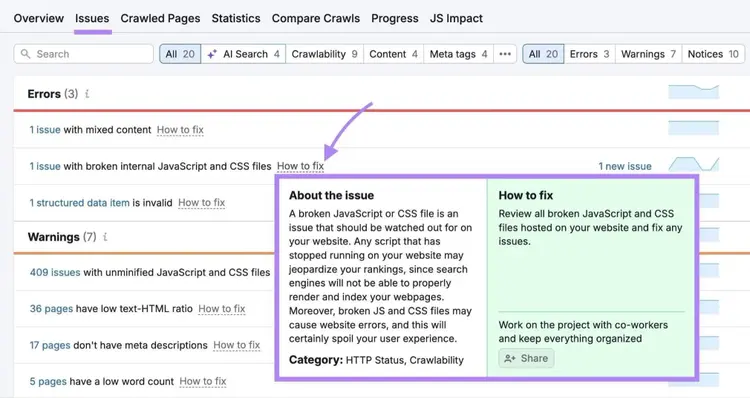
Click the “How to fix” link next to each issue to understand why something is an issue and how to fix it.
11. Update, distribute, and track after you publish
Over time, blog content becomes outdated and loses visibility in search results, especially when competitors publish fresher content.
The posts that consistently drive traffic are the ones that get updated, promoted, and monitored.
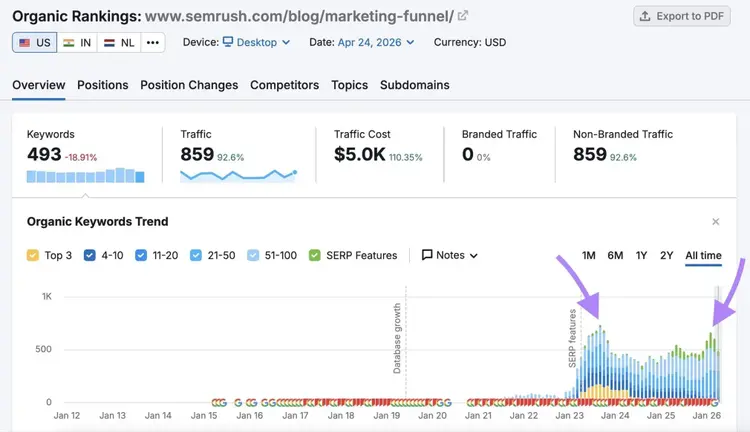
For example, we updated our guide to marketing funnels in 2023 and again in 2025. Both updates led to performance spikes.
But how do you know which blog posts to update?
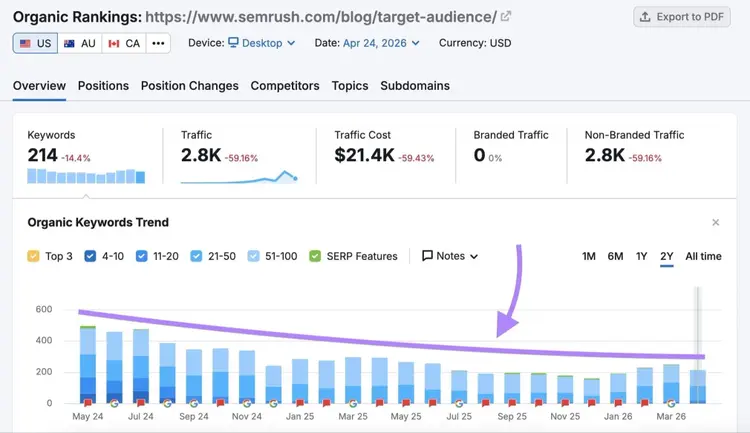
Drop some of your older blogs into Semrush’s Organic Rankings tool and check the Pages report for traffic trends. Posts with declining traffic over the last 6 to 12 months are your update candidates.
For example, if we do this for our guide on finding your target audience, we see a steady decline in traffic. That makes it a strong candidate for an update.
When updating posts, consider these best practices:
- Refresh any stats, sources, or examples older than two years
- Add sections covering questions the original post didn't answer
- Cut sections that are no longer relevant
- Re-check whether the post still matches current search intent, not just the intent you wrote for originally
And sometimes, it's best to rewrite the entire post. Don't be afraid to do that, especially if a keyword's intent has shifted and your content no longer matches what's ranking.
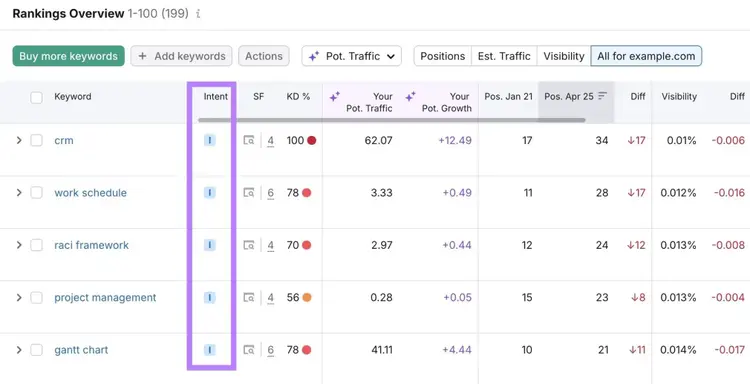
To spot these shifts early, set up Semrush's Position Tracking. Its Intent column classifies each tracked keyword (informational, navigational, commercial, or transactional), so you can watch for changes alongside your ranking data.
If a keyword's SERP format shifts (from blog posts to ecommerce pages, for example), that's a signal your content may need a format change, not just an update.
If a post isn’t gaining traction after an update, distribute it more widely:
- Share it through your newsletter
- Post it on your socials
- Boost high-performing social posts with paid ads
- Share it in your industry’s Slack groups, communities, and forums
- Repurpose key sections into short form video
Backlinks also help. Building them through PR, partnerships, or linkable assets makes your content more discoverable for both readers and search engines.
Finally, track whether your updates have improved performance in traditional and AI search results with Semrush’s AI Visibility Toolkit.
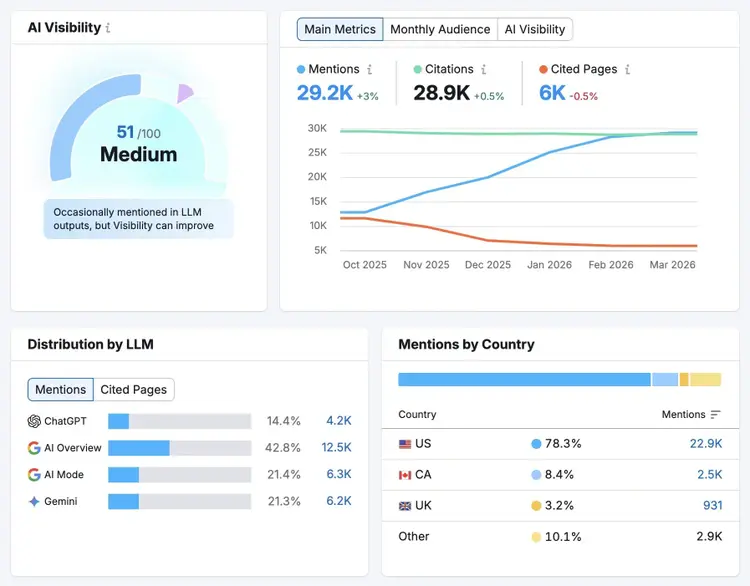
You can monitor which of your posts are being surfaced in AI-generated answers, so you can see what's working and double down on the structure, format, and topics that get cited most.
Traditional rankings and AI citations don't always move together, so monitoring both gives you the full picture.
Start optimizing your blog today
Pick one blog post that's already getting some traction but hasn't hit its potential. Apply the on-page fundamentals, lead each section with a direct answer, and add the trust signals your niche expects.
Then use Semrush's On Page SEO Checker to see what each post is missing and where to focus next. Traditional rankings and AI citations don't always move together, so keep an eye on both as you go.
Get blog optimization ideas
with the On Page SEO Checker

Cecilia is a senior editor and strategist with more than 12 years of experience shaping editorial strategies, refining brand messaging, and leading high-impact teams. She began her career in print and digital editorial leadership roles before transitioning to SEO and digital marketing, focusing on data-driven strategies. She‘s passionate about ensuring operational efficiency, upholding editorial standards, and mentoring writers to deliver top-quality, brand-aligned content.
Cecilia Meis
Cecilia is a senior editor and strategist with 12+ years of experience spanning print, digital, and SEO. She’s passionate about optimizing editorial processes, upholding quality standards, and mentoring writers to deliver brand-aligned content.
Tells Google to show you more from Semrush in AI, Search, and Discover.
Table of contents
-
11 SEO blog tips to improve search and AI visibility
- Pick topics people search for and where AI answers leave gaps
- 2. Match your content format to search intent
- 3. Build a question map before you outline
- 4. Structure your content for traditional and AI search engines
- 5. Lead with the answer in every section
- 6. Show your expertise and back up your claims
- 7. Write clearly for both readers and AI tools
- 8. Add images and videos (not just text)
- 9. Nail the on-page SEO that earns clicks and citations
- 10. Get the technical foundations right (indexing, speed, schema)
- 11. Update, distribute, and track after you publish