
Driving traffic to your blog now means much more than relying on traditional search engines.
In this guide, you’ll learn nine actionable ways to increase blog traffic.
Let’s get started.
1. Write Content on Topics People Care About
Finding and writing about topics your target audience is interested in can help you rank in search engines and get cited by AI tools. And can keep your readers engaged once they arrive at your blog.
How do you find the right topics? Here are a few ways:
- Use Google’s People Also Ask section. Search for a broad topic in your niche. For example, type “personal finance tips” into Google. Scroll to the "People Also Ask" section (if there is one) to find common questions people are asking.
- Study trending news stories. Use tools like Google Trends or Exploding Topics to find emerging topics. Be sure you focus on those within your niche.
- Explore forums like Reddit and Quora. Browse forums or Q&A platforms where your audience spends time. You’ll find a lot of discussion about pain points, solutions, and troubleshooting that you might not find elsewhere.
- Use AI tools to brainstorm. Provide AI tools like ChatGPT with detailed information about your target audience. Then, ask about challenges your audience might be facing and the questions they’re likely asking.
Once you have some initial ideas, use the Keyword Magic Tool within Semrush’s SEO Toolkit to validate your ideas and find specific keywords people are searching for.
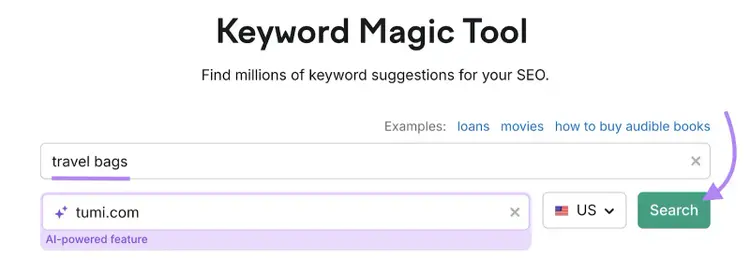
To get started, enter a broad term related to your niche (e.g., “travel bag”), enter your domain, and select your target country.
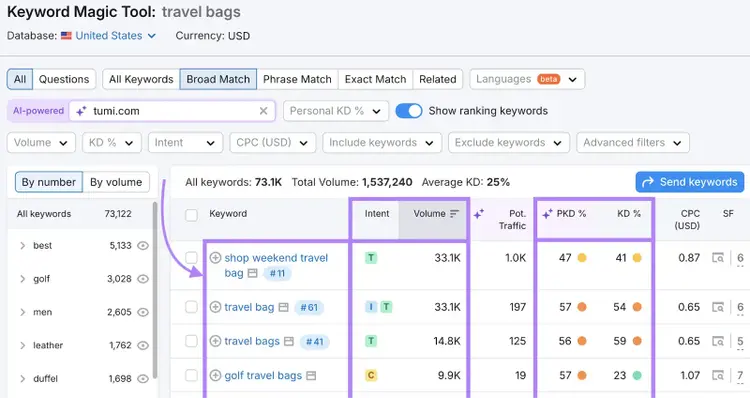
The tool will then provide a list of related keywords along with key metrics for each. Like:
- Volume: How many searches the keyword gets each month
- Search Intent (Intent): What users are trying to achieve when searching the keyword
- Keyword difficulty (KD %): How hard it is to rank in the top 10 results for the keyword
- Personal Keyword Difficulty (PKD %): How hard it would be for your website to rank in the top 10 results for the keyword
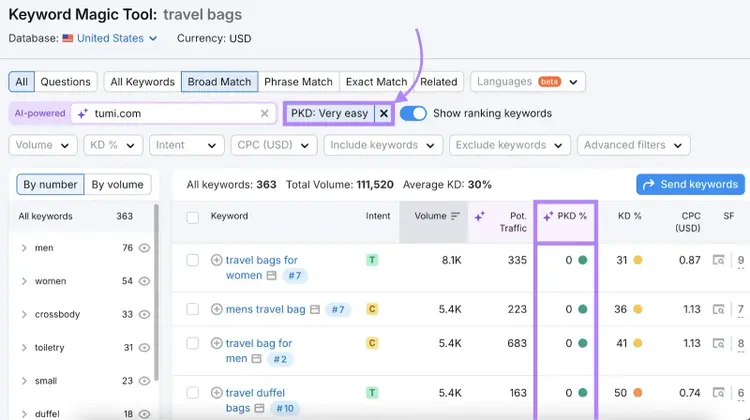
To identify low-difficulty keywords for your domain, use the “Personal KD%” filter and set it to “Very Easy.”
This will give you a list of terms you can feasibly rank for.
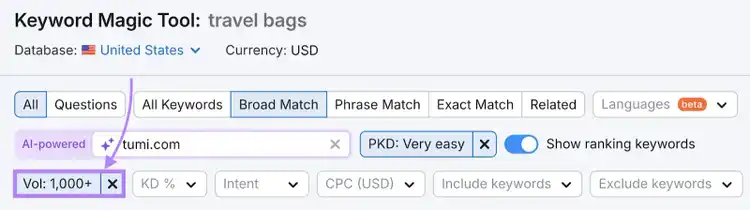
To identify low-difficulty keywords with decent search volumes, use the “Volume” filter and set the starting range to something like 1,000 (or whatever you consider a good search volume for your niche).
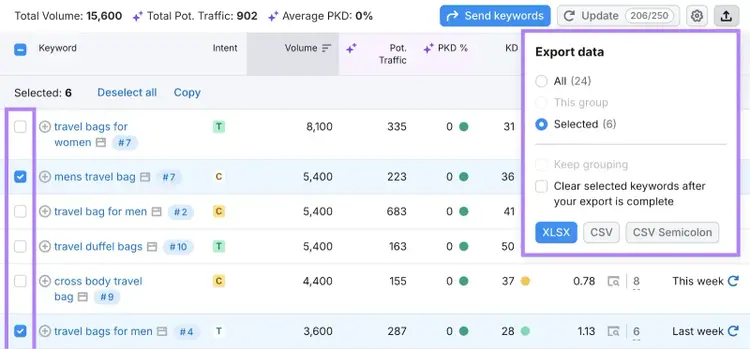
Manually review the list to identify keywords that are most relevant to your blog. And click the checkboxes next to each one.
You can then create a list or export the keywords as a file to share with your team.
Creating and publishing high-quality content on these topics can attract more visitors to your site, especially if you use the optimization tips we’re about to go over.
2. Optimize Your Content for Search Engines
Fine-tuning your content with search engines in mind can increase the likelihood of your blog posts ranking highly on search engine results pages (SERPs)—and within features like Google’s AI Overviews and AI Mode.
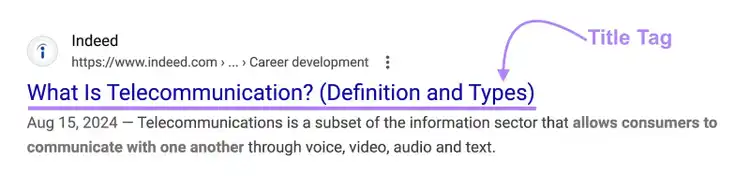
Start with your title tags—HTML elements that provide the webpage title to search engines and can be displayed in search results. Keep them to around 55 characters and incorporate your primary keyword.
Also, write compelling meta descriptions—short HTML summaries that can appear below titles in search results—to give users a quick preview of your page and possibly improve your click-through rate.
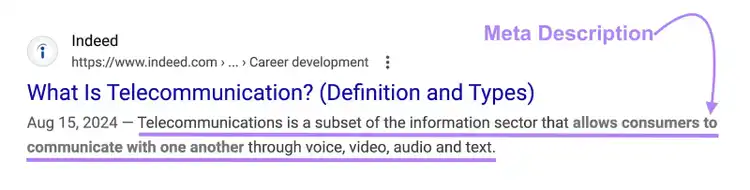
(Google can choose its own title and description to display. But it’s still worth optimizing both.)
You can further optimize your content by:
- Structuring your content with headings (H1, H2, etc.) and incorporating keywords in those headings where natural
- Including links to other relevant content on your blog or site (called internal links)
- Incorporating keywords naturally throughout the body content
- Adding engaging images with descriptive alt text (HTML that describes images) to search helps search engines and visually impaired users understand what’s being shown
Finally, fix technical SEO issues on your site to help all your content (including blog posts) appear prominently in search and more likely to drive traffic.
Juan Pineda, Managing Partner at Agile Digital Agency, offers some advice on how to avoid technical issues:
“I make sure the URL structure, internal linking, and page hierarchy are organized and set up for long-term growth. Many new sites also forget to implement structured data—for rich snippets—and to optimize images for speed and accessibility.”
Run a free website audit to surface technical issues like URL structure, structured data, headings, and image SEO.
To find and address all technical issues across your site, use Semrush Site Audit.
Follow this configuration guide to set up your project and run an audit. (You can also use the default settings.)
Once the audit is complete, you’ll find SEO issues grouped into categories.
Head to the “Issues” tab to view a full list of errors, warnings, and notices.
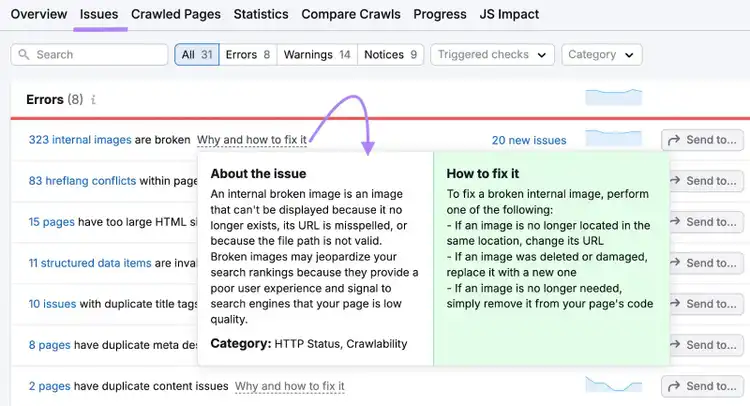
Work your way down the list to address these issues to potentially boost your rankings and drive more traffic to your blog.
Further reading: On-Page SEO Checklist: The Complete Task List for 2025
3. Optimize Your Content for AI Tools
Now that more people are using AI tools for search, it’s important to optimize your content with those tools in mind to give yourself a better chance of being surfaced in responses to user prompts.
Here’s how you can prime your blog content for AI visibility:
- Refresh your content regularly. A Seer Interactive study shows content recency plays a big role in AI visibility. So, make it a priority to regularly audit and update your content.
- Focus on answering users’ questions. Writing your content around conversational queries aligns with how users actually interact with AI tools. And that may lead to more mentions and citations.
- Incorporate images and videos. Visual elements add more context to your content. And AI tools cite various content formats in responses, so using images and visuals gives you another way to appear within AI responses.
- Optimize each passage in your blog posts. AI tools tend to extract specific paragraphs to use in their answers, which means each section needs to be able to stand on its own.
Kevin Moore, CMO of WalterWrites.ai, explains his approach to optimizing for passage-level retrieval:
“I start by placing answers clearly within H2 or H3 sections and ensure that every segment resolves a single query. Paragraphs are kept lean and scoped tightly to reduce confusion during extraction.”
If you need help finding what prompts to focus your content around, use Semrush’s AI Visibility Toolkit. The Questions report shows what questions users are asking about your brand, product or service, and industry and groups them by theme.
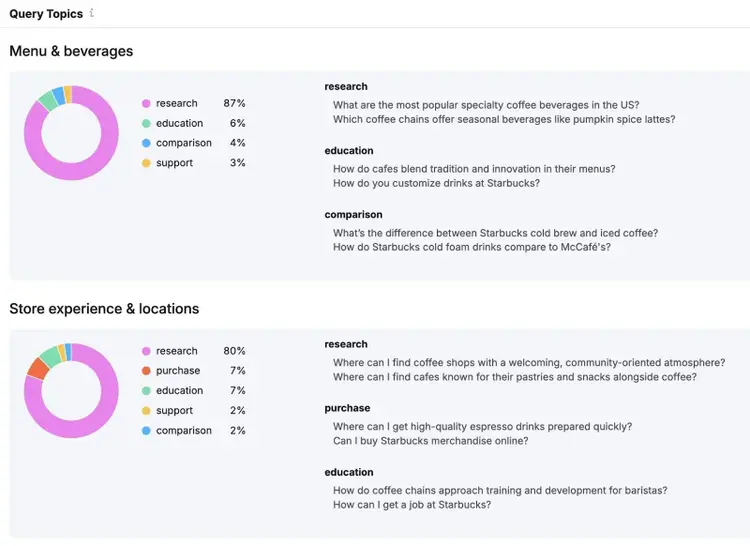
You can use these prompts to form the basis of entire blog posts, to serve as specific subsections in posts, or within FAQ sections.
Beat Your Competition in LLMs
with the Semrush AI Visibility Toolkit
4. Build Your Authority
Establishing yourself as an authority builds trust with readers and can translate to better visibility in search engines and AI tools.
At a basic level, building authority starts with writing blog posts on topics you’re knowledgeable about.
For example, the Semrush blog covers topics related to SEO, AI, content, and other marketing concepts.
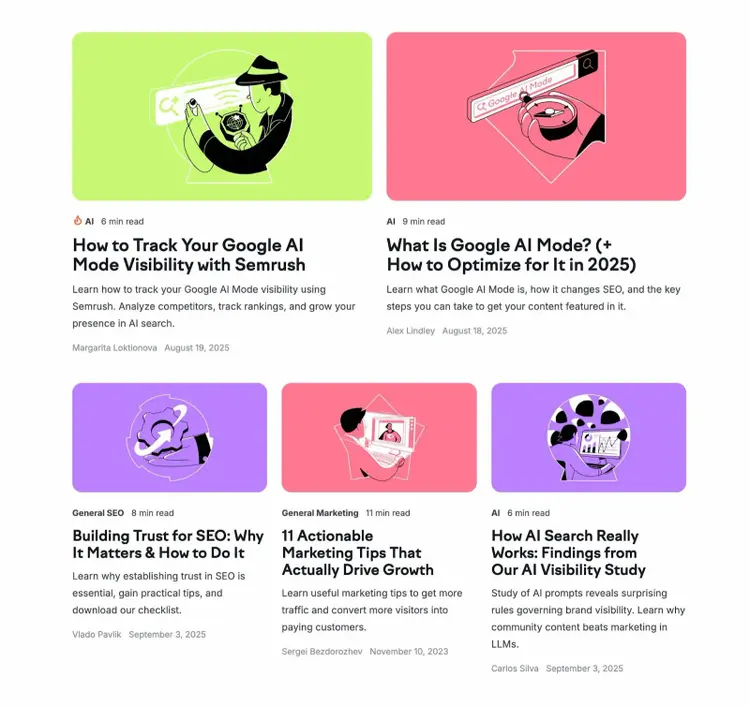
To further signal authority to search engines and AI tools, work to build backlinks (links from other sites that point to yours) and brand mentions from trusted sources. Brand mentions are particularly important for gaining AI visibility that may result in more blog traffic.
Here are a few ways to get more backlinks and mentions:
- Reach out to authors of relevant “best blog” lists to tell them why your blog would be a great addition and ask to be added
- Find broken links on other websites that used to go to competing blogs and suggest your blog as a suitable alternative
- Engage in forum conversations related to your niche. Just be wary of spamming users—aim to provide genuine value.
- Publish useful content that others are likely to share
5. Make Your Content Interesting and Helpful
Content that’s useful and intriguing is more likely to be shared across the web—this can drive more traffic to your blog.
Plus, when interesting and helpful content is shared, it can naturally lead to backlinks and mentions that drive more traffic from AI tools and search engines.
How do you make your content interesting and helpful? Here are some tips:
- Challenge conventional thinking. Question common beliefs and present bold, fresh perspectives that make readers think differently.
- Share something new. Stand out by providing unique insights or actionable information that other blogs lack.
- Incorporate expert input. Add credibility and depth by including insights from subject matter experts.
Further reading: Quality Content: What It Is + 10 Actionable Tips for Success
6. Publish Regularly
Regular publishing can lead to more keyword rankings and AI citations that may translate to more traffic to your site. You may even get more direct traffic if your consistency helps you build a loyal following.
So, make it a habit to publish steadily—whether it’s twice per week or once per month.
To keep up a regular publishing cadence without sacrificing quality, use Semrush’s AI Article Generator to create your first drafts.
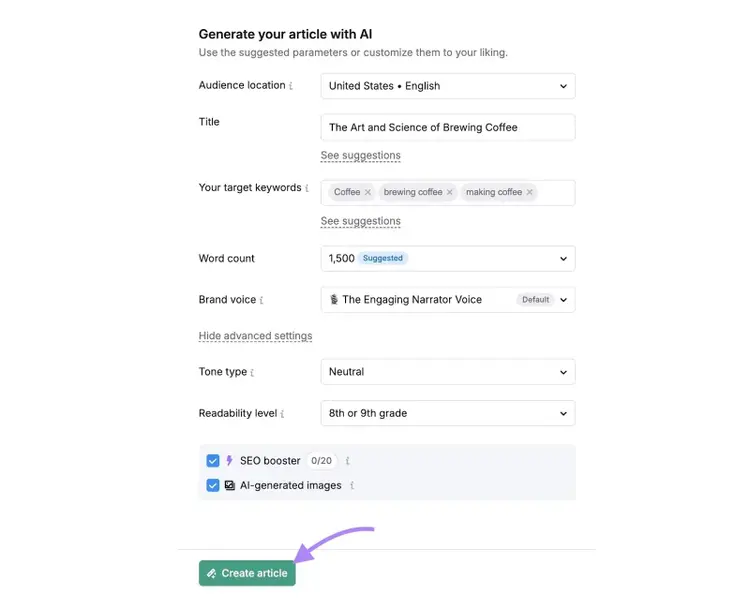
Start by entering a primary topic you want to cover.
Next, customize the article settings like the title, keywords, brand voice, and word count. For extra optimization, enable the “SEO boost” and “AI-generated images” options.
Click “Create article” to generate your first draft using AI.
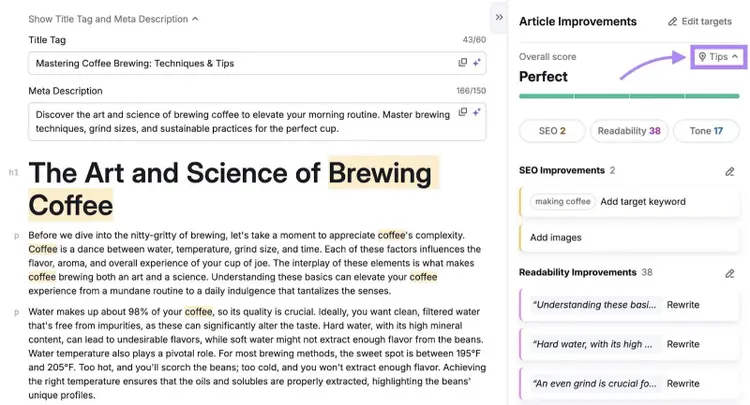
Once it’s ready, use the built-in editor to add personal insights, incorporate relevant statistics, etc. And click the drop-down arrow next to “Tips” to see improvement ideas.
7. Share Your Content on Social Media
Using social media platforms to promote your blog posts can drive more traffic to your blog.
Share both new posts and older content, focusing on platforms where your audience spends their time for the best results.
For example, if you run a marketing blog, your readers are likely marketing professionals. That means LinkedIn might be the ideal platform to share your content.
But if you run a fashion blog, Instagram would likely work better since it’s a highly visual platform.
Sharing doesn’t have to come from just your brand account, either. You and any team members you work with can also share content from your own accounts to reach even more people.
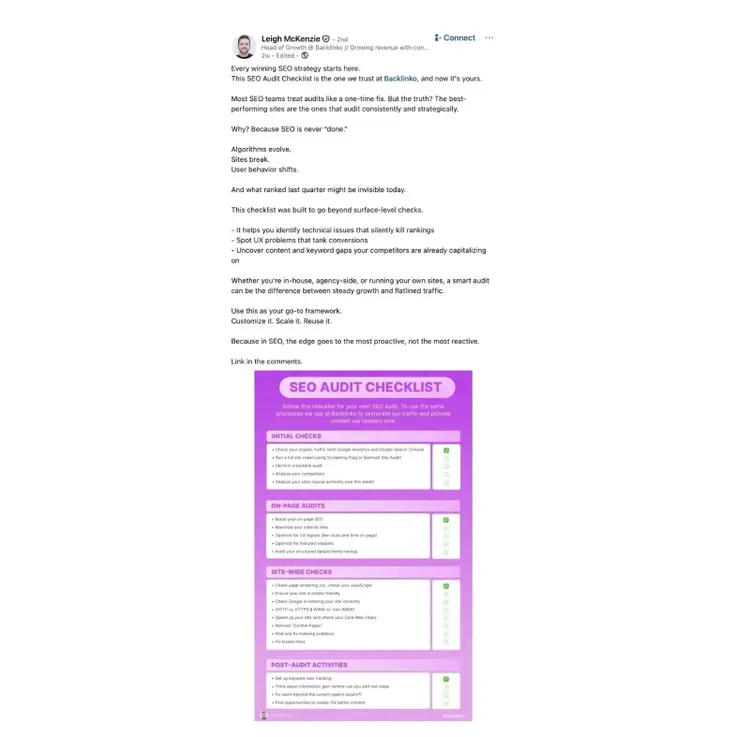
Leigh McKenzie, Head of Growth at Backlinko, often shares newly published blog posts from the Backlinko blog using his personal account on LinkedIn.
8. Create an Email Newsletter
Email is a powerful marketing channel for sharing blog posts with people who’ve opted in to receiving messages from you.
Email is especially good for reaching highly specific segments. And it allows you to maintain relationships.
To grow your email list:
- Publish content that can only be accessed when users provide their contact information
- Include a sign-up form on your blog
- Promote your newsletter on social media
Then, craft messages that highlight new blog posts or popular articles you think your email subscribers will enjoy.
Like in this example from Search Engine Land:

9. Be a Guest or Expert Source for External Content
Being featured on external websites and platforms is a great way to reach new audiences who may visit your blog from those sources’ links or directly later on.
One option is to be a podcast guest. So, consider reaching out to podcast hosts in your niche and pitching yourself as a guest. They’re often looking for new guests to bring other perspectives and are often happy to mention and provide shownote links to those guests’ projects.
Another good option is to serve as a subject matter expert for journalists or writers covering topics you’re knowledgeable about. The author may link to your blog when citing you in the piece.
For example, AAA Connect links to Anna Mazurek’s travel blog in an article featuring the blogger’s advice about traveling solo.

Just know that podcasts and publications have different policies on whether and how to link. So, it’s best to ask about the possibility of getting a link to your blog upfront.
Implement These Tactics to Increase Your Blog Traffic
You now know how to grow your blog with great content and effective promotion.
And you can use Semrush’s tools at every step to streamline the process.
Sign up for a free trial today.
Claim Your Free 7-Day Trial
and Explore Our Digital Marketing Tools

Alex is a managing editor with 10+ years of experience leading content and SEO teams across SaaS, tech, ecommerce, and digital publishing. He specializes in building editorial systems that balance human judgment with AI-assisted workflows, helping teams produce original, high-impact content as search and discovery evolve. His work spans SEO strategy, content quality frameworks, and adapting content operations for AI-driven search.
Alex Lindley
Alex is a managing editor with 10+ years of experience leading content and SEO teams. He focuses on building AI-aware editorial systems that help teams produce original, high-impact content as search evolves.

Tells Google to show you more from Semrush in AI, Search, and Discover.
Table of contents
- 1. Write Content on Topics People Care About
- 2. Optimize Your Content for Search Engines
- 3. Optimize Your Content for AI Tools
- 4. Build Your Authority
- 5. Make Your Content Interesting and Helpful
- 6. Publish Regularly
- 7. Share Your Content on Social Media
- 8. Create an Email Newsletter
- 9. Be a Guest or Expert Source for External Content
- Implement These Tactics to Increase Your Blog Traffic