Below, we’ve rounded up 10 of the most effective content marketing tactics to use in 2024 and beyond.
Tip
Claim your free trial to follow along with the Semrush tutorials in this guide.
1. Analyze and Satisfy Search Intent
Create content that targets relevant keywords (i.e., search engine queries). And satisfies their search intent (i.e., what the user wants).
That way, you can increase your brand’s organic (unpaid) visibility in search engines like Google. And attract more potential customers to your website.
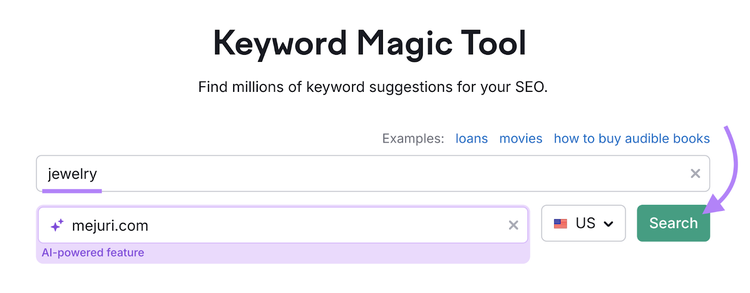
Go to Semrush’s Keyword Magic Tool. And enter a term to base your search around (one that’s related to your brand).
Then, add your domain and target country before clicking “Search.”
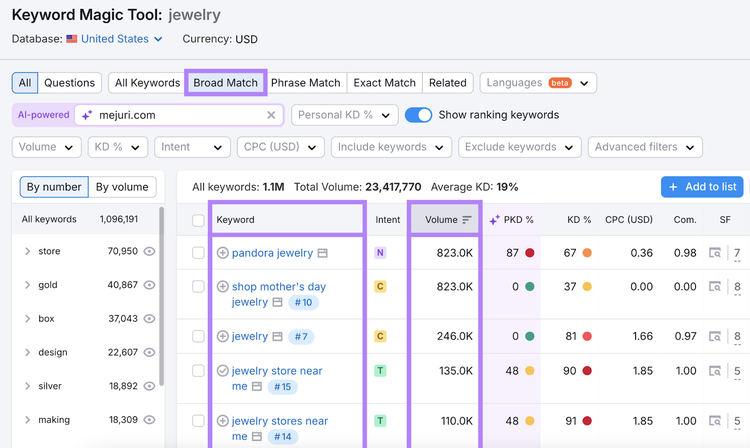
The tool will search Semrush’s database of over 26 billion keywords. To display “Broad Match” keywords containing your starting term or a close variation.
They’re sorted by “Volume.” Which represents the average number of monthly Google searches.
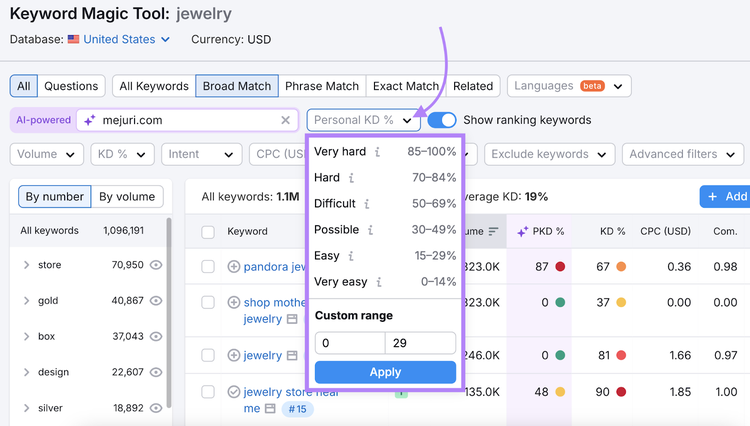
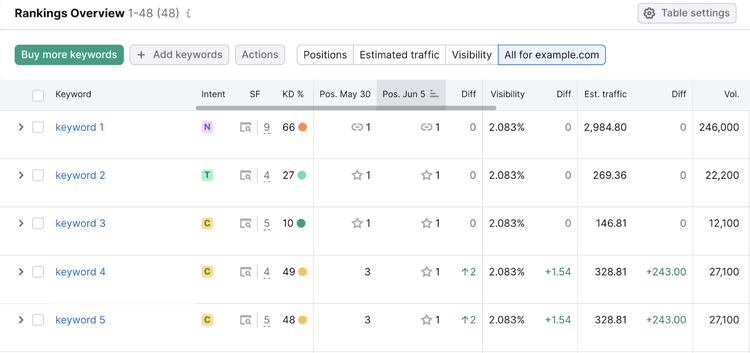
Another important metric is “PKD%” (Personal Keyword Difficulty).
This estimates how hard it’ll be for your site to earn a top-10 organic ranking for the keyword.
If you’re new to search engine optimization (SEO), it’s best to target keywords in the “Very Easy” to “Easy” range (0% to 29%). And work your way up over time.
Lower-difficulty keywords usually have lower search volumes. But it’s generally better to rank highly for a low-volume query than lowly for a high-volume query. Because most users don’t scroll very far.
Next, pay attention to the “Intent” column.
This shows the type of search intent (user goal) behind each keyword:
Informational (I) means the typical user is seeking information
Commercial (C) means the typical user is researching a product, service, or brand
Navigational (N) means the typical user is seeking a particular webpage or website
Transactional (T) means the typical user is looking to make a purchase
Generally, informational and commercial keywords are best for content marketing.
If this type of content seems like a good fit for your brand—and you think the keyword is worth targeting—go ahead with creating search-optimized content.
Create Optimized Content and Satisfy Search Intent
There are two main things you must do to optimize content for a particular keyword (or group of related keywords):
Primary data is information unique to your business. It can help you create engaging, unique content.
Take Spotify Wrapped, for example.
In this yearly campaign, Spotify provides users with a personalized summary of their listening habits over the past 12 months. And shares global and national trends.
It drives a ton of social media and press activity.
To get started with this content marketing tactic, identify primary data your business has access to. (Or consider conducting research so you can gather it.)
For instance:
Survey responses
Sales data
Website analytics
Product usage data
Then, think about what kinds of questions your data could answer. Questions your audience will be interested in.
You can then perform data analysis to get the answer.
If your findings are interesting and new, you have a story to tell.
For example, Spotify answers questions like “Who’s the most streamed artist on Spotify?”
It’s possible to analyze data from external sources and discover unique stories. But primary data tends to make your content more unique, interesting, and authoritative.
3. Use Topic Clusters
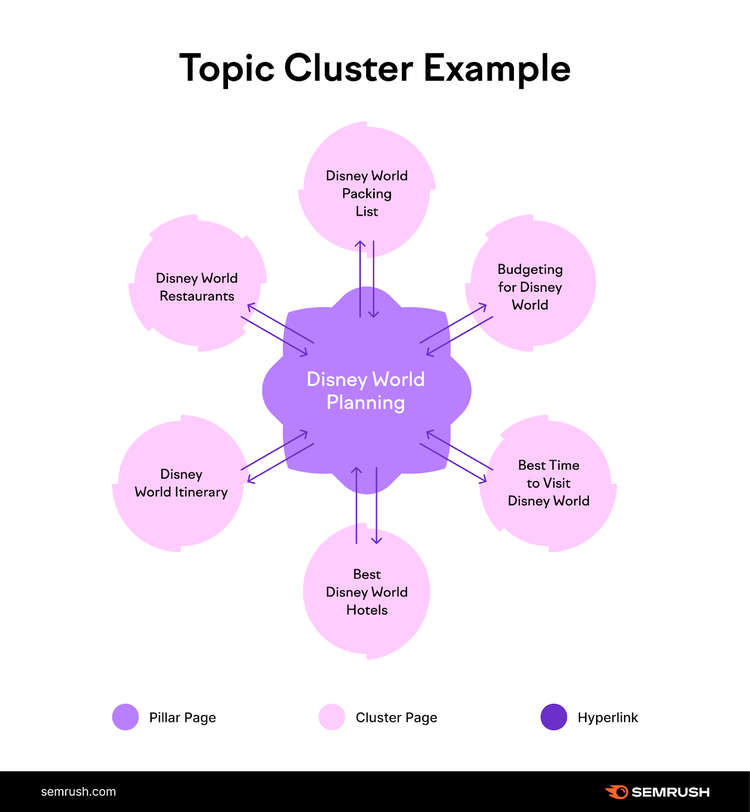
A topic cluster is a set of interlinked webpages (usually blog posts) that work together to cover a topic comprehensively.
It contains a pillar page, which provides a topical overview. And multiple cluster pages, which address associated subtopics.
Hyperlinks connect the pillar page to all the cluster pages—and vice versa.
Like this:
Topic clustering is a good content marketing technique because it helps build topical authority.
In other words, users and search engines are more likely to think of you as a subject matter expert. Which can lead to more traffic, search visibility, and engagement.
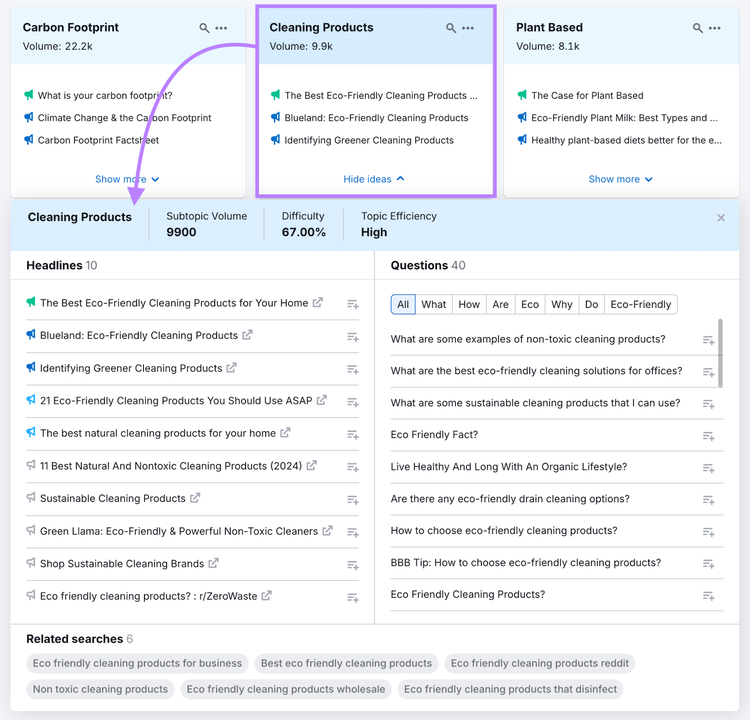
You can gather ideas for your clusters with the Topic Research tool.
Just enter a topic and target country to get a list of subtopic ideas. Along with useful data about each one.
4. Repurpose Existing Content
Repurposing content (i.e., adapting content into different formats) can improve your reach and engagement.
Turning the same content into different formats caters to people with varying needs, preferences, and habits. And allows you to distribute content across different platforms.
Repurposing also tends to be quicker and easier than creating content from scratch. So, it can be a highly cost-effective content marketing tactic.
When repurposing, start with your best-performing content. To see if you can replicate its success across other platforms.
You can then brainstorm suitable content marketing formats. Based on subject matter, your target audience, and your wider marketing strategy.
For instance, a B2B marketer might be able to repurpose a blog post into a:
Webinar
Podcast
Video
Ebook
Infographic
LinkedIn post
Newsletter
It’s often a good idea to repurpose in just a few ways rather than trying to create as many iterations as possible. So you can focus more on the quality of the content you do create.
AJ Eckstein, Founder of Creator Match, shared some advice about how to grow on LinkedIn that’s also applicable to other types of content:
“Start where you can be consistent (like text + image on LinkedIn). Depth beats distribution.”
Using multiple formats together can even be a good idea. Embedding a video in a blog post, for example, can improve engagement of visual learners.
5. Build a Content Marketing Funnel
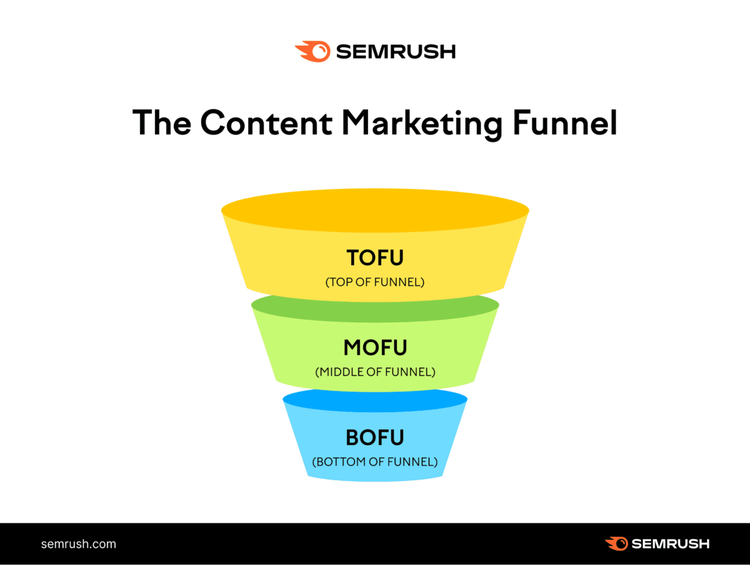
A content marketing funnel is a collection of content that works to engage prospects across the entire buying journey.
It covers three main stages:
Top of the funnel (ToFu): Prospects become aware of the problem you can solve
Middle of the funnel (MoFu): Prospects want a solution and consider their options
Bottom of the funnel (BoFu): Prospects decide on a solution and become customers
The funnel diagram represents the audience size narrowing as the journey progresses toward purchase:
A robust content marketing funnel allows you to reach more prospects, build stronger relationships with them, and guide them toward conversion.
If you have a weakness at any stage of the funnel, prospects are likely to go to a competitor instead.
To illustrate, let’s look at the mattress brand Casper.
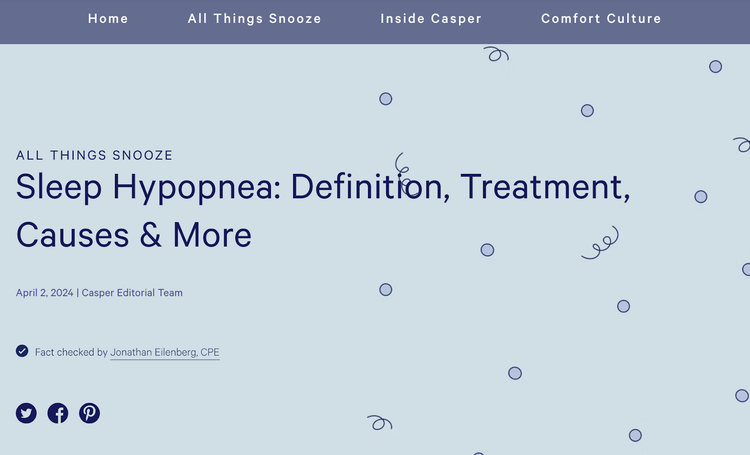
The company has blog posts about various sleep problems. These attract people at the top of the funnel who might be interested in a new mattress—but don’t know it yet.
Casper also offers mattress buying guides and comparison guides.
These are designed to help people in the middle of the funnel. Who are researching their options.
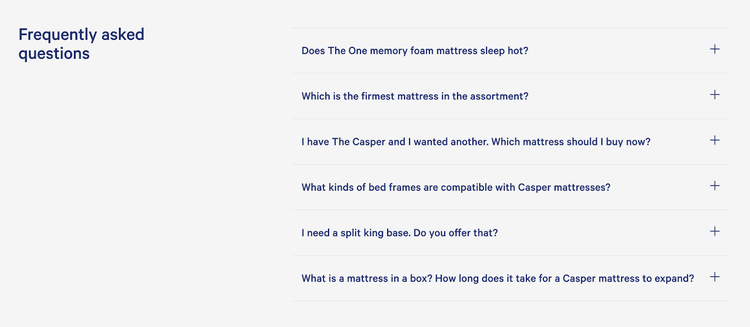
At the bottom of the funnel, detailed product pages and customer service FAQs help turn shoppers into buyers.
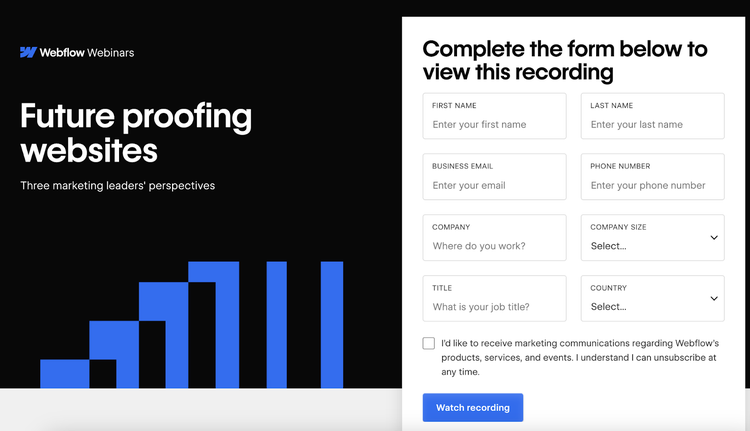
Gated content is high-quality content that users must submit their information to access.
Like this:
The main goal is to generate leads. If users give permission, you can contact them with personalized emails.
Collecting data can also give you valuable insight into audience demographics etc.
To get started, you need to develop a piece of high-quality content tailored to your target audience. Common types of gated content include:
Research reports
White papers
Ebooks
Webinars
Newsletters
Tools
Templates
Product demos
Then, build the landing page that encourages users to opt in.
When designing the form, carefully consider what fields to include. More fields means more data but increases the risk of the user backing out.
Tip
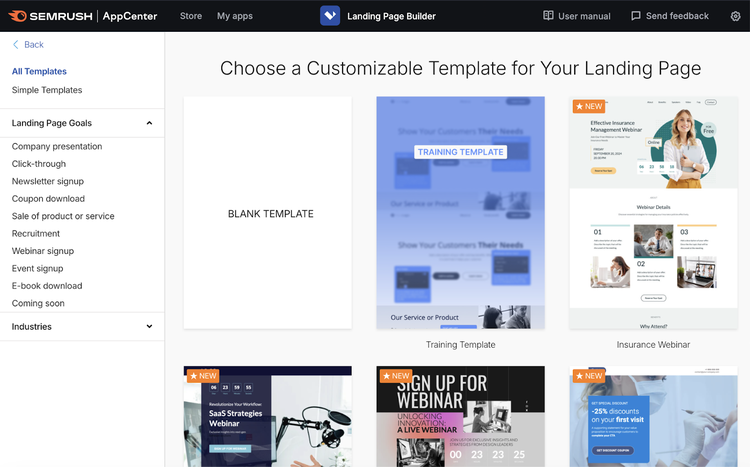
Create conversion-focused landing pages with Landing Page Builder. The app has a click-and-drag interface and multiple templates to choose from. To make building a landing page as easy as possible.
7. Engage in Thought Leadership
Thought leadership is the process of sharing original ideas, insights, and opinions. With the aim of influencing or inspiring others. And building your reputation.
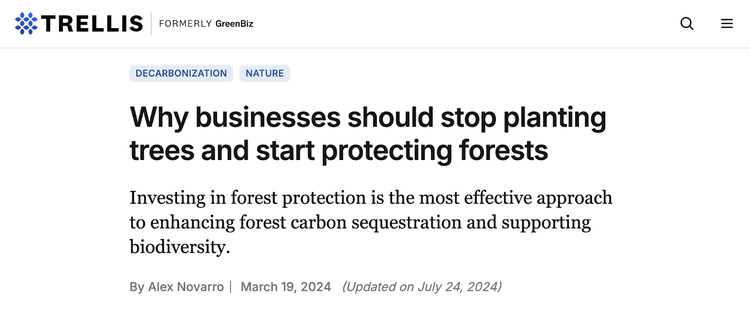
For example, Alex Novarro argues that businesses “should stop planting trees and start protecting forests” on behalf of Trellis (a sustainability networking company).
Thought leadership is a particularly good B2B content marketing tactic. Because business buyers tend to value expertise and innovation highly.
You can publish thought leadership content on your own blog, social media profiles, etc. Or try to get featured in industry publications.
To do so, you’ll need to come up with an engaging idea. And send convincing outreach emails to relevant websites.
Skyscraper content is content designed to be a better version of a widely linked resource.
The goal is to inherit the links the resource already has. And ones it could acquire in the future.
Because links from other websites (backlinks) can drive valuable referral traffic. And boost your SEO.
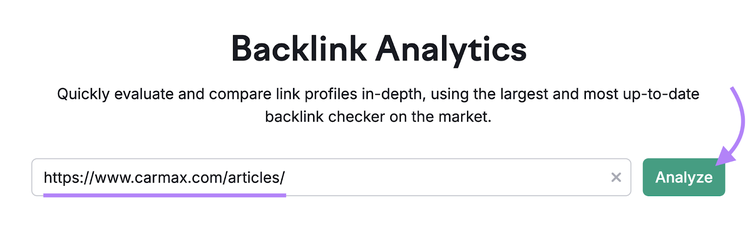
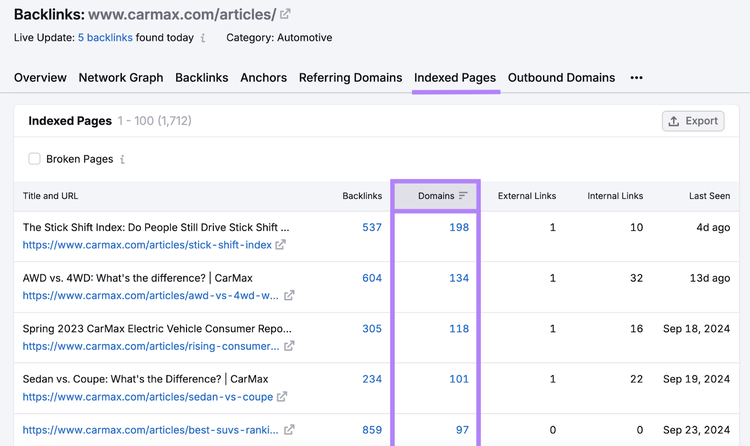
To see which of your competitor’s pages get the most backlinks, enter their domain (or a relevant subfolder) into the Backlinks tool. And click “Analyze.”
Go to the “Indexed Pages” tab to see which pages have links from the most domains.
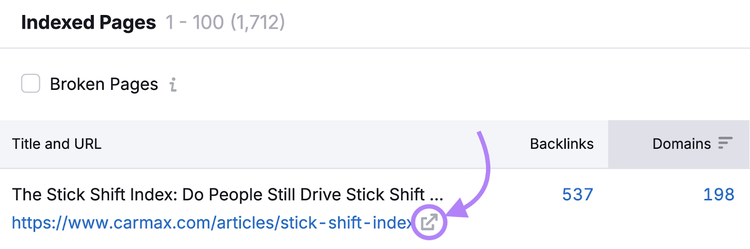
Review the content by clicking the icon that looks like this:
And determine if you can create a better version of the page.
Perhaps you can:
Make the content more comprehensive
Include original ideas, insights, or data
Add better visuals or interactive elements
After creating skyscraper content, contact the reputable sites that link to your competitor’s page. And encourage them to link to your version, instead.
You can manage the entire outreach process (and identify other link building prospects) with Semrush’s Link Building Tool.
Encouraging UGC can be a cost-effective way to increase content production.
It can also improve your relationship with your audience:
People who create UGC may feel more involved with and valued by your brand
People who consume UGC may view your brand as more authentic and trustworthy
For example, action camera brand GoPro runs a “photo of the day” challenge.
The company gives winners a cash prize. And shares winning entries on its social media profiles with millions of followers.
This content marketing tactic allows GoPro to generate high-quality content at a relatively low cost. And foster an engaged community around its brand.
Consider what types of content your users could create. And incentivize them to create it.
10. Try Storytelling
Storytelling can be an effective content marketing technique. Because it allows you to communicate your brand values in a more humanistic, engaging way.
It generally involves telling real stories about people in your community.
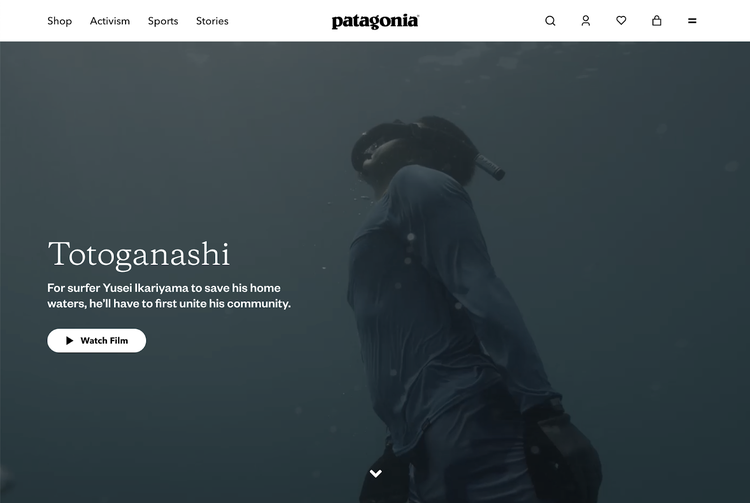
For example, outdoors brand Patagonia created a film about a surfer trying to protect a vulnerable coastline.
The story doesn’t directly reference Patagonia or its products. But it signals that the brand is passionate about the same things its target audience is.
Plus, that kind of high-quality content elicits an emotional response. People who are passionate about the film’s message are likely to share it with their peers, increasing Patagonia’s reach.
To tell a good story, you typically need:
A structured narrative with a beginning, middle, and end
Compelling characters that humanize the story
Emotional appeal
Authenticity (i.e., a message that truly aligns with your brand’s values)
Measuring the Success of Content Marketing Tactics
To discover the most effective approach for your brand, you must measure the success of your content marketing tactics.
That means tracking two vital things:
What resources you invest
What benefits you gain (and over what time frame)
Not all benefits are easy to measure. But there are many content marketing metrics you can use to gauge your performance.
For example, the Position Tracking tool lets you monitor your keyword visibility in Google.
You can make the most of this tool and many others with your free Semrush trial.
Ana Camarena leads Semrush’s Organic Content team. At Semrush, she helps scale blog production while maintaining quality, driving significant content growth. With 10+ years of experience in SEO and content marketing, she has developed content strategies for SaaS and e-commerce brands with an international scope. Ana has taught classes at EDEM Business School, Warwick University, and IEM Digital Business School. She holds a BA in Journalism and a Master’s in Digital Business & Innovation.
Subscribe to learn more about Content
Subscribe
By clicking “Subscribe” you agree to Semrush Privacy Policy and consent to Semrush using your contact data for newsletter purposes
Ana Camarena
Ana Camarena leads Semrush’s Organic Content team, where she focuses on delivering high-quality content that drives business. With 10+ years in SEO and content marketing, she has built global content strategies for SaaS and e-commerce brands.
Share
Tells Google to show you more from Semrush in AI, Search, and Discover.