
Have you ever noticed that Google correctly answers questions even when you’re being vague or indirect?
Just look at the result for this query:
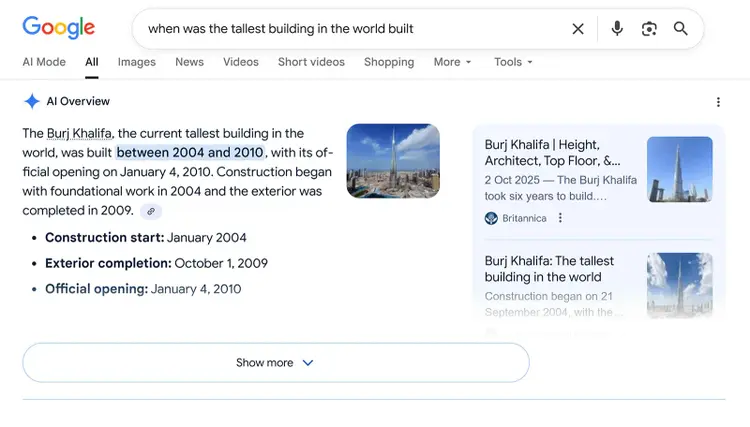
Despite not mentioning the specific building name, Google knew that we were asking about the Burj Khalifa—and mentioned the exact year it was completed. Google’s understanding of entities makes this possible.
In this post, you'll learn what entities are, how they're used by search engines and LLMs, and how you can leverage entity optimization to improve your visibility in search results.
What Is an Entity?
An entity is a thing or concept that is singular, unique, well-defined, and distinguishable, such as a person, place, organization, or event.
Continuing from our earlier example, the Burj Khalifa is an entity. Google knows that it’s a building, and also knows other attributes like:
- Its status as the world’s tallest building
- Its completion date
- Its location
- Its height
When we asked “when was the tallest building in the world built,“ Google connected all the pieces it knows about the Burj Khalifa to answer our question.
In practice, Google maintains a massive database of entities called the Knowledge Graph—a collection of billions of entities and the relationships between them. This helps Google understand the query whenever you search for something to surface the right information (or sources).
Large language model tools (LLMs) like ChatGPT learn about entities through their training data.This helps them correctly associate brands, their products/services , and their expertise with relevant topics.
Why Are Entities Important in SEO & AI Search?
Entities are important because they’re the foundation of how modern search engines and AI systems surface content based on what those systems know about the people, places, things, and concepts behind the words searchers use.
When a user searches for something, the search engine or AI platform isn't simply looking for pages that contain their exact keywords. It's figuring out what they actually want to know, then finding content that covers that information well.
Here's how strategically incorporating entities in your content benefits your site:
- Increases topical authority: When you signal relevant entities through your site, search engines and LLMs start recognizing your site as an authority for those topics. Which makes it easier to rank for relevant queries.
- Ensures accurate brand representation: When search engines and LLMs understand your brand as an entity with specific attributes and relationships, they're more likely to describe and represent your brand accurately in their responses.
If you want to know how you’re being mentioned in AI search, try Semrush's AI Visibility Toolkit. It tracks your visibility in Google’s AI Mode, ChatGPT, Perplexity, and other AI platforms.
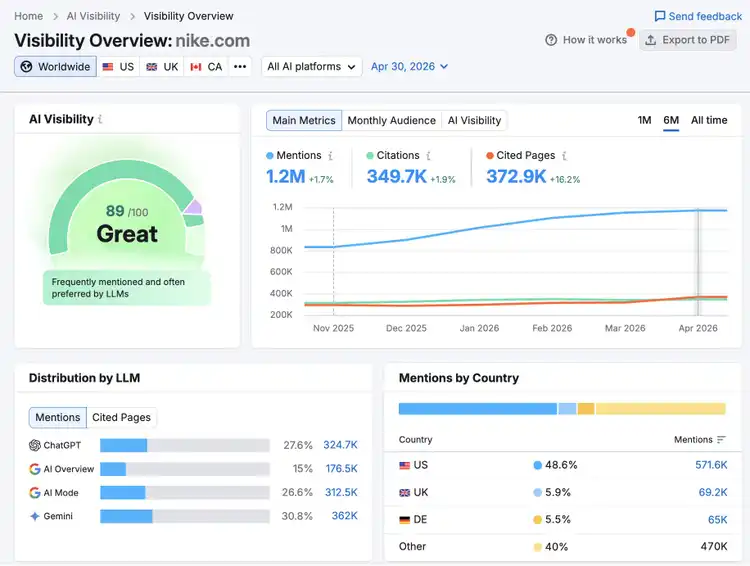
Track Your Visibility in AI platforms
with the Semrush AI Visibility Tool
What’s the Difference Between Entities and Keywords?
Entities and keywords might seem similar, but they're fundamentally different in SEO.
A keyword is just a string of text—the actual words someone types into a search bar. It's the surface-level language.
An entity is the underlying concept or thing that a keyword refers to. It's the meaning behind the words.
Entities also have three defining characteristics that keywords don't:
- Entities are unique and distinguishable: There's Tesla the car company and (Nikola) Tesla the inventor. New York the state and New York the city. Each is a separate entity that search engines can differentiate through context and attributes.
- Entities have attributes that describe them: A product has a manufacturer, price, and features. A person has a profession, location, and affiliations. A company has a CEO, a founding date, and industry. These attributes help search engines understand not just what an entity is, but also how it relates to other entities.
- Entities exist independently of language: Nintendo is the same company whether you search in English, Spanish, or Japanese
Let’s use a practical example to see how entities differ from keywords. Suppose you're writing a travel guide for Paris. Here are the keywords you might target:
- “paris travel guide”
- “things to do in paris”
- “paris vacation itinerary”
- “best attractions in paris”
- “paris trip planning”
And here are the entities that could appear in that content:
- Paris
- Eiffel Tower
- Louvre
- France
- Seine River
- Croissant
- Paris Metro
The Paris-related keywords are different variations of how someone might search for the same information—they're the specific phrases you're trying to rank for.
The entities are the actual landmarks, places, and concepts that are mentioned in your content. They tell search engines what your article is fundamentally about: a travel guide covering major attractions, transportation, and experiences in Paris.
Including entities means your content has a better chance of ranking for related searches.
How to Optimize for Entities
Now that you understand what entities are and why they matter, let's cover how to actually optimize your website for them.
1. Map Out Your Core Entities and Start Using Them
Start by making a list of the most important entities related to your business:
- Your brand entity: Your company name
- Product/service entities: The specific offerings you provide
- Primary topic entities: The topics you want to be an authority on
- Nice topic entities: Entities related to the specific content pieces present on your site
For example, here's how this might look for Semrush:
- Brand entity: Semrush
- Product entities: AI Visibility Toolkit (for tracking visibility in LLMs), SEO Toolkit (for improving a website’s rankings in search engines), Keyword Magic Tool (for researching keywords), etc.
- Primary topic entities: SEO, AI visibility, keyword research, backlink analysis, content marketing, competitive analysis, etc.
- Niche topic entities: Broken links, 404 errors, redirects, redirect chains, Google Search Console, crawl budget, etc.
Listing out all these entities will help you understand which ones you should be reinforcing throughout your site.
Once you've mapped out your core entities, integrate them strategically across key pages:
- On your homepage & about page, clearly establish your brand entity and what you do
- On your product/service pages, detail your product and service entities with specific attributes and use cases
- In your blog content, reinforce primary topic and niche topic entities where relevant
2. Build Out Topic Clusters
One of the best ways to establish important primary topic and niche topic entities on your site is by creating topic clusters.
A topic cluster is a collection of interlinked content pieces organized around a central topic (pillar page) with supporting articles (cluster pages) that dive deeper into specific subtopics.
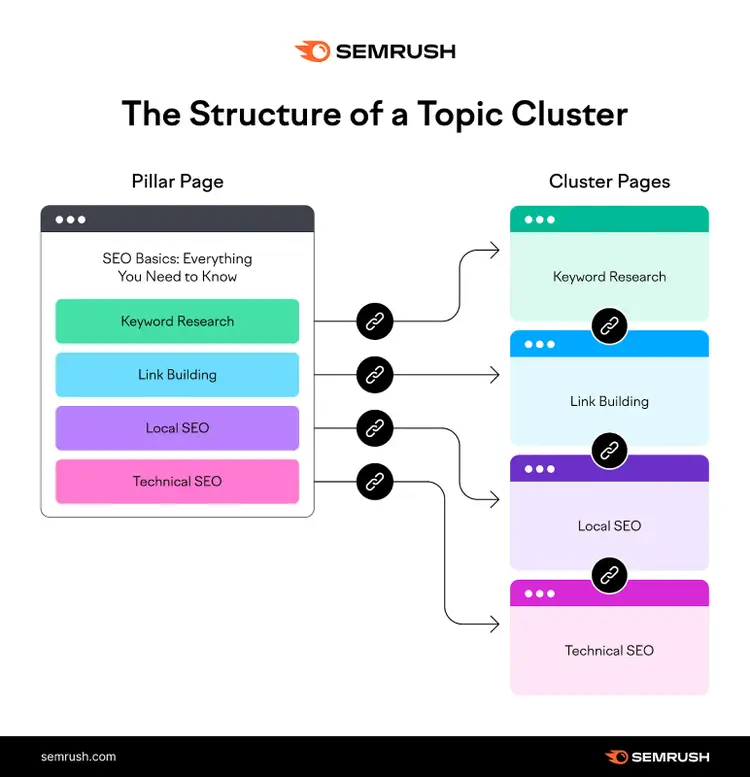
Your pillar page covers the broad topic comprehensively and introduces all the key entities related to that topic. For example, a pillar page on the basics of SEO would mention primary topic entities like "keyword research," "link building," "local SEO," and "technical SEO."
Then, each supporting cluster page goes deep on a specific subtopic and covers niche topic entities. For example:
- A keyword research guide will cover entities like search volume, keyword difficulty, Keyword Magic Tool, and long-tail keywords
- A link building article will explore entities like backlinks, domain authority, guest posting, and broken link building
- A local SEO piece will mention entities like Google Business Profile, local citations, NAP consistency, and local pack
- A technical SEO guide will cover entities like site speed, crawl budget, XML sitemap, and robots.txt
Also, make sure to link every pillar page to its cluster pages and vice versa. This internal linking shows search engines what topics your brand wants to be associated with.
3. Add Schema Markup
Schema markup is structured data that explicitly tells search engines what entities are on your page and what their attributes are.
For example, it would be easier for Google to extract meaning from structured data like this:
[…]Product: iPhone 17 ProBrand: ApplePrice: $1,199Availability: In StockRating: 4.8/5Description: Apple’s Latest flagship smartphone with advanced camera system[…]
Than from natural language like this:
You can buy the iPhone 17 Pro from Apple for just $1,199, and the good news is it's currently available for immediate shipping. This is Apple's latest flagship smartphone featuring an advanced camera system. Customers love it, giving it an average rating of 4.8 out of 5 stars.
Benefits of using schema markup include:
- Faster and more accurate entity recognition
- Better chances of appearing in rich results (e.g., recipe cards)
- Stronger associations in Google's Knowledge Graph—meaning Google can better understand and connect your brand, products, and topics,
- Higher likelihood of being cited by AI systems
Here are some schema types you can use to establish entities on your site:
- Organization schema: Defines your brand entity with attributes like name, logo, social profiles, and contact information. This goes on your homepage and helps search engines understand who you are as an entity.
- Product schema: Marks up your product entities with details like name, price, availability, ratings, and reviews. Product schema is mostly relevant for ecommerce sites. This helps your products appear as distinct entities in search results and shopping features.
- Article schema: Identifies your content as articles with attributes like headline, author, publish date, and featured image. This helps search engines understand some of your topic entities.
- Breadcrumb schema: Shows the hierarchical structure of your site, helping search engines understand how your content and entities are organized
If you're on WordPress, you can use plugins like Yoast or RankMath to automatically add schema to your pages and posts with just a few clicks. If your website is custom-built, get help from a developer on your team to implement schema markup.
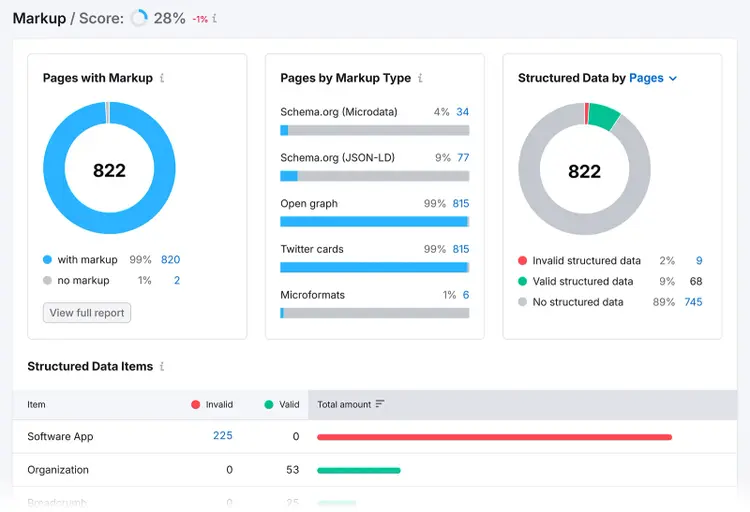
Run a free SEO audit for a quick check on your schema. For a full review, use Semrush Site Audit — the "Markup" report shows any invalid items to address.
4. Run an Entity Analysis
Run an entity analysis to see which entities are present in your content—and whether those match your intended focus.
If you notice that some important entities are missing, you can tweak your content to include them.
You can use either Google's Natural Language API or TextRazor for entity analysis.
I prefer TextRazor because I find the way it formats the results to be very user-friendly. It shows entities and the sentences they appear in.
Here's how to use TextRazor for entity analysis:
- Go to textrazor.com
- Scroll all the way down to find a text box
- Paste the content you want to analyze
- Click “Analyze”
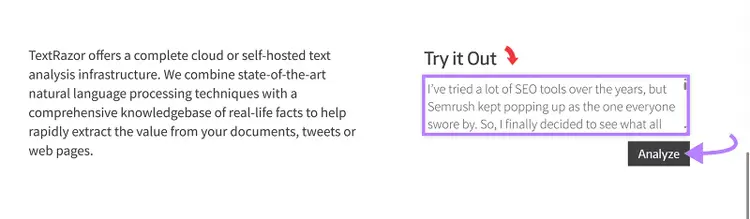
Once the analysis is complete, you'll see individual sentences that contain entities, with each entity highlighted. And a "Topics" section to the right that shows the main topics detected across your entire content excerpt.
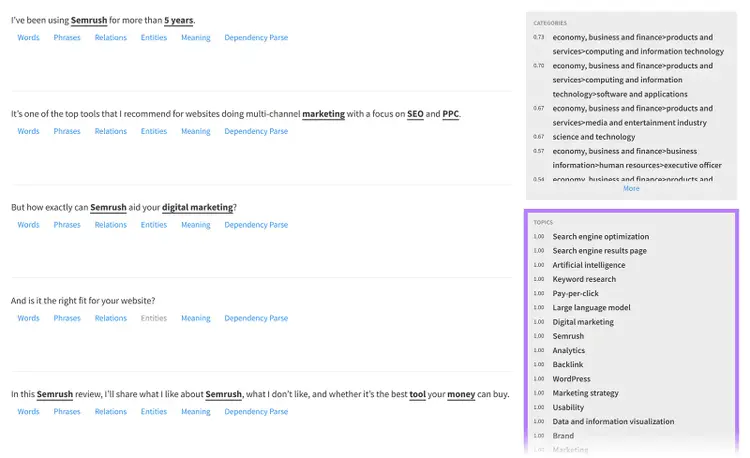
Review this list to see if your target entities are present. If your entities are missing or barely mentioned, that's a signal you need to revise your content. Consider adding new sections, including those missing entities, and discussing their attributes.
5. Avoid Common Pitfalls
Entity optimization is straightforward in theory, but there are a few common mistakes that can actually hurt your efforts:
- Stuffing entities unnaturally: Just like keyword stuffing, cramming entity names into every sentence makes your content unreadable. Mention entities where they naturally fit within the context of what you're discussing.
- Adding irrelevant entities:More entities doesn't automatically mean better optimization. Including irrelevant entities can dilute focus and confuse search engines. Stick to entities that genuinely matter for the topic.
- Inconsistent entity naming: Use consistent names for your brand, products, and other key entities across all online properties. If you're "ABC Marketing" on your homepage but "ABC Marketing Agency" on LinkedIn and "ABC Mktg" on Twitter, you're making it harder for search engines to recognize you.
Entity SEO in Action: End-to-End Example
Let’s go through an example to see how a business can optimize for entities step by step.
Imagine you run a wellness company called Mindfulness that conducts meditation sessions, yoga classes, and sells wellness products (yoga equipment, meditation cushions, and aromatherapy supplies) through your website.
The problem? When people search for "online yoga classes" or "how to meditate properly," your company barely shows up—even though you've been in business for five years.
Here's how you can use entity SEO to help Google and AI systems understand who you are, what you do, and what topics you’re an expert on. So you're far more likely to be cited or ranked for queries about relevant topics.:
First, you’ll start by identifying the key entities related to your business:.
- Brand entity: Mindfulness
- Product/service entities: Online yoga classes, guided meditation sessions, yoga mats, meditation cushions, aromatherapy diffusers, essential oils, etc.
- Primary topic entities: Meditation, mindfulness, yoga, stress relief, wellness routine, breathing techniques, etc.
- Niche topic entities: Chakra balancing, posture correction, sound healing, relaxation exercises, etc.
After mapping out your core entities, you’ll weave them naturally throughout your site:
- On your homepage and about page, reinforce your brand entity and what you do
- On your service pages, incorporate service entities with specific benefits and what makes your approach unique
- On your product pages, weave in product entities, along with images, price, descriptions, and use cases
- On your blog, build topic clusters around primary topic and niche topic entities to signal your authority for those topics
Once you’ve incorporated entities into your content, you can reinforce your entities further by:
- Adding Organization, Product, and Event schema markup to more clearly identify certain entities
- Running an entity analysis with TextRazor to check that your target entities are actually used on your site
- Maintaining consistent entity information (brand, products, services, and topics) across your website and social media
Start Optimizing for Entities
As we move into an AI-driven search era, visibility isn’t only about keywords anymore. It’s about helping Google and LLMs understand who you are, what you do, and how you connect to the topics users care about.
The steps we’ve covered in this article are simple to implement. So what are you waiting for? Get started with entity optimization today.
Semrush’s AI Visibility Toolkit lets you track how often you’re being cited in AI-generated responses and how AI describes your brand. Use it to see whether your entity optimization efforts are paying off.
Track Your Visibility in AI Platforms
with the Semrush AI Visibility Toolkit

Tushar has been involved in SEO for the past six years, specializing in content strategy and technical SEO. He gained his experience in agencies, where he worked on various ecommerce and B2B clients. On the Semrush blog, he writes about SEO and marketing based on experience drawn from his client work, focusing on sharing practical and effective strategies. His goal is to turn Semrush blog into the ultimate destination for learning SEO and web marketing.
Tushar Pol
Tushar is an SEO expert with over six years of experience in content strategy and technical SEO. Having worked with various ecommerce and B2B clients at agencies, he now writes for the Semrush blog, sharing practical and effective SEO strategies.
Tells Google to show you more from Semrush in AI, Search, and Discover.