
Organic search traffic is falling for many brands, even when their rankings haven't moved. That's because Google AI Overviews now answer queries directly on the results page, so users get what they need without visiting your site.
ChatGPT, Perplexity, and other AI platforms do the same by recommending products and surfacing brands in generated answers. But the traffic AI does send is qualified: Semrush research shows AI search visitors convert at 4.4 times the rate of traditional organic visitors.
This is the AI search era. Every AI-generated answer is already agentic: the machine evaluates on behalf of the user, judging which sources to trust and composing a response. To stay visible across this spectrum, brands need presence across traditional search, AI answers, and community and social platforms.
This article covers what brand visibility is, how it differs from awareness and perception, how to increase yours, and how to measure it across channels.
What is brand visibility?
Brand visibility is how often your brand appears to potential customers, relative to competitors, across every channel where buying decisions happen.
Today, visibility means being present everywhere search happens: traditional search and media, AI-powered search and recommendations, and the social and community spaces where peer influence drives decisions. We call this “Search Everywhere,” and winning at it means being retrieved, cited, and trusted across each surface.
Building brand visibility today combines SEO with making your brand discoverable, clear, authoritative, and trusted to AI systems — across the spectrum from a single ChatGPT answer to autonomous agents that browse and transact.
Measuring brand visibility is especially important in the era of agentic search, where AI agents collect information, evaluate options, and make recommendations on behalf of users. In some platforms, AI agents can also make purchases for the user (known as agentic commerce).
Knowing where your brand is visible, and how visible it is, tells you whether you're part of the conversation when decisions get made.
What is the difference between brand visibility, brand awareness, and brand perception?
Brand visibility, brand awareness, and brand perception are related concepts that each measure a different aspect of how your brand exists in the market.
Brand visibility influences awareness and perception. So the more consistently your brand appears where buyers and large language models (LLMs) are looking, the more likely they are to recognize and trust it. It's the same logic that drives share of voice in search, but with AI chats and social forums layered in.
5 ways to improve brand visibility
Improve brand visibility by appearing where searchers go for information: traditional search, AI answers, and community and social platforms.
The five strategies below span all three layers: trust signals and AI search optimization for AI answers, employee posting and reviews for community and social, and machine-legibility tactics for traditional and agentic search.
(Existing technical SEO work covers the foundation of traditional search, so these strategies focus on what's new.)
1. Build trust signals
AI systems decide which brands to surface based on five trust signals: entity recognition, third-party validation, cross-platform consistency, content relevance, and credibility. Build each one to increase your odds of being cited.
- Entity recognition: AI systems recognize brands as entities. Add Organization schema (structured data) with the sameAs property linking to profiles like your LinkedIn, Facebook, Crunchbase, and Wikidata so AI systems can verify your business across the web.
- Third-party validation: AI systems trust what others say about your brand more than what you publish yourself. Work on building backlinks and mentions from reputable and relevant sites.
- Cross-platform consistency: Consistent brand information across directories, social profiles, and listings signals to AI that your business information is updated and relevant
- Content relevance: LLMs prioritize relevant content, and if your content is outdated with stale information, you’re less likely to be cited. Keep a schedule for updating content so it always contains accurate information.
- Credibility: LLMs want to mention credible brands. Include expert author bylines and bios, cite credible sources, and demonstrate first-hand experience in your content.
Note
Not all AI platforms weigh these signals the same way, and citation patterns vary across ChatGPT, Perplexity, and Google AI Overviews. Our research on the most-cited domains in AI shows the variance is significant — doing everything right may get you appearing in one platform but not all. That's why tracking your visibility across platforms matters.
2. Optimize content for AI search
Optimize content for AI search by structuring your pages so AI systems can pull accurate, relevant information from them without friction.
AI systems scan content for clear, direct answers they can extract and surface in generated responses. If your content buries the answer or assumes the reader will connect the dots, AI will pull from a source that delivers it cleanly.
And while traditional rankings still matter, you don't have to dominate the SERP to earn AI mentions. Semrush research shows ChatGPT cites pages ranking in traditional positions 21 or lower almost 90% of the time. Strong, extractable answers can earn citations even when your page isn't on page one.
Structure your content for extractability by:
- Answering immediately: State the answer to each heading's question in the first sentence. Don't warm up to it.
- Using descriptive headings: Write headings as questions or clear statements so AI knows what each section is about before parsing the body copy
- Keeping paragraphs tight: One idea per paragraph. Long, dense blocks are harder for AI to extract cleanly.
- Using structured formats: Lists, tables, and step-by-step formats are easier for AI to lift and reproduce accurately than flowing prose
- Avoiding ambiguous pronouns and references: Write so each sentence stands alone. If a sentence only makes sense in context, AI may extract it incorrectly or skip it.
The goal is content that gives AI a clean, confident answer to surface with your brand attached to it.
3. Use employees as brand visibility channels
Use your employees as brand visibility channels by encouraging them to post content from their professional social profiles (like Reddit threads or LinkedIn posts). Those signals feed into how AI systems understand and build trust with your brand.
The more channels your brand appears on through real people, the broader your brand visibility footprint.
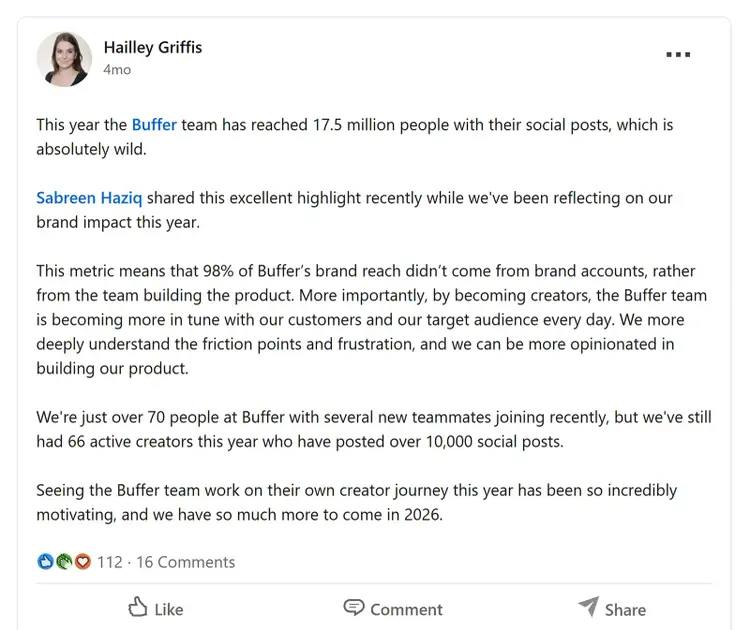
For example, Buffer launched a company-wide “Team of Creators” initiative in 2025, with the explicit goal of every employee — across every role — building a creator presence on social. The bet: a brand's footprint expands faster through real people than through corporate handles.
Get your employees posting by:
- Building an idea backlog: Create a shared spreadsheet of post ideas employees can pull from at any time
- Repurposing existing content: Encourage employees to pull stats, quotes, and insights from existing blog posts, podcasts, and reports to use as the basis for their own social posts
- Creating light guardrails: Write a brief style guide that preserves brand voice without being so restrictive that employees disengage
- Choosing channels deliberately: Focus on platforms where your customers are and where your team can credibly show up. For example, LinkedIn and X work for most B2B brands.
- Iterating based on signal: Test ideas on lower-friction platforms first. What resonates on X becomes a LinkedIn post; what performs on LinkedIn becomes a blog post or webinar.
4. Build trust through online reviews
Build trust through online reviews by finding people who love your product and asking them to share honest experiences on the platforms your prospects use for recommendations. Online reviews are the most powerful form of third-party validation (the second trust signal in strategy No. 1) because they're high-volume, recent, and crawled by AI systems for product recommendations.
This matters more than ever in the era of agentic search. Your buyers aren't the only ones scanning these platforms for recommendations. AI platforms are too.
AI platforms learn about products from third-party content like reviews, discussions, and forums. And if your product shows up consistently in those conversations, you’re more likely to be surfaced in AI-generated answers.
One way to find people who love your product (and review it) is with a Net Promoter Score (NPS) survey, which identifies people most likely to promote your brand to others.
Then, ask your promoters to leave reviews in places that feed both buyer decisions and AI recommendations. AI systems actively crawl and cite these platforms when generating answers, so a strong presence here improves your chances of being surfaced:
- Review platforms like Google Reviews, Facebook, Yelp, G2, and Amazon
- Community platforms like Reddit and niche forums
- Video platforms like YouTube and TikTok
- Social platforms like LinkedIn and X
- Industry-specific sites like Capterra, TrustRadius, and TripAdvisor
You need consistent volume and fresh reviews over time because AI platforms weigh recent content more heavily when generating recommendations. Staying active keeps your product visible to both buyers and the models they rely on.
5. Make your brand legible to AI agents
Make your brand legible to AI agents by structuring your information so agents can find, verify, and cite it without friction. Most agentic search today is single-turn: a ChatGPT response, an AI Overview, a Perplexity answer.
What's emerging is multi-step: agents that browse, compare, and transact across multiple sources. The brands those agents surface are the ones whose data is machine-readable, consistent, and current.
Build agent-readiness through:
- Structured data: Implement Organization, Product, Service, and FAQ schema so agents can parse your offerings without scraping. Schema tells an agent "this is a product, this is its price, this is its rating" in a format the agent can act on.
- Consistent product and service data across the web: Make sure your name, descriptions, pricing tiers, and feature lists match across your site, third-party listings, app stores, and review platforms. Agents cross-reference sources, and inconsistency is a downgrade signal.
- Machine-readable feeds and APIs: If you sell products or services agents could surface in shortlists or transactions, publish a clean product feed and consider exposing a public API endpoint. Early-stage but increasingly relevant for agentic commerce.
- Review recency and volume on AI-cited platforms: Agents weight recent reviews more heavily than older ones when generating recommendations. The review-velocity work in strategy #4 directly supports agent visibility.
- Site health for crawlability: Site errors that block bots (broken pages, redirect loops, blocked resources) prevent agents from accessing the data they need. Run a website audit to find and fix issues that affect agent access.
Agentic search is where the three layers of brand visibility converge. Your traditional search presence informs agent research, your AI visibility determines whether agents recommend you, and your community and review presence provides the trust signals agents use to finalize decisions.
How to measure brand visibility across channels
Measure brand visibility per channel. A single aggregate number doesn't give you useful insight.
1. Organic search
Measure organic search visibility using share of search (the percentage of branded search traffic in your category that belongs to your brand versus competitors).
Use Semrush's Position Tracking tool. Configure it with the keywords you want to track, then open your project.
Click “Overview” and make sure the chart is set to "Competitive Analysis” and “Visibility.” Add any competing domains to see how your visibility compares against your rivals.
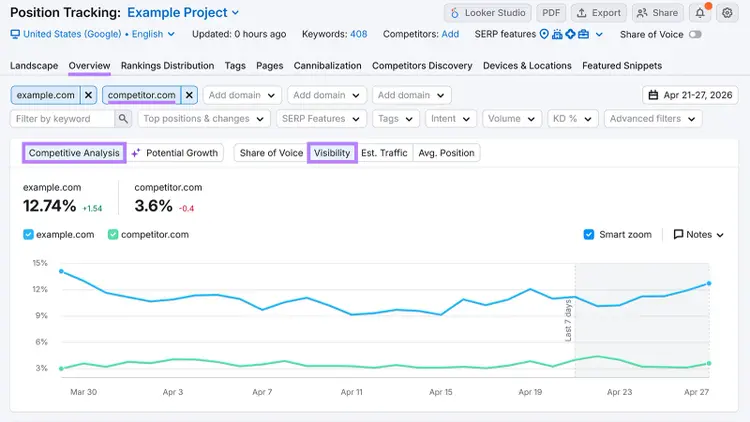
Low or falling visibility in organic search signals that you should review your keywords to see which ones aren’t driving traffic. Then, update existing content to see if rankings improve, or find new keywords to target.
You can also check your visibility for AI Overviews by choosing “AI Overviews” from the “SERP Features” dropdown.
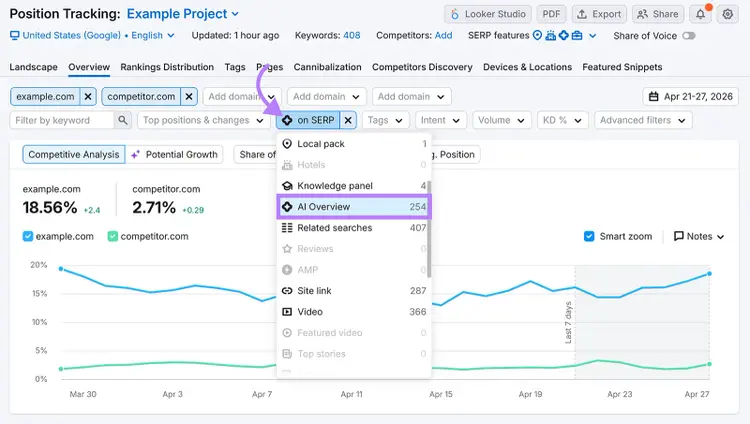
For deeper guidance on ranking in AI Overviews and other AI platforms, see our dedicated post.
2. Paid search
Measure paid search visibility by tracking the keywords you're actively bidding on and how your presence compares to competitors.
Google Ads has a metric called "search impression share" that shows how your ad performs against competing ads, giving you a sense of paid visibility.
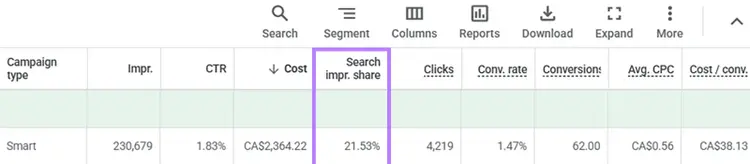
You can also measure paid visibility against specific competitors using Position Tracking. Open your project, enter your competitor domains, and change the settings to "Google Ads."
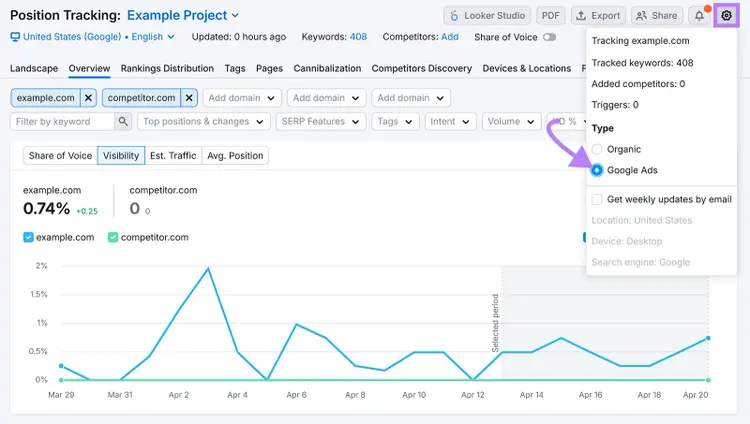
Low paid visibility signals weak ads. Review your ad copy and landing pages to make sure they're compelling and relevant.
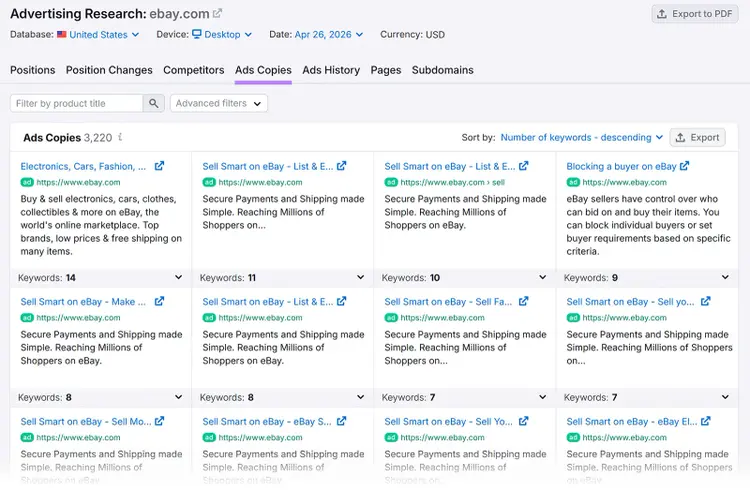
Semrush's Advertising Research lets you review your competitors' ad copy in the "Ads Copies" tab.
3. Social media
Track visibility on social media by seeing how often your brand gets mentions compared to your competitors.
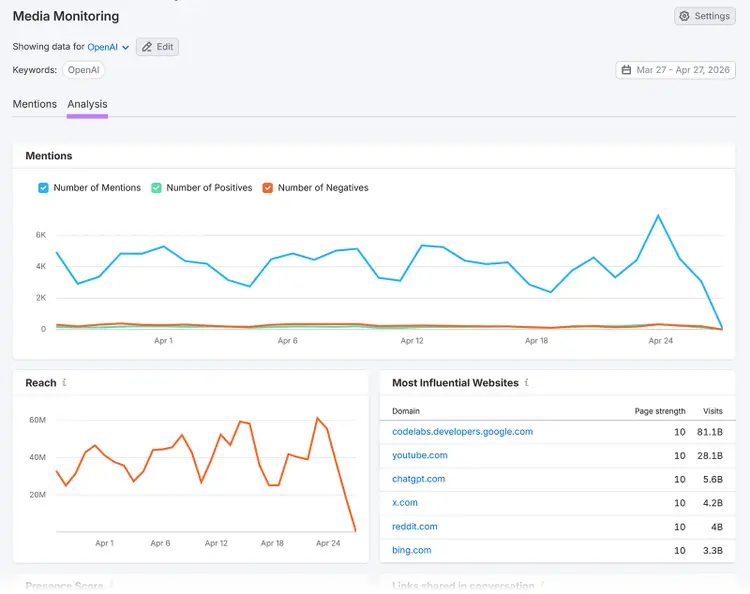
Semrush's Media Monitoring tracks brand mentions across social platforms, news sites, blogs, and forums. It scores sentiment and shows mention volume trends over time.
This tells you whether your brand is being talked about and whether the conversation is positive.
For example, a brand generating consistent unprompted mentions on LinkedIn, Reddit, and YouTube is building visibility.
Start by configuring Media Monitoring with terms you want to track. For brand visibility, track your brand name and any branded products. (Set up a separate project for competitor terms.)
During configuration, you can also choose to track sources that extend beyond social media platforms (like blogs and newsletters).
Once setup is complete, you'll see data for all tracked keywords. Click the "Analysis" tab to view your mentions and reach, which gives you a sense of how your visibility compares to your competitors'.
Note
Reddit, YouTube, and LinkedIn are among the platforms AI systems frequently cite in brand-related answers, so growing mentions on these channels directly supports your AI visibility.
4. Referral and review sites
Measure referral and review site visibility through your placement quality and review velocity on the platforms your buyers use.
When people are comparison shopping, they want to see that you’re well recommended and trusted by influential people and brands in the space.
Plus, review sites like G2 and Capterra are among the most frequently cited sources in AI-generated answers, according to research by Lantern. When a buyer asks ChatGPT or Perplexity "what's the best [category] software," the answers are often drawn directly from these sites.
To build and maintain review velocity:
- Run an NPS survey and route promoters directly to your review site of choice
- Follow up with high-value customers for testimonials
- Prioritize recency: a consistent flow of new reviews outperforms a large but stale bank
5. AI search visibility
Measure AI search visibility by tracking how often your brand is mentioned in AI platforms like ChatGPT, Gemini, Perplexity, and Google AI Overviews.
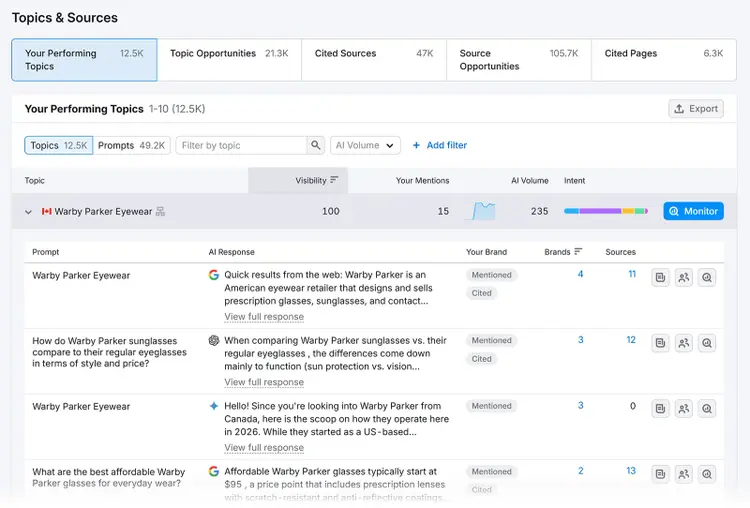
To do so, use Semrush's AI Visibility Toolkit. Enter your domain in the Visibility Overview tool to see how your visibility changes over time. Look at metrics like cited pages, mentions, and AI visibility.
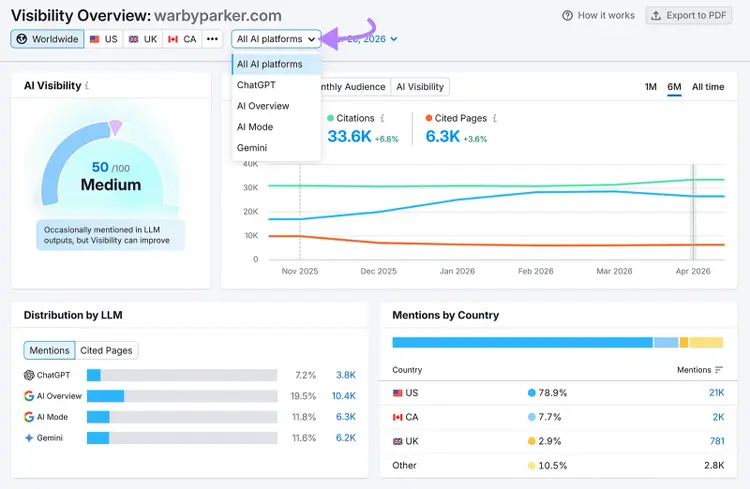
The bottom of the report shows which topics and prompts drive your brand mentions, so you can see where you're winning and where you're missing.
Note
Manual prompt tracking is unreliable because you can't analyze enough prompts to collect useful insight. Semrush's AI Visibility Toolkit analyzes millions of prompts to give you reliable data.
AI-era brand visibility KPIs
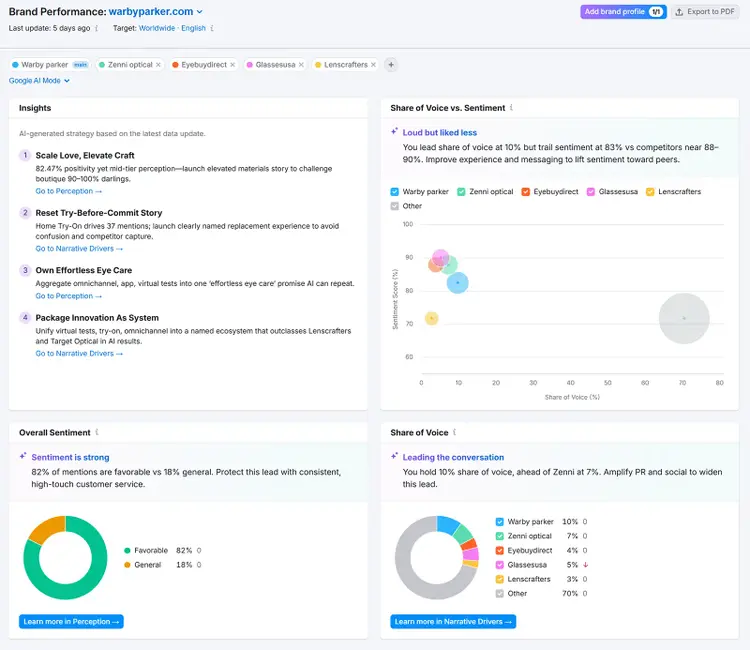
Measuring AI visibility means tracking metrics traditional analytics tools weren't built for. Use this set alongside your channel-by-channel measurement to see how AI systems perceive and surface your brand.
How to read these metrics:
- AI mentions and cited pages tell you what's working: A page that earns repeat citations is a template for the rest of your content. Reverse-engineer what makes it extractable: structure, format, claims, sourcing.
- AI share of voice is the leading indicator: It moves before traffic does, so a rising AI share of voice today often means rising AI-referred sessions in 30 to 60 days. Falling AI share of voice means competitors are gaining ground in the answer set you care about.
- Source opportunities are your roadmap: Prompts where competitors get cited and you don't tell you exactly where to invest content next.
- Entity accuracy is the underrated one: AI mentions only matter if AI describes your brand correctly. Audit a sample of prompts monthly to confirm AI is positioning your products and value props the way you would.
Track these monthly at minimum, weekly during active campaigns. AI visibility moves faster than traditional search, so a single high-authority source mention or schema update can shift citation patterns within days.
Get your brand ready for the next era of search
Semrush research projects that AI search visitors could outnumber traditional organic visitors by early 2028 for digital marketing topics, with similar shifts likely across other industries soon after.
But the shift goes further than search. AI agents are beginning to complete purchases, book services, and shortlist vendors with minimal human input. When that happens, your buyer isn't always going to be a person reading your content, and might be a machine evaluating signals.
The brands that win in agentic search aren't necessarily the biggest. They're the ones that have made themselves legible to machines through the strategies listed above.
And because AI systems learn from accumulated signals over time, the advantage compounds. Every citation earned today increases the likelihood of being cited in the future.
Search is already agentic. Your first step is to measure where you stand today. From there, the strategies above tell you where to invest.
Ready to measure and improve your brand visibility?
Beat your competition in AI Search
with the Semrush AI Visibility Toolkit

Carlos Silva leads the editorial pipeline for the English blog—coordinating writers, editors, strategy, and building AI workflows that boost content quality and AI visibility. With 10+ years of experience writing and editing across in-house and agency roles, Carlos blends content strategy, SEO, and AI to help marketers stay ahead of an evolving search landscape.
Carlos Silva
Carlos Silva leads the editorial pipeline for the English blog and builds AI workflows that boost content quality and AI visibility. 10+ years writing and editing across in-house and agency roles.
Tells Google to show you more from Semrush in AI, Search, and Discover.