
What Is AI Search?
AI search is a way to find information online using large language model tools (LLMs)—like ChatGPT and Perplexity—that generate conversational, synthesized answers from training data and web sources.
Instead of scanning websites like with Google’s search results, users get clear, direct answers, often with source citations they can verify. This is because the AI tool reads, compares, and summarizes the content.
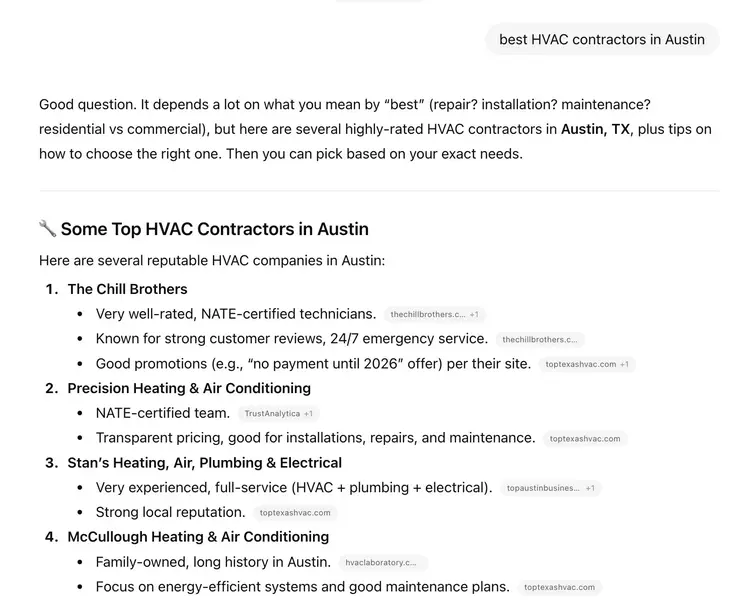
What Are AI-Powered Search Engines Like ChatGPT and Perplexity?
AI-powered search engines like ChatGPT and Perplexity are platforms that process information from multiple sources (like websites and forums) to give users answers to their questions.
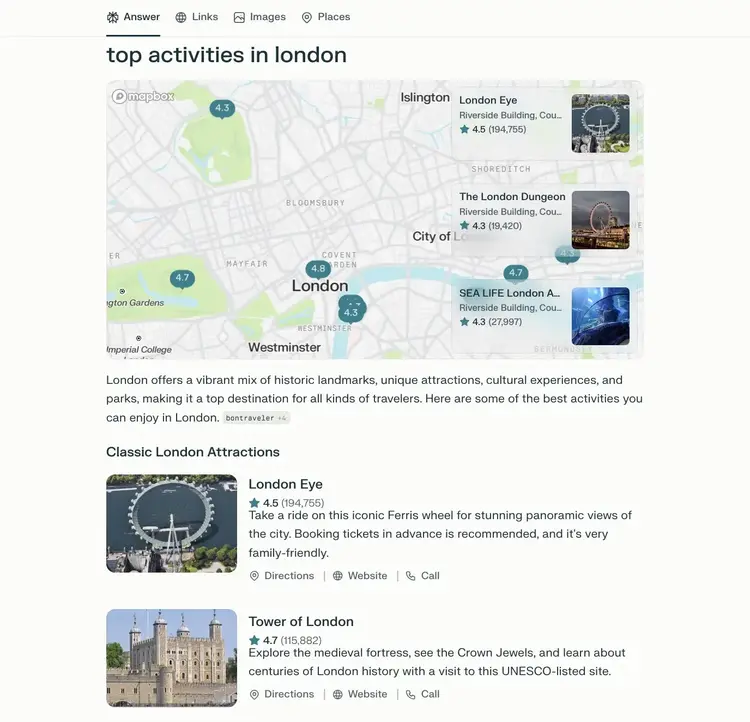
Google’s AI Overviews and AI Mode are also AI-powered search engines. They use Google’s Gemini model to summarize information from multiple sources and display concise, AI-written answers.
How Do Google AI Overviews and AI Mode Change the Search Experience?
Google AI Overviews and AI Mode change the search experience by delivering AI-generated answers that don’t require users to click through to websites.
Traditional search requires you to open multiple pages and synthesize information yourself. Whereas AI Overviews and AI Mode do the synthesis for you.
AI Overviews appear as a summary box at the top of search results. For example, if you search "how to measure seo roi” you’ll probably see a multi-paragraph explanation of key metrics before seeing any links.
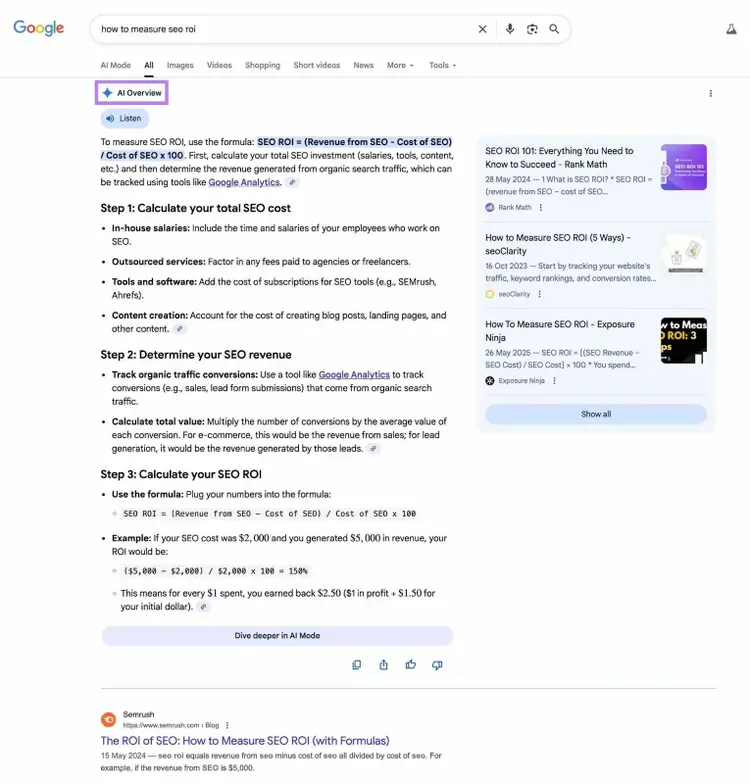
You can read the overview and leave. Or click the citations for more detail.
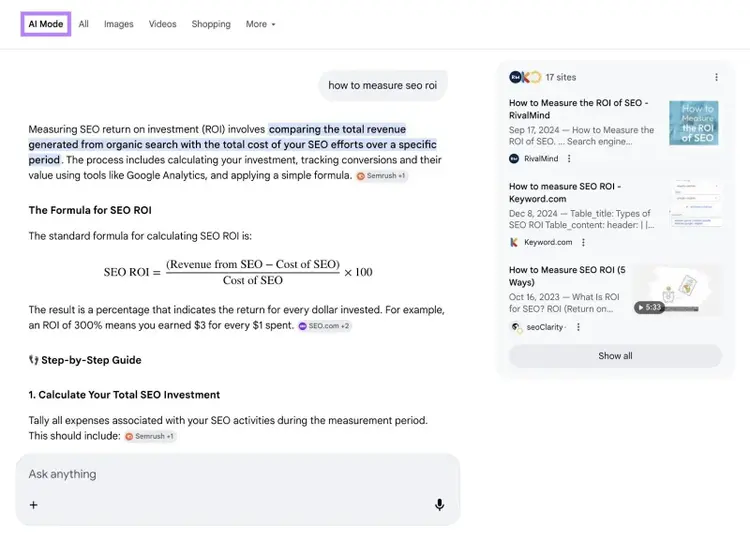
AI Mode provides a conversational, AI-first interface within Google Search. You ask a question, receive an answer, then ask follow-ups without starting a new search.
How Fast Is AI Search Adoption Growing?
AI search adoption is growing rapidly, with ChatGPT being the fastest growing app in history.
ChatGPT reached 100 million users just two months after launch. For comparison, Instagram took two and a half years to reach 100 million users. And TikTok took nine months.
The growth in AI search means you can reach your audience if your brand is mentioned within AI-generated results.
Why Is AI Search Taking Off Now?
AI search is taking off now because people can get accurate and personalized responses to their queries at a time when there’s more content than ever to wade through.
Other reasons people are turning to AI include:
- Instant satisfaction: AI search gives you direct answers in one place
- Interactive exchanges: You can ask follow-up questions, refine context, and get definitions or explanations tailored to your needs
- Actionable information: Users don’t just want to find information—they want to use it. AI search supports writing, decision-making, research synthesis, and more—all within one workflow.
Is Traditional Search Starting to Lose Ground?
Traditional search isn’t losing ground—our research found that there was a slight increase in average Google search usage after ChatGPT adoption.
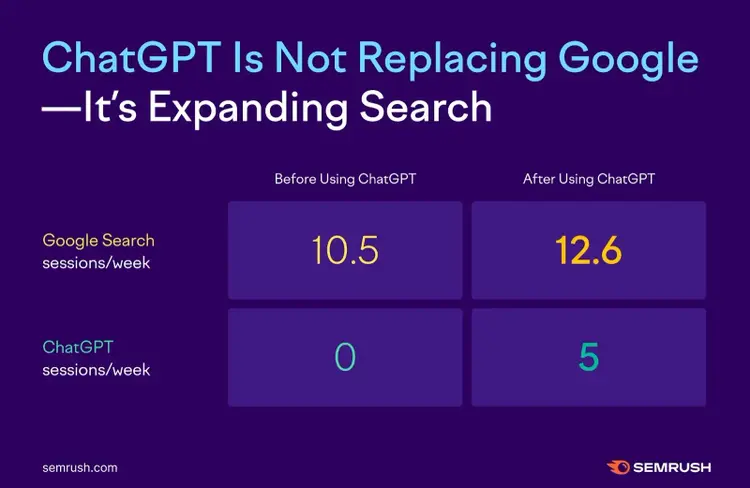
ChatGPT is expanding search and providing users with other places to go to get answers to their questions.
How Are Organizations and Consumers Using AI Search?
Organizations and consumers are using AI search to find information faster and make better decisions.
OpenAI’s research found that people mainly use AI for three purposes:
- Asking: Seeking advice, explanations, or guidance
- Doing: Completing tasks such as writing, planning, or coding, often for work
- Expressing: Using AI for reflection, creativity, or exploration
And according to a survey by Moneypenny, the top five ways organizations currently use AI include:
- Content generation
- Telephone answering
- Analytics and reporting
- Productivity and automation
- Sales and lead generation
How Is Search Behavior Changing in the AI Era?
Search behavior is shifting from typing relatively short keywords to having conversations with longer prompts and more follow-ups.
Traditional search relies on a "search → click → read → compare" workflow. You type a query, scan multiple blue links, and piece together your own answer.
In contrast, AI search completes the full process of assessing sources for you. It reads pages and/or draws on training data, extracts key insights, and gives readers one cohesive answer.
For example, you can ask ChatGPT: "I need running shoes for marathon training on roads that are designed for mild overpronation, and I have a budget under $150. What do you recommend?" You’ll get a list of products that fit your query. And from there, you can ask specific follow-up questions.
Are Prompts Becoming More Conversational and Complex?
AI prompts seem to be more conversational and complex—our research shows that the average prompt length for ChatGPT is 23 words versus 3.4 words for a Google search.
Which Types of Queries Trigger AI Answers Most Often?
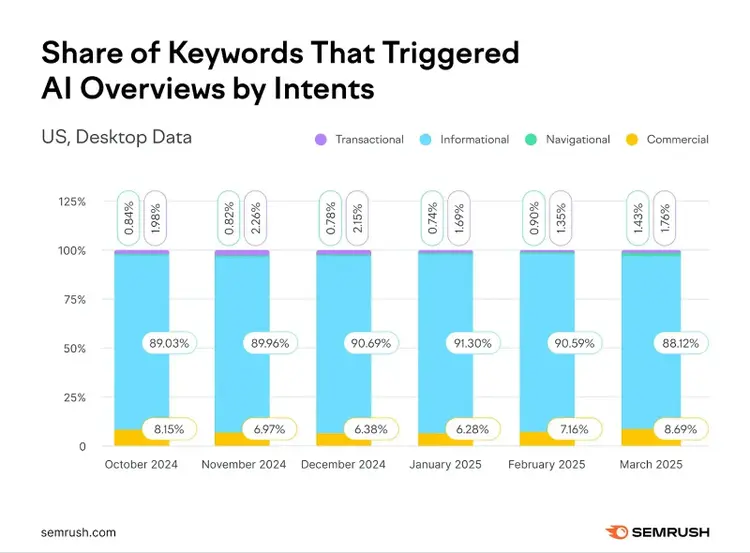
We analyzed 10,000 terms that trigger AI answers in Google and found that long-tail, low-difficulty informational queries trigger AI Overviews the most.
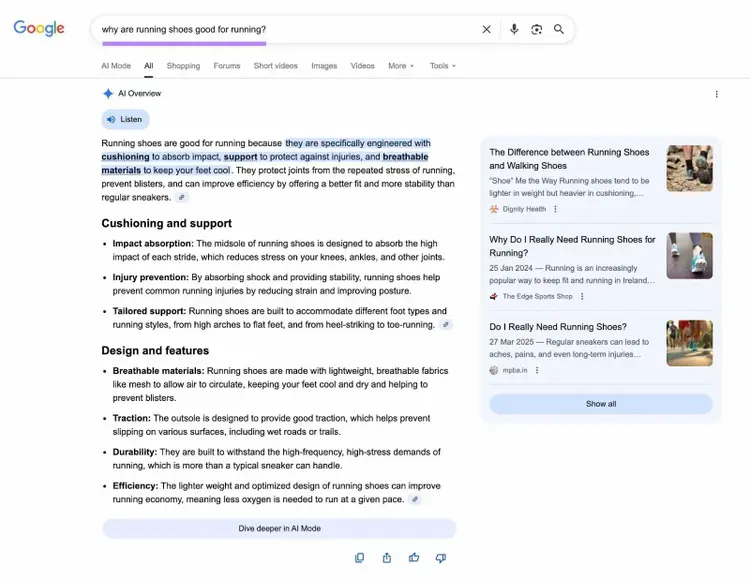
However, commercial queries (like “best running shoes”) don’t tend to trigger AI Overviews.
Can AI Search Results Be Trusted?
AI search results can’t be fully trusted without verification in most cases, but they’re improving.
While AI systems can be highly accurate for many topics, they can sometimes hallucinate or misinterpret data.
AI platforms have added measures to improve reliability:
- Citations and source transparency: Tools like Perplexity and Google AI Overviews display linked references so users can trace where information came from
- Continuous model updates: Models are retrained frequently to correct reasoning capabilities and address biases
- User feedback loops: AI search tools allow users to report incorrect answers, helping improve results over time
Where Do AI Answers Come From?
AI answers come from a combination of licensed data (such as content from Reddit or academic publishers), training data, and sometimes real-time search results.
When you ask a question, the AI scans a range of sources, compares key facts, and generates a single, conversational answer. And it often provides citations, so you can verify facts.
How Often Do AI Citations and Sources Change?
AI citations and sources change frequently—sometimes every time you ask a question.
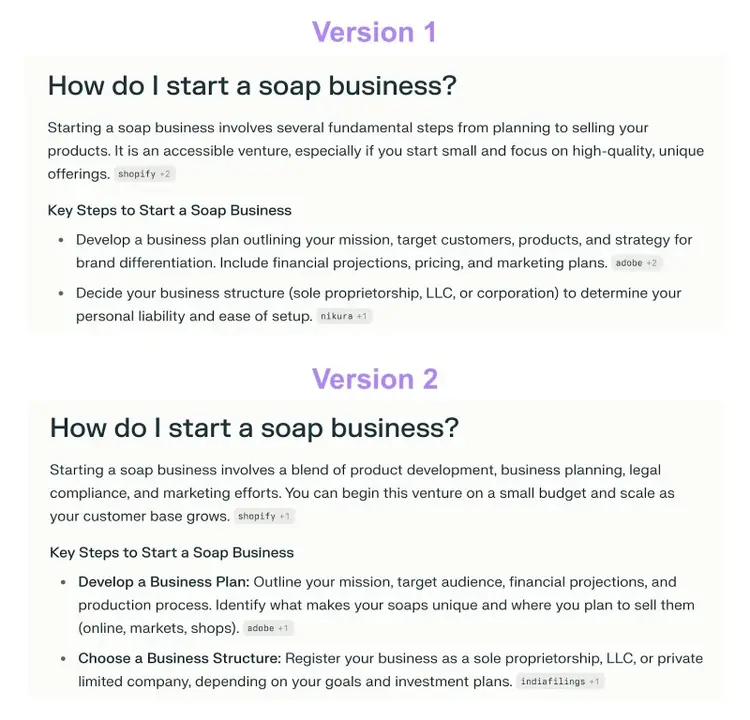
And because AI search engines (like AI Overviews and ChatGPT) often pull live information from the web, users can often get up-to-date answers.
What Is Generative Engine Optimization (GEO)?
Generative engine optimization (GEO) is the process of optimizing your content so it appears in AI-generated answers from generative search engines like ChatGPT, Perplexity, and Google AI Overviews.
GEO and SEO are different. GEO focuses on improving metrics like brand mentions and citations in generative engines, while traditional SEO focuses mostly on rankings in search results.
Why Does GEO Matter Now?
GEO matters now because more people are turning to AI search to find answers.
Marketers who optimize now for GEO can stay ahead of their competitors who might not be focussing on it.
How Does AI Search Affect Web Traffic and SEO?
AI search affects web traffic and SEO by reducing clicks from search results while increasing competition for brand visibility within AI-generated answers.
Features like Google AI Overviews and ChatGPT’s contextual responses often give users the information they need without them having to visit a website. As a result, informational queries (questions intended to solve a problem) now generate fewer organic clicks.
Are There Any Upsides to AI Search for Brands?
Brands that consistently show in AI answers can grow brand awareness and capture traffic from LLMs and traditional search.
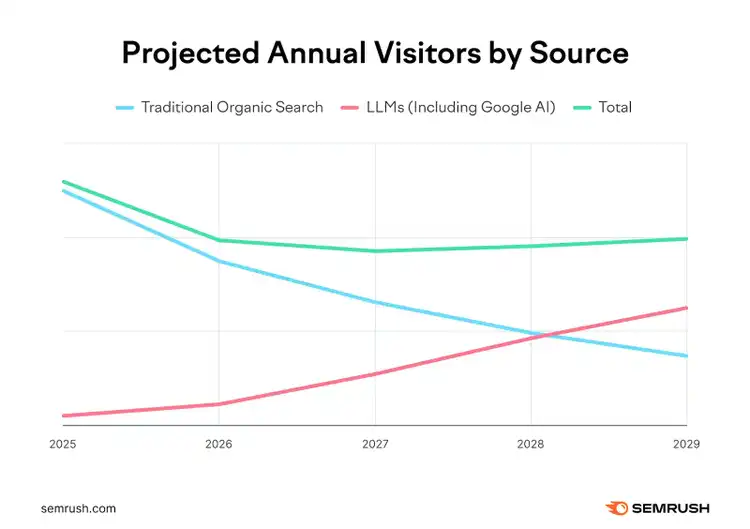
Based on our AI search and SEO traffic study, we estimate that website traffic from LLMs will surpass website traffic from organic search by 2029. Meaning brands that optimize their sites for both SEO and LLMs now might perform better in the future.
What Can I Do to Appear in AI Search?
You can appear in AI search by focusing on strategies that are known to improve citations and brand mentions with AI outputs.
Let’s go over some specific techniques you can apply:
How Do I Improve Citations & Mentions in AI Systems?
You can improve AI citations and mentions by creating content that LLMs can easily read and cite.
To increase your chances of appearing in AI systems:
- Make sure your brand, product, and service names appear consistently across sources like your Google Business Profile, LinkedIn, and other online places your business appears
- Gain brand mentions and backlinks from trusted publications and forums
- Publish expert insights that show real experience
- Consistently highlight what sets your brand apart (price, selection, expertise), so AI tools have reasons to recommend you
- Follow technical SEO best practices and keep your content publicly available, so models can easily access, read, and process it
Tracking metrics (more on those next) helps you determine whether the above strategies are making your brand more visible in AI searches.
What New Metrics Matter in AI Search?
The emerging metrics that matter in AI search include:
- AI mentions: Measures the total number of AI responses that mention your brand
- AI visibility: Measures your brand’s presence in AI-generated answers compared to other brands
- Share of voice: Measures how often your brand is mentioned along with how high it appears in AI-generated answers compared to competitors
- Sentiment: Measures how favorable mentions of your brand are
- Engagement from AI-driven traffic: Measures how AI referral traffic interacts with your site based on metrics like time spent on site and conversions
How Can I Track My Performance in AI Search?
You can track your performance in AI search with Semrush’s AI Visibility Toolkit.
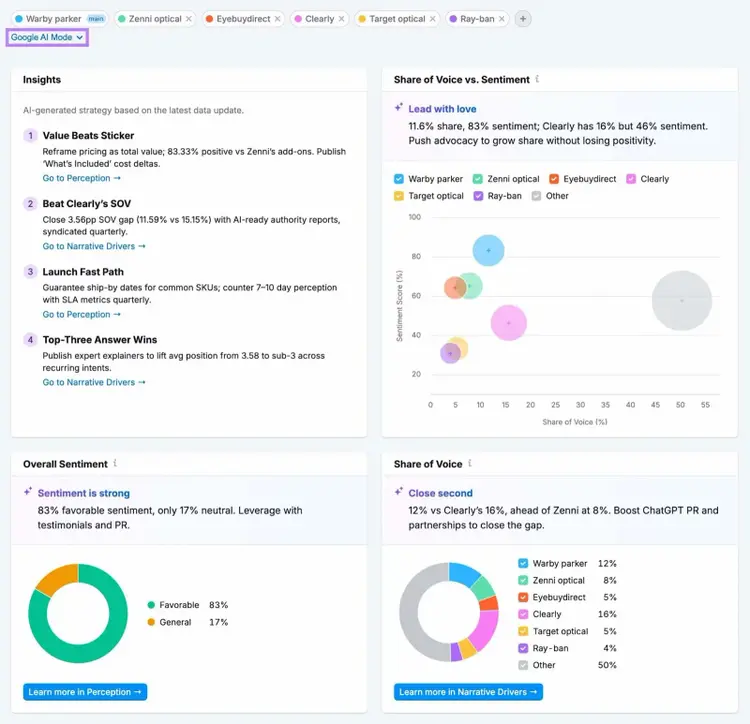
The “Brand Performance” dashboard shows your brand’s share of voice and sentiment across different AI models.
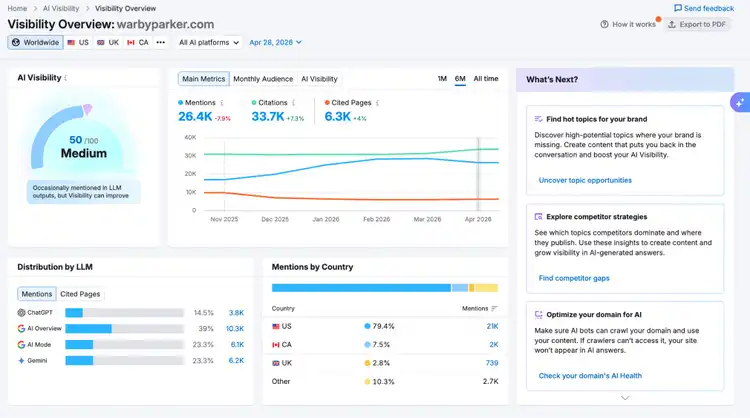
And the “Visibility Overview” report shows your mentions and overall visibility metrics.
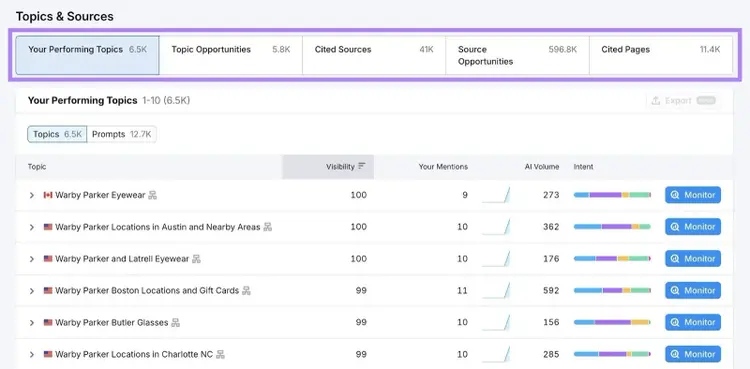
Scroll down on the “Visibility Overview” report to see where you’re mentioned, where you’re cited, and where you have room to improve. Knowing this helps you prioritize which topics to create content for.
How Can I Stay Ahead as AI Search Evolves?
You can stay ahead as AI search evolves by monitoring and comparing your performance in LLMs and search engines to that of your competitors. And continually working to optimize and improve your presence.
Semrush One gives you access to the AI Visibility Toolkit and SEO Toolkit so you can stay on top of your entire search presence.
Try it today.
Stand Out Across All Search Experiences
with Semrush One

Carlos Silva leads the editorial pipeline for the English blog—coordinating writers, editors, strategy, and building AI workflows that boost content quality and AI visibility. With 10+ years of experience writing and editing across in-house and agency roles, Carlos blends content strategy, SEO, and AI to help marketers stay ahead of an evolving search landscape.
Carlos Silva
Carlos Silva leads the editorial pipeline for the English blog and builds AI workflows that boost content quality and AI visibility. 10+ years writing and editing across in-house and agency roles.
Tells Google to show you more from Semrush in AI, Search, and Discover.