
The 8 Best LLM Monitoring Tools for Brand Visibility in 2026
When someone asks ChatGPT, Claude, or Google's AI Overviews about products in your industry, your brand either shows up — or it doesn't.
LLM monitoring tools offer precise insights into your brand’s presence across these AI platforms.
Below are eight of the most popular LLM monitoring solutions that are currently available in the market.
Now, before we get into the details about each of these tools, let’s review some basics to make sure we're all on the same page.
What Are LLM Monitoring Tools?
LLM monitoring tools track how your brand appears in AI-generated responses from platforms like ChatGPT, Claude, and Google's AI Overviews.
When potential customers ask AI about products or services in your industry, you need to know if your brand gets mentioned. And how you compare to competitors.
These tools that monitor LLM visibility detect brand mentions, position in responses, and competitor presence. Some tools focus on marketing visibility; others measure technical performance
Software for monitoring brand mentions in LLMs includes:
- AI brand monitoring tools track marketing visibility and brand mentions across AI platforms
- Technical LLM observability tools monitor performance metrics like API usage and latency
The best LLM monitoring tools, like Semrush, help you benchmark your AI visibility against competitors and track sentiment around brand mentions.
For example, when someone asks "What are the best project management tools?", these tools show if your brand appears, how often, and where.
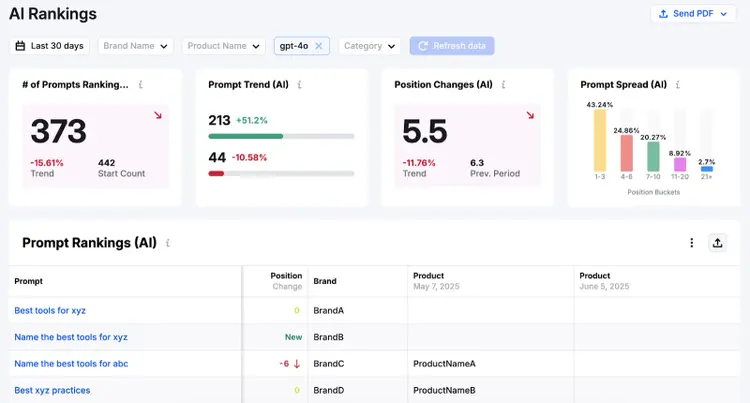
I've tested the leading tools. And found the 9 best.
Here’s what you need to know first.
Why LLM Monitoring Tools Matter for Your Business
LLM monitoring tools are essential because AI platforms now shape how people research products and services.
ChatGPT had over 400 million weekly active users as of February 2025, according to Reuters. Google's AI Overviews appear in nearly half of all monthly searches, according to a study conducted by Botify and DemandSphere.
When users ask AI about solutions in your industry, your brand needs to appear in the responses. If not, you risk losing qualified traffic and sales to competitors who do.
Which tools help benchmark my AI visibility against competitors?
LLM monitoring tools provide this competitive intelligence by showing:
- How often your brand is mentioned in ChatGPT Claude, and other AI platforms
- Where competitors appear for your target keywords
- Whether AI platforms describe your brand positively or negatively
- Your share of voice compared to competitors
Without monitoring, you can't track when competitors dominate AI responses or when negative sentiment affects your brand mentions.
The best ways to monitor AI brand mentions include using dedicated tools that track real-time changes across multiple AI platforms.
How LLM Monitoring Tools Track Brand Mentions
Most LLM monitoring tools follow a similar three-step process to track brand visibility across AI platforms. Understanding this helps you choose the most accurate solution for your business.
Most tools follow three steps:
- Submit queries to AI platforms
- Analyze the responses
- Track competitive positioning and sentiment
1. Query Automation
Tools send industry-relevant questions to AI platforms like ChatGPT, Claude, and Google's AI Overviews multiple times per day.
A CRM software company might track queries such as:
- "best CRM for small business"
- "Salesforce alternatives for startups."
Tools like Semrush Enterprise AIO automate this process, testing hundreds of relevant queries to capture comprehensive brand visibility data.
2. Response Capture and Analysis
LLM monitoring tools collect full AI responses and analyze them for brand mentions, position in the response, and context of the mention.
Advanced software for monitoring brand mentions in LLMs shows if your brand appears as the top result, within a list, or in a competitor comparison.
For example, if ChatGPT lists five project management tools and your brand appears third, the tool may log your rank and surrounding text.
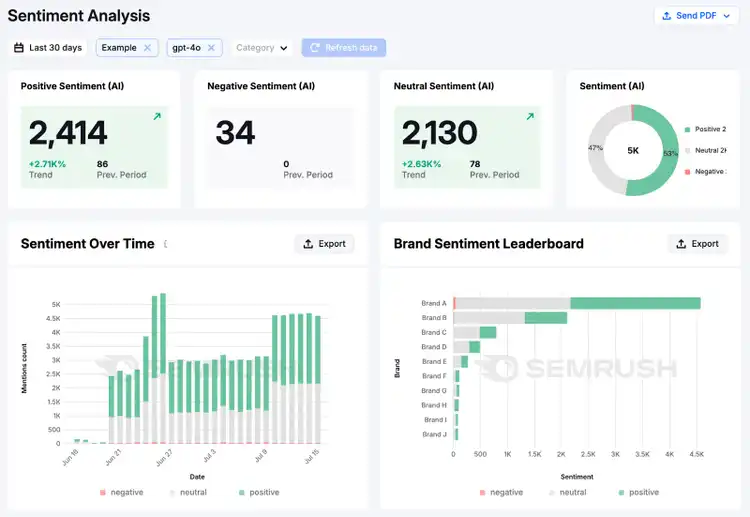
3. Competitive and Sentiment Tracking
LLM monitoring tools compare your brand’s mentions with competitors and track sentiment in real time.
They can show:
- How often competitors appear for your targeted queries
- Whether AI responses describe your brand in a positive, neutral, or negative way
Semrush Enterprise AIO tracks both competitive positioning and sentiment across all major AI platforms.
Types of LLM Monitoring Tools You Should Know
Comparing popular AI optimization tools for enterprise AIO requires evaluating features like AI platform coverage, competitive benchmarking, and sentiment analysis capabilities. Enterprise solutions often focus on scalability, integration with existing platforms, and the ability to manage large data volumes effectively.
There are three main types of LLM monitoring tools.
- Technical LLM observability tools
- AI brand monitoring tools
- Hybrid LLM monitoring solutions
Knowing the difference between the types helps you choose the right solution for your business.
Some tools are designed for developers. Others focus on brand and marketing visibility. A few do both.
Technical LLM Observability Tools
These tools help development teams monitor AI model performance.
Key focus areas:
- API response times and error rates
- Token usage and cost tracking
- Model accuracy and hallucination detection
Best for: Developers optimizing LLM applications. Not suited for marketing visibility.
AI Brand Monitoring Tools
These tools track how often your brand appears in AI-generated content on platforms like ChatGPT and Claude.
Key focus areas:
- Brand mention frequency across AI platforms
- Sentiment analysis of brand references
- Share of voice vs. competitors
The best software for monitoring brand mentions in LLMs includes Semrush Enterprise AIO. It tracks how often your brand appears and compares it to competitors across AI platforms.
Best for: Marketing teams that need brand visibility and competitive intelligence data.
Hybrid LLM Monitoring Solutions
Hybrid tools combine brand monitoring and technical observability in one platform.
Key focus areas:
- Technical metrics like API usage and system costs
- Brand visibility across ChatGPT, Claude, and others
- Competitive benchmarking
Which tools help benchmark my AI visibility against competitors?
Hybrid solutions like Semrush Enterprise AIO provide comprehensive monitoring that includes competitive benchmarking and technical metrics.
Best for: Teams that need both technical monitoring and brand visibility data in one solution.
8 Best LLM Monitoring Tools for Brand Visibility in 2026
We've tested the top tools based on brand mention tracking accuracy, ease of use, and pricing to help you choose the right solution for monitoring your AI visibility.
1. Semrush
Semrush is a complete brand visibility solution that combines LLM monitoring, SEO, and competitor research in one platform. It's the only tool on this list that connects your LLM visibility back to the SEO signals shaping those answers.
We use Semrush internally to monitor our own LLM visibility. Tracking and acting on the data it surfaces helped us grow our AI share of voice from 13% to 32% in one month.
You can access Semrush' LLM monitoring tools in two different ways, depending on the size of your team.
Semrush Enterprise AIO
What it does:
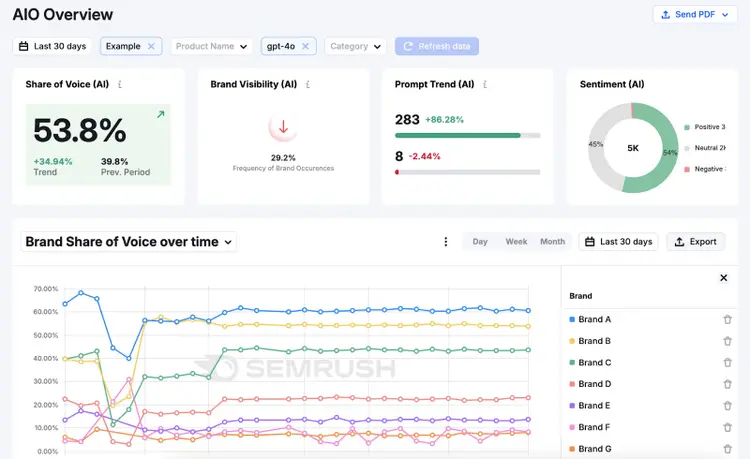
Semrush Enterprise AIO tracks your brand's visibility across AI platforms like ChatGPT, Claude, and Google's AI Overviews.
It shows how often your brand appears, how it compares to competitors, and what you can do to improve.
Key features:
- Tracks brand mention across major AI platforms (updated daily)
- Benchmarks competitor visibility vs. your brand
- Flags negative sentiment in AI-generated responses
- Recommends content optimizations based on what performs in AI results
Key benefits of integrating AI optimization at enterprise scale include enhanced visibility, streamlined brand monitoring, and better data-driven decision-making. Large teams benefit from automation, competitive analysis, and real-time adjustments to ensure consistent and strategic brand positioning.
Best for:
Enterprise marketing teams looking to expand into AI visibility tracking, with the added benefit of Semrush's proven SEO tools for enhanced integration.
What I’ve found:
The competitive benchmarking is the most valuable feature. You get clear data showing how often each brand is mentioned and in what context.
For example, when I tested queries like "best SEO tools," I could see which brands appeared most often, whether as top picks or in a list.
Limitations:
It’s designed for enterprise use. Solo marketers or small teams can get similar benefits at a more manageable scale with the AI Visibility Toolkit.
Enterprise AI optimization tools, such as Semrush Enterprise AIO, are designed to support large-scale businesses in managing AI-driven brand visibility across multiple platforms. These tools offer comprehensive data analytics, competitor benchmarking, and content optimization strategies tailored for enterprise needs.
Pricing:
Contact Semrush for custom enterprise pricing based on your company size and tracking needs.
Semrush AI Visibility Toolkit
What it does:
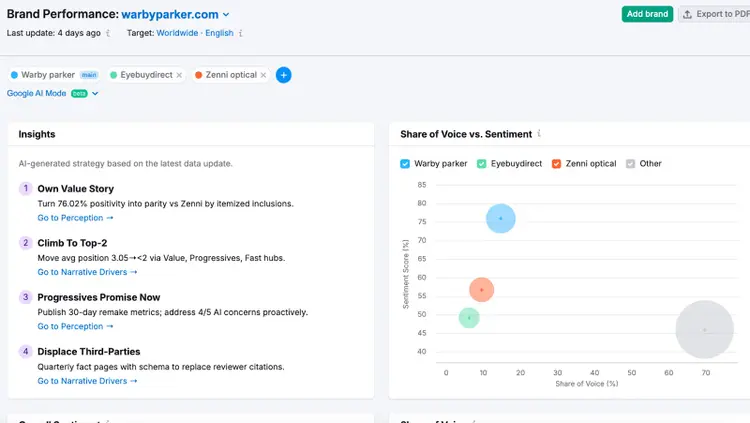
Semrush AI Visibility Toolkit (formerly known as the AI SEO Toolkit) tracks your brand’s visibility across ChatGPT, Google AI Overviews,, Gemini, Perplexity, and other AI platforms. It shows how your brand appears in AI responses, how you compare to competitors, and what actions can improve visibility.
Key features:
- Measure any domain’s AI visibility score
- See where rivals are mentioned, which prompts they rank for, and which sources cite them
- Discover real prompts and topics your audience asks AI, with demand, difficulty, and intent data
- Track share of voice and how AI platforms describe your brand compared to competitors
- Identify the themes shaping brand perception in AI responses
- Monitor priority prompts daily to measure gains or drops in visibility
Best for:
CEOs, business leaders, and marketing teams who need strategic insights into brand perception on AI platforms. Helpful for identifying what customers ask AI about your industry.
What I've found:
The competitive analysis clearly shows how each platform views your brand. It helped me spot surprising differences in how we were positioning against competitors. The tool also reveals real customer questions, which helped me uncover content gaps.
Frequent updates keep the data fresh, which matters since AI results can shift quickly.
Limitations:
For enterprises with large-scale monitoring requirements, advanced AIO workflows, or detailed sentiment and accuracy tracking needs, AI SEO may not be sufficient. Choose Enterprise AIO instead.
Pricing:
$99 per month. No free trial, but you can request a free demo report before subscribing. Semrush does offer a free AI visibility checker if you're looking for fast insights.
2. Peec AI
What it does:
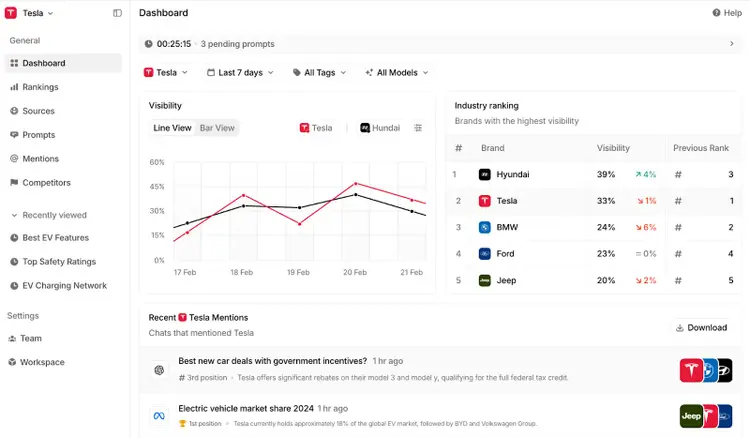
Peec AI tracks your brand mentions across multiple AI platforms. It focuses on brand visibility in AI-generated responses and compares your performance against competitors.
Key features:
- Monitors brand mentions across AI platforms
- Tracks mention frequency multiple times per day
- Analyzes sentiment in AI descriptions of your brand
- Benchmarks your share of voice vs. competitors
- Displays trends and visibility patterns in a clear dashboard
Best for:
Marketing teams at mid-size to enterprise companies that need dedicated AI brand monitoring.
Works well for brands that want detailed analytics on their AI visibility without needing technical performance metrics.
What I've found:
Peec AI runs frequent checks on the same queries, which helps capture shifts in AI results.
The competitor benchmarking is clear. When I tested SaaS tools, it clearly showed which brands dominated certain query types and which ones barely appeared.
The sentiment analysis also revealed subtle differences. Some brands got frequent mentions but not always in a positive tone.
Limitations:
Peec AI doesn’t provide technical monitoring. If you need data on model performance, you’ll need a separate tool.
Costs can also increase if you track many query types or competitors.
Pricing:
Starts around €89 per month for basic tracking. Enterprise pricing is higher and varies by coverage.
3. Profound
What it does:
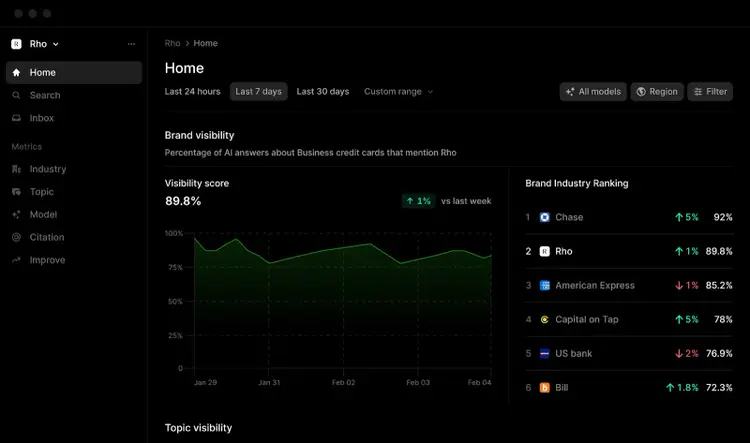
Profound positions itself as enterprise-grade software for monitoring brand mentions in LLMs. It focuses on competitive intelligence and detailed reporting.
Key features:
- Tracks enterprise-level brand mentions across major AI platforms
- Offers competitor benchmarking with analytics
- Provides customizable dashboards for different stakeholders
- Includes API access for business intelligence integration
- Comes with account support and consultation
Best for:
Large enterprises and agencies that need robust, customizable reporting and visibility tracking across multiple brands or complex market segments.
What I've found:
Profound focuses on data depth over flash. For example, it captures variations of search queries to find all the ways your brand appears in AI responses.
The reporting system stands out. You can build automated reports tailored to each team, from executive summaries to detailed marketing comparisons.
Limitations:
It's designed for enterprise teams and priced accordingly. Smaller businesses may find the tool too advanced. The setup process also takes time and usually involves onboarding support.
Pricing:
Pricing starts at $499 per month for the Lite version aimed at startups and agencies. Full enterprise pricing is custom, based on brand count, query volume, and reporting complexity.
4. HubSpot AEO
What it does:
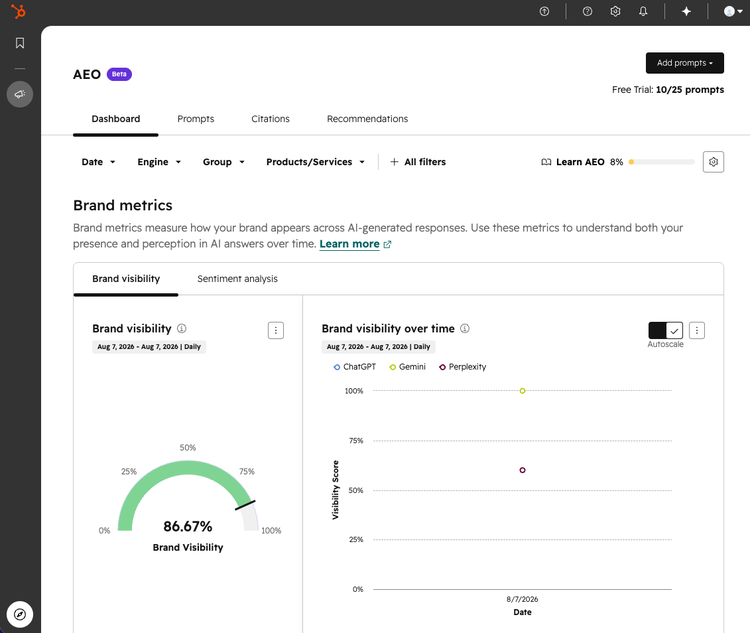
HubSpot AEO tracks how your brand shows up in AI answers across ChatGPT, Gemini, and Perplexity, then turns that data into prioritized recommendations for what content to create or fix. It's built as a standalone tool but plugs into the rest of HubSpot's marketing stack.
Key features:
- Tracks brand visibility score and sentiment across ChatGPT, Gemini, and Perplexity
- Measures share of voice against competitors
- Suggests prompts to track based on your company, competitors, and industry
- Citation analysis showing which domains and content types are driving AI mentions
- Prioritized recommendations tied to specific visibility gaps (new page, technical fix, LinkedIn post, etc.)
Best for:
Marketing teams that want AEO tracking without a steep learning curve, especially those already in or open to the HubSpot ecosystem. Also a fit for teams that want visibility data paired with CRM context to make recommendations more specific.
What I've found:
The prompt suggestions are a nice touch — instead of guessing which queries matter, it recommends a starting set based on your company and competitors. The recommendations feature also goes a step further than most tools on this list by naming the specific action to take (write this post, fix this page, post on LinkedIn) rather than just flagging a gap.
Limitations:
It only covers three AI platforms (ChatGPT, Gemini, Perplexity) — no Claude tracking, which is a gap if your buyers use that platform. The base plan caps out at 25 prompts, and going deeper on CRM-informed recommendations requires a Marketing Hub Pro or Enterprise subscription on top of the AEO tool itself.
Pricing:
$50/month ($45/month billed annually), and includes 25 prompts; additional prompts can be purchased anytime. A free trial is available with no credit card required.
5. Otterly AI
What it does:
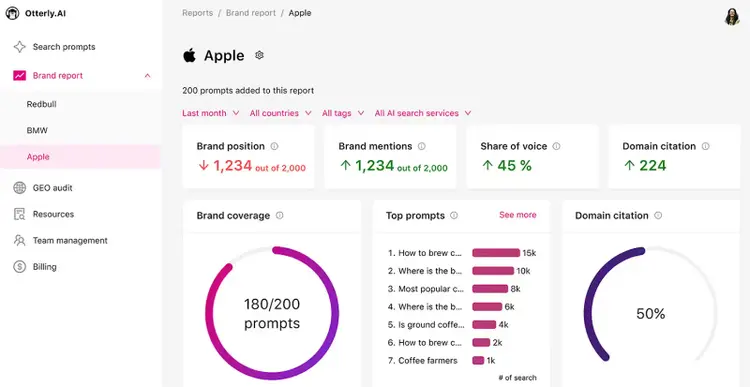
Otterly AI tracks your share of voice across AI platforms. It shows how often your brand appears compared to competitors and highlights visibility trends over time. Its LLM rankings tracker lets you benchmark visibility share against competitors.
Key features:
- Tracks share of voice across ChatGPT, Claude, Perplexity, and other AI platforms
- Monitors brand mention frequency with historical data
- Allows you to build competitor comparison dashboards showing relative visibility
- Analyzes sentiment of brand mentions in AI outputs
- Provides query performance insights showing which prompts drive the most mentions
Best for:
Marketing teams at mid-size to large companies that need to measure competitive positioning in AI search. Particularly useful for brands in crowded industries where AI results influence lead generation.
What I've found:
Otterly makes share of voice easy to understand. Instead of just telling you "your brand was mentioned X times," they show you what percentage of the conversation you're capturing.
For example, when I tested queries for project management software, Otterly showed me that one brand captured 40% of mentions across AI platforms while their main competitor only got 15%. That kind of context makes the data actionable.
Historical tracking is a strong point, too. You can see whether your optimization efforts are improving your visibility over time.
Limitations:
Otterly focuses on measurement, not strategy. It shows what’s happening but doesn't tell you how to fix low visibility, for example. Also the data-heavy interface may feel overwhelming for new users.
Pricing:
Starts at $27 per month for basic share of voice tracking. Enterprise plans with competitive insights and historical data cost more. Contact Otterly for custom pricing.
6. Authoritas
What it does:
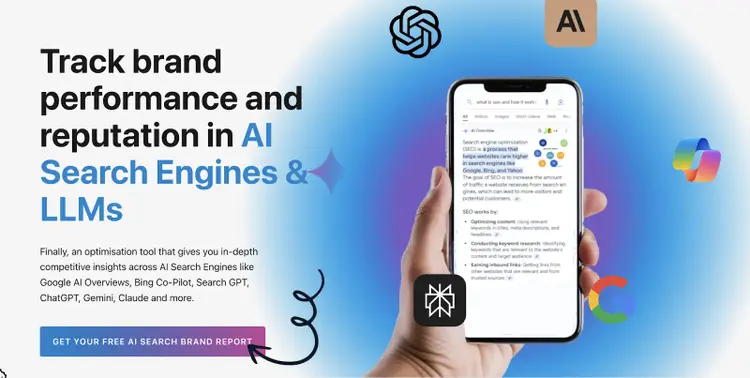
Authoritas provides AI brand monitoring as part of its larger SEO and digital marketing platform, focusing on tracking brand mentions across AI search engines and LLMs.
They position it as an extension of traditional SEO monitoring, helping you understand how your brand appears in both traditional search and AI-generated responses.
Key features:
- Tracks brand mentions across major platforms like ChatGPT, Claude, and Google's AI Overviews
- Integrates with your SEO data and keyword tracking
- Benchmarks your visibility against industry competitors
- Analyzes which sources AI platforms cite when mentioning your brand
- Combines AI monitoring with SEO reporting in one dashboard
Best for:
SEO professionals and digital marketers who want to monitor both SEO performance and brand mentions in LLMs, without the need for separate tools. This is ideal for teams already using Authoritas, as it combines both SEO and AI monitoring in one platform.
What I've found:
The integration is the main advantage. You can see if pages that rank well in traditional search also show up in AI-generated results.
That kind of cross-channel view helps you understand what content drives real AI visibility.
Citation tracking is another highlight. It shows which pages or third-party sources AI tools reference when mentioning your brand.
Limitations:
Authoritas focuses on SEO first, so the AI monitoring features aren’t as deep as tools built specifically for that purpose. The platform also assumes SEO knowledge, which may create a learning curve.
Pricing:
Pricing depends on the full package you choose. Contact Authoritas for a custom quote based on whether you want the full SEO suite or just AI tracking capabilities.
7. Writesonic
What it does:
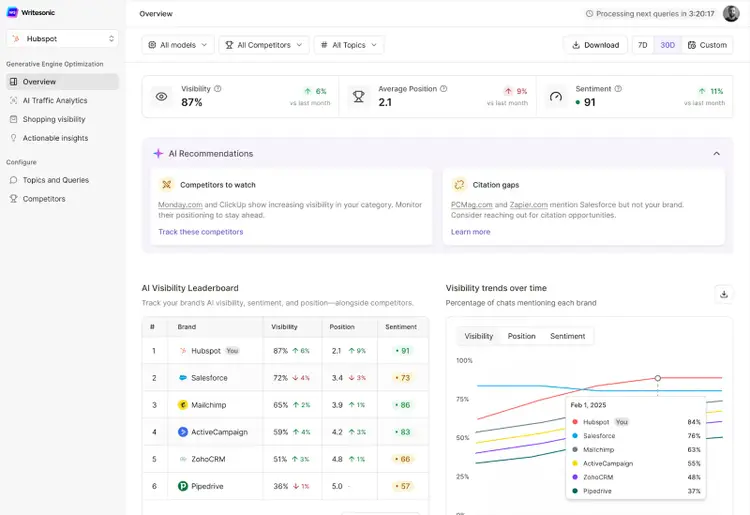
Writesonic combines AI content creation with brand visibility tracking, offering their "AI Search Visibility (GEO) Tool" to monitor how your brand appears in AI-generated responses.
It focuses on both tracking your current AI visibility and helping you create content that performs better in AI platforms.
Key features:
- Tracks brand visibility across ChatGPT, Claude, Perplexity, and other platforms
- Makes content optimization suggestions based on what's working in AI responses
- Analyzes how competitor brands appear in AI-generated responses
- Integrates monitoring with Writesonic AI writing tools
- Tracks performance of content created within the platform
Best for:
Content teams and marketers who want to monitor brand visibility and produce AI-optimized content in one workflow. Ideal for teams already using AI writing tools for content production.
What I've found:
Writesonic stands out by combining content creation with visibility tracking. It shows your brand’s performance and helps you improve it.
For example, if you're tracking mentions for "project management software" and notice competitors are getting more visibility, their tool can suggest content approaches that might help you compete.
The integration between monitoring and content creation is pretty seamless.
You can see which types of content get mentioned more often by AI platforms, then use their writing tools to create similar content for your brand.
Limitations:
Because it splits focus between creation and monitoring, you may not get the same depth as dedicated visibility tools. AI content suggestions may also feel too generic in niche industries.
Pricing:
Starts at $39 per month for basic AI search visibility tracking as part of the content creation suite. More advanced tracking and competitive analysis features are available in higher-tier plans.
8. Scrunch
What it does:
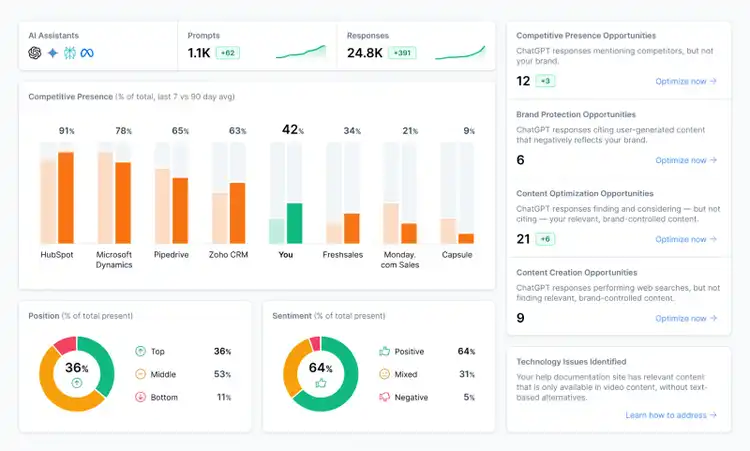
Scrunch tracks how your brand appears in AI-generated responses across platforms like ChatGPT, Claude, Gemini, and Google AI Overviews. It provides tools to manage prompts, audit webpages for AI visibility, and analyze persona-based query coverage, ultimately helping teams improve generative engine optimization (GEO)
Key features:
- Tracks brand visibility across major AI platforms
- Tests prompt performance and rankings
- Audits pages to identify AI optimization opportunities
- Offers persona-based insights for targeted monitoring
- Includes share-of-voice data and competitive comparisons
Best for:
Content, marketing, and SEO teams focused on improving brand presence in AI-generated results. Ideal for businesses implementing GEO strategies.
What I've found:
Scrunch is structured around improving how your content appears in AI outputs.
The prompt testing and persona tools give actionable insights into what’s showing up and what’s not.
Page audit tools are especially useful for identifying missed opportunities in AI search.
Limitations:
Scrunch no longer includes influencer marketing tools. If you’re looking for cross-channel brand analysis or legacy influencer features, this isn’t the right fit.
Pricing:
Plans start at $300 per month. Higher tiers offer more prompt slots, personas, audits, and user licenses.
Bonus Tool to Assess Future LLM Visibility: Brand24
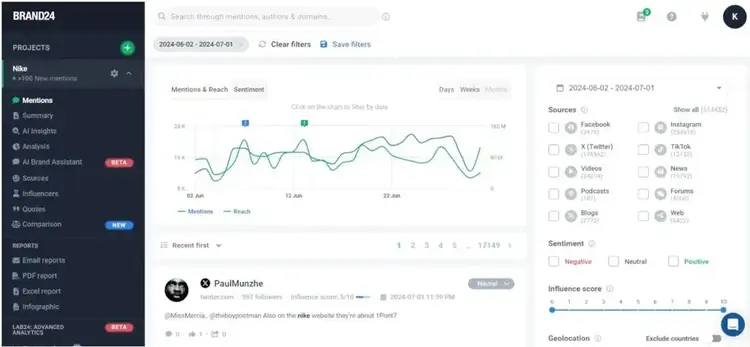
What it does:Brand24 tracks and analyzes brand mentions across major social platforms and publications to give you a sense of how LLMs perceive your brand, which influences whether you appear in AI-generated summaries and how you’re represented.
In short, Brand24 reveals which mentions strengthen your authority and where your presence may need reinforcement.
Key features:
- Tracks audience sentiment by analyzing the emotional tone of brand mentions
- Detects unusual spikes in discussion volume
- Determines conversation patterns based on topic and intent analysis
- Compares brand performance with competitors
- Finds influential creators who can amplify brand visibility and support campaign goals
Best for:
Social media managers, PR specialists, and marketers who oversee a company’s reputation and overall online performance.
What I've found:
Brand24 uses AI features to transform a lot of online data into actionable insights.
Some of Brand24’s most valuable AI-driven features include the Anomaly Detector, Sentiment Analysis, Topic Analysis, and the AI Brand Assistant.
Limitations:
Brand24 analyzes only the data collected from the moment a monitoring project is created, which is why it’s best to set up tracking before launching a major campaign.
Pricing:
You can try Brand24 free for 14 days. Paid plans start at $149 per month.
How to Choose the Right LLM Monitoring Tool
What to consider when selecting AI optimization software includes ease of integration, the flexibility to scale with your business, and the ability to generate actionable insights. Ensure the software can track and optimize key metrics such as sentiment analysis, brand visibility, and competitor performance across platforms.
Here’s how to make the decision step-by-step:
1. Define Your Monitoring Goals and Use Cases
Start by identifying what you need to solve.
- Competitive intelligence: For benchmarking and share-of-voice data, tools like Semrush Enterprise AIO can help you analyze brand visibility across AI platforms.
- Performance tracking: If you're looking to track historical trends and visibility, the Semrush AI Visibility Toolkit offers insights into your brand's performance across AI search engines.
- Reputation Management: To monitor real-time sentiment and brand mentions, focus on tools that help track how your brand is being discussed and perceived across AI-driven search results.
Most companies fall into one of these categories. Pick your main use case. You can expand later.
2. Assess Technical Requirements and Integration Needs
Think about how the tool fits into your workflow.
- If you're already using tools like Semrush, choose a monitoring solution that integrates with your analytics stack
- Consider who will use the tool and what kind of reporting they need
- Be realistic about setup complexity. Some tools are plug-and-play. Others require onboarding support or custom configuration.
3. Evaluate Key Features and Capabilities
When selecting a tool, consider the best practices for optimizing LLM training data sources. Effective tools leverage high-quality, relevant training data to ensure AI platforms provide accurate and valuable brand insights. These data sources should be continually updated and aligned with your business objectives.
- Make sure the tool supports the AI platforms your audience uses (ChatGPT, Claude, Gemini, etc.)
- Tracking frequency matters if you’re in a fast-moving or brand-sensitive market
- Look for tools that test prompts multiple times to account for variability in AI responses
4. Consider Budget and Pricing Models
LLM monitoring tools use different pricing structures: by brand, query volume, or enterprise tier.
- Watch for hidden costs like sentiment tracking, historical data, or API access
- Think about ROI. Monitoring is only valuable if you act on the data.
- Start with a smaller plan or trial before committing to a large contract
5. Test and Compare Your Top Options
Run side-by-side trials before making a final choice:
- Use the same queries in 2-3 tools to compare data accuracy and results
- Pay attention to how easy it is to find insights and generate reports
- Give each tool at least two weeks of real usage before deciding
How to Set Up LLM Monitoring for Your Brand
Effective LLM monitoring starts with a focused setup.
I've seen teams rush into monitoring everything, only to get overwhelmed by data they don't know how to interpret.
Follow these four steps:
1. Identify Priority AI Platforms and Queries
Start with the AI platforms your audience uses. For most brands, this includes ChatGPT, Google’s AI Overviews, Claude, and Perplexity.
Focus on high-intent queries: what people ask when they’re ready to buy.
Begin with 10-15 core prompts across:
- Branded queries (“Is [Brand] good for X?”)
- Category searches (“Best [category] for [audience]”)
- Competitor comparisons (“[Brand A] vs. [Brand B]”)
Avoid tracking everything at once. You can expand once you understand which prompts matter most.
2. Configure Your Monitoring Tool Settings
Adjust settings to match your industry pace:
- Use daily tracking for fast-changing markets (e.g., tech, SaaS)
- Use weekly tracking for stable categories (e.g., legal, B2B services)
Track 3-5 direct competitors. Set alerts only for meaningful shifts, like major drops in visibility or sudden competitor surges.
Test with a small set of queries to confirm the data is accurate and relevant.
3. Establish Baseline Metrics and KPIs
Define success before optimizing. Start with:
- Mention frequency: How often your brand appears
- Share of voice: How your visibility compares to competitors
- Sentiment: Whether AI platforms describe your brand positively
- Positioning context: How your brand is framed (e.g., premium, budget)
Pick 3-4 KPIs tied to business goals. Set realistic benchmarks based on current performance, not aspirational targets.
4. Set Up Alerts and Reporting Workflows
Build alerts and reports that trigger action, not just awareness.
- Alert on sharp changes: e.g. a 20% drop in share of voice or a negative sentiment spike
- Schedule reports to match your team’s workflow: weekly for agile teams, monthly for long-term tracking
- Add insights and next steps to every report
- Assign ownership for monitoring and follow-up
Tailor reports by audience:
- Executives want high-level positioning
- Marketing teams need content and optimization insights
- Sales teams want to understand how AI visibility impacts pipeline
Strategies to Improve AI Visibility After Monitoring
Most traditional SEO strategies also apply to LLM optimization. The key difference is focusing on what AI platforms prioritize when choosing which brands and sources to cite.
Real-world applications of AI optimization software in digital marketing show how companies leverage AI insights to refine content strategies, increase customer engagement, and drive conversions.
How AI optimization software boosts results lies in its ability to provide businesses with granular data, enabling them to make targeted adjustments. By tracking brand mentions and sentiment across various AI platforms, marketers can enhance their content strategies, increase brand visibility, and improve customer perception.
Once you know how your brand appears in AI results, use these four strategies to improve visibility:
Share-of-Voice Tracking in AI Outputs
Use share of voice data to see where competitors dominate and why.
- Identify the queries where you appear less often than key competitors
- Analyze what gives them the edge: usually clearer answers, more citations, or stronger authority
- Create content for the queries where your share of voice is low but business value is high
- Track improvements and double down on what increases visibility for those queries
Sentiment Analysis for Brand Mentions
Fix negative sentiment before it becomes part of the AI training cycle.
- If AI platforms describe your brand as “budget” when you aim for “premium,” by refining your messaging or adjusting your content strategy.
- Publish content that reinforces your desired positioning
- Get cited by trusted sources. Press, awards, and expert reviews hold more weight than your own content.
Competitive Benchmarking and Analysis
Use competitor data to find what’s working and what’s missing:
- Study queries where competitors outperform you
- Reverse-engineer their advantage: content length, tone, formatting, or citation quality
- Look for queries where no brand dominates: These are chances to become the default answer with comprehensive, helpful content
Cross-Platform LLM Monitoring
Don’t treat all AI platforms the same.
- ChatGPT, Claude, and Perplexity value different content formats and sources
- Prioritize optimization on platforms your audience uses most
- Track whether visibility changes in one platform affect others. Success in one often boosts visibility elsewhere.
What to Do After Tracking Your AI Brand Presence
Monitoring is just the beginning. The next step is using that data to drive real business results.
Your next steps:
- Fix your biggest gaps first. Focus on queries where competitors consistently outperform your brand.
- Connect monitoring to revenue. Track how AI visibility changes affect site traffic, lead generation, or conversions.
- Create a monthly review process. Regularly monitor results, optimize content, measure the impact, and repeat.
- Scale what works. Document what improves AI visibility and apply those tactics across other content and queries.
The bottom line:
The brands winning AI visibility treat it as part of their core content strategy, not a side project.
Which tools help benchmark my AI visibility against competitors?
Semrush Enterprise AIO can help you benchmark your AI visibility against your competitors and track how your optimization efforts impact your market position.
If you’re ready to see where you stand, start monitoring your AI brand presence and turn insights into competitive advantage.
Boost Your SEO & AI Performance
with Semrush Enterprise

Cecilia is a senior editor and strategist with more than 12 years of experience shaping editorial strategies, refining brand messaging, and leading high-impact teams. She began her career in print and digital editorial leadership roles before transitioning to SEO and digital marketing, focusing on data-driven strategies. She‘s passionate about ensuring operational efficiency, upholding editorial standards, and mentoring writers to deliver top-quality, brand-aligned content.
Cecilia Meis
Cecilia is a senior editor and strategist with 12+ years of experience spanning print, digital, and SEO. She’s passionate about optimizing editorial processes, upholding quality standards, and mentoring writers to deliver brand-aligned content.
Tells Google to show you more from Semrush in AI, Search, and Discover.