
Marketing is evolving at record speeds.
Artificial intelligence is reshaping how we create, optimize, and personalize campaigns. Cookies are disappearing. And community is becoming more valuable than ever.
To help you stay ahead, we surveyed two dozen marketing leaders from top brands about what’s working now and what’s coming next.
We’ve combined those insights with insights from our own marketing strategies at Semrush to create this guide.
Here are the top marketing trends to watch in 2025—and how to capitalize on them.
1. AI-Powered Marketing Continues to Surge
Every single marketer we surveyed said they are either already using AI or automation in their marketing or have plans to.
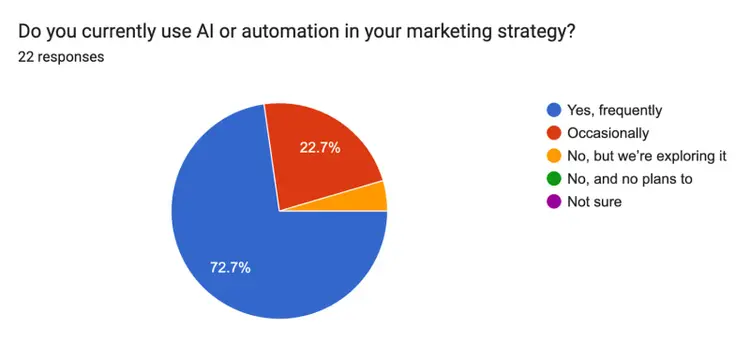
HubSpot’s 2025 State of Marketing report supports this, with 92% of poll respondents saying AI has impacted their role already.
The good news?
Only 47% of marketers understand how to use AI effectively. Which means that if you learn to use AI in your marketing now, you’ll be ahead of the curve.
Here is how to get started with AI-driven marketing:
- Create content faster. Tools like ChatGPT and Jasper help teams brainstorm, draft, and edit blog posts, email copy, and social content at record speeds.
- Optimize ad targeting. AI in Google Ads and other platforms adjusts bidding and targeting strategies based on behavior data.
- Enhance customer support. Chatbots like ManyChat answer FAQs and qualify leads, freeing up sales reps to handle higher-value conversations.
- Personalize outreach. Tools like ActiveCampaign’s Predictive Sending tailor email campaigns and landing pages based on user behavior, industry, and lifecycle stage.
Remember, AI can still hallucinate (make things up).
And the quality of output for simple prompts likely won’t be up to your standards.
To counter this, use AI for first drafts and have a human editor fact-check and refine the content for tone and voice.
Ready to get started?
Try Semrush’s Content Toolkit to generate full SEO-friendly articles using AI.
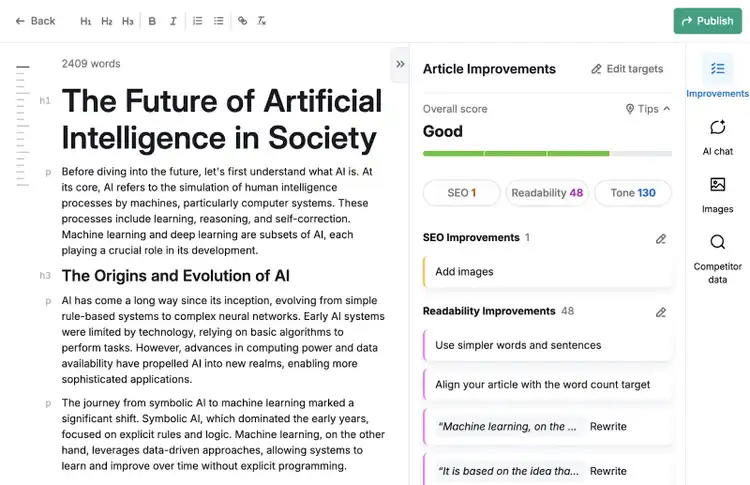
Again, be sure to have a human review and edit the article. This is a starting point to make the process faster.
2. SEO Makes Way for GEO (Generative Engine Optimization)
To stay visible in AI-powered search, brands are shifting from traditional SEO to generative engine optimization (GEO) by structuring content for AI readability, prioritizing user intent, and showcasing trust and expertise.
Here’s why:
BrightEdge reports that Google’s organic search clicks dropped by 30% in the past year—largely because some users now get instant answers from AI tools like Google’s AI Overviews and AI Mode and Microsoft Copilot.
Zero-click results mean your content needs to be structured, trusted, and readable by AI if you want to be featured.
To optimize for AI-powered search:
- Structure your content for scanning. Use clear headings, short answers, and Q&A formats.
- Write well. Concise phrasing, bulleted lists, and well-attributed claims increase the chance of appearing in AI-generated summaries.
- Implement schema markup. Use FAQ, HowTo, and other markup to make content easy for AI to parse.
- Showcase E-E-A-T (Expertise, Experience, Authoritativeness, and Trustworthiness). Include original insights, client examples, or firsthand results in your content.
- Prioritize intent. Focus on intent and topic coverage over exact-match keywords.
Track your results using Semrush’s Position Tracking tool to monitor how your content appears in generative search.
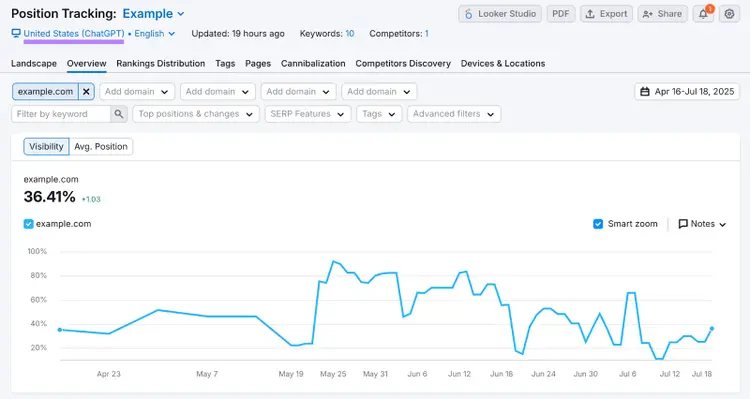
Track AI Mentions
with the Position Tracking Tool
Further reading: 10 Ways to Use AI for SEO
3. Cookies Are Being Replaced By Privacy-First Marketing
Third-party cookies—which marketers have relied on to track user behavior, personalize experiences, and deliver targeted ads—are being phased out.
Safari and Firefox now block cookies by default, and Chrome may not be far behind.
That’s not all:
According to Cisco, 86% of U.S. adults support privacy legislation—which makes third-party tracking a potential trust issue with the majority of the U.S. population.
This means marketers will need to start collecting first-party data and shift from behavioral targeting to contextual advertising.
Here’s how to prepare for a cookieless future:
- Collect your own data. Offer value to your visitors in exchange for email signups and survey responses. For instance, mobile games often give in-game currency in exchange for survey responses.
- Track website analytics. Use Google Analytics to monitor audience behavior on your website, including page views, click-through rates, and user journeys.
- Use contextual advertising. Focus on placing ads based on the content of the page, not user behavior. For example, place ads for hiking boots on blog posts about hiking trails rather than targeting users based on their browsing history.
- Audit your martech stack. Identify tools that rely on third-party cookies and find alternatives that prioritize user privacy.
- Leverage privacy-compliant tools. Explore solutions like Google’s Topics API, which deliver relevant ads without compromising privacy.
The future may be cookieless, and the best marketers will adapt by collecting their own data.
4. Short-Form Video Continues to Dominate
Short-form video content like TikToks, Reels, and YouTube Shorts drive some of the highest engagement and return on investment (ROI) across marketing channels.
According to HubSpot, 21% of marketers said that short-form video is their #1 content format for ROI, followed by images at 19% and live-streamed videos at 16%.
Here’s how to use short-form video marketing:
- Choose the right platform. Use LinkedIn or YouTube Shorts for professional content. TikTok or Instagram are better if your audience is early-stage founders, creatives, or Gen Z buyers.
- Repurpose existing content. Slice long webinars or interviews into 30-60 second clips.
- Keep it real. Authentic, unscripted content builds trust and performs better.
Let’s look at a few examples.
Great podcasters clip the most interesting bits of their podcast and turn those into shorts, like this one by The Alpha Mind podcast, which got over 2.7 million views:

Short-form content is a trend you won’t want to skip in 2025.
They are an easy way to extend and repurpose your existing content to gain more reach and hook new visitors into your funnel with minimal effort.
5. Marketers Are Turning to Micro-Influencers
Some marketers are shifting toward micro-influencers for higher engagement, authenticity, and ROI—favoring long-term, niche creator partnerships over celebrity endorsements.
According to Influencer Marketing Hub, 53.8 % of brands engage nano‑influencers and 21.6 % use micro‑influencers.
Our own survey backs this up, finding that a quarter of the marketers we polled are investing heavily in micro-influencers and creator partnerships this year.
Here’s what to know if you want to hop on this trend:
- Build long-term relationships. Ongoing partnerships feel more authentic than one-off promotions.
- Explore diverse platforms. For B2B, look at LinkedIn influencers, YouTube channels, newsletters, or niche Slack/Discord communities.
- Use internal advocates. Your team may already have some nano-influencers (1k-10k followers). Encourage them to share your content and speak publicly about your brand.
- Stay compliant. Ensure influencers disclose sponsorships per FTC guidelines.
One excellent example of utilizing micro-influencers is HubSpot’s partnership with Tina Huang in her video guide to the fundamentals of AI agents:

Not only did this video perform extremely well with over 1.2 million views, but HubSpot took it a step further.
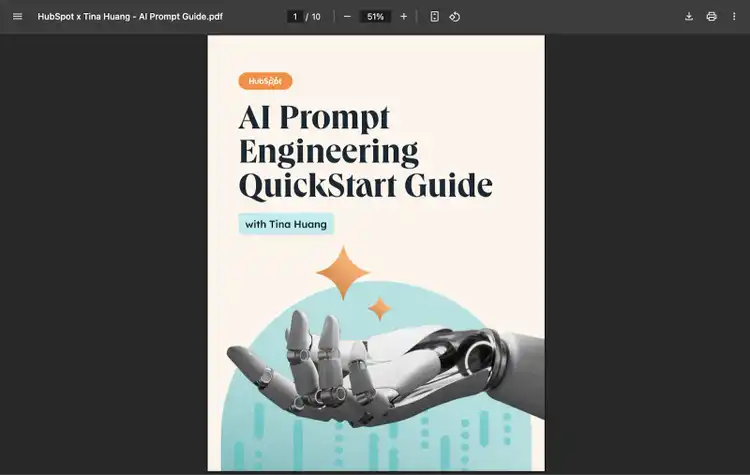
They worked together with Tina to create this AI prompt guide to turn that video engagement into email subscribers:
And that’s not all.
Tina speaks well of HubSpot throughout the video, and her appreciation of them sounds sincere. There’s clearly a good relationship between them.
Also, HubSpot didn’t just pay her for a simple mention.
They invested in the relationship by building out an entire lead funnel promoting Tina’s name and videos alongside the HubSpot guide.
Further reading: How to Find Influencers for Your Brand
6. Marketers Are Capitalizing on User-Generated Content (UGC)
Marketers are leaning into user-generated content (UGC) because it builds trust, drives purchases, and outperforms brand-created content
A study by EnTribe found that 84% of consumers are more likely to trust a brand's marketing campaign if it features user-generated content.
This trust translates into action—77% of shoppers are more likely to buy a product they found through UGC.
Keep in mind that UGC can take many forms: product reviews, customer testimonials, photos or videos where your brand is tagged, community discussions, or even unprompted social mentions.
Here’s how to capitalize on all this free content:
- Encourage UGC. Run campaigns, use branded hashtags, or ask happy customers to share their story or leave a review in exchange for a chance to win a prize or be highlighted on your social media page.
- Repurpose UGC. Curate UGC across your website, social media, and sales decks. Just be sure to always credit the creator.
- Moderate for quality. Not all UGC is on-brand. Set clear guidelines and highlight what great content looks like.
- Use review platforms. B2B software brands can showcase reviews from G2, Capterra, or TrustRadius directly on landing pages or even in nurture emails.
Already getting mentioned by customers?
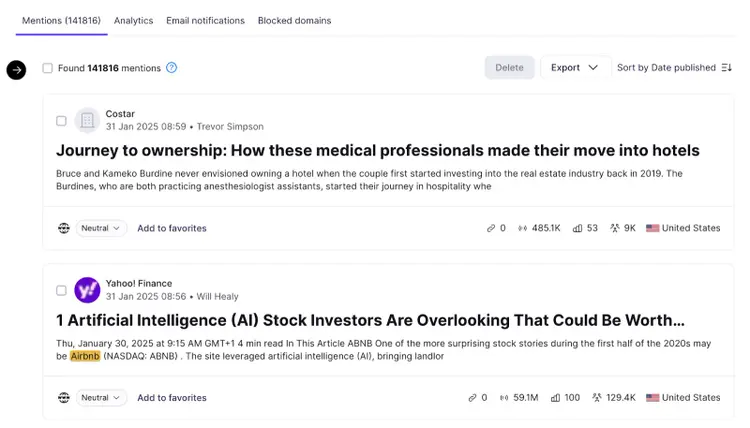
Use Semrush’s Brand Monitoring tool to track those mentions, find UGC worth resharing, and join the conversation while it’s still fresh.
7. Marketers Are Using AI to Personalize at Scale
AI enables hyper-personalized content at scale. Personalization today goes beyond “Hi [First Name]” and includes delivering the right message based on real user behavior.
It’s still early, but it will likely soon be the norm.
How so?
Michal Stín, Strategic Advisor for Trackdesk, told us he believes that “Digital ads will become more native.”
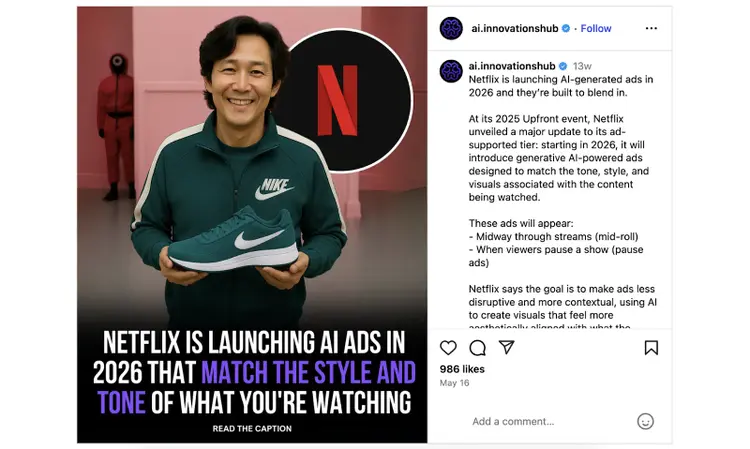
The example he gave is astonishing—Netflix announced that, in 2026, they will launch AI ads that match the style and tone of the content you’re watching.
Here’s how you can use AI personalization (without having the budget of Netflix):
- Use dynamic content blocks. Show different CTAs, case studies, or headlines based on the visitor’s industry, role, or behavior (which you acquire through first-party data).
- Deploy account-based personalization. Customize landing pages or email flows based on company size, funnel stage, or firmographics.
- Let users set their preferences. Preference centers let your visitors control content type, frequency, and format—which is valuable free data you can use to inform your marketing.
- Balance privacy with relevance. Be transparent about how you use data, and offer easy ways for users to opt in or out.
We’re not in a place where anyone can use AI for hyper-personalization at scale—but we’re close, and it’s worth keeping an eye on it.
8. Marketers Are Investing Heavily in Building Communities
Marketers that build thriving communities are earning more trust, deeper engagement, and long-term loyalty.
Why?
Because even with AI and advanced targeting, buyers still turn to their peers for recommendations.
“Community is the last untapped network effect,” says Kevin Kirkpatrick, CMO of Sunsama.
The data backs it up:
According to a 2024 report by Higher Logic, 76% of brands with active communities say they boost customer retention, and 61% say they improve brand perception.
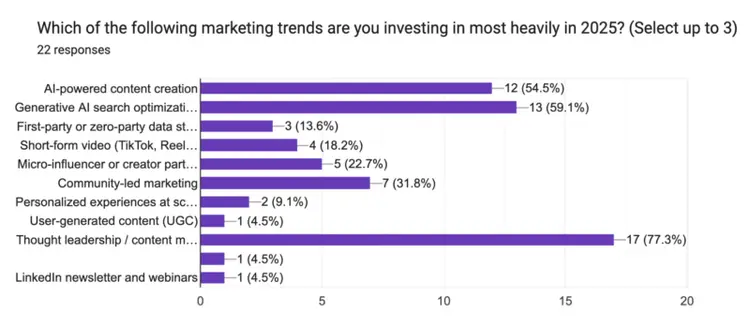
And our survey found that community-led marketing ranked fourth among the most heavily invested in marketing trends of 2025:
That’s not all.
Industry leaders like Tony Robbins and Alex Hormozi are investing heavily in community platforms like GoKollab and Skool.
They’ve gone all-in on community-led marketing because they see the power in it.
Luckily for you, creating a community is easy.
You can start with a free Slack or WhatsApp group to connect with your followers and get members talking.
Or, if you want something more official, consider creating a Facebook, Skool, or GoKollab community of your own.
For example:
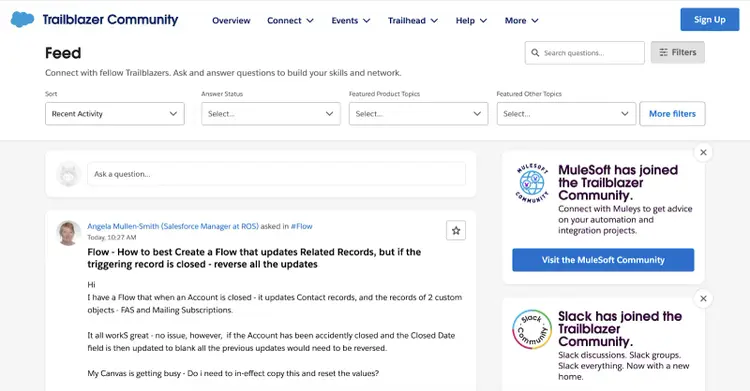
Salesforce created the Trailblazer Community—a forum-style section on their website where users can support each other and submit product feedback.
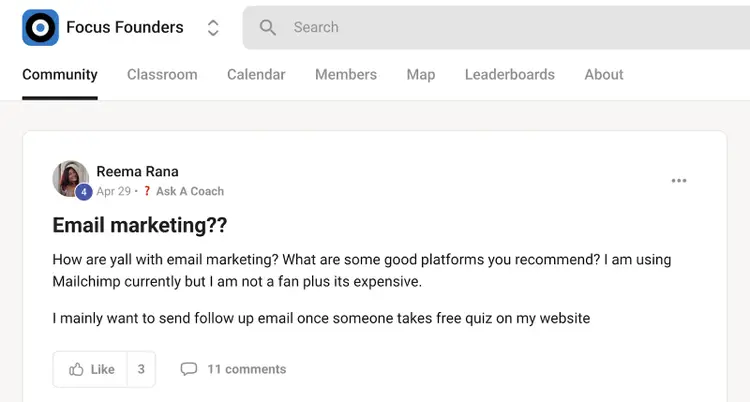
On a smaller scale, there are free Skool communities like Focus Founders, where business founders gather to support each other and get accountability and coaching.
Take this post by Reema, for example. She asked for help choosing an email marketing software:
Communities like these are so powerful because they serve many purposes:
They can be a lead funnel, a space for lead nurturing, a way to retain current clients, and a way of gathering first-party data.
9. Quality Content & Thought Leadership Still Matter
Original, high-quality content and thought leadership remain essential for building trust, driving traffic, and standing out as a credible authority.
In fact:
Marketers we surveyed ranked thought leadership through content marketing as their number one most heavily invested strategy for 2025, stating:
“In a world flooded with AI-generated text, content grounded in genuine experience and personal perspective will be the only way to rise above the noise.” – Gal Orian Harel, Co-Founder of Blix
So what can you do to stand out?
Here are a few tips to create quality content and win thought leadership:
- Refresh old content. Update top-performing posts with new stats, examples, and experiences to boost rankings and maintain authority—both with Google and AI-generated search.
- Run original surveys. Use proprietary data to back your claims, just like we did for this post. You’ll be seen as an authority and may even get more backlinks and shares from others citing your insights.
- Repurpose everything. Turn a blog post into a video, podcast episode, carousel, or email sequence to reach more people with less effort.
Ready to get started?
Use the Topic Finder feature in the Content Toolkit to find interesting content ideas. Just enter a topic like “AI” and click “Get content ideas”.
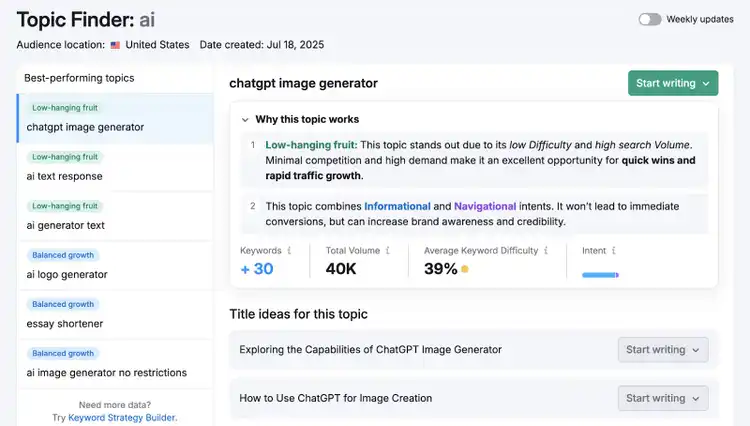
Once you have an interesting idea, use the Content Toolkit to draft and polish ideas faster.
Put These Marketing Trends into Action
The future of marketing belongs to those who adapt fast, think long-term, and leverage the right tools.
To help you get started, try some of Semrush’s most powerful marketing tools:
- Try the Content Toolkit to instantly come up with topic ideas, SEO briefs, and AI-generated blog post drafts
- Set up Position Tracking to monitor how you rank in both classic and generative search results
- Use Brand Monitoring to notice when your brand is mentioned on social media and generate UGC
Implement These Trends
with a Free Semrush Account

Tushar has been involved in SEO for the past six years, specializing in content strategy and technical SEO. He gained his experience in agencies, where he worked on various ecommerce and B2B clients. On the Semrush blog, he writes about SEO and marketing based on experience drawn from his client work, focusing on sharing practical and effective strategies. His goal is to turn Semrush blog into the ultimate destination for learning SEO and web marketing.
Tushar Pol
Tushar is an SEO expert with over six years of experience in content strategy and technical SEO. Having worked with various ecommerce and B2B clients at agencies, he now writes for the Semrush blog, sharing practical and effective SEO strategies.

Tells Google to show you more from Semrush in AI, Search, and Discover.
Table of contents
- 1. AI-Powered Marketing Continues to Surge
- 2. SEO Makes Way for GEO (Generative Engine Optimization)
- 3. Cookies Are Being Replaced By Privacy-First Marketing
- 4. Short-Form Video Continues to Dominate
- 5. Marketers Are Turning to Micro-Influencers
- 6. Marketers Are Capitalizing on User-Generated Content (UGC)
- 7. Marketers Are Using AI to Personalize at Scale
- 8. Marketers Are Investing Heavily in Building Communities
- 9. Quality Content & Thought Leadership Still Matter
- Put These Marketing Trends into Action