
SWOT Analysis: How to Do It, Examples, & Free Template
What Is a SWOT Analysis?
A SWOT analysis is a framework that evaluates a business’ strengths, weaknesses, opportunities, and threats. Performing a SWOT analysis can help you make better business decisions.
The analysis typically involves creating a matrix with the four categories:
- What’s working for your business (strengths)
- What’s not working for your business (weaknesses)
- The external factors your business could capitalize on (opportunities)
- The external factors that could harm your business (threats)
In this post, you’ll learn how to do a SWOT analysis. We’ll include examples and also give you a free SWOT analysis template.
But first, let's explore why you should do this analysis in the first place.
Why Is It Important to Do a SWOT Analysis?
A SWOT analysis is a valuable framework that can help you evaluate your business from different angles and discover new ways to grow and improve.
By doing a SWOT analysis, you can:
- Use your strengths to stand out from your competitors
- Address your weaknesses before they hurt you
- Find and seize new opportunities
- Prepare for and avoid potential threats
Which means:
A SWOT analysis can help you make smarter decisions, plan better, and reach your goals faster.
What Are the Components of a SWOT Analysis?
A SWOT analysis evaluates a business or project based on its strengths, weaknesses, opportunities, and threats.
Here’s how you might think about filling out a SWOT chart:
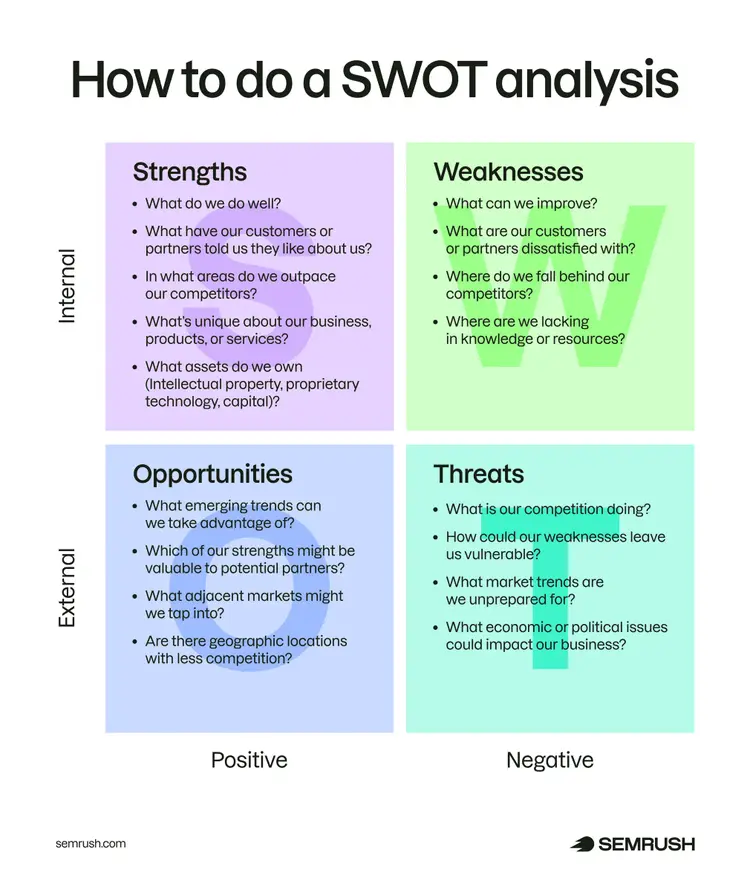
Let’s look at all four components one by one.
Strengths
Strengths are the positive attributes that give you an advantage over competitors—the things that you do well, you're proud of, and help you stand out.
Some examples of strengths are:
- A loyal customer base
- A strong brand reputation
- A unique product or service
- A skilled and motivated team
- A high-quality website
Weaknesses
Weaknesses are your business’s negative attributes (things to improve, fix, or avoid) that limit your performance or hinder your growth.
Some examples of weaknesses are:
- A lack of financial resources
- A high employee turnover rate
- A weak online presence
- A low customer satisfaction rate
- A low-quality product or service
Opportunities
Opportunities are favorable situations or conditions you can leverage to achieve your business goals.
Some SWOT analysis opportunity examples are:
- A growing demand for your product or service
- A new market segment or niche
- A new technology that automates routine tasks
- A new partnership or collaboration
Threats
Threats are unfavorable situations or conditions that can harm your business and that you need to recognize.
Some examples of threats are:
- A declining demand for your product or service
- A new competitor or alternative
- A new technology that makes one of your services less valuable
- A negative publicity campaign
- A change in regulation or policy
How to Do a SWOT Analysis (+ Examples)
A SWOT analysis is an assessment of your business’s strengths, weaknesses, opportunities, and threats.
But it’s more than that. It’s also a tool to strategically advance your business.
And that means going beyond a simple list of facts.
Here’s how to do a SWOT analysis the right way:
1. Start with a Clear Purpose
Define why you're doing a SWOT analysis. What business decision are you trying to make that the analysis can help guide?
For example, you may want to do a SWOT analysis before making important business decisions, such as:
- Deciding whether you should expand your business into newer markets
- Assessing the feasibility of new products or services
- Deciding if changing HR processes is worth it
Try using this simple formula to pin down exactly what you're deciding:
Decide whether to [specific action] to achieve [desired outcome].
Let’s look at an example.
Imagine you run an ecommerce store and want to increase the revenue from your business.
You know that marketing is important, and you’ve already tried various organic channels with modest success. You've heard that paid methods—such as digital advertising—can deliver faster results. But you're not sure whether you’re ready to make the investment.
So, using the formula above, the focus for your analysis becomes:
Decide whether to invest in digital advertising to achieve revenue growth.
You’ll evaluate strengths, weaknesses, opportunities, and threats specifically in the context of investing in digital advertising.
Having this clarity up front makes the rest of your analysis sharper—and far more actionable.
For the next four steps, we’ll walk through how to do each part of the SWOT analysis itself.
2. Assess Strengths
In this step, you’ll list your business’s strengths.
Get started by asking some questions:
- What does your business do well?
- In what areas do you outpace your competitors?
- What customer data or unique insights do you have about your business?
- What assets do you own (talented teams, technological solutions, capital, etc.)?
You might come up with quite a lot of strengths when you start brainstorming. Every idea is a good one. So don’t leave anything out.
Examples of Strengths
Because we're focusing on deciding whether to invest in digital advertising, here are some strengths you might list:
- Strong brand recognition that can be leveraged in digital ad campaigns
- Knowledgeable team with digital marketing expertise
- A large email subscriber base that can be used for audience targeting
- High-quality visual assets (product photos and videos) are available
- Affordable pricing that can be emphasized in ad messaging
3. Uncover Weaknesses
Next, honestly and thoroughly write down your weaknesses—your goal is to make improvements.
Here are some questions that can help:
- In what ways are your competitors better than you?
- Where are you lacking in knowledge or resources?
- What are some underperforming areas of your business?
- Do you see any gaps in your strategy?
The good news is that weaknesses are internal factors. Which means you have control over them and can use them to improve.
Examples of Weaknesses
For a decision about whether to use digital ads, here are some examples of weaknesses you might consider:
- Limited marketing budget
- Lack of clearly defined target audience segments
- Outdated website design or poor user experience (UX)
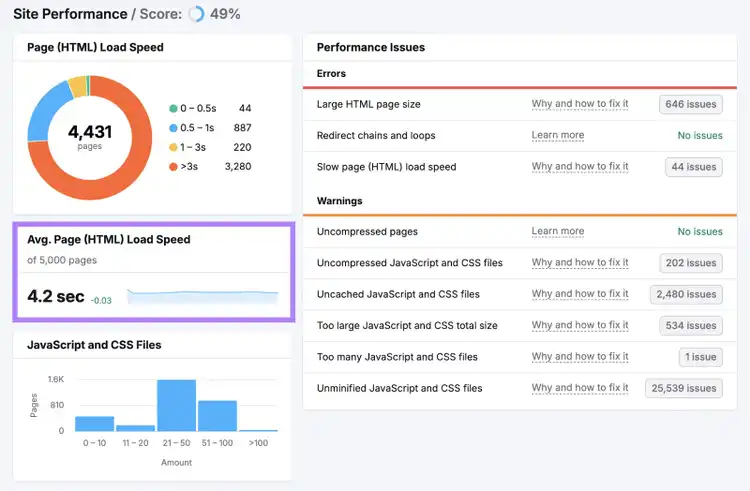
Sometimes, you need external tools to discover or validate weaknesses you might not be aware of.
For example, you might use Semrush Site Audit tool to find that your website has a slow loading speed of 4.2 seconds. That’s not ideal because loading speed affects conversions.
4. Consider Opportunities
Opportunities are external factors you can use to your advantage.
Here are some questions you can think through to uncover opportunities:
- What emerging trends can you take advantage of?
- Are there new tools or technologies you could use?
- Are there activities the competition isn’t pursuing?
- Are customer needs or behaviors shifting in a way you could tap into?
Examples of Opportunities
To guide your decision on whether to use digital ads, here are some examples of opportunities you might list:
- A new social media platform is getting popular and offers ad capabilities
- Established competitors are scaling back their advertising efforts
- New targeting capabilities are now available on existing advertising platforms like Meta, YouTube, or TikTok
- There’s growing demand for educational content in your industry
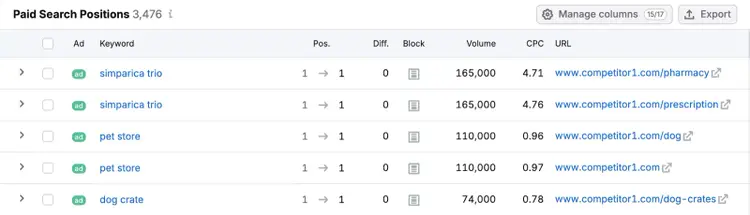
Finding opportunities is often easier when you have access to specialized tools and data.
For example, you can use the Advertising Research tool to find keywords your competitors are bidding on that you could also use.
5. Identify Threats
Threats are the external factors that could put your business at risk—but you can plan for them.
Here are some questions that will help you identify threats:
- What are your competitors doing that could affect you?
- Are there any negative trends in your industry?
- Are there changes in consumer behavior that could negatively impact your business?
- Are there any economic, political, or regulatory changes that could hurt you?
If you’re paying close attention to your industry, you probably know the major threats you face.
Examples of Threats
For our example, here are some threats you might list in a SWOT analysis:
- Increasing marketing costs across multiple channels
- New competitors entering the market with aggressive promotions
- Growing consumer skepticism toward advertising
- Potential economic downturn affecting customer spending
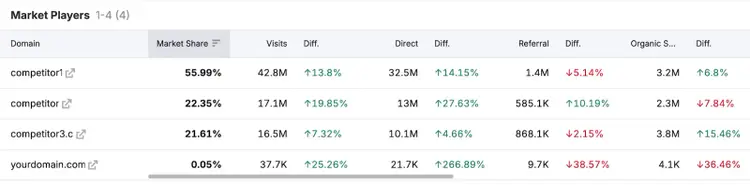
You can use Semrush’s Traffic and Market toolkit to monitor new competitors entering your space, changes in traffic trends, or shifts in audience interests—all of which could signal potential threats.
6. Make a Decision and Create an Action Plan
Once you have a decent number of items in each of your four SWOT categories, use the analysis to make your decision.
And if you decide to move forward, create a rough action plan to achieve your goal.
Start by weighing your strengths and opportunities against your weaknesses and threats.
Ask yourself:
- Do the potential benefits outweigh the risks?
- Can you leverage your strengths and capitalize on the opportunities?
- Can you address or mitigate your weaknesses and threats?
For our digital advertising example, your decision might be to proceed with the investment.
Here’s a simple action plan based on that decision:
- Build on strengths: Your brand recognition gives you a head start—people already know who you are, so your ads will feel familiar and trustworthy. Use your team’s expertise in marketing to create compelling campaigns. And don’t forget to use your email list to create retargeting campaigns.
- Address weaknesses: Get clarity on your target audience and redesign your website to improve user experience. Allocate a small portion of your budget for testing different ad platforms before making larger investments in any of them.
- Capture opportunities: Get on the new social media platform early to understand what’s possible with ads, create a short educational content series that you can repurpose as a lead magnet, and explore new targeting capabilities to reach more qualified prospects
- Mitigate threats: Build a distinct brand voice that stands out from competitors and optimize spending to maintain efficiency (despite rising costs)
Free SWOT Analysis Template
Here’s a SWOT analysis template you can use when evaluating your own business.
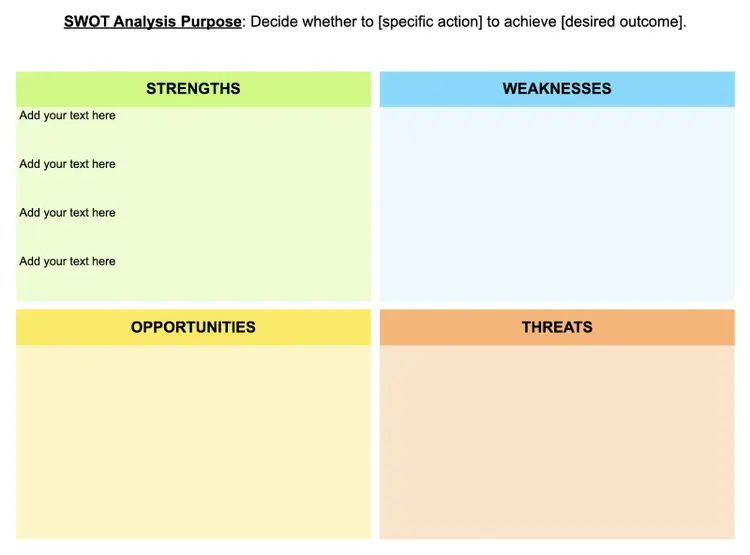
This simple but effective template gives you a clear structure to organize your thoughts about each SWOT component.
Here are some pro tips for getting the most out of it:
- Use specific, measurable statements rather than vague generalizations
- Review each item with key stakeholders to ensure accuracy
- Consider how different quadrants interact—for example, which strengths can help you capitalize on which opportunities
- Use your completed SWOT analysis to evaluate if it’s worth pursuing your chosen goal. If so, sketch a rough action plan.
Complete Examples of SWOT Analyses
Let's explore some full SWOT analysis examples to see this framework in action. We'll look at one real company facing major strategic decisions right now, and how they might use SWOT to guide their decision.
Plus, we’ll also include one hypothetical small business example to illustrate how a SWOT analysis is useful at any scale.
Meta's AI Investment SWOT Analysis Example
In 2025, Meta is investing billions in AI technology while facing intense competition from OpenAI, Google, and Anthropic.
Should Meta continue massive AI investments and compete directly with rivals in the consumer AI market?
Let’s analyze the SWOT components to decide:
Meta may decide to continue investing in AI after doing this analysis, as it has the user base, infrastructure, and capital to compete.
Here’s how they might create their action plan:
- Build on strengths: Tap into the massive user base across Meta platforms to increase adoption of their AI chatbot. The company can also take advantage of its strong financial position to fund long-term AI research and acquire promising startups (if necessary).
- Address weaknesses: Trust is still an issue for Meta, so being transparent about how their AI uses data (and giving users more control) could help rebuild some of that. The company’s large size can slow things down—they’ll need to cut through some red tape and speed up decision-making. And they can iterate faster to innovate and release better models that beat benchmarks.
- Capture opportunities: Meta should go after the growing chatbot market, but they should also create vertical-specific tools (e.g., coding agent). As open-source AI gains traction, Meta can contribute selectively to the community to build goodwill while using the ecosystem to test and improve its own models.
- Mitigate threats: To keep up with faster competitors, Meta needs to launch early and often to gain feedback they can use to improve. The company should also proactively engage with policymakers and build compliance into its AI systems to prepare for any forthcoming regulations.
Hypothetical Fashion Boutique SWOT Example
Imagine you own a successful fashion boutique that currently sells clothing and accessories from various independent designers.
You're considering launching your own private-label clothing line. To determine whether this makes sense, you conduct a SWOT analysis.
Your goal: deciding whether to develop and launch a private-label clothing line for your boutique.
Let’s analyze the SWOT components:
After completing this analysis, it's time to make a decision and create an action plan.
Weighing your strengths against weaknesses and opportunities against threats, you might decide to proceed with the idea.
Here’s what your action plan might look like:
- Build on strengths: You know your customers and what they like—that's great! Use your knowledge of fashion trends to create something that they’ll really like. Having a popular brand is a plus, and your relationships will come in handy when starting production.
- Address weaknesses: Start small to manage that upfront investment—maybe begin with a capsule collection of just five to 10 signature pieces. Consider partnering with a local designer who can help create designs. Make sure the end product is of high quality.
- Capture opportunities: Leverage social media to tell the story behind your clothing line—customers love seeing the process and connecting with local businesses
- Mitigate threats: Keep your first collection focused on timeless pieces that won't go out of style quickly. Be transparent with your existing partners about your plans—maybe even find ways to collaborate rather than compete. Start with a smaller investment that won't put your business at risk if economic conditions worsen.
Analyze Your Business & Achieve Your Goals
Doing a SWOT analysis is key for making informed decisions. And then, you can set effective goals you’re more likely to achieve.
If you haven’t already, grab your free SWOT analysis template.
Take your time. Be thoughtful. And your SWOT analysis will lead to better decisions.

Alex is a managing editor with 10+ years of experience leading content and SEO teams across SaaS, tech, ecommerce, and digital publishing. He specializes in building editorial systems that balance human judgment with AI-assisted workflows, helping teams produce original, high-impact content as search and discovery evolve. His work spans SEO strategy, content quality frameworks, and adapting content operations for AI-driven search.
Alex Lindley
Alex is a managing editor with 10+ years of experience leading content and SEO teams. He focuses on building AI-aware editorial systems that help teams produce original, high-impact content as search evolves.
Tells Google to show you more from Semrush in AI, Search, and Discover.