
What is zero-click marketing? How to execute and measure it
In 2022, Amanda Natividad, then-Vice President of Marketing (and now Chief Evangelist) at SparkToro, published a blog post advising brands to create content that provides value without requiring clicks to other pages.
The reason? Search and social platforms no longer send as many clicks to sites as they used to. So, brands needed to deliver value where users are instead of making them go elsewhere for it.
Amanda has given this content strategy a name: zero-click marketing (although she spells it as “zero click marketing” with no hyphen).
Here’s what zero-click marketing means, why it’s important, how to do it, and how to measure its results.
What is zero-click marketing?
Zero-click marketing is a strategy built around publishing content that delivers value without requiring a click to another page.
Traditionally, digital content was designed to end in a click. In contrast, zero-click marketing content provides standalone value. The content may link to useful external resources, but users can understand the main point from the content itself.
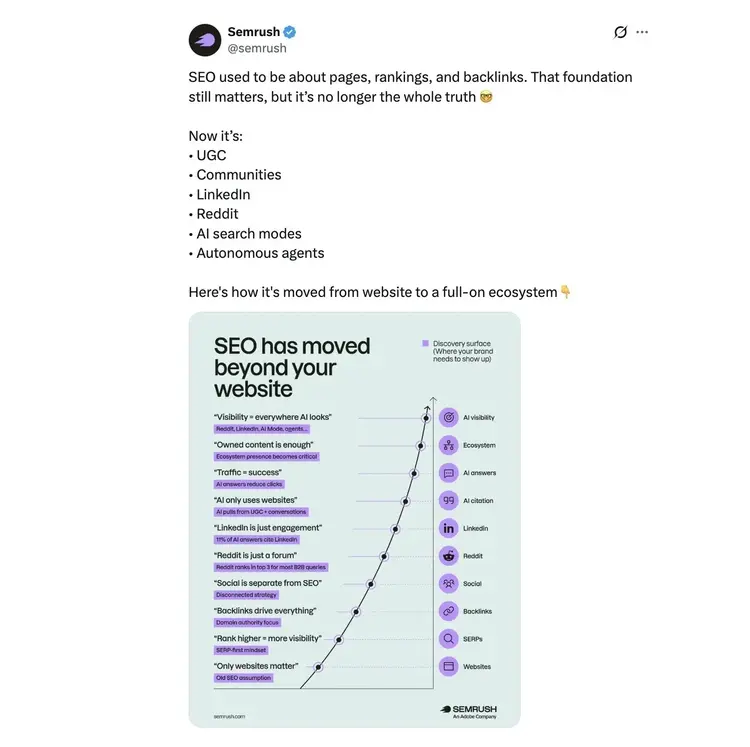
For example, this X post from Semrush directly informs users that SEO has moved beyond optimizing a website to optimizing for multiple discovery surfaces. It also tells users what those surfaces are.
Semrush’s X post doesn’t have a link for users to click to get more information. And users don’t need more details, because the post delivers its message in full.
Other examples of zero-click marketing content are:
- An email newsletter that covers a topic in detail without linking to other pages
- A blog post you publish on your site about your product’s benefits, for AI systems to mention in responses
Zero-click marketing vs. zero-click search
Zero-click search is when users get answers to their queries directly from search results without having to visit a website, while zero-click marketing is a strategy for delivering standalone value on any platform.
An example of a zero-click search is “what is vibe coding.” Google cites IBM’s content to provide a succinct AI Overview explanation. I’m satisfied with this answer, and I don’t need to visit a website for more information.
Why is zero-click marketing important?
Zero-click marketing is important because it helps brands build awareness, influence, and trust despite the prevalence of zero-click searches and social platforms’ preferences for linkless posts.
Just 8% of users who see an AI summary in Google click an organic search result, according to Pew Research. On the other hand, 15% of users click through when they don’t see an AI summary.
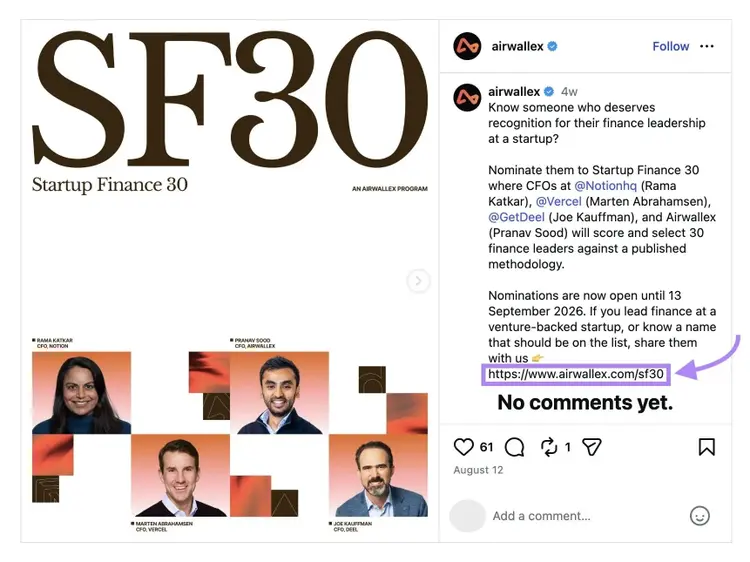
Social platforms also favor posts without links, likely because these posts keep users engaged on the platform for longer instead of sending them elsewhere. Links in post captions aren’t even clickable on Instagram:
Platforms like LinkedIn that do allow clickable links in posts may suppress those posts’ reach. While LinkedIn hasn’t publicly confirmed a link penalty, a LinkedIn post with an attached link preview gets a median of 414 impressions compared to 795 for posts without one, according to MagicPost’s study of over 560,000 LinkedIn posts.
Consistently publish genuinely useful content, and you’ll build influence and trust with your audience even if they don’t visit your site. Awareness of your brand will also grow as people share your content.
Then, when users do need what you sell, you’re one of the brands they already recognize. And buying from you is an easy choice.
How to do zero-click marketing
Here’s how to do zero-click marketing in six steps:
1. Discover where your audience already spends time
Discover where your audience already spends time, so you can create zero-click content for those platforms.
The most direct way to find out your audience’s preferred platforms is asking them. But since interviewees are usually customers, their answers may not reflect your total audience’s preferences.
For a more comprehensive understanding of your audience’s preferred platforms, use Semrush’s Traffic & Market Toolkit, which draws on audience intelligence data from clickstream data providers.
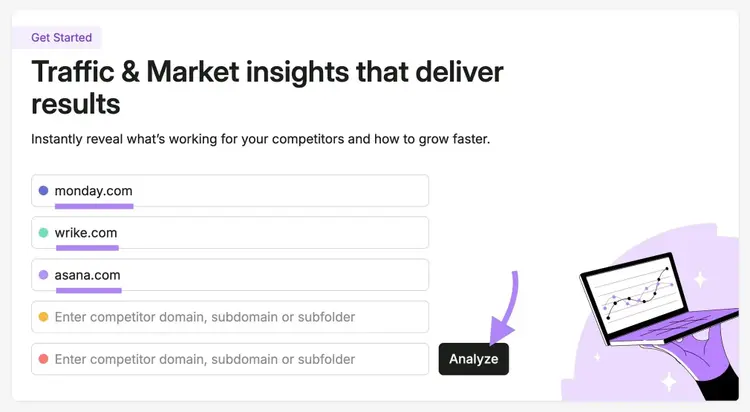
Launch the Traffic & Market Toolkit and enter your domain and up to four competing ones, because your competitors’ website visitors are also part of your audience. Then, click “Analyze.”
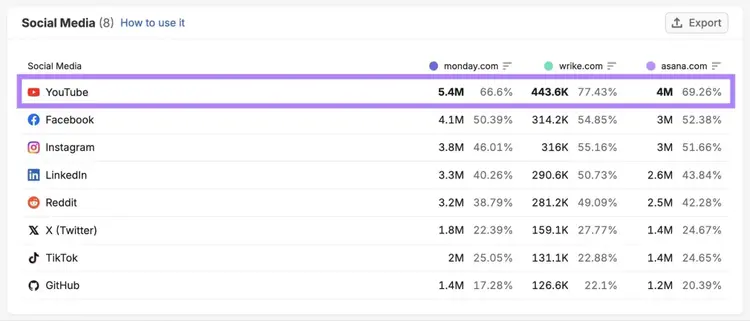
Navigate to the Behavior report and check the “Social Media” section to learn the social platforms that your site visitors and your competitors’ website visitors frequent.
In this example, the most-visited social platform among these visitors is YouTube:
2. Research your audience
Research your audience’s wants, needs, interests, and pain points, as these can spark content ideas.
For example, you can create social media posts that address certain frustrations or pre-empt common sales objections.
Ways of carrying out audience research include:
- Reviewing customer interview transcripts. As you do this, look for phrases or doubts that come up more than once.
- Conducting keyword research and prompt research to learn the queries your audience types into search engines and AI systems. These queries indicate what’s on your audience’s mind.
- Analyzing recurring themes in community discussions. For example, if certain questions regularly surface in Reddit threads.
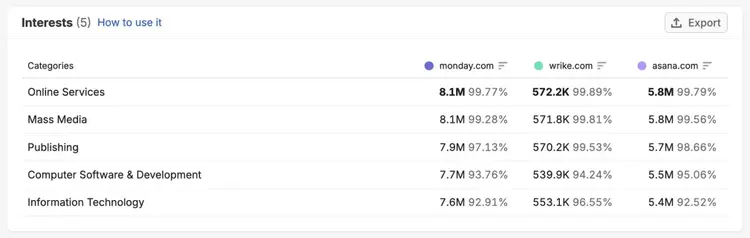
- Using a market analysis tool: The Behavior report in Semrush’s Traffic & Market Toolkit provides a snapshot of your audience’s interests
Build buyer personas to organize your findings into a comprehensive view of your audience.
3. Identify your strongest content ideas
Use what you learned about your audience to identify the content ideas that are most likely to appeal to your audience and won’t be too resource-intensive to execute.
Rank your ideas from highest to lowest priority based on factors like:
- What your audience cares about. Content that targets your audience’s core motivations and struggles is more likely to drive interest and engagement than content tied to tangential ones.
- Which topics come up most often. For example, frequently asked questions indicate a greater need for answers. So, creating content that addresses these questions may generate interest among a larger share of your audience.
- Whether you can offer a unique perspective on the topic. Users tend to engage more with content backed by personal expertise and original research.
- The effort required to produce the content. Content you can produce with low effort is worth pursuing, especially if you think it will resonate with your audience.
4. Decide how to cover the same idea on different platforms
Decide how to create content covering the same idea on different platforms, tailoring each piece to the platform’s native content format.
Native format refers to the medium a platform is designed for. For example, blog posts work well if you’re publishing on your site or contributing to others’ websites. These blog posts can include links to other resources, but users shouldn’t need to click them to understand the core topic.
If you’re posting on social media, your content also needs to match the platform’s business-to-business (B2B) or business-to-consumer (B2C) focus. This table lists the primary focus and native content format for common social platforms:
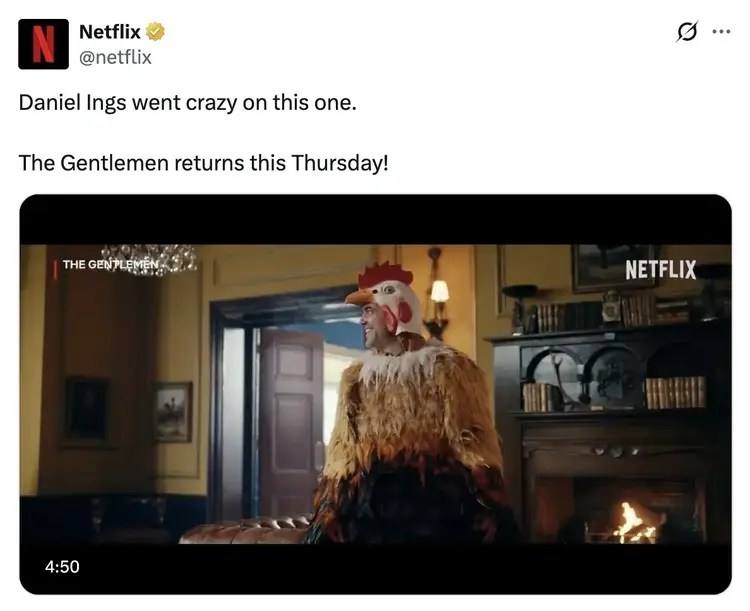
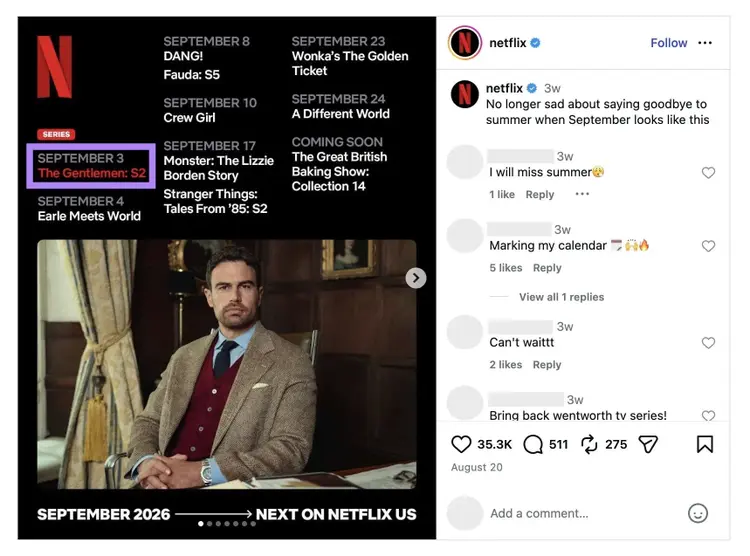
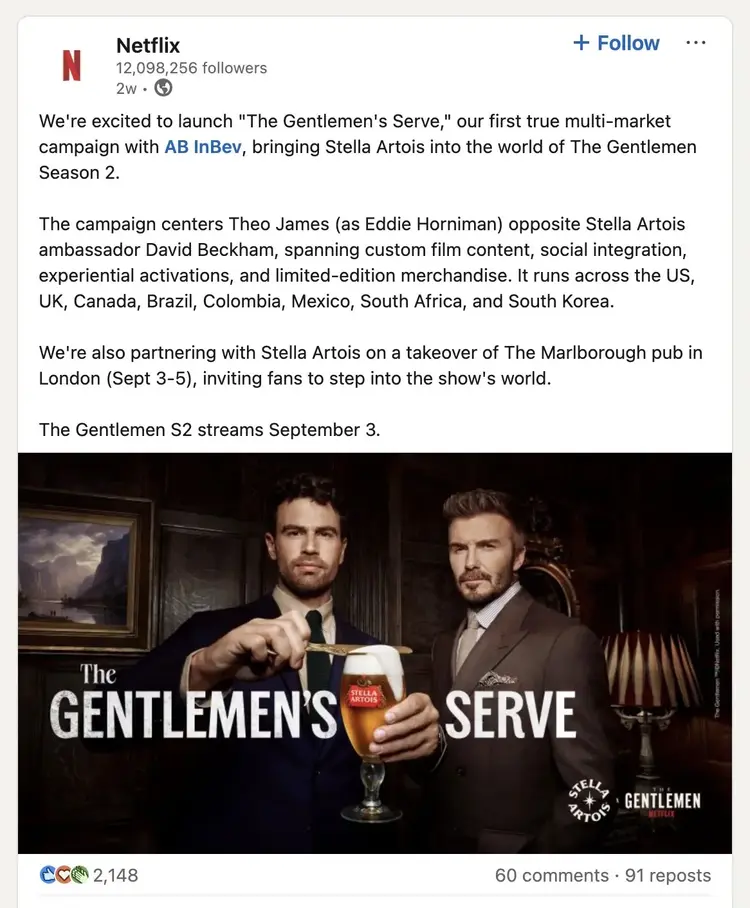
Here’s an example of how Netflix adapted the way it promoted season two of the TV show “The Gentlemen” for different platforms:
On X, Netflix posted a video highlighting actor Daniel Ings’s performance in “The Gentlemen” with a short caption reminding viewers of season two’s release date:
On Instagram, Netflix posted an image carousel showing viewers the season two release date for “The Gentlemen” (and other upcoming shows):
And on LinkedIn, Netflix published a corporate-focused post detailing its first multi-market campaign with beer maker AB InBev — mentioning the season two release date for “The Gentlemen” only at the end.
5. Make each content piece complete on its own
Make each content piece complete on its own, so it provides standalone value.
Craft your content piece as usual. Then, remove its call-to-action (CTA) text and link, and review if the remaining content makes sense.
This LinkedIn post promoting Semrush’s AI Search Operating System course passes the test. When we remove the post’s CTA text and course landing page link, the post still provides standalone value — an AI search optimization checklist users can follow to improve their AI visibility.
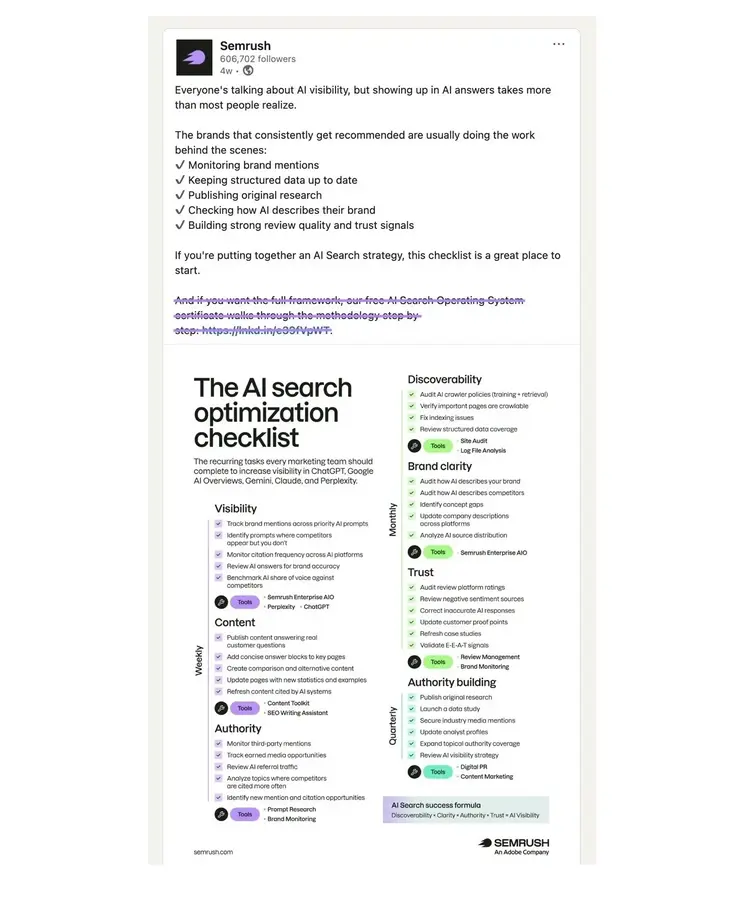
If your content reads as incomplete without a CTA text and link, adjust it so the points come across without needing details or context from elsewhere. One way of doing this is to tweak your CTA text to share information without expressly directing users to do something.
For instance, your content could just say “The webinar replay is now on YouTube” instead of “Watch the webinar replay on YouTube: [link].” Users interested in the replay will know how to find it on YouTube, even if you don’t link to it.
For a more neutral opinion on whether your content offers value without needing a click, have a colleague run this check.
6. Help AI systems retrieve and cite your content
Help AI systems retrieve and cite content about your brand to increase your brand visibility for zero-click searches.
Here are tips for improving AI retrieval and citation:
- Implement clear content structure: Where possible, use heading tags to indicate your content’s headings, so AI systems can better understand the flow and hierarchy of your points
- Provide direct answers: Open each content section with a succinct answer to the section’s heading before adding supporting details. Doing this helps AI systems extract relevant, self-contained passages to use in answers.
- Publish original data: AI systems may prefer citing your content if it contains original data as opposed to generic information available from any other source
- Build a brand presence on third-party platforms AI systems trust: These platforms include Reddit, G2, and Yelp. This tactic works especially well if your target platforms overlap with the ones your audience spends time on. For example, ChatGPT often cites Reddit in its answers, so you could prioritize posting to subreddits your audience frequents.
Learn more in our guide to AI search optimization.
4 ways of measuring zero-click marketing results
Measure zero-click marketing results by asking users how they found you and tracking metrics like branded search traffic, user engagement on social platforms, and AI visibility. This data gives a clear picture of whether your content is driving brand awareness, even if you can’t directly attribute clicks to it.
1. Ask users how they found you
Ask users how they found you to learn the exact platform — and content — that brought them in, since zero-click content may not generate a click you can attribute the conversion to.
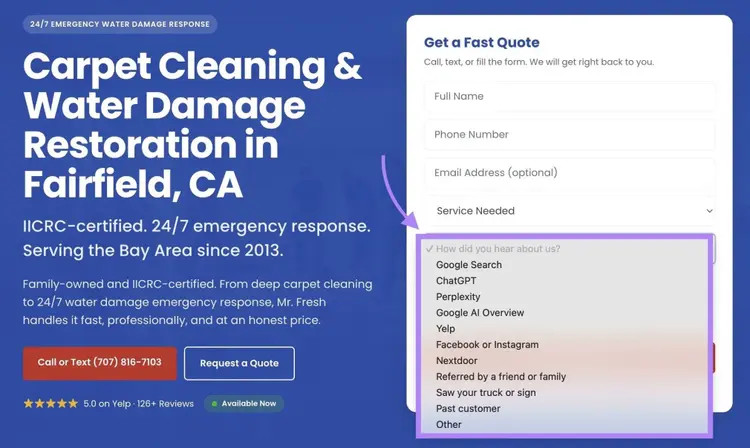
When meeting with prospects during sales calls or interviewing customers, ask them how they heard about you. For online leads, add this question to your contact form.
Just like how the contact form for carpet cleaning service Mr. Fresh Carpet Care asks “How did you hear about us?” and lets users select from multiple referral channels — including AI systems:
2. Track your branded search traffic
Semrush’s Organic Rankings tool tracks your branded search traffic, which could result from users searching your brand after viewing your zero-click content.
Enter your brand and go to the “Positions” tab. Next, click the “Advanced filters” drop-down and add these two conditions:
- “Include” > “Keyword type” > “Branded”
- “Include” > “Traffic” > “Greater than” > “0”
Click “Apply” after that.
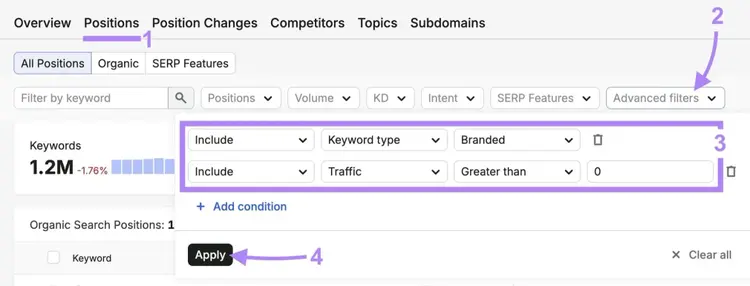
The “Estimated Traffic Trend” chart will update to show your branded search volume. Further down, you’ll see the branded keywords that led visitors to your site.
Check for spikes in search volumes for keywords related to your recent marketing campaigns.
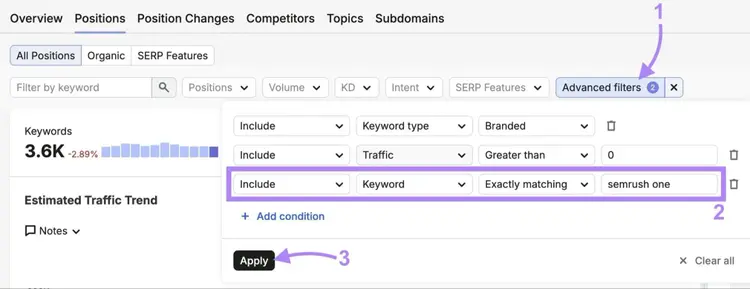
To view the traffic volume for a specific branded keyword, click the “Advanced filters” drop-down, followed by “Add condition.”
Add this extra condition: “Include” > “Keyword” > “Exactly matching” > “[keyword].” Then, click “Apply.”
3. Measure user engagement on social platforms
Measure user engagement with social platforms’ built-in analytics, because higher engagement indicates higher interest and awareness — especially if users shared your posts with others.
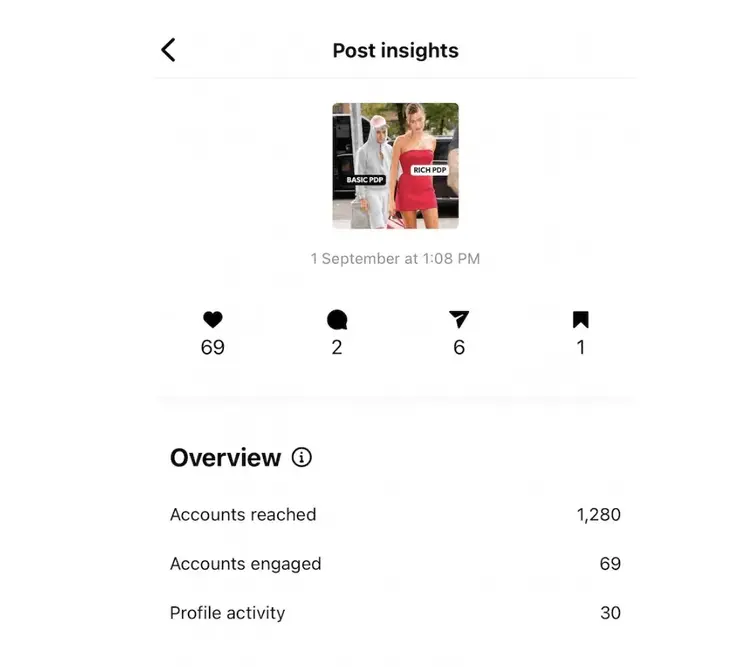
For example, Instagram shows you how many users have liked, commented on, shared, reposted, and saved your posts.
4. Monitor AI visibility
Monitor your brand’s AI visibility, because each AI mention or citation signals that your content is building awareness.
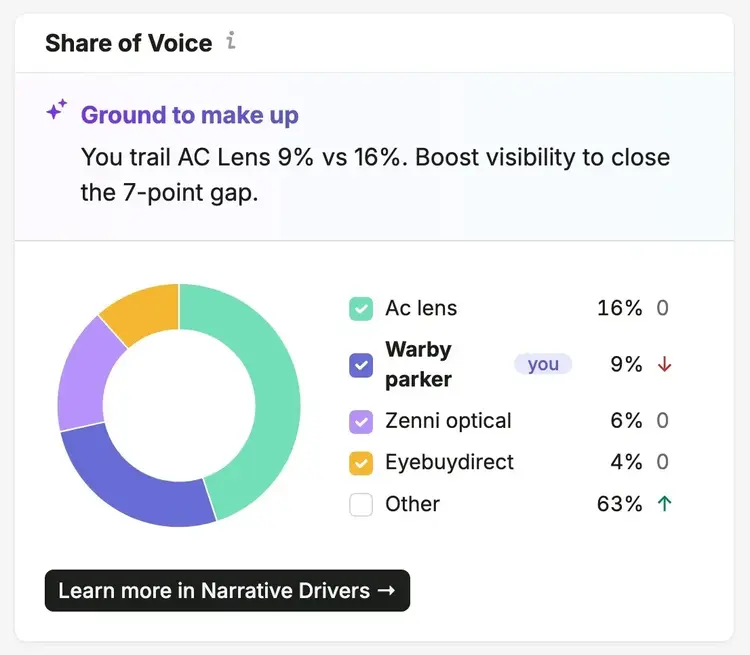
Use Semrush’s AI Visibility Toolkit to monitor metrics like AI citations and share of voice. The Visibility Overview report shows your number of AI citations over time. You can also view your total number of mentions and cited pages.
To learn your share of voice, go to the Brand Performance report. Then, scroll to the report’s “Share of Voice” section. The higher your share of voice percentage, the better.
Try the AI Visibility Toolkit today.
Measure zero-click marketing impact
with the AI Visibility Toolkit

Carlos Silva leads the editorial pipeline for the English blog—coordinating writers, editors, strategy, and building AI workflows that boost content quality and AI visibility. With 10+ years of experience writing and editing across in-house and agency roles, Carlos blends content strategy, SEO, and AI to help marketers stay ahead of an evolving search landscape.
Carlos Silva
Carlos Silva leads the editorial pipeline for the English blog and builds AI workflows that boost content quality and AI visibility. 10+ years writing and editing across in-house and agency roles.
Tells Google to show you more from Semrush in AI, Search, and Discover.