
How to Do a Market Analysis: A Step-by-Step Guide
Expert reviewed
Our subject matter experts have reviewed this article to ensure it meets the highest standard for accurate information and guidance. Learn more about our editorial standards and process.
What is market analysis?
Market analysis is the process of researching your specific market and your position within it to determine the demand for your product or service and evaluate factors that could impact success.
Typically, a market analysis includes:
- Determining your market size and growth potential
- Identifying and analyzing competitors
- Understanding audience needs and behaviors
- Analyzing industry trends
How to perform a market analysis
Performing a market analysis involves seven steps:
- Define the purpose
- Analyze market size and growth
- Study the competition
- Identify your target audience
- Analyze industry trends
- Do a SWOT analysis
- Summarize the data and provide recommendations
1. Define the purpose
Start by determining what you’re trying to accomplish by performing a market analysis to keep your work focused.
Are you looking to validate a new product or service? Assess a potential investment? Prepare for expansion?
Then, write a one- or two-sentence statement summarizing the purpose and scope of your market research. For example:
“The purpose of this market analysis is to determine whether there’s an underserved segment of our market for our scheduling software.”
This will help guide the rest of your process.
2. Analyze market size and growth
Determining how large your market is and how fast it’s growing will help you decide whether a potential opportunity is worth pursuing.
Three key metrics you’ll want to examine are:
- Total addressable market (TAM): The total demand for your product or service, assuming you could sell to 100% of the market
- Serviceable addressable market (SAM): The portion of your market that you could realistically serve, considering factors like your capabilities and target geographical area
- Serviceable obtainable market (SOM): The portion of your SAM you could realistically obtain, considering your resources and competition
You can use Semrush’s Market Overview tool to uncover the TAM and SAM for a specific market. All you need to do is enter your domain (or a suitable substitute if you haven’t yet launched) and the domains of your top competitors.
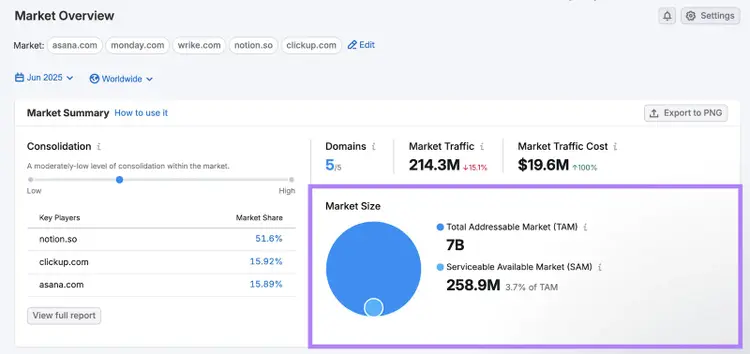
Continuing with our scheduling software example, your TAM might include all gyms and fitness studios in the U.S. And your SAM would consist of those that fit your ideal customer profile (e.g., independently owned gyms and salons in urban areas).
As for your SOM, this is always going to be an estimate. You can get a rough idea of your SOM by considering:
- How much visibility you can realistically generate based on your marketing budget
- The conversion rate for similar products or services
- Your pricing
Once you get a better understanding of market size, you can determine growth potential by analyzing:
- Market growth rate: Is the demand for your product or service growing over time? Look at historical search data, industry reports, and financial data from public companies in your industry to learn more.
- Market consolidation: Is your market dominated by a handful of large players? Or are there a lot of smaller competitors? If the market contains many smaller companies, there’s likely more room for you to innovate.
3. Study the competition
Studying your competition helps you uncover market gaps, find opportunities to stand out, and refine your positioning.
You probably already know who your top competitors are. For example, if you offer scheduling software, you likely already know that your competitors include companies like Calendly.
You can use the following methods to uncover even more competitors:
- Ask customers and prospects what other solutions they use or have used in the past
- Visit industry forums and communities to learn what other solutions potential customers are discussing
- Check review and comparison sites to see what other solutions are listed in your category
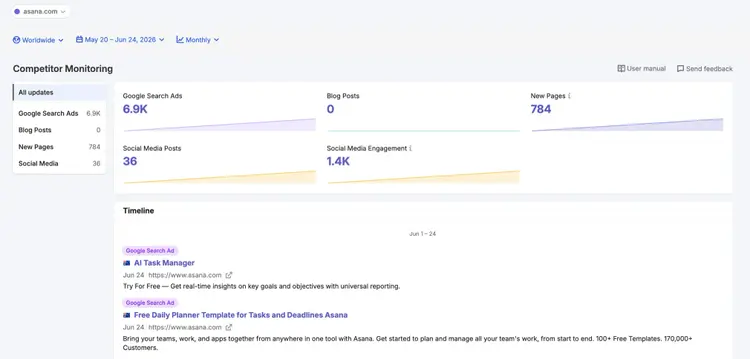
Apart from doing a one-time competitive analysis, you should also track your competition on an ongoing basis. Semrush’s Competitor Monitoring tool can help here.
You’ll be able to track your rivals’ content, social media, and ads to stay on top of changes in strategy, pricing, positioning, and more.
4. Identify your target audience
You can use the following methods to get a better understanding of your target audience and your potential customers’ needs and behaviors:
- Surveys: Collect data from a large number of prospects (perhaps by using a survey tool that allows you to poll a specific group) to gain quantitative insights. Surveys are great for identifying patterns and trends in customer behavior or preferences.
- Interviews: Perform one-on-one interviews with customers to learn more about their motivations and pain points. Interviews allow you to uncover qualitative insights that are hard to capture with surveys.
- Social media listening: Use tools like the Brand Monitoring app to track mentions of your brand, your competitors, and relevant industry terms on social media. To get insight into real conversations your target customers are having.
- Review tracking: Read through reviews of your product or service and competing solutions. This allows you to learn what customers like or dislike about a particular solution—and learn what their ideal solution looks like.
- Customer support log analysis: Analyze customer support logs (if possible) to learn what kind of questions customers are asking and the types of issues they’re having. This can help reveal customers’ biggest pain points and common expectations.
- Audience research tools: Audience research tools can help you understand your target audience’s age, gender, and geographic distribution at a glance.
By combining these methods, you’ll get a well-rounded view of your target audience. Including how your potential customers think, what they need, and what frustrates them.
From here, you can use the following attributes to define your target market:
- Demographics: Age, gender, and location
- Socioeconomics: Income, education level, and household size
- Psychographics: Behaviors, interests, values, and lifestyle
- Firmographics (if you’re in B2B): Company size, industry, and company revenue
Then, use the above to create buyer personas (fictional representations of your target customers) or ideal customer profiles (descriptions of target companies that would be the best fit for your product or service). So you can craft more effective messaging later on.
In our scheduling software example, your ideal customer profile might be independently owned gyms with fewer than 10 employees that are located in urban areas and have a need for an efficient booking system.
5. Analyze Industry trends
Analyzing industry trends will help you anticipate changes in customer behavior, spot emerging technologies, and uncover risks that could impact your business.
For example, analyzing industry trends might help a scheduling software company learn there’s an industry-wide shift toward mobile booking or AI-based appointment scheduling. Uncovering these trends early could then help shape your product roadmap and messaging.
Here are a few places where you can learn more about trends in your industry:
- Market research firms: Independent firms such as McKinsey & Company, Gartner, and Forrester publish detailed reports on a variety of industries. You can use these reports to learn about high-level industry trends and forecasts.
- Market data platforms: Platforms such as Statista and IBISWorld can provide information about specific changes in your market over time
- Trade publications and industry blogs: Dedicated trade publications and industry blogs can help you track emerging topics and competitive moves
6. Do a SWOT Analysis
Performing a SWOT analysis will help you understand your current place in the market as you lay out all your strengths, weaknesses, opportunities, and threats.
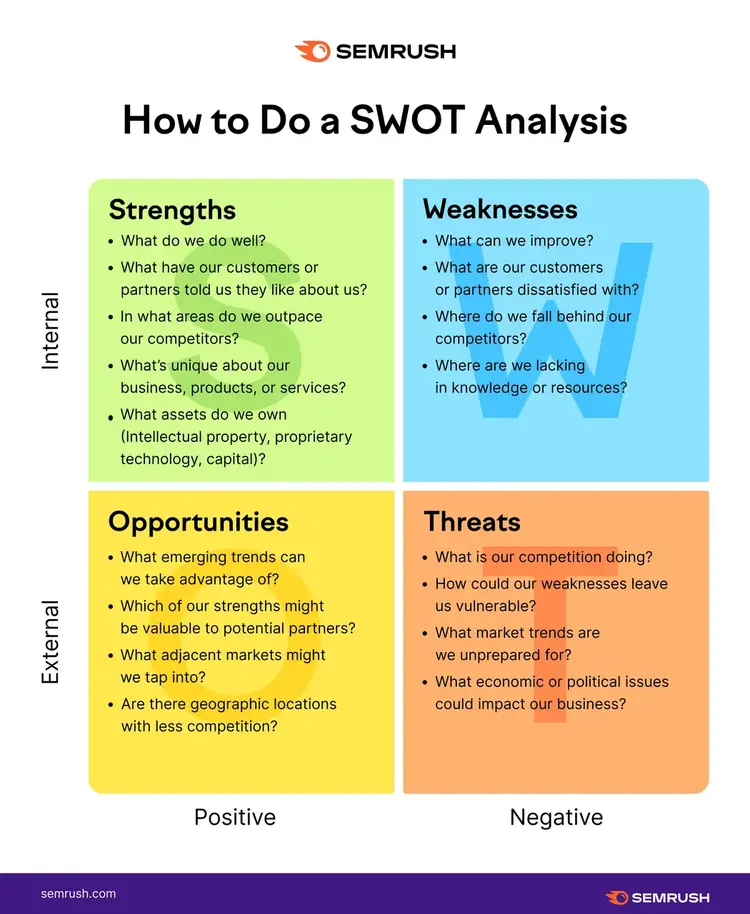
Use these questions to identify what to include in each section:
- Strengths: What do you do particularly well? What separates you from the competition?
- Weaknesses: What are some things you lack? What are competitors doing better than you?
- Opportunities: Are there any external factors (such as trends, gaps, or changes) in the market that you could take advantage of?
- Threats: Is there something (e.g., an upcoming change in state laws or regulations) that has the potential to negatively impact your business?
Here’s how this might look like for our scheduling software example:
- Strengths: User-friendly interface and fast setup
- Weaknesses: Lack of third-party calendar integrations and limited brand recognition
- Opportunities: An untapped market segment for small, independently owned gyms
- Threats: Larger competitors offering freemium versions
7. Summarize the Data and Provide Recommendations
Once you’ve gathered market insights using the steps outlined above, turn those insights into an actionable report.
Start by organizing your findings into categories:
- Market size and growth
- Customer needs and behavior
- Competitive landscape
- Industry trends
- Opportunities and risks
Make sure to highlight key insights that can directly impact decision-making. And remember to tie each insight to the main purpose of your analysis (which you’ve determined in the first step).
Using our scheduling software example, your market analysis could uncover that a relatively large number of small, independently owned gyms are still using manual booking systems.
With that in mind, you might decide to focus your go-to-market strategy on businesses that haven’t yet adopted digital tools.
How experts perform market analyses in 2025
We surveyed 100 marketers about how they perform market analyses and found the most common reasons for doing these evaluations include:
- Identifying customer needs and pain points (59%)
- Analyzing competitors (39%)
- Improving targeting or segmentation (37%)
- Spotting industry trends (31%)
- Sizing the market (31%)
Many marketers we surveyed (40%) conduct some form of market analysis on a monthly basis. And most analyses are triggered by product or feature launches.
When performing a market analysis, marketers rely on these data sources the most:
- Google Search (53%)
- Customer surveys (45%)
- Competitor websites (38%)
- Social listening (38%)
- Customer interviews (36%)
The biggest challenges marketers face when doing market analyses are a lack of reliable, up-to-date data and limited access to customer insights.
Analyze market trends and beat the competition
Performing a market analysis is crucial for determining the right strategy for beating the competition and succeeding in your market.
Semrush’s Traffic & Market Toolkit makes it easy to get detailed insights on your competition and your target market.
Try it today.
Get Market Insights to Drive Growth
with the Semrush Traffic & Market Toolkit

Ana Camarena leads Semrush’s Organic Content team. At Semrush, she helps scale blog production while maintaining quality, driving significant content growth. With 10+ years of experience in SEO and content marketing, she has developed content strategies for SaaS and e-commerce brands with an international scope. Ana has taught classes at EDEM Business School, Warwick University, and IEM Digital Business School. She holds a BA in Journalism and a Master’s in Digital Business & Innovation.
Ana Camarena
Ana Camarena leads Semrush’s Organic Content team, where she focuses on delivering high-quality content that drives business. With 10+ years in SEO and content marketing, she has built global content strategies for SaaS and e-commerce brands.

Tells Google to show you more from Semrush in AI, Search, and Discover.