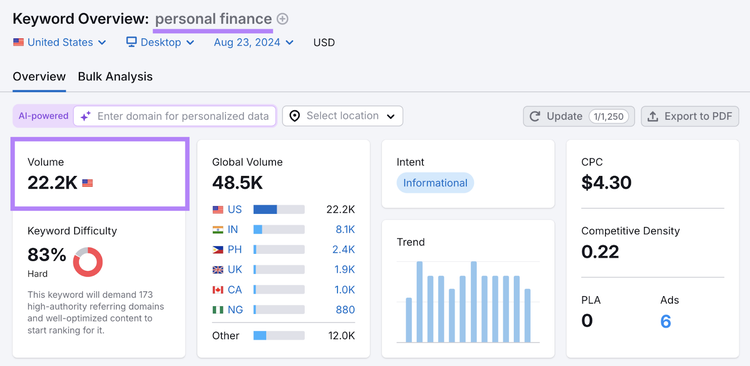
Search volume is the average number of times a keyword is searched per month.
High search volume indicates popularity. Meaning a lot of people are searching for that specific keyword.
Targeting and ranking well for a keyword with high search volume can mean more website traffic. Which can lead to more potential sales (if that’s your goal).
To analyze a keyword’s search volume, use Semrush Keyword Overview tool.
Just enter your keyword into the tool. And you'll see its monthly search volume. Along with other useful metrics.
Target keywords with sufficient search volume—we recommend at least 100 monthly searches as a general rule of thumb. That way, your efforts are more likely to yield meaningful traffic.
Targeting keywords with low search volume (like 10-20 searches per month) probably won’t bring enough visitors to your site.
Note
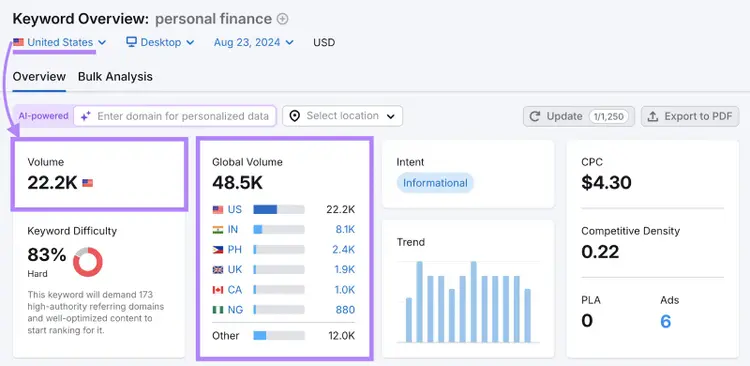
If your business is international, consider the global search volume of the keyword. This metric will give you a better picture of overall traffic potential.
Semrush provides global search volume for any keyword. And country-specific data. Simply toggle the region in the top-left corner of Keyword Overview.
Keyword difficulty shows how hard it would be to rank on page one of Google for a specific keyword.
A higher difficulty score means you may need to put in more effort to rank well for that keyword.
Most SEO tools provide a difficulty score. Usually on a scale of 1-100.
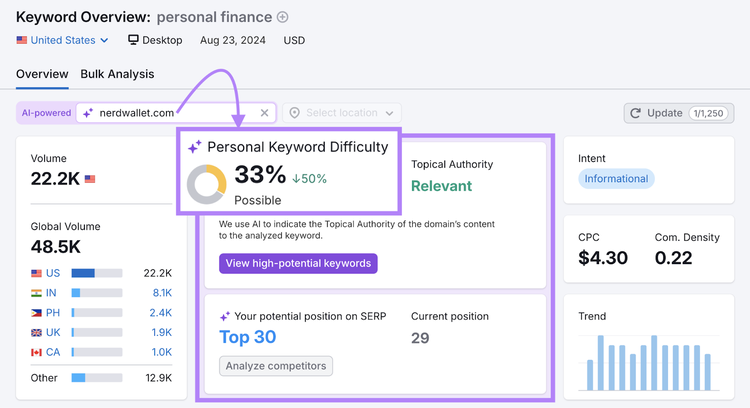
Semrush does the same but goes one step further: It provides a personalized difficulty score for your domain specifically.
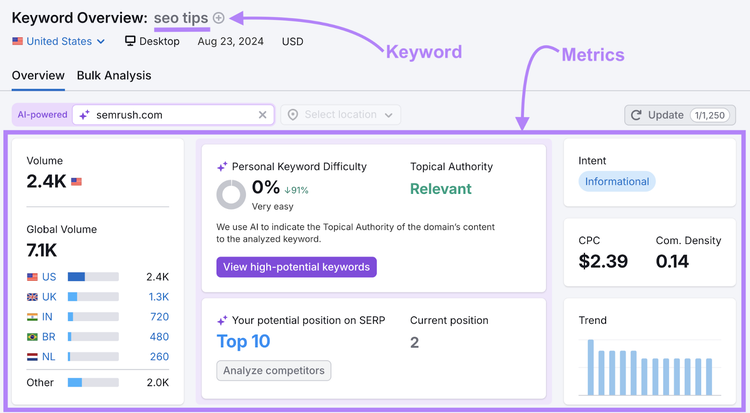
We call this metric personal keyword difficulty (PKD).
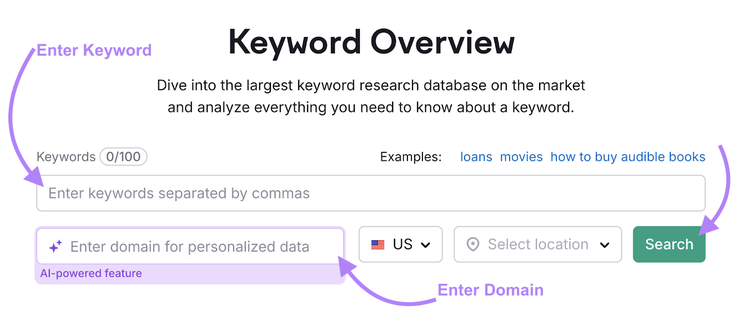
To find your PKD, enter your keyword into the Keyword Overview tool. And enter your domain name into the field provided.
Then hit “Search.”
This will ensure that your PKD score appears. Along with other AI-powered keyword metrics (e.g., “Topical Authority” and “Your potential position on SERP”).
Lower difficulty keywords are often easier targets, especially for new websites. If you fall into this category, any keyword with a PKD score below 30% is a great opportunity to consider.
3. Search Intent
Search intent is the purpose behind a user's search query.
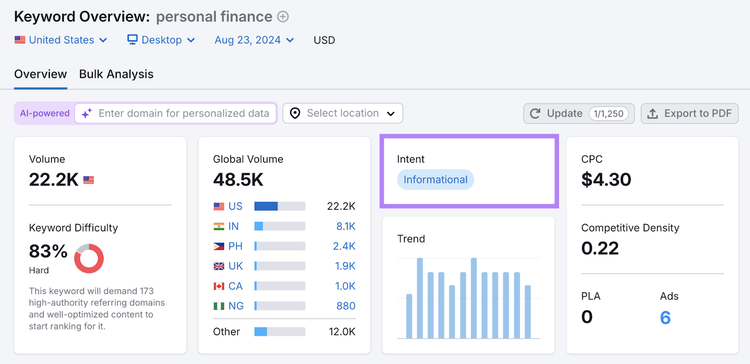
This isn’t a “metric” in the classic sense, but it’s important to understand it. Because it tells you what type of content to create to rank for your target keyword.
Content that matches the searcher’s intent is much more likely to rank high in search results.
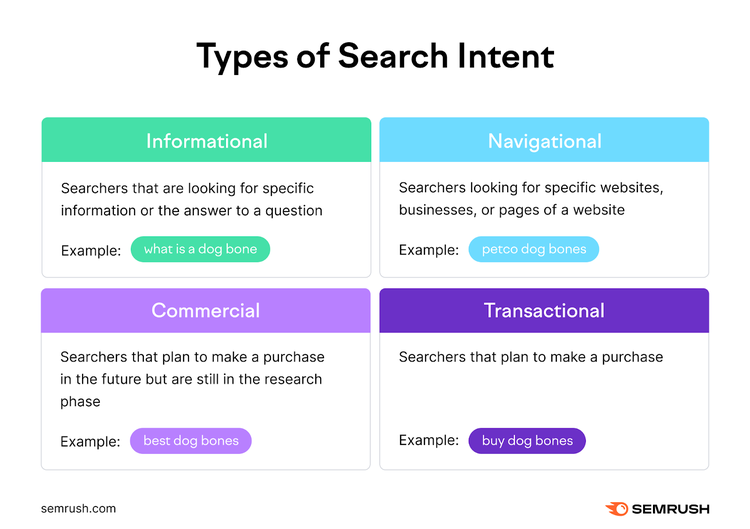
The four primary search intents are:
Informational: Users are looking for information or answers to questions. They may be seeking how-to guides, definition posts, or general knowledge about a topic. For example, "What is SEO?" or "How to bake a cake."
Navigational: Users intend to find a specific website or page. They may enter a brand name as part of their query. For example, "Facebook login" or "Amazon."
Commercial: Users are researching products or services with the intent to make a purchase in the future. They may compare options or read reviews. For example, "best smartphones 2024" or "laptop reviews."
Transactional: Users are ready to make a purchase or complete a transaction. This intent is often indicated by keywords like "buy," "order," or "discount." For example, "buy running shoes online" or "best price for a camera."
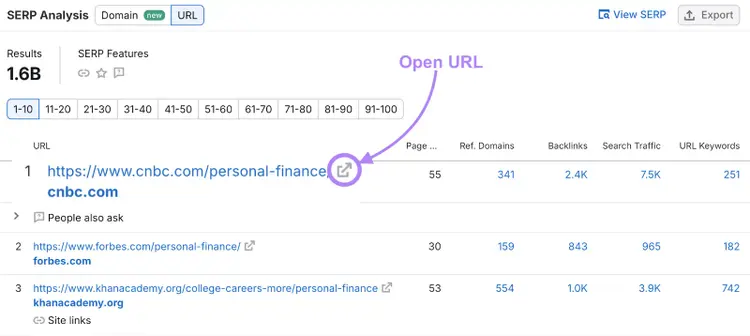
To get even more inspiration on what type of content to create, scroll down to the “SERP Analysis” section. And open the top-ranking articles by clicking on the “open in external link” icon.
Look at the structures and topics of the top-ranking content. And use the information to inspire your own content.
Once you identify the search intent behind a keyword, create quality content that aligns with that intent.
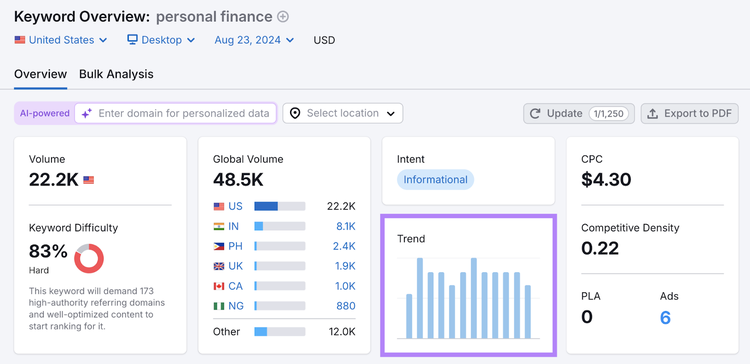
Search trend shows how the popularity of a keyword has changed over time.
It gives you insight into whether people’s interest in a topic or keyword is growing, declining, or steady.
A declining trend might indicate that the keyword is becoming less relevant over time. So it may be OK to deprioritize this keyword.
An upward trend, on the other hand, suggests that interest in the keyword is growing. Which means it might be a good opportunity to jump on early and target that keyword.
The Keyword Overview tool will help you analyze keywords’ search trends.
Note
Some keywords have predictable patterns based on seasons or events. For example, "Christmas gift ideas" will spike in November and December.
Recognizing these seasonal trends will help you plan your content calendar effectively.
In this example, you might want to create (or update) content related to Christmas gifts before the holiday season. To capture the surge in interest.
5. Cost Per Click (CPC)
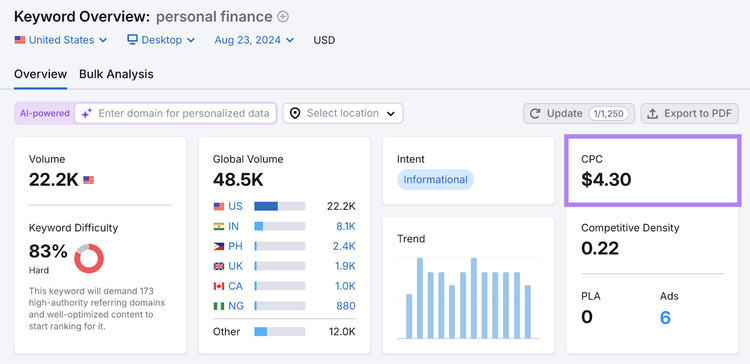
Cost per click shows you how much advertisers pay for each click on their ads for a specific keyword.
While CPC is primarily used in paid advertising, it's also valuable for SEO.
A high CPC often suggests that advertisers are willing to pay more for clicks on that keyword. Which could indicate a higher conversion potential and value for your business.
CPC can vary significantly across industries. A "high" CPC in one niche might be average in another.
CPC data is an average calculation. Actual costs for a paid campaign could be higher or lower.
6. SERP Features
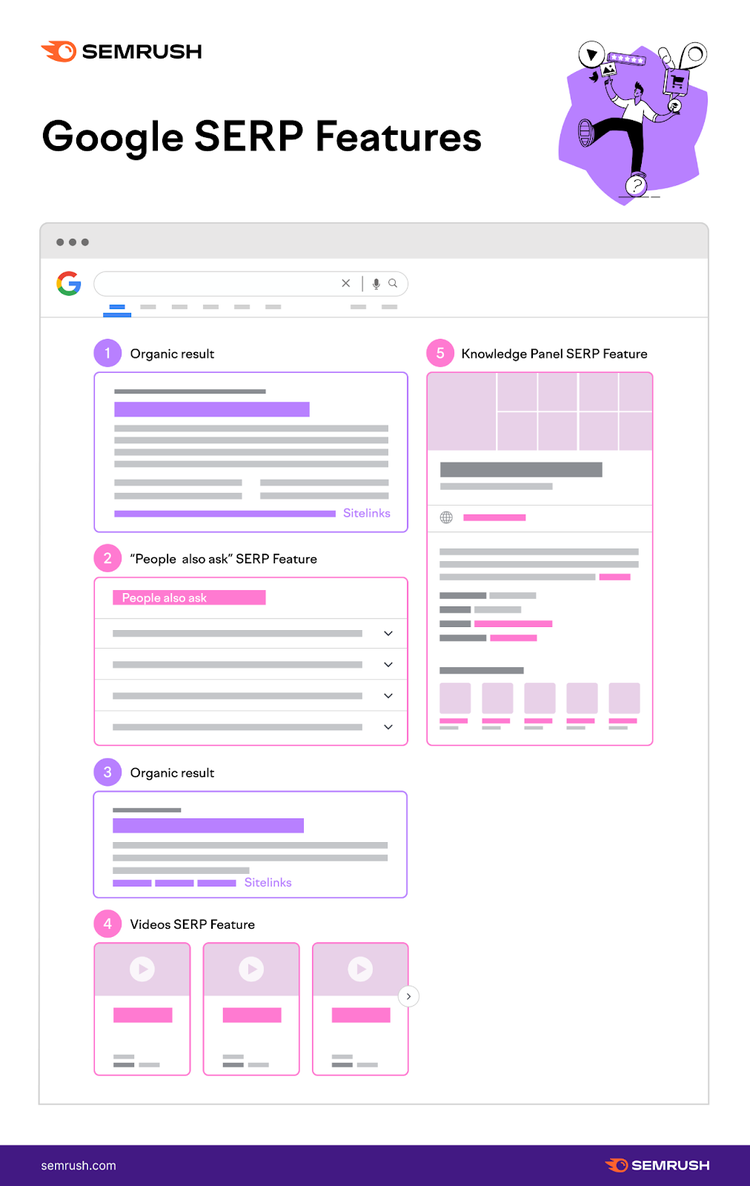
SERP features are special elements that appear on search engine results pages (SERPs) in addition to the standard organic listings.
Like this:
SERP features are important to consider when choosing keywords. Because SERP features can significantly impact your visibility.
Common SERP features include:
Featured snippets: These are brief answers or summaries that appear at the top of the SERP
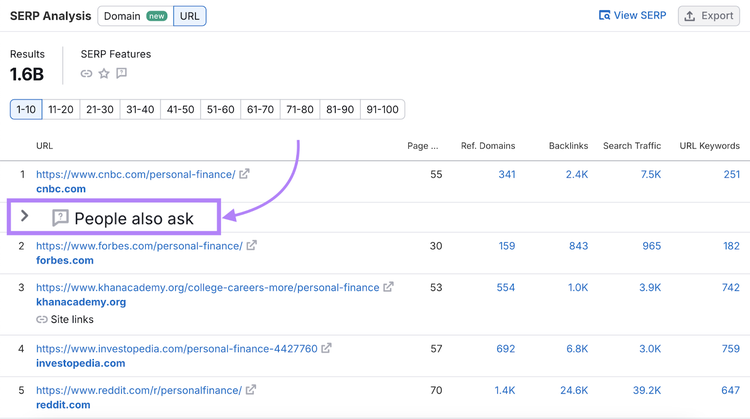
People also ask: A box containing related questions and expandable answers
Local pack: A map and list of local businesses relevant to the search query
Knowledge panel: An information box that appears on the right side of the SERP for certain entity-based searches
If your keywords trigger SERP features, there is an opportunity to gain additional visibility.
You can check this using Semrush's Keyword Overview tool. The tool shows the snapshot of the results page and the various SERP features that appear for that keyword.
Bonus: 4 Tips for Choosing the Right Keywords
Here are some important things to keep in mind when selecting keywords for SEO.
Make Sure Keywords Are Relevant to Your Business
This one is pretty obvious. But it's worth emphasizing.
Relevance is crucial because it ensures that you're attracting the right audience—people who are actually interested in what you offer.
The keywords you choose should be directly related to your products, services, or content. And your goals.
For example, a blog post selling products should target keywords like “top 10 running shoes in 2024.” Not “How to fix your running shoes.”
Using irrelevant keywords might bring traffic. But that traffic probably won’t convert.
Identify the Quick Wins, but Have a Long-Term Strategy
When you’re just starting out, choose low-difficulty keywords to get quick wins.
These keywords can help you gain some initial traction. And start driving traffic to your site faster.
While quick wins are important, don't neglect more competitive, high-volume keywords entirely.
Ranking for these terms will take more time and effort. But they can provide substantial traffic in the long run. So start targeting them from day one so you’re well-positioned for future growth.
Analyze the SERPs
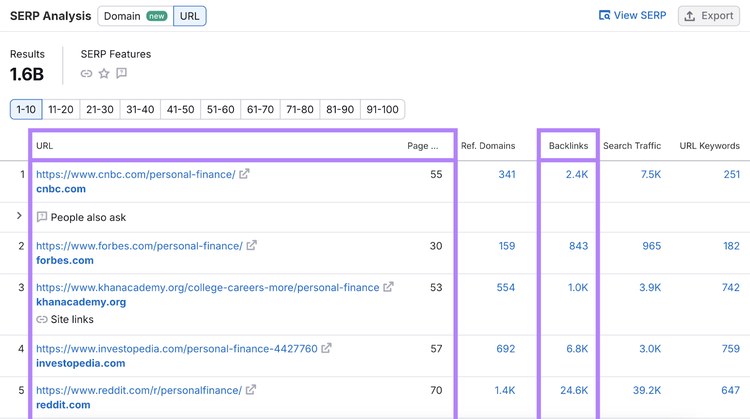
Before you finalize your keyword choices, analyze the SERPs for those keywords.
This analysis will help you understand the competitors you need to outrank.
If the top-ranking pages are from well-known brands in your industry, it may be more challenging to outrank them. Especially if you're a newer or smaller player.
These established websites often have strong authority, a large number of backlinks, and quality content that search engines favor.
You can see the analysis report of top competitors directly within Semrush’s Keyword Overview tool.
Look at Multiple Metrics Together
During keyword analysis, consider multiple metrics together (not in isolation).
For instance, a keyword with moderate search volume and low difficulty might seem attractive at first glance. However, if it has a low CPC and doesn't trigger any useful SERP features, it may not be as valuable as initially thought.
On the other hand, a keyword with slightly lower search volume but a high CPC, moderate difficulty, and the potential to appear in a featured snippet could be a more strategic choice.
So look at all the metrics to get a well-rounded view of the potential value from the keyword.
And remember that Semrush’s Keyword Overview tool provides all the data you need to make the right choices.
Use Keyword Metrics to Choose the Perfect Keywords
Keyword metrics tell you whether a keyword is worth targeting.
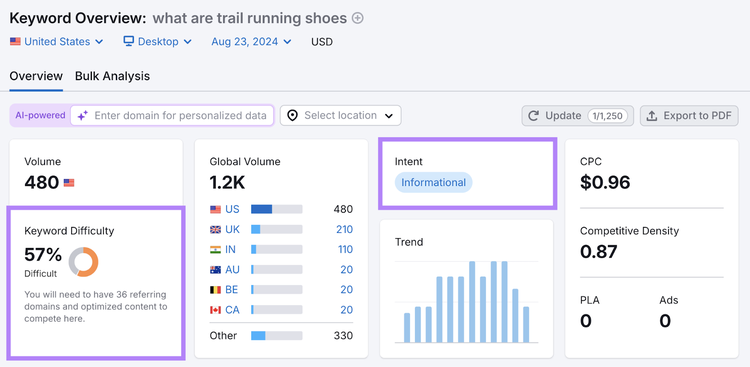
While a keyword like “what are trail running shoes” might look like the perfect keyword for a shoe store, it may not be, depending on your goals.
Especially since the keyword is difficult to rank for (with a 57% keyword difficulty score). And has an informational intent, meaning searchers looking up this keyword aren’t looking to buy running shoes.
Use Keyword Overview to find AI-powered keyword metrics. So you can target relevant keywords that will actually contribute to your brand’s bottom line.
Sydney has been creating content for over 10 years. She has been a writer, content manager and coordinator, editor, and strategist. At Semrush, she’s a blog editor who makes sure each article is as accurate, optimized, and helpful as possible.
Subscribe to learn more about Keyword Research
Subscribe
By clicking “Subscribe” you agree to Semrush Privacy Policy and consent to Semrush using your contact data for newsletter purposes
Share
Tells Google to show you more from Semrush in AI, Search, and Discover.