
A Guide to the Best Advertising Platforms for Your Business
Imagine being able to identify where your potential customers are, targeting and engaging them effectively, and driving business growth with optimized spending.
That's the advantage of using a digital advertising platform to help your audience convert.
In this article, you’ll learn about the top online advertising platforms’ unique features. Plus which platform to choose to reach more of your target audience with better ROI.
What Are Advertising Platforms?
Advertising platforms are digital spaces where businesses display paid ads to promote their products or services to a targeted customer base.
Platforms range from social media networks and search engines to websites and apps. Each offers various ad formats and targeting options to reach potential customers effectively. We’ll cover the main ones later in this section.
Use digital advertising platforms to increase your business's visibility, drive website traffic, and boost sales.
For example, a local bakery could use social media advertising on Facebook to reach interested users from a specific geographic area.
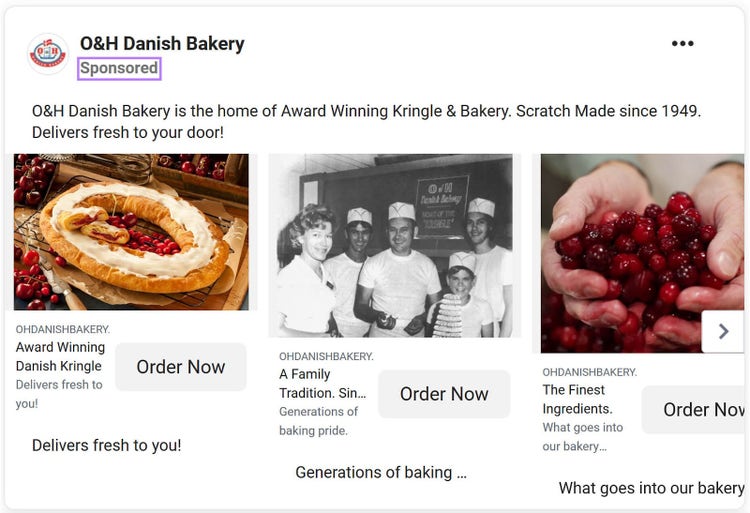
Image Source: Meta Ad Library
Compelling ads can attract new customers, promote special offers, increase in-person traffic to a physical store, and more.
Focusing on a qualified audience allows you to allocate your marketing budget more efficiently.
Further reading: Paid Advertising 101: A Beginner’s Guide
How Do Advertising Platforms Work?
Advertising platforms operate through three main components that enable you to reach your target audience more successfully.
- Ad auctions: Occur in real time when an advertising slot becomes available. Advertisers bid on slots based on the value they assign to them, often determined by keywords, audience demographics, or the platform itself. The highest bidder, or sometimes the bidder providing the most value considering both bid amount and ad quality, wins the ad slot.
- Targeting options: Ensure ads reach the most relevant audience. You can segment audiences based on demographics, interests, and behaviors. For example, a fitness equipment store can target individuals interested in health and fitness, fine-tuned by age, geographic location, or recent search history related to workout gear.
- Types of ads: Include text ads, display ads, video ads, and interactive ads. Choosing a format depends on your campaign goals, product or service, and where your target audience spends time online. For instance, a video ad might be more effective on a platform like YouTube. Whereas a text ad could perform better in Google’s search engine result pages (SERPs).
Imagine a small business launches a new product and uses an advertising platform to promote it.
- The business sets a budget and bids for (video) ad slots on a social media network like Instagram, targeting users who have expressed interest in similar products
- The advertising platform displays its ad to targeted users
- The platform's algorithms optimize the ad's delivery. Ensuring it reaches individuals most likely to engage based on their past online behavior and preferences.
- Interested users engage with the ad and perform a desired action. Like signing up for the product’s free demo or registering for a webinar that discusses the product in more detail.
This targeted approach maximizes the ad's impact, improving its chances of driving sales and achieving a better return on investment (ROI).
The Top 12 Advertising Platforms
The right digital ad platform can help you reach your target audience, engage potential customers, and convert interest into tangible results.
Understanding these platforms’ strengths and niches is the first step toward crafting a successful online advertising strategy tailored to your business needs.
Here are some of the best platform options to use for your ads:
1. Google Ads
Google Ads offers your business a direct pathway to appear in front of potential customers precisely when they search for your services or products.
Google's extensive network includes its search engine, YouTube, and the Google Display Network (GDN).
Note
GDN comprises millions of websites, apps, and videos where Google ads can appear. Providing unparalleled targeting capabilities to reach a diverse audience based on search behavior, interests, and online activities.
Here’s what a Google Search ad looks like:
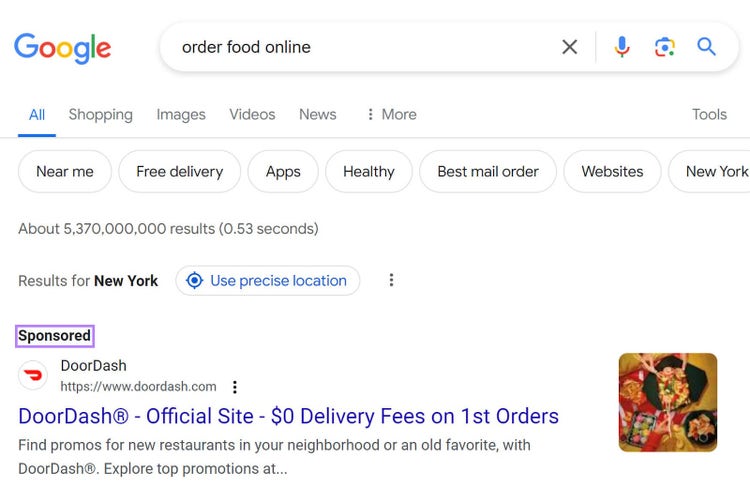
The cost of advertising on Google Ads varies widely. Depending on factors like keyword competition, the quality of your ads, and your targeting specifics.
The advertising platform operates on a pay-per-click (PPC) model, meaning you pay only when someone clicks on your ad. Which makes it a flexible option for businesses of all sizes, as it gives you control over budgets and bids to maximize your ROI.
Further reading: How Much Does Google Ads Really Cost?
Google Ads supports the following ad types:
- Search ads: Appear in Google search results, targeting users based on their search queries
- Display ads: Appear on websites within the GDN, targeting users based on their interests or the content they’re viewing
- Shopping ads: Showcase products directly in search results, offering quick product information at a glance
- Video ads: Captivate users with video content on YouTube—ideal for storytelling and engaging potential customers
- App ads: Promote mobile apps across Google's network using auto-generated ad formats
Tools like Semrush's Ads Launch Assistanthelp you fully manage your Search and Smart ad campaigns from launch to optimization.
Launch High-Performing Google Ads
Powered by Ads Launch Assistant
2. Facebook Ads
Facebook Ads lets you run ads across Facebook's ecosystem (over 2.1 billion daily users) thanks to seamless integration.
This advertising platform's audience encompasses many users, making it suitable for any business.
Below, Colorado State University ran a Facebook video ad to announce its summer courses:

One of the vital strengths of Facebook ads lies in its detailed targeting options, including:
- Demographics: Age, gender, location, and even life events
- Interest-based: Specific interests, from broad categories like fitness or fashion to more niche hobbies
- Behavioral: Activities like purchase behavior and device usage
- Connection-based: Users who have a particular kind of connection to your page, app, event, or their friends
The integration with Instagram has the following advantages:
- Unified ad management: Create, manage, and track your Facebook and Instagram ad campaigns from the same place.
- Cross-platform targeting: Reach a wider audience across both Facebook and Instagram regardless of users’ preferred platform—increasing the overall effectiveness of your ad campaigns
- Consistent branding across platforms: This consistency helps you build brand recognition and trust with your audience. So it’s a seamless experience for users moving between the two platforms.
As of March 2024, the average CPC for Facebook Ads (cost per click) was $0.778.
Besides image and video ads, types of Facebook ads include:
- Carousel ads: Allow showcasing up to 10 images or videos with individual headlines, descriptions, and buttons. Ideal for displaying multiple products or telling a story.
- Collection ads: Feature a central image or video with three smaller images, leading users into an immersive Instant Experience to engage further with the brand
- Instant experience ads: Offer an engaging visual storytelling or brand experience once the user taps on full-screen ads optimized for mobile
- Poll ads: Engage your audience with a two-answer poll in your ad—perfect for gathering insights or preferences
- Slideshow ads: Create a looping visual story with three to 10 images or a video, offering a more straightforward and cost-effective alternative to video ads
- Messenger ads: Appear in the Chats tab of the Messenger app, expanding into a detailed view with ad details upon tapping
Further reading: Check out our comprehensive guide on Facebook Business Manager to learn how to build custom audiences for effective Facebook ad campaigns.
Create Facebook Ads in Minutes
with AdCreative.ai
3. Instagram Ads
Instagram is the second most popular social network marketers use, after Facebook. And it allows businesses to set the same ad campaign objectives as Facebook.
Instagram Ads’ strong visual appeal captures the attention of younger demographics, who are highly active on Instagram. As of January 2024, 28.4% of Instagram users in the U.S. were between 25 and 34 years old.
The cost of advertising can vary widely depending on factors such as targeting, ad format, competition, and time of year.
On average, Instagram advertising costs $0.00-$0.25 per click, $0.00-$4.00 per 1,000 impressions, and $0.03-$0.08 per engagement. Meta recommendsstarting with at least $5 for your budget.
Instagram offers several ad formats, including:
- Photo ads: Simple yet effective, allowing brands to showcase their products through engaging images
- Video ads: Up to 60 seconds long, providing a deeper look into the brand or product
- Stories ads: Full-screen ads that appear between users' stories, offering a highly engaging way to connect with the audience
- Carousel ads: Allow users to swipe through a series of images or videos in a single ad, ideal for highlighting multiple products or telling a brand story
Here’s a fashion brand’s carousel ad showcasing its products:

Gather Competitor Social Media Insights
with AdClarity
4. LinkedIn Ads
With over 700 million professionals on the platform, LinkedIn marketing can be particularly effective for business-to-business (B2B) marketing.
93% of B2B content marketers reportedly use LinkedIn for organic social marketing.
LinkedIn Ads target factors including job titles and functions, industries and companies, skills and seniority, plus education and experience.
LinkedIn supports different ad types to help businesses reach their goals, such as getting more visibility or finding leads.
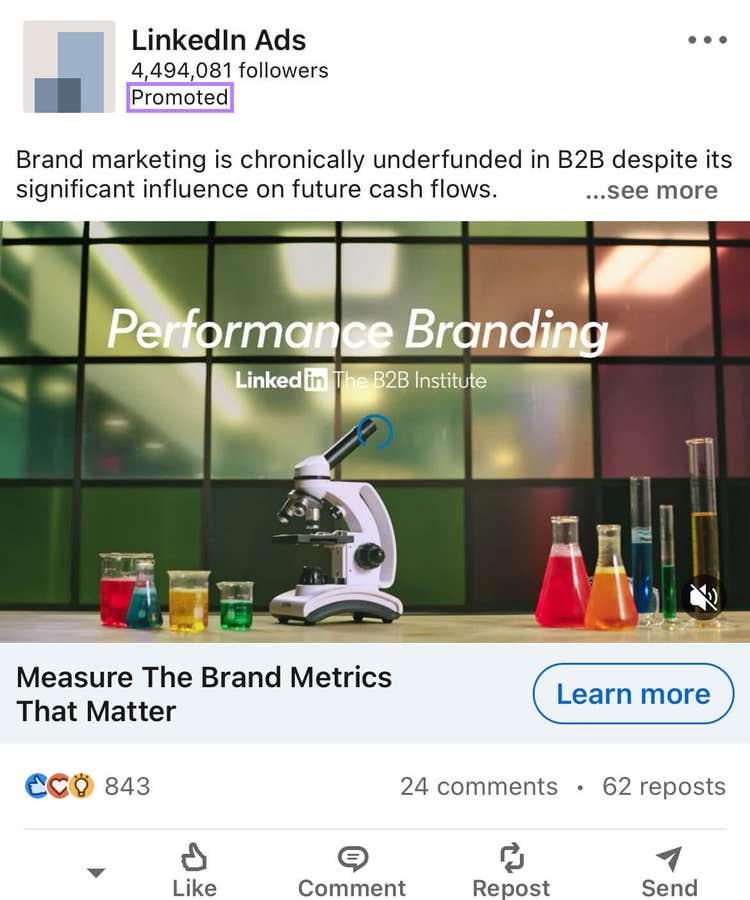
- Sponsored content: Ads that look like regular posts but appear as “sponsored” in your feed. And can include pictures, videos, or a series of images.
- Message ads: Direct advertising in users' inboxes, evolving into conversation ads with multiple CTAs
- Text ads: Ads that show up on the side of LinkedIn pages
- Dynamic ads: Personalized ads that can show your photo, where you work, and your job title
- Lead gen forms: Forms that fill automatically with your LinkedIn info, making it easy to sign up for something without leaving the platform
In this sponsored content ad, LinkedIn addresses the platform users with a topic that’s highly relevant to them:
You need a minimum daily budget of $10 for any ad type. New or inactive campaigns must have a minimum lifetime budget of $100.
After launching, the minimum lifetime budget becomes $10 multiplied by the campaign's duration.
5. X Ads
The X (formerly Twitter) platform allows you to target ads based on demographics, interests, behaviors, keywords, and specific events or conversations.
You can also engage with an audience in real time. This immediacy makes X Ads particularly effective during live events, product launches, or any time-sensitive promotions.
X has different types of ads, including:
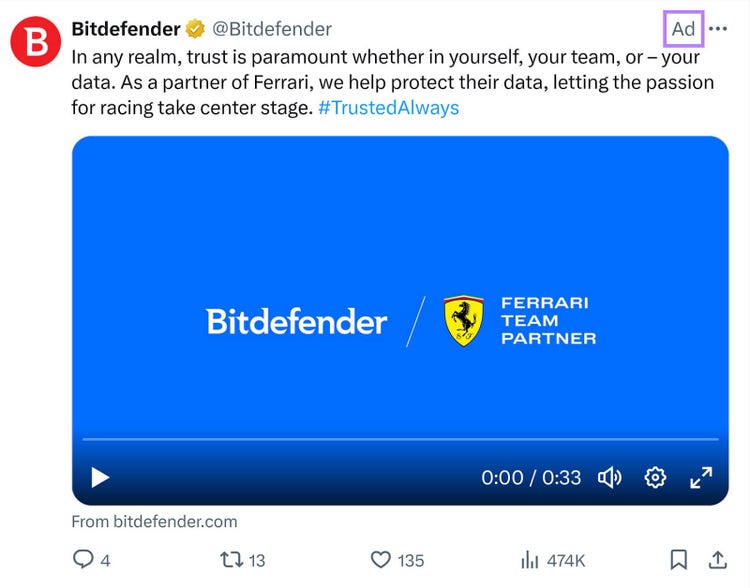
- Promoted tweets: Paid tweets to reach more people or engage followers
- Promoted trends: Make a hashtag popular at the top of the "Trending" list
- Twitter cards: Add more than text to tweets, like app installs or website previews
- Video ads: Include short video clips that appear on users’ feeds
Below is a promoted tweet from cybersecurity company Bitdefender:
You can make X Ads fit your budget with no minimum spend by setting a cap at the start of your campaign. Your targeting, design, and bid choices will affect the cost.
6. Pinterest Ads
Pinterest ads are paid-for posts or “Pins” that advertise a product or service to users on the platform. As Pinterest is a visual platform, advertising focuses on images and video.
There are plenty of opportunities to reach an audience here, where 46% of weekly users report discovering a new brand or product.
Pinterest offers a variety of ad formats, including:
- Promoted pins: Paid pins marked as "Promoted" to boost visibility and web traffic
- Video pins: Engaging video ads for storytelling and product showcasing
- Carousel ads: Multi-image ads featuring product details or stories
- Shopping pins: Direct-to-product links for easy purchasing, enhanced with Catalogs for auto-generated shoppable pins
- Collection ads: Main visuals combined with product images for an immersive shopping experience
Check out this promoted pin example from the Mazda car manufacturer:

On average, Pinterest ads cost $0.00-$0.10 per click, $0.00-$2.00 per conversion, and $0.00-$1.50 per 1,000 impressions.
7. YouTube Ads
YouTube is arguably the most prominent video advertising platform. Its ads enable you to advertise your content to audiences of all demographics.
Choose from several video ad formats depending on what you want to achieve, who you want to reach, and the story you want to tell.
- Skippable in-stream ads: Play before, during, or after videos on YouTube, allowing viewers the option to skip
- Non-skippable in-stream ads: Require viewers to watch the entire ad before the main video plays
- In-feed video ads: Show up in YouTube's content discovery areas, like search results or related video suggestions
- Bumper ads: Short, unskippable ads lasting 6 seconds, ensuring viewers see your entire message
- Outstream ads: Mobile-focused ads outside of YouTube, extending your reach across the Google Video Partners (GVP) network
- Masthead ads: Prominently displayed at the top of the YouTube homepage for high visibility
See this in-feed video ad example:
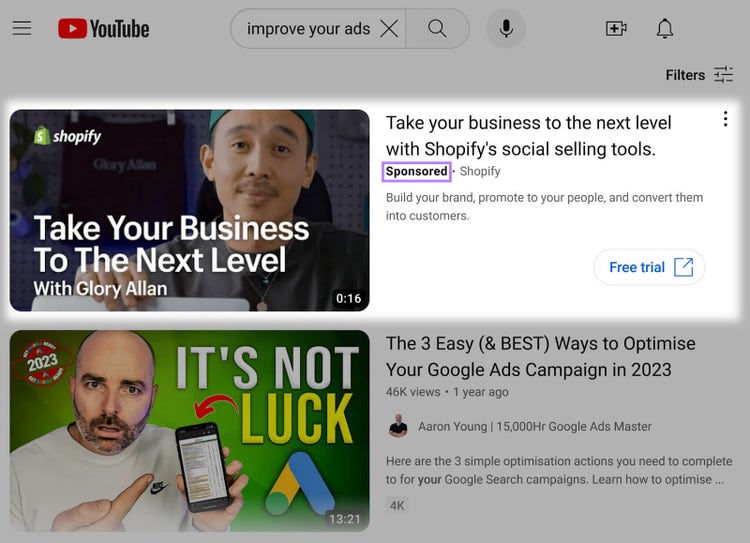
YouTube ads cost around $0.11-$0.50 per view or action, with businesses typically setting a daily budget of $10.
The actual cost of your campaign can vary according to the quality of your video, whom you’re targeting, and your ad goals.
8. Snapchat Ads
Snapchat’s advertising platform may suit your business if your primary audience is young adults.
In January 2023, one in five global users were men between 18 and 24 years old. Women between 18 and 24 made up 18.3% of all Snapchat users.
Its focus on images, temporary messages, and a commitment to privacy and creative expression attracts a younger demographic.
Plus, Snapchat's AR lenses offer engaging and deeply immersive interactive experiences because:
- They blend the real world with digital fun, making ads more memorable
- Users get to interact by making faces or tapping, which keeps them engaged
- They're fun, so people share them—helping ads reach more without extra cost
- You can tailor ads for specific events or products, grabbing the attention of the right audience
Here’s an AR ad from Coca-Cola:
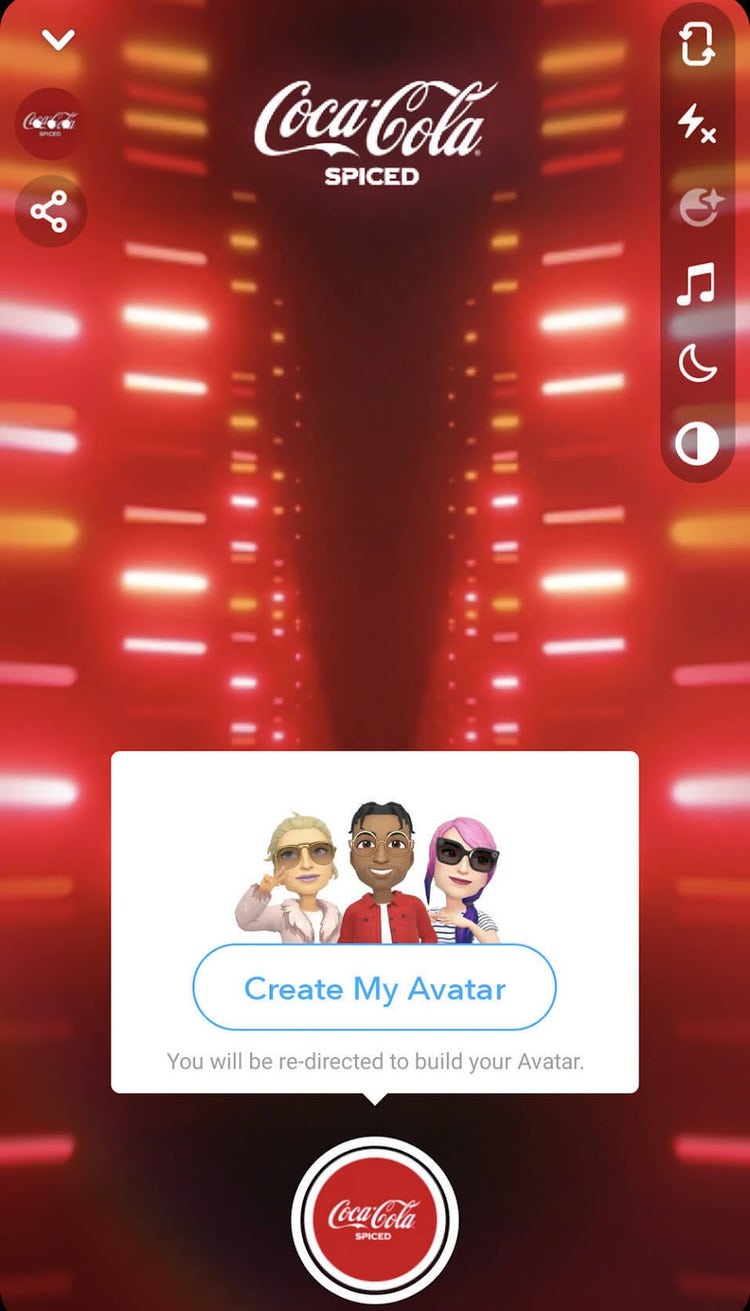
Spend as little as $5 daily on ads, but Snapchat recommends at least $20-50 daily to help your ad complete an “Exploration Phase.”
This phase allows the platform to determine who in your target audience will most likely take action on your ad—and optimize its performance accordingly.
9. TikTok Ads
TikTok’s short-form video content provides a unique and engaging way for advertisers to reach potential customers (1.5 billion active users worldwide in 2023).
The ads can go viral as a result of these factors:
- Algorithm-driven discovery: The platform’s “For you” page promotes viral ad potential through user-tailored recommendations
- High engagement format: The short videos encourage repeat viewing and sharing, boosting ad virality
- Creative and collaborative features: Hashtag challenges and branded effects turn ads into interactive, community-driven campaigns
See this viral in-feed ad from TikTok:
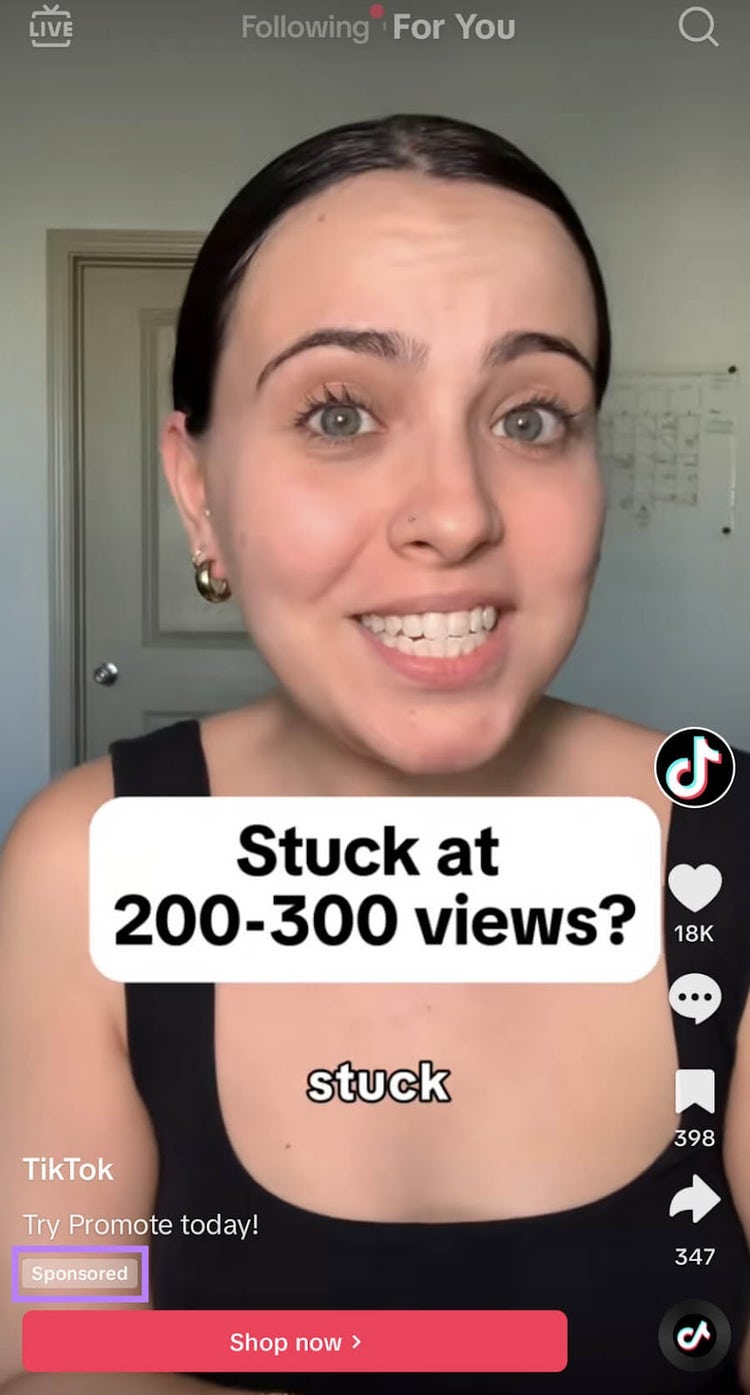
Types of TikTok ads include:
- In-feed ads: Appear on TikTok’s "For You" page, blending with organic content
- Brand takeover ads: Full-screen ads visible upon opening the app
- TopView ads: A longer format of Brand takeover ads, appearing 3 seconds after app launch with up to 60 seconds of full-screen video
- Branded hashtag challenges: Sponsored challenges that encourage user content creation and participation, boosting engagement and awareness
- Branded effects: Custom filters, stickers, and effects for users to incorporate in videos
10. Amazon Ads
Amazon Ads can increase your brand visibility, give you a competitive edge in the crowded ecommerce space, and improve your chances of conversion.
A direct shopping integration seamlessly incorporates advertising solutions within Amazon’s vast ecommerce platform (which recorded 2.7 billion visits in December 2023.)
The average CPC for Amazon ads is $0.81.
Further reading: What Is Amazon PPC?: A Complete Beginners Guide to Optimization
Ad types include:
- Sponsored products: Promote individual product listings directly in search results
- Sponsored brands: Boost brand visibility through customizable ads at the top of search results
- Sponsored display ads: Target and re-target shoppers on and off Amazon based on their browsing and buying behavior
- Amazon Demand Side Platform (DSP): Reach audiences with programmatic ads both on Amazon's platform and across the web
Check out this sponsored product ad for a writing tablet:

11. Bing Ads
Microsoft Advertising, formerly Bing Ads, is an effective alternative to Google Ads.
The Bing search engine and its partner networks (other websites and platforms that show Bing ads) complement Google Ads by tapping into a different audience segment—often with less competition and potentially lower costs.
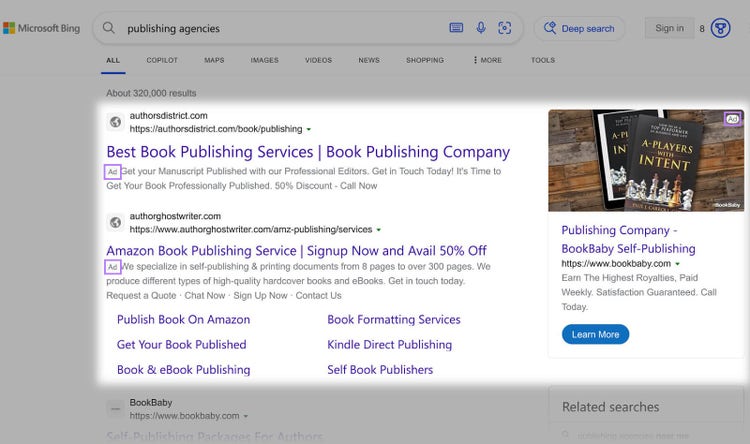
It’s an appealing option for advertisers seeking broader reach without a significant budget increase.
The average CPC on Bing across all industries is $1.54.
Bing ad formats include:
- Text ads: Appear in search results and contain a headline, display URL, and description text
- Shopping ads: Ideal for ecommerce businesses, showcasing products directly in search results
- Video ads: Can appear on Bing's partner networks
- Responsive ads: Automatically optimizes ad combinations of up to 15 headlines and four descriptions you provide. To present the most effective combination for your target audience.
12. Apple Search Ads
Apple Search Ads can help you improve your app’s discoverability, given the vast number of apps available in the App Store (over 1.83 million).
Ads can appear in different formats depending on the user’s device and search query. They always have a blue background and an ad disclosure icon.
Here’s the app ad we got when we searched for "vacation planner:"
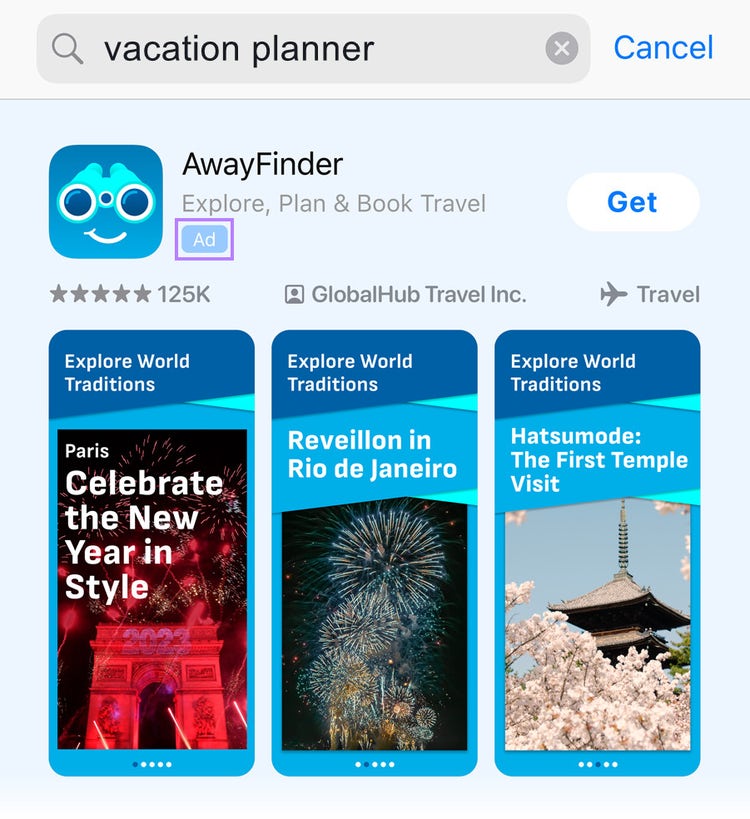
Image Source: Apple
Apple Search Ads automatically generates your ad based on the existing metadata, video, and imagery in your App Store listing.
Note
Apple claims that more than 650 million people discover and download apps weekly in Search Ads.
Here are some unique features of Apple Search Ads:
- Direct targeting & high intent: Target users actively searching for apps, capturing their high intent. And significantly increasing the chances of app downloads with prominent visibility in search results.
- Customizable campaigns: Offer precise targeting options through keywords and audience segmentation (demographics, location, user behavior). Along with creative sets (screenshots, app previews) for optimized ad presentation.
- Performance tracking & optimization: Detailed analytics for monitoring ad performance (impressions, taps, conversion rates)—essential for campaign adjustments and optimization
- Cost-effectiveness: A cost-per-tap (CPT) model ensures you only pay for user engagement. Plus, you can set daily and total campaign budgets for financial control.
Choosing the Right Advertising Platform for Your Business
Run your ads on platforms where your target audience spends its time and engages most actively.
Ensure they complement your marketing objectives, such as increasing brand awareness, driving sales, or fostering customer loyalty.
Ultimately, your ad platform choice has to make financial sense.
Apply the following four key criteria to determine the best ad platforms for your needs.
Target Audience and Demographics
Understanding your target audience and its demographics helps you focus your advertising strategy on where it will be most effective to maximize engagement and ROI.
Gain insights into your potential customers’ behaviors, preferences, and online habits (like where they spend the most time online). Then:
- Select platforms where those who most likely are interested in your products or services can see them
- Spend your budget on platforms where your target audience is active to improve campaign efficiency
- Tailor your ads to a specific audience’s interests and behaviors to optimize engagement and conversion
Semrush’s One2Target tool provides the comprehensive audience insights needed to help you choose the right ad platform.
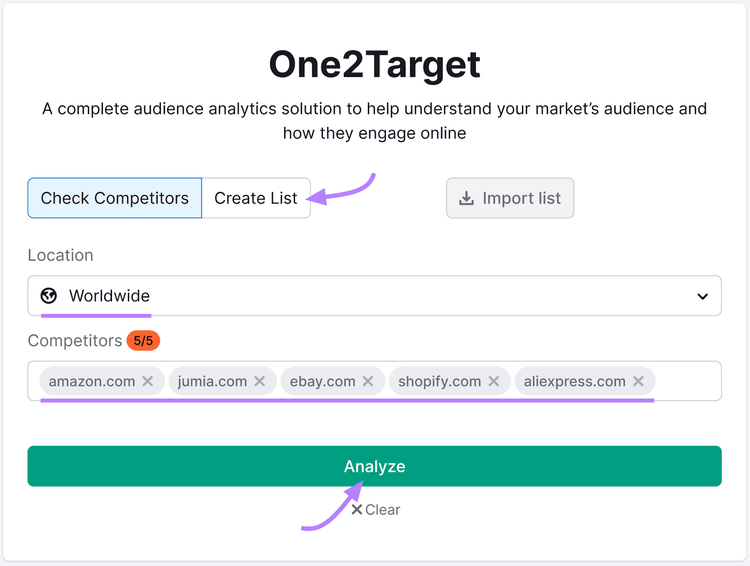
Click “One2Target” under “.Trends” in the left-hand navigation bar. Select your target location, enter up to five competitors’ domains in the input box, and click “Analyze.”
You can also click the “Create List” tab to learn about the audiences of up to 100 domains.
Your report will look something like this:
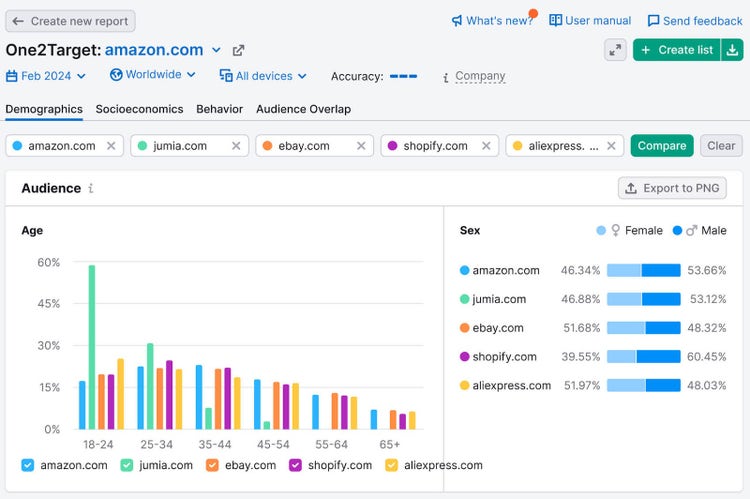
And covers various audience factors, including:
- Demographics: Age, sex, and location
- Socioeconomics: Education levels, employment status, and household sizes
- Behavior: Interests like social media usage and device preferences
- Audience overlap: To what extent competing websites share visitors
Here are some actionable tips to use the tool data effectively:
- Break down your audience into smaller, more specific groups to tailor your advertising messages more effectively. For example, If you're selling sports equipment, tailor your ads to fitness blogs or outdoor gear reviews, and use social channels your target audience prefers.
- Run small-scale tests with short, identical ads on platforms like Instagram, Twitter, and Facebook for a week. Track which platform drives more visits to your website or has higher engagement such as likes, shares, comments. Adjust your strategy to focus more resources (like ad spend and formats that fit the platform best) there
- Monitor the latest platform trends and demographic shifts to keep your digital marketing strategies relevant. Say you notice a surge in Instagram's popularity among 18-to-24-year-olds. Use this insight to create Instagram-specific content to reach this audience.
Budget and Cost-Effectiveness
Assess different platforms’ cost-effectiveness to maximize reach and engagement without overspending.
Start by defining your advertising objectives to determine the critical metrics for your business goals.
Examples of ad metrics include:
- Cost per click (CPC): The price you pay each time someone clicks on your ad
- Cost per acquisition (CPA): The cost of acquiring a customer who takes a specific action, such as making a purchase
- Return on ad spend (ROAS): The revenue earned per dollar you spend on advertising
Choose digital advertising platforms with metrics that align with your goals and target audience. Then, estimate the potential ROI for each platform.
For example, your ROI is positive if a platform's average CPC is $1 and you can convert one in every 100 clicks into a $150 sale.
Follow these best practices to continue assessing platform cost-effectiveness:
- Understand whether a platform’s user demographic aligns with your target audience. A platform with a higher price might still be more cost-effective if it reaches a more relevant or engaged audience for your product.
- Set small budgets on a few platforms to test their effectiveness. Monitor metrics such as click-through rates (CTR), conversion rates, and overall engagement.
- Use analytics software to understand campaign performance across different platforms. And make better data-driven decisions about where to spend your budget.
If you pick Google Ads as your platform, Semrush’s Advertising Research can support your campaigns by analyzing your paid search competitors.
You’ll get valuable data including the keywords competing domains bid for, plus estimated monthly costs for the ads that rank on SERPs.
Analyze Competitors’ Ads
with the Advertising Research Tool
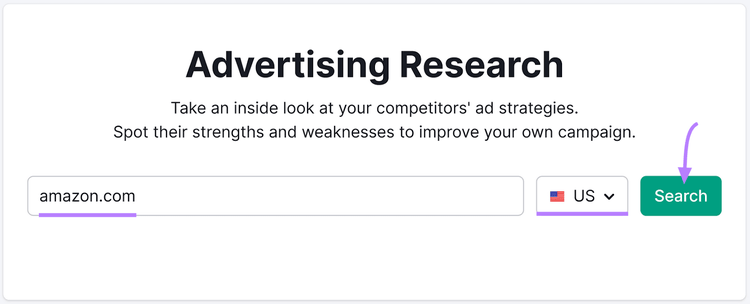
Hover over “Ad” in the left-hand navigation bar. And click “Advertising Research” to launch the tool. Enter your competitor’s domain, select the target location, and hit the “Search” button.
You’ll see a report showing a detailed analysis of your competitor’s advertising history in Google Ads.
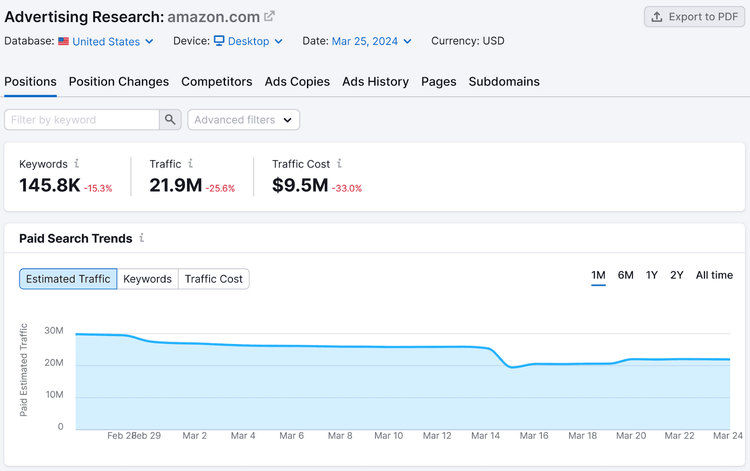
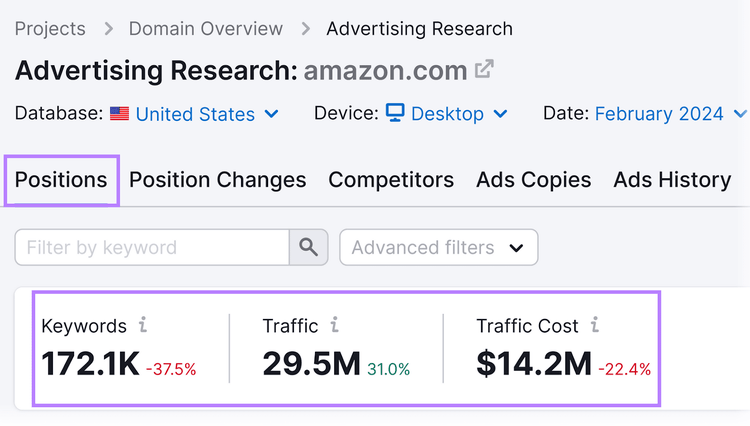
The “Positions” tab shows the keywords your competitor gets traffic for, how much traffic, and the estimated cost to rank for those keywords in Google Ads.
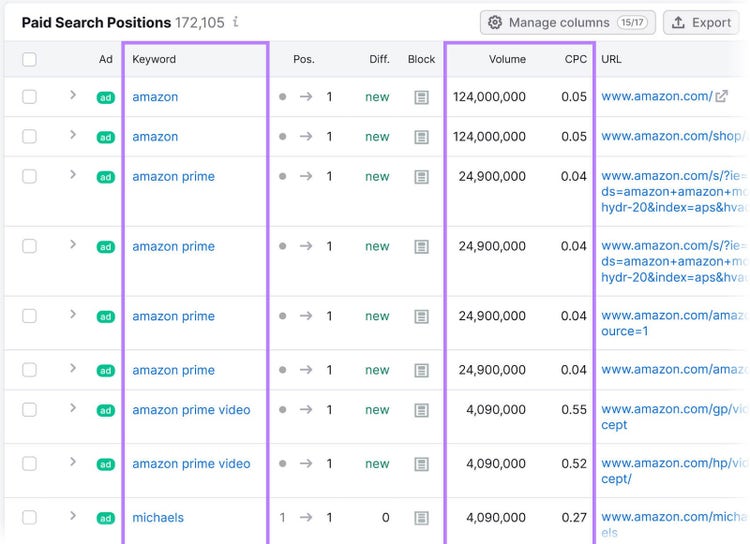
Scroll down to view the “Paid Search Positions” and the keywords, their volume, and respective CPC.
Apply the tool insights to your ad campaign strategy. For instance:
- Use cost data to plan your advertising budget more effectively and allocate enough funds to compete for desired keywords without overspending
- Identify keywords with higher volume and lower cost for more affordable campaign opportunities
- Adjust your current campaigns by tailoring your ad and landing page copy to match search intent(the motivation behind a user’s search term) more effectively. Helping you to improve conversion rates and ROAS.
Ad Format and Content
Platforms that support ad formats best suited to your message increase your chances of captivating and resonating with potential customers.
So, base your choice on your preferred content delivery types—whether video, image, text, or interactive formats.
Here’s how:
- Research which types of content your target audience prefers and interact with. Then, choose the platforms that excel in the ad formats relevant to your content strategy (e.g., video ads on YouTube, image ads on Instagram).
- Test various ad formats on your selected platforms to see which ones yield the best engagement and conversion rates
- Use analytics tools to track performance and tweak your strategy accordingly
- Regardless of the chosen format, ensure your ads include attractive visuals and clear calls-to-action (CTAs) to maximize impact
Use Advertising Research to assess how to outperform your closest competitors’ ad copy in Google’s paid search results. View their headlines and CTAs, and the landing pages where they direct traffic.
Click the tool’s “Ads Copies” tab.
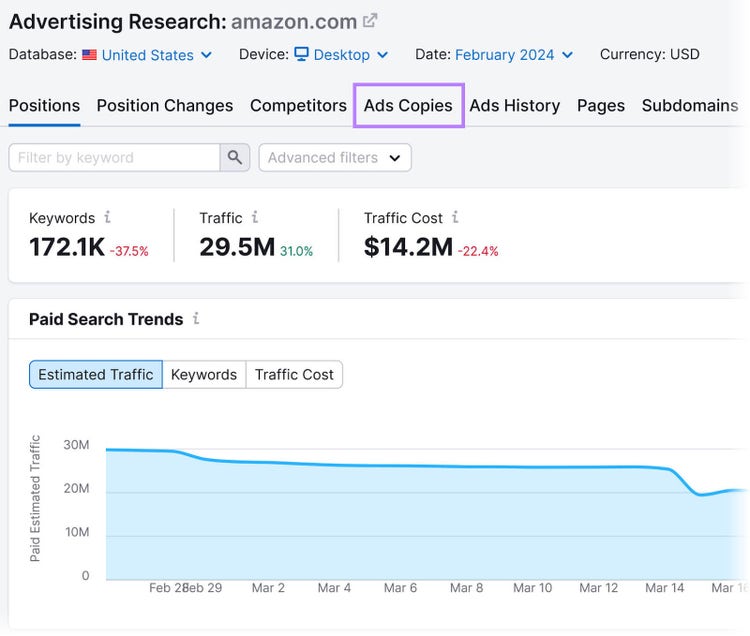
The report shows unique ad copy that the domain ranked for in Google's paid search results. And for how many keywords.
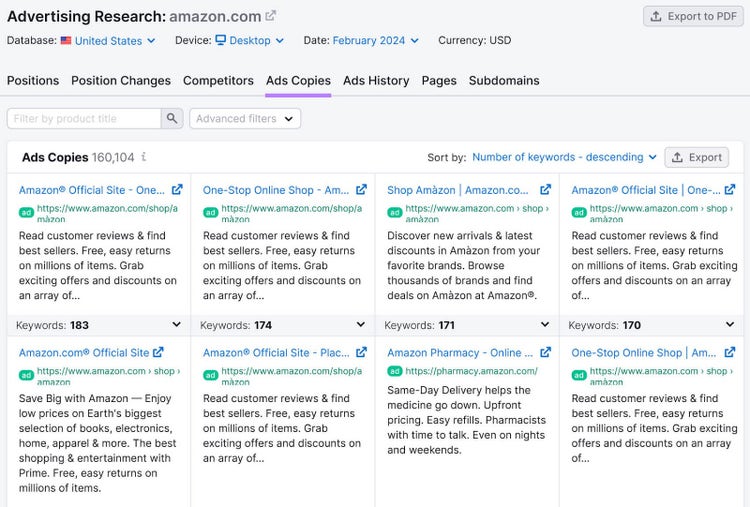
Click on the “Keywords” dropdown menu under each ad to view which keywords triggered the ad’s SERP appearance. Complete with each keyword’s search volume, CPC, and competition level.
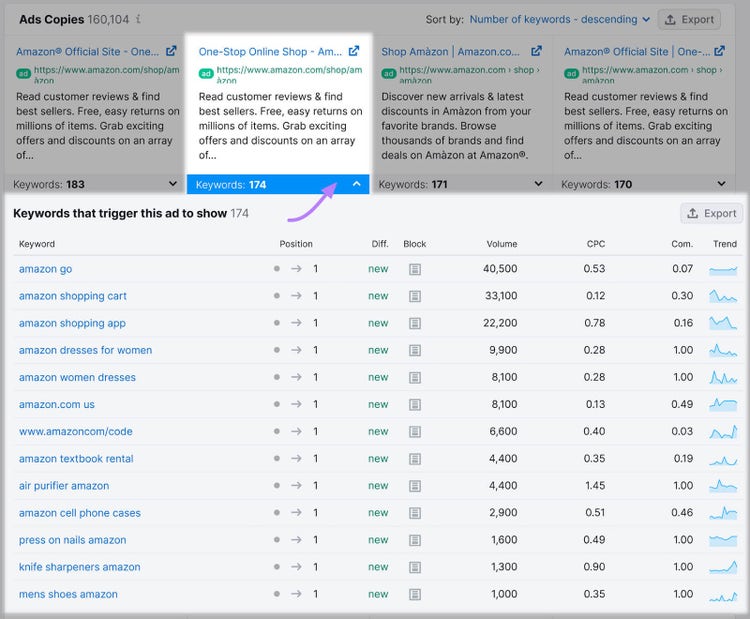
Use this information to:
- Assess successful keyword and ad copy combinations to differentiate your brand and gain a competitive edge in your market.
- Identify new trends or emerging interests within your industry to stay ahead of the curve with timely, relevant ad content.
Further reading: Check out our PPC Keyword Research guide on using PPC Keyword Tool to streamline keyword management.
Performance Tracking and Analytics
Analytics provide insights into your business’s key performance indicators (KPIs)—such as CTR, engagement rates, conversion rates, and overall ROI.
And helps you tweak your ad campaign parameters and target prospects more effectively for higher ROAS.
For example, if a particular ad underperforms in CTR, you can adjust its content, audience targeting, or placement to improve its performance.
If you run an ad campaign without access to analytics, you could miss out on crucial data. Like who engages with your ads, when they're most active, and which ads drive conversions.
Let’s explore how to find an ad platform that meets your performance tracking and analytics needs:
- Look for detailed insights into audience demographics and behavior, real-time campaign performance, and conversion tracking
- Confirm integration with other tools and platforms you're using, such as Google Analytics or CRM software like Semrush CRM. Which gives you a comprehensive view of your campaign's performance across all channels.
- Identify platforms that not only provide data, but also offer actionable recommendations, or automated optimizations
Use Diverse Advertising Platforms to Broaden Your Reach
Combining ad touchpoints can extend your brand’s reach and help you capture more market share.
A multi-platform presence reinforces your brand message and encourages deeper engagement through repeated exposure.
For instance, you could build a campaign where a consumer sees your brand on a Twitter ad in the morning, watches your YouTube video ad in the afternoon, and encounters a retargeting ad on Facebook in the evening.
Apply these three tips to maximize your conversion potential through ad diversification:
- Use retargeting ads to follow your audience across platforms with tailored messages that guide them through the conversion funnel
- Understand the unique strengths of each platform, and the role it can play in your customer's journey. Optimize your content and CTAs accordingly.
- Use unified tracking tools like Google Analytics 4(GA4) to attribute conversions resulting from your multi-platform campaigns. So you can identify successes and further refine your efforts.
The Semrush toolkit helps you optimize a multi-platform advertising strategy.
Sign up for a free trial to understand your audience's preferences and behavior, gain insights into competitors' advertising tactics, and craft ad content that resonates with your prospective buyers.
Elevate Your Digital Advertising Strategy
with a Semrush Subscription

Sydney has been creating content for over 10 years. She has been a writer, content manager and coordinator, editor, and strategist. At Semrush, she’s a blog editor who makes sure each article is as accurate, optimized, and helpful as possible.
Tells Google to show you more from Semrush in AI, Search, and Discover.