A Google algorithm update is a change to Google’s search ranking systems. These updates are designed to improve the quality of search results for users.
For example, an update might seek to promote sites with helpful content. Or penalize pages with slow load times.
How Can You Recover from Google Algorithm Updates?
If your organic traffic is suffering because of a Google algorithm update, it’s important to understand what changes Google made. Look at any Google guidance, as well as industry commentary.
Conduct an SEO competitor analysis on rival sites, too. To see whether they experienced a similar decline in performance. Or to identify factors that contributed to their success.
You can then take corrective action and, if necessary, adjust your SEO strategy.
But don’t fall into the trap of taking action too soon. Or making changes based on gut instinct, rather than hard evidence. Otherwise, you can do more harm than good.
Also, bear in mind that it takes time to recover your rankings—even if you take all the right steps. You might even have to wait for the next algorithm update.
2024 Updates
Here’s a quick overview of the latest Google algorithm updates.
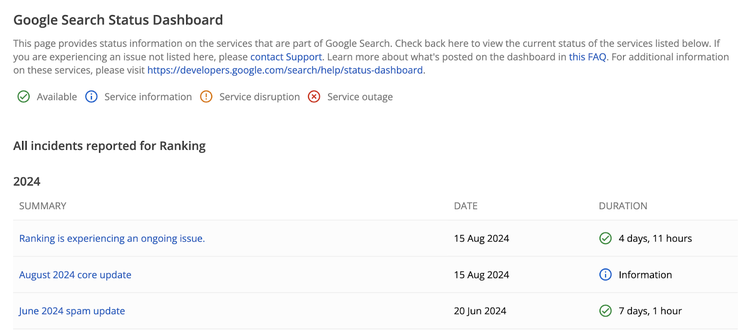
August 2024 Core Update
The August 2024 core update was designed to improve the quality of content found in search results. Based in part on feedback provided by creators and users.
It aimed to further demote sites that rely on outdated SEO practices. Or produce low-quality content.
If your site was affected by this update, focus on creating quality content. And improving any content that doesn’t put the user first.
Announced: August 15, 2024 Started: August 15, 2024 Completed: September 3, 2024 Duration: 19 days, 4 hours
June 2024 Spam Update
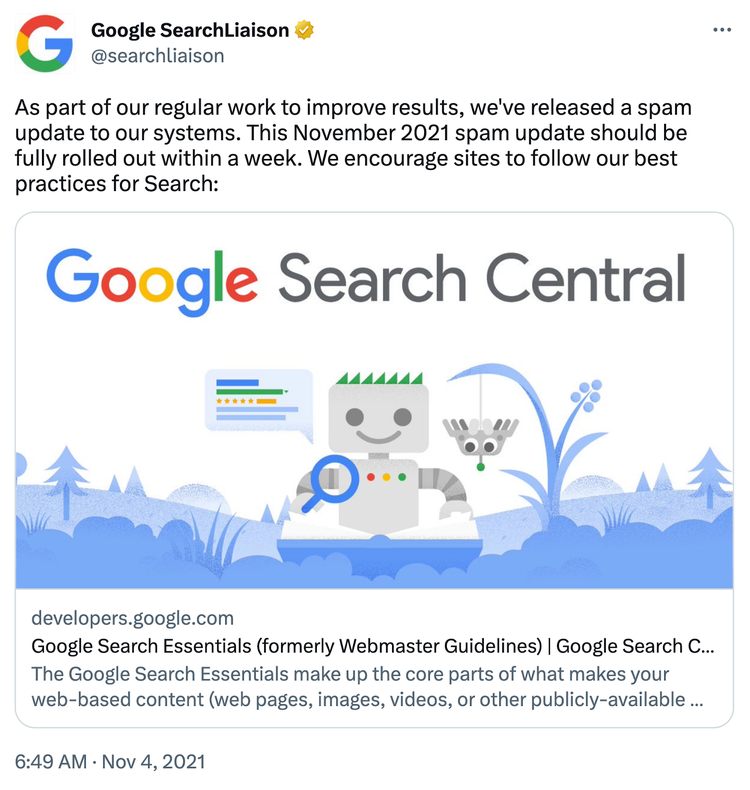
The June 2024 spam update was designed to make Google better at identifying sites or pages that violate its spam policies. So that it can demote them in search results (or remove them altogether).
Here are some examples of spammy practices to avoid:
Cloaking: Presenting different content to Google and users
Scraping content: Plagiarizing content from other sites
Sites that violate Google’s spam policies may receive a Google penalty. Which harms the site’s visibility in search results.
Announced: June 20, 2024 Started: June 20, 2024 Completed: June 27, 2024 Duration: Seven days, one hour
March 2024 Spam Update
The March 2024 spam update was designed to improve Google’s spam detection abilities.
On the day the update was launched, Google announced three new spam policies concerning:
Expired domain abuse: Exploiting an expired domain's SEO authority for manipulation or spam
Scaled content abuse: Publishing large volumes of low-quality or unoriginal content
Site reputation abuse: Hosting third-party content with little to no editorial oversight
So, it’s likely that the update targeted these bad practices.
Announced: March 5, 2024 Started: March 5, 2024 Completed: March 20, 2024 Duration: 14 days, 21 hours
Tip
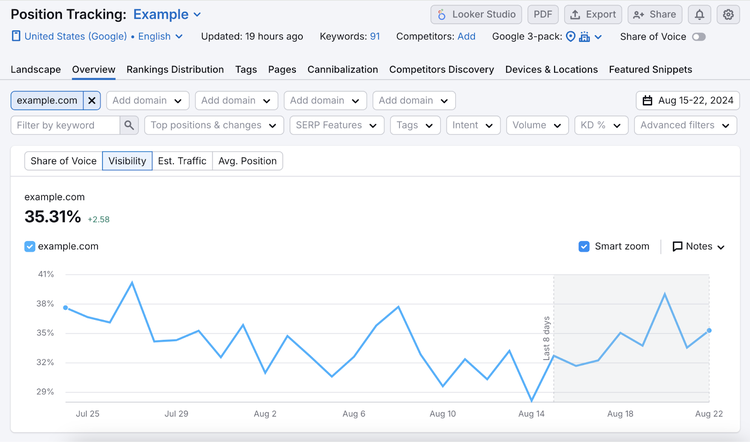
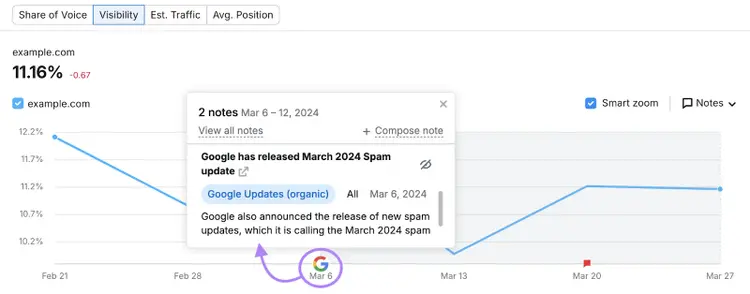
Semrush’s Position Tracking tool makes it easy to see if Google algorithm updates correlate with changes in your search visibility.
March 2024 Core Update
Google described the March 2024 core update as a “complex update” that “marks an evolution in how we identify the helpfulness of content.”
Before this update, Google used a single system to identify helpful content. Now, it uses a variety of signals and systems.
The goal is to promote content that people find useful. And demote unsatisfactory content.
If your site is negatively affected by a core update, it doesn’t necessarily mean you’ve violated any Google guidelines. It could just mean that your competitors have beaten you.
Google advises against trying to “fix” anything if a core update has affected your site. Instead, focus on creating quality content.
Announced: March 5, 2024 Started: March 5, 2024 Completed: April 26, 2024 Duration: 45 days
2023 Updates
These are all the confirmed Google search algorithm updates from 2023:
November 2023 Reviews Update
The November 2023 reviews update promotes original, well-researched reviews that help people make good decisions.
Providing evidence of experience with the review subject
Explaining what sets something apart from its competitors
Google said this would be the last reviews update to appear on the Search Status Dashboard. Because its reviews system would now be improved at a “regular and ongoing pace.”
Announced: November 8, 2023 Started: November 8, 2023 Completed: December 7, 2023 Duration: 29 days
Is created for people first and search engines second
Provides comprehensive, original, and reliable information
Announced: September 14, 2023 Started: September 14, 2023 Completed: September 28, 2023 Duration: 13 days, 11 hours
August 2023 Core Update
The August 2023 core update was designed to make organic search results better for users.
Out of results that made the top 10, around 10.85% had ranked outside the top 20 prior to the update. On average, websites gained/lost three positions.
This shows the huge potential for traffic gains following a core update.
Announced: August 22, 2023 Started: August 22, 2023 Completed: September 7, 2023 Duration: 16 days, three hours
April 2023 Reviews Update
The April 2023 reviews update aimed to reward reviews “that share in-depth research, rather than thin content that simply summarizes a bunch of products, services or other things.”
It affected reviews of products, services, destinations, games, movies, and more. Previously, Google’s review updates focused on product reviews.
Announced: April 12, 2023 Started: April 12, 2023 Completed: April 25, 2023 Duration: 13 days
March 2023 Core Update
The March 2023 core update was designed to make Google better at identifying quality content. And therefore improve search results for users. (Just like other core updates.)
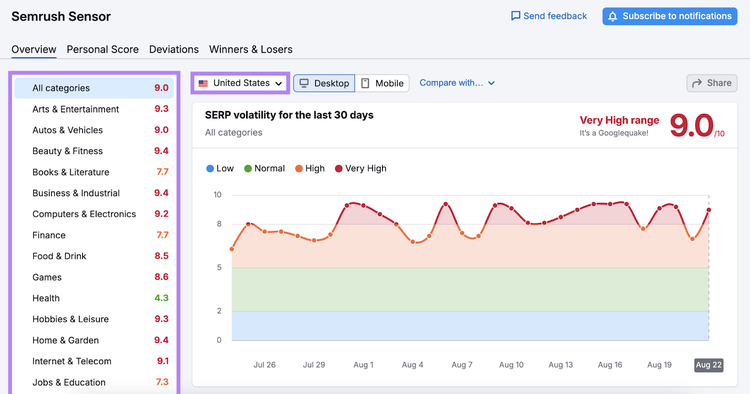
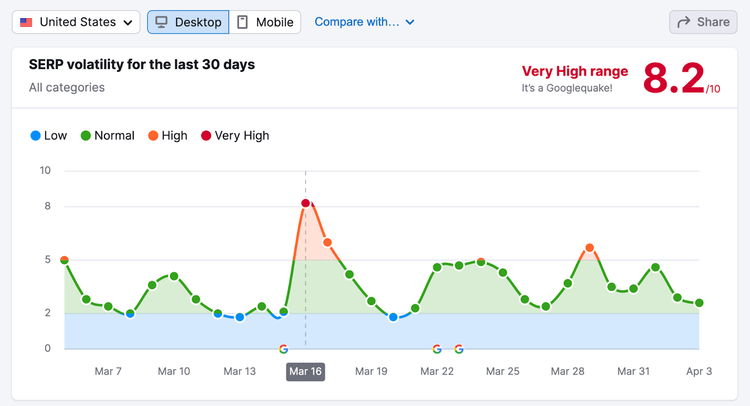
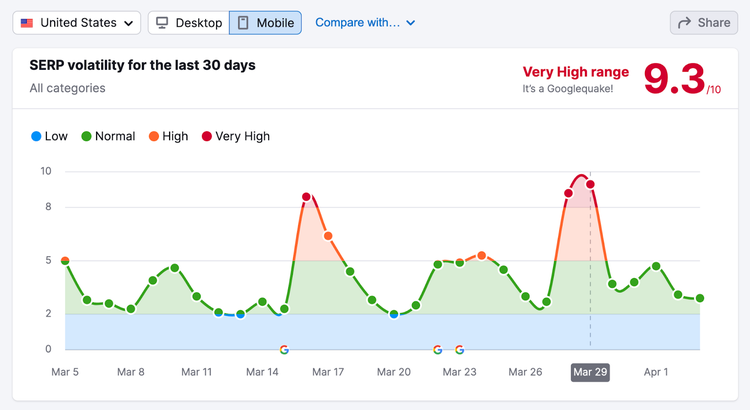
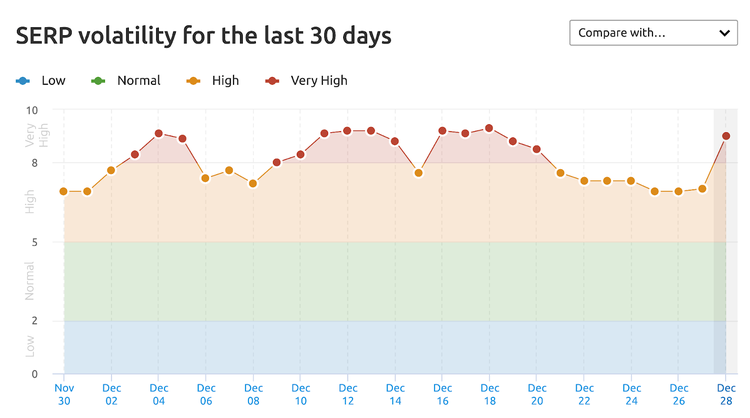
The update led to “Very High” SERP volatility, according to the Semrush Sensor. This means that Google’s search engine results pages (SERPs) changed around much more than normal.
In the U.S., desktop SERP volatility peaked the day after the update began:
Almost two weeks later, mobile SERP volatility peaked even higher. Suggesting that the March 2023 core update had a more dramatic impact on mobile rankings.
(Desktop and mobile SERPs are often different. Because Google wants users to have the best experience on each device.)
Announced: March 15, 2023 Started: March 15, 2023 Completed: March 28, 2023 Duration: 13 days, seven hours
February 2023 Product Reviews Update
The February 2023 product reviews update aimed to reward in-depth, high-quality product reviews. So, it affected sites that publish this type of content.
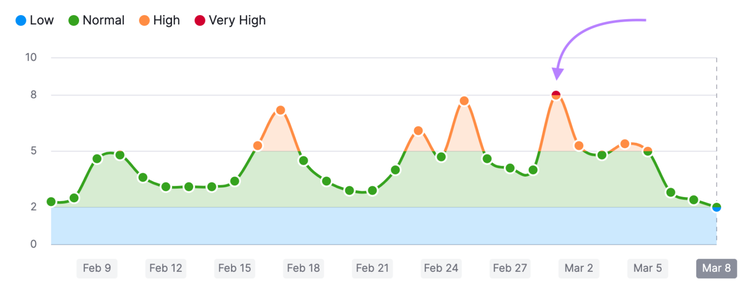
SERP volatility peaked in the “Very High” range on March 1, 2023.
As part of this product reviews update, Google published two new recommendations:
Provide evidence of your experience with the product
Include links to multiple sellers
Announced: February 21, 2023 Started: February 21, 2023 Completed: March 7, 2023 Duration: 14 days
2022 Updates
Here are all the confirmed Google algorithm changes from 2022:
December 2022 Link Spam Update
The December 2022 link spam update enhanced Google’s ability to identify sites that buy and sell links for SEO purposes. It was an improvement to SpamBrain, Google’s AI spam-detection system.
Google neutralizes the spammy links it finds through this update. Meaning sites previously benefiting from these backlinks may have dropped in the rankings.
Announced: December 14, 2022 Started: December 14, 2022 Completed: January 12, 2023 Duration: 29 days
December 2022 Helpful Content Update
The December 2022 helpful content update aimed to demote sites that create content primarily for SEO purposes—rather than for people.
During the rollout, Google changed its E-A-T (Expertise, Authoritativeness, Trustworthiness) guidelines into E-E-A-T guidelines. Adding in an extra “E” for “Experience.”
The goal was to reward content creators who demonstrate firsthand experience with the subject matter.
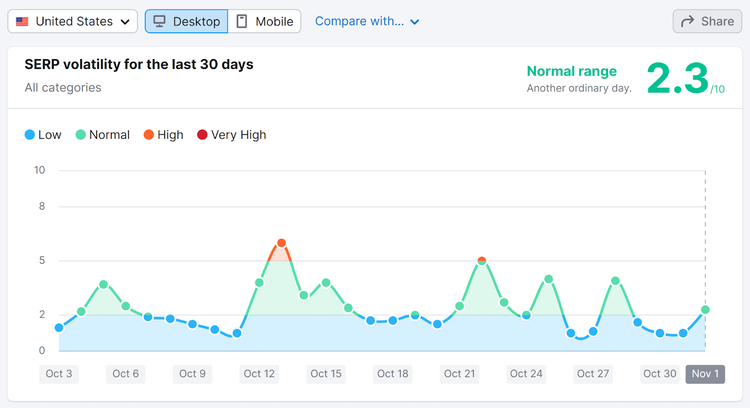
The October 2022 spam update was designed to make Google better at detecting spam. Sites found to engage in spammy practices (i.e., violate Google’s spam policies) may have seen rankings drop.
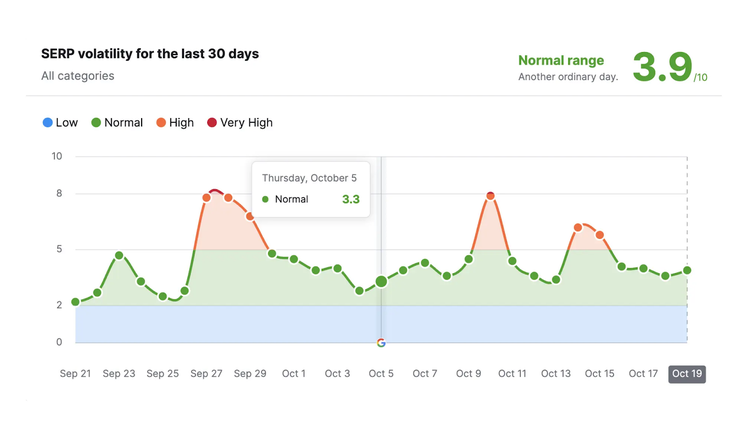
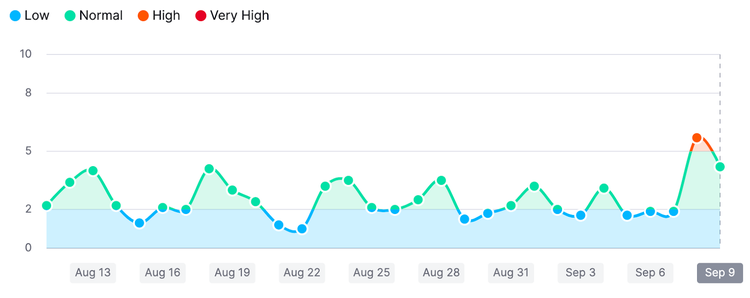
SERP volatility nudged into the High range on the day after the rollout.
Announced: October 19, 2022 Started: October 19, 2022 Completed: October 21, 2022 Duration: Two days
September 2022 Product Reviews Update
The September 2022 product reviews update aimed to reward comprehensive, high-quality product reviews. And applied to English-language content only.
Announced: August 18, 2022 Started: September 20, 2022 Completed: September 26, 2022 Duration: Six days
September 2022 Core Update
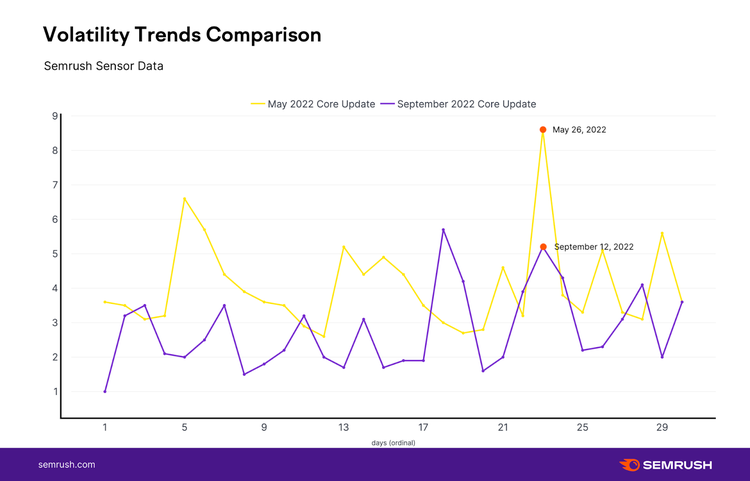
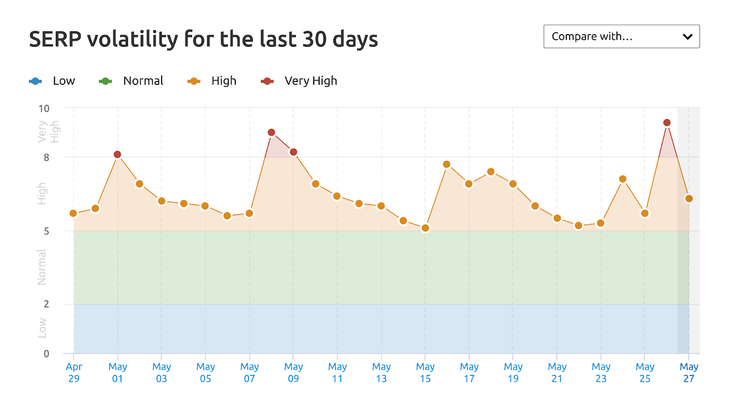
The September 2022 core update overlapped with the September 2022 product reviews update (above). Despite this, SERP volatility remained below 6/10. Lower than we might expect for a core update.
Here’s how volatility compared to the previous core update in May 2022:
Announced: September 12, 2022 Started: September 12, 2022 Completed: September 26, 2022 Duration: 14 days
The August 2022 helpful content update was the first Google algorithm update of its kind. It was designed to ensure searchers “see more original, helpful content written by people, for people.”
After a couple of calm weeks, the change led to high volatility in the SERPs.
In a supporting blog post, Google said users should create content primarily for humans—not search engines. But still follow SEO best practices.
Announced: August 18, 2022 Started: August 25, 2022 Completed: September 9, 2022 Duration: 15 days
July 2022 Product Reviews Update
The July 2022 product reviews update was designed to help high-quality product reviews rank higher. And demote low-quality product review pages that offer little value to the reader.
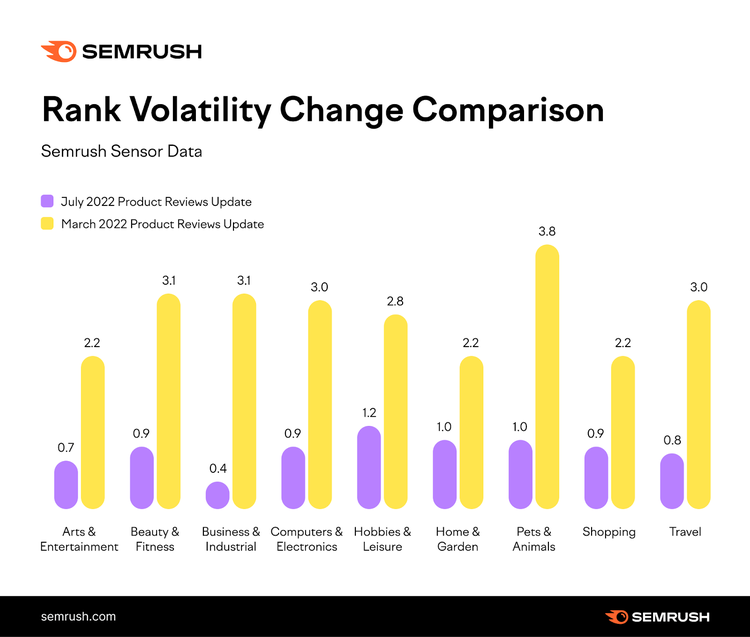
This Google algorithm update only took six days to roll out, rather than the 14 to 21 days expected. And it was far less volatile than the March 2022 product reviews update.
Announced: July 27, 2022 Started: July 27, 2022 Completed: August 2, 2022 Duration: Six days
May 2022 Core Update
The May 2022 core update followed a volatile few weeks in Google’s SERPs. Many site owners witnessed significant fluctuations in their search rankings.
However, Google reminded users that “there's nothing in a core update that targets specific pages or sites. Instead, the changes are about improving how our systems assess content overall.”
Announced: May 25, 2022 Started: May 24, 2022 Completed: June 9, 2022 Duration: 15 days
March 2022 Product Reviews Update
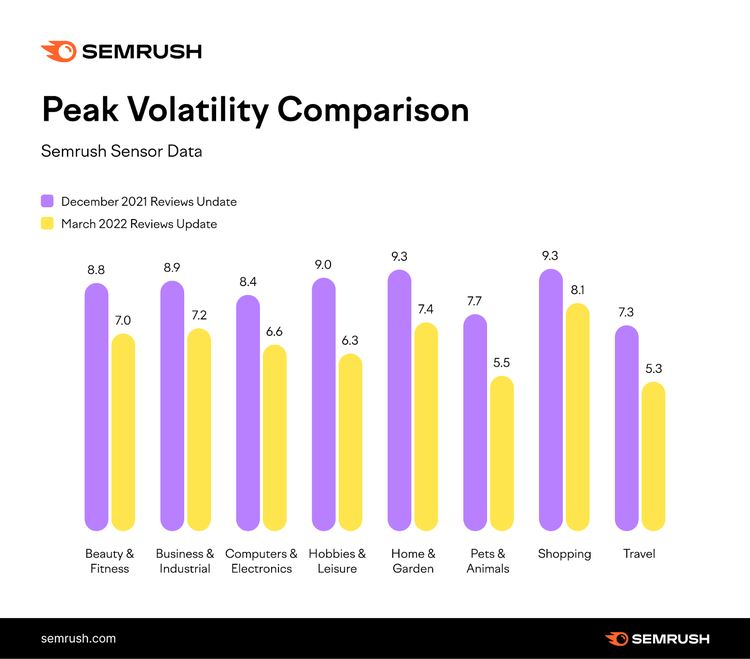
The March 2022 product reviews update enhanced Google’s ability to identify high-quality product review pages. But was less impactful than the December 2021 product reviews update.
In a blog post about this algorithm update, Google shared the following information:
Product reviews updates also apply to ranked lists and comparison reviews
Recommendations for the “best” products should be justified
Separate reviews for products in ranked lists can prove beneficial
Announced: March 23, 2022 Started: March 23, 2022 Completed: April 6, 2022 Duration: 14 days
Page Experience Update for Desktop
The page experience update for desktop made Core Web Vitals a desktop ranking factor. This meant desktop rankings were affected by the following metrics:
Largest Contentful Paint (LCP): The time it takes for the main content of the page to appear
First Input Delay (FID): The response time to the user’s first interaction (Note: Interaction to Next Paint—INP—replaced FID on March 12, 2024.)
Cumulative Layout Shift (CLS): A measure of layout movements that occur during loading
Note
Google completed the page experience update for Mobile in September 2021.
Prior to this algorithm update, Google released a Search Console report allowing site owners to review their desktop Core Web Vitals.
Announced: November 4, 2021 Started: February 22, 2022 Completed: March 3, 2022 Duration: Nine days
Tip
Check your Core Web Vitals and get tips for improving them in Semrush SEO Audit tool.
2021 Updates
These are the confirmed Google search engine algorithm updates from 2021:
Google released the second part of the June 2021 spam update on June 28, 2021. (Google released the first part on June 23, 2021.) To further enhance its spam-prevention algorithms.
Announced: June 23, 2021 Started: June 28, 2021 Completed: June 28, 2021 Duration: 23 hours, 59 minutes
June 2021 Spam Update (Part One)
Google released the first part of the June 2021 spam update on June 23, 2021. (Google released the second part on June 28, 2021.) Both updates were efforts to fight web spam.
Announced: June 23, 2021 Started: June 23, 2021 Completed: June 23, 2021 Duration: 23 hours, 59 minutes
Page Experience Update for Mobile
The page experience update for mobile made Core Web Vitals a mobile ranking factor. This meant mobile rankings were affected by the following metrics:
Largest Contentful Paint (LCP): The time it takes for the main content of the page to appear
First Input Delay (FID): The response time to the user’s first interaction
Cumulative Layout Shift (CLS): A measure of layout movements that occur during loading
In a blog post about this algorithm change, Google explained it would do the following:
Add a Page Experience report to Search Console
Remove the AMP requirement for the Top Stories carousel on Google Search
Announced: May 28, 2020 Started: June 15, 2021 Completed: September 2, 2021 Duration: 79 days
Note
Google completed the page experience update for desktops in March 2022.
June 2021 Core Update
The June 2021 core update was the first core update in 2021. Google couldn’t fit many of the planned improvements in, so the improvements spilled over to the July 2021 core update.
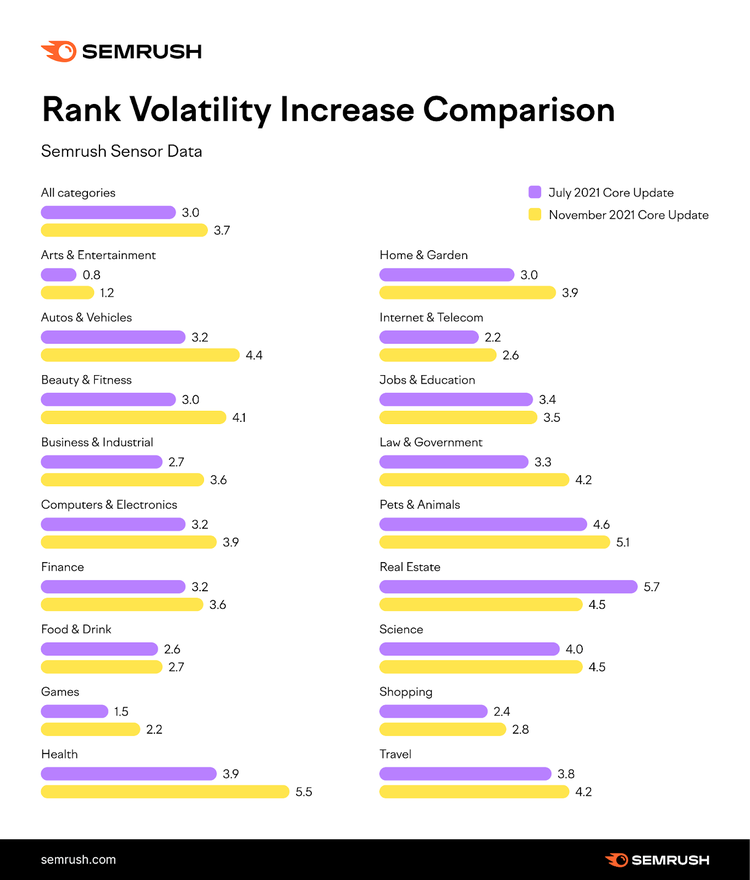
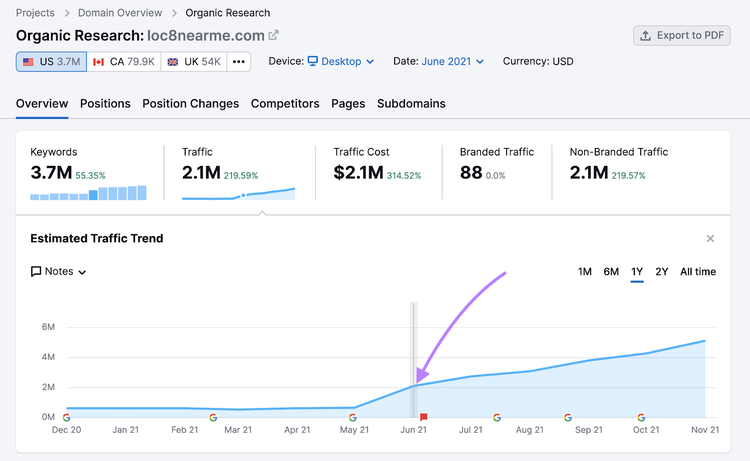
Following this Google algorithm update, Loc8nearme, Foursquare, MoovitApp, and BusinessyAB saw the biggest average position spikes in the U.S. Perhaps as local businesses were beginning to reopen following COVID-19 restrictions.
Announced: June 2, 2021 Started: June 2, 2021 Completed: June 12, 2021 Duration: 10 days
Tip
Check out our Google Maps marketing guide to learn more about promoting your local business.
April 2021 Product Reviews Update
The April 2021 product reviews update was the first update of its kind. The idea was to reward expert product reviews “rather than thin content that simply summarizes a bunch of products,” according to Google.
Google shared these product review recommendations (among others) in a blog post about the update:
Provide insightful analysis and original research
Have reviews written by topical experts or enthusiasts
Explain what sets a product apart from its competitors
Discuss product benefits and drawbacks
Identify and address key decision-making factors
Describe how a product has evolved
Announced: April 8, 2021 Started: April 8, 2021 Completed: April 22, 2021 Duration: 14 days
2020 Updates
According to the Search Status Dashboard, there were only three confirmed Google algo updates in 2020. All core updates.
Let’s explore them:
December 2020 Core Update
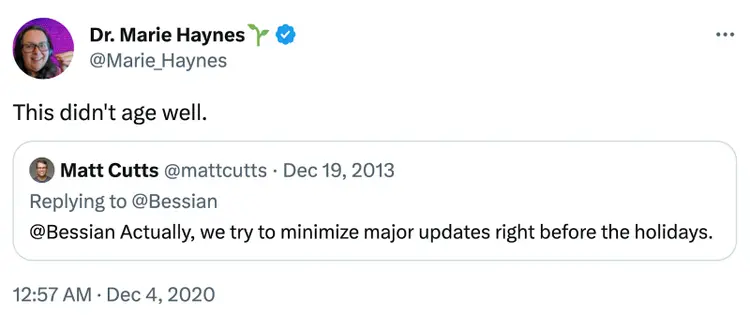
The December 2020 core update was released before the holiday season. Which raised some eyebrows in the SEO community.
However, there are losers and winners with every Google algorithm update. While some sites got less holiday traffic than expected, others benefited from higher rankings.
For example, eBay gained 44 positions after the first day of the update.
Announced: December 3, 2020 Started: December 3, 2020 Completed: December 16, 2020 Duration: 13 days
Google released the May 2020 core update shortly after the COVID-19 outbreak. Many commenters believed this algorithm update tackled health misinformation in the SERPs.
Health is a YMYL (Your Money or Your Life) topic. This means that E-E-A-T (just E-A-T at the time) plays an even bigger role in creating quality content.
Announced: May 4, 2020 Started: May 4, 2020 Completed: May 18, 2020 Duration: 14 days
January 2020 Core Update
The January 2020 core update rolled out in just three days.
Announced: January 13, 2020 Started: January 13, 2020 Completed: January 16, 2020 Duration: Three days
Pre-2020 Major Updates
These are the most important Google algorithm updates announced before 2020:
BERT Update, October 2019: BERT is a natural language processing (NLP) algorithm that helps Google understand the nuances of users’ search queries. And therefore deliver more relevant results. For example, Google could better understand the difference between “brazil to usa” and “usa to brazil.”
Medic Update, August 2018: The August 2018 core update was colloquially known as the Medic update because it seemed to target medical sites. Particularly those that didn’t comply with Google’s E-A-T (now E-E-A-T) guidelines. For example, sites making medical claims without substantiating them.
RankBrain Update, October 2015: RankBrain was Google’s first AI system and deep learning model. It helps Google identify related words and concepts. Google began using RankBrain in April 2015 to better understand new queries (which accounted for around 15% of searches).
Mobilegeddon, February 2015: The Mobile-Friendly Update, more commonly known as “mobilegeddon,” boosted the rankings of mobile-friendly pages in mobile search results. This meant that mobile SEO became extremely important.
Hummingbird Update, September 2013: With the Hummingbird update, Google moved away from matching all words in a query to words on a page. It began to ignore words that weren’t hugely relevant to the searcher’s meaning. This meant Google could better deal with natural language (conversational) queries.
Penguin Update, April 2012: Penguin penalized sites engaging in webspam tactics—i.e., sites attempting to manipulate search rankings with SEO tactics that violate Google’s guidelines. It made it harder to influence rankings through keyword stuffing and link schemes.
Panda Update, February 2011: The Google Panda algorithm update was designed to reduce rankings for low-quality sites (with unoriginal, unhelpful content). And improve rankings for high-quality sites (with useful, original content).
Caffeine Update, August 2009: The Caffeine update made Google quicker at discovering and indexing new content. So searchers could find the latest information more quickly. The update was a change to Google’s indexing system rather than its ranking algorithm.
Prepare for the Next Google Update
To prepare for the next Google algorithm update, audit your site and look for opportunities to improve. Semrush has all the SEO tools you need, including:
Rachel is a Senior Content Writer with 12+ years‘ experience in content marketing and SEO. In a previous role as Head of Content at a digital marketing agency, Rachel developed and executed search-driven content strategies for a diverse range of clients, including global ecommerce brands and local B2B companies. She later transitioned to an in-house role at an SaaS startup, where she focused on scaling content operations and driving organic growth.
Subscribe to learn more about General SEO
Subscribe
By clicking “Subscribe” you agree to Semrush Privacy Policy and consent to Semrush using your contact data for newsletter purposes
Rachel Handley
Rachel is a Senior Content Writer with 12+ years‘ experience in content marketing and SEO. She has worked agency-side, developing and executing content strategies for a wide range of brands, and in-house, driving organic growth for a SaaS startup.
Share
Tells Google to show you more from Semrush in AI, Search, and Discover.