Search engine optimization (SEO) is the practice of optimizing your website to improve its visibility in organic (unpaid) search engine results.
Pay-per-click (PPC) advertising, on the other hand, involves paying for ads that appear at the top of search engine results or on other websites.
The main differences between the two lie in cost and timing—SEO focuses on long-term growth through organic traffic, while PPC offers immediate visibility through paid ads.
But both are beneficial. Especially if you use them together (go here to learn how).
When to Use SEO vs. PPC
Choose SEO when:
Your budget is limited
You’re in it for the long run
You want to build authority in your niche
Your audience is searching for answers and information
Pick PPC if:
You need quick results
You’re launching a new or unique product
You’re promoting an event
You want to drive traffic to specific pages
The best choice between SEO and PPC depends on your goals, budget, and timeline.
Often, a mix of both drives the best results.
What Is SEO?
SEO is the process of improving your website’s visibility in search results with the goal of attracting more organic (non-paid) traffic.
It can boost brand awareness, drive targeted traffic, and lead to higher conversions without having to pay for each visitor.
SEO usually involves four main components:
Keyword research: finding and targeting words people search for
On-page SEO: creating high-quality content and optimizing pages with relevant keywords
Off-page SEO: building backlinks and improving your site’s authority and trustworthiness
Technical SEO: ensuring search engines can find, understand, and store your content
Keyword research for SEO means finding and analyzing the words and phrases your audience is searching for in search engines.
Performing keyword research helps you understand your target user’s needs. So you can create content that satisfies their queries. And improve your organic rankings.
Keyword research usually involves using keyword research tools like the Keyword Magic Tool.
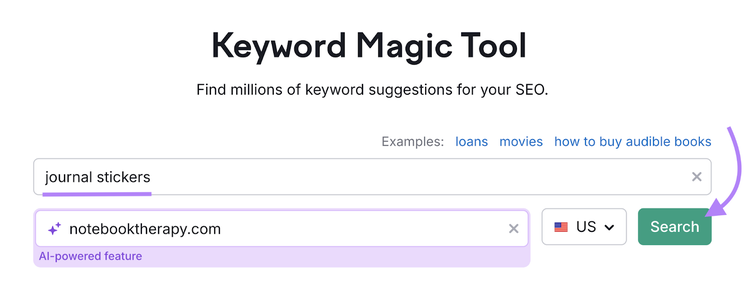
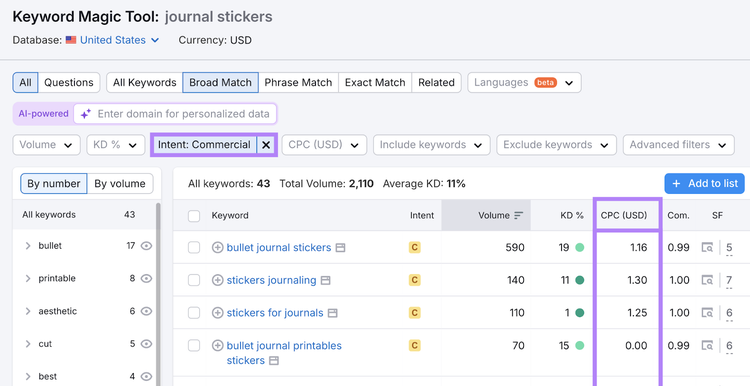
Let’s say you run an online journal sticker store. Most of your target audience is probably looking up “journal stickers” or “stickers for journals.”
So plug those into the Keyword Magic Tool. Along with your domain. And hit “Search.”
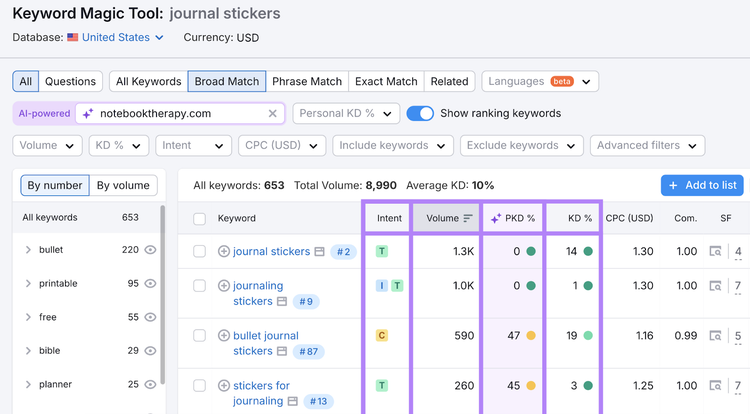
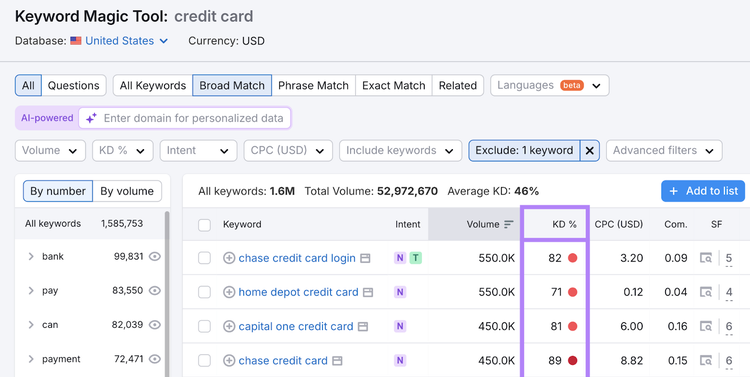
You’ll see a lot of keywords related to your original term. Along with the following important metrics:
Intent, or search intent, which tells you what type of content searchers are looking for when they use that specific keyword
Volume, or search volume, which estimates how many times a keyword gets searched per month
KD %, or keyword difficulty, which estimates how easy or difficult it is to rank in the top 10 search results for a keyword on a scale of 0% (easiest) to 100% (hardest)
PKD %, or Personal Keyword Difficulty, which tells you how easy or difficult it is for your website, specifically, to rank in the top 10 search results on Google
Like this:
Marketers use keyword metrics to determine whether a keyword is worth targeting. And what type of content will perform best for that keyword.
On-page SEO is the process of optimizing individual webpages to help search engines understand your content and users find exactly what they’re looking for.
Which, in many cases, can lead to higher rankings in organic search results.
One of the most important on-page SEO tasks is optimizing for search intent (the reason behind someone’s search).
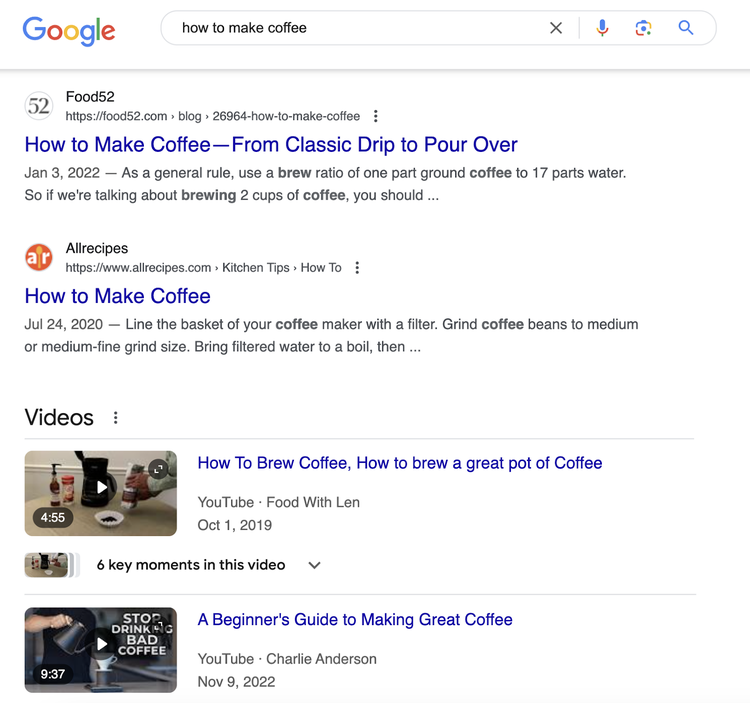
For example, when someone searches “how to make coffee,” they likely want step-by-step guides and videos.
Which is why the results page includes articles and videos that teach readers how to make coffee.
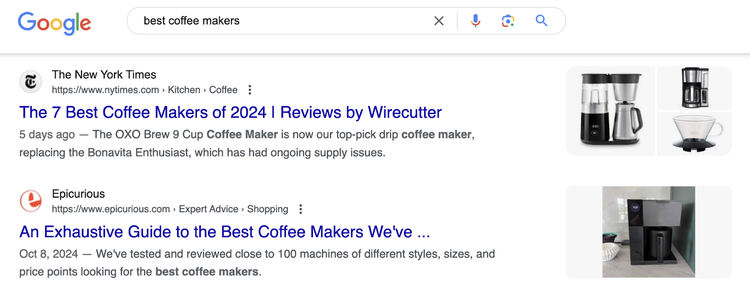
But if someone searches “best coffee makers,” they probably want product reviews and comparison articles.
Which is why the results page shows review articles containing feedback for multiple coffee makers.
The intent behind each keyword is different. Aligning your content with these intents can impact your ability to rank.
Other on-page optimization tactics and best practices include the following:
Using your target keyword in the title, first paragraph, and throughout the page naturally
Creating high-quality content that matches search intent and covers the topic thoroughly
Including relevant images and videos with descriptive alt text and file names
Using internal links to connect related content on your site
Tip
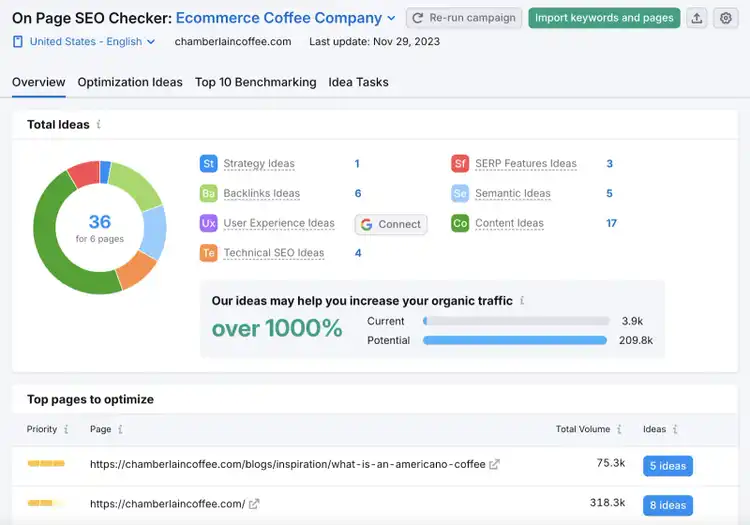
Quickly get actionable on-page SEO optimization ideas for your site with On Page SEO Checker.
Off-page SEO is a set of actions taken outside your website to build your site’s reputation to signal to search engines that your site is trustworthy and valuable.
This can lead to better visibility and ranking in search results.
A key off-page tactic is link building (getting other websites to link to yours). Because search engines treat SEO backlinks (links from other sites) like endorsements.
So, the more quality backlinks (i.e., backlinks from reputable sites) your site has, the more trustworthy it seems.
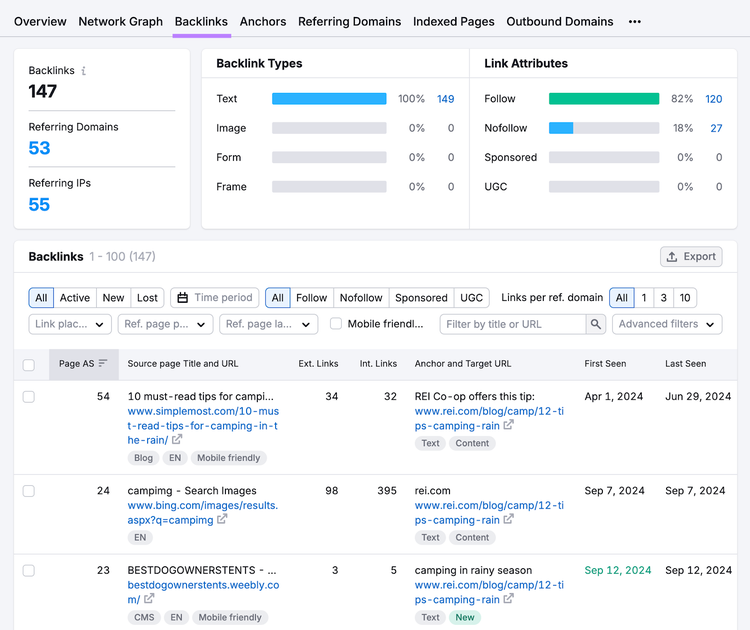
You can see who links to you (and your competitors) with the Backlink Checker.
Other key off-page SEO tactics involve:
Using digital PR to increase brand awareness and gain more backlinks
Engaging on social media to attract attention
Managing online reviews to manage your brand reputation
Writing guest blogs to reach new audiences and get backlinks
SEO as a marketing strategy comes with both advantages and disadvantages.
Pros
1. You get sustainable growth.
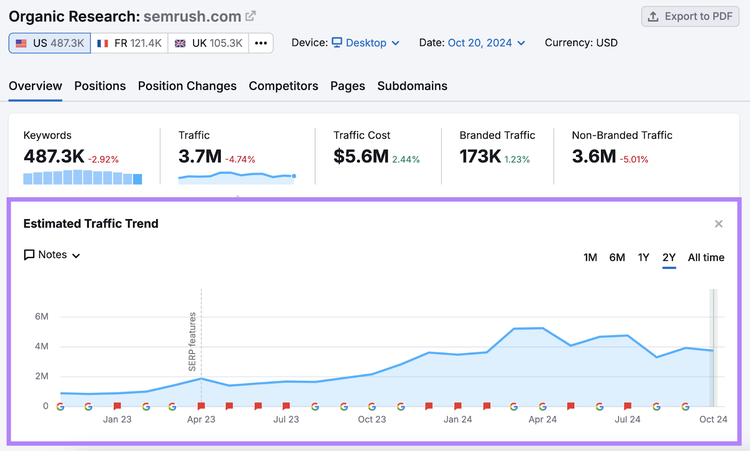
SEO builds lasting organic traffic. Once you rank for valuable keywords, you'll continue to attract visitors without paying for each click. This compounding effect can lead to significant long-term growth.
Here’s what the organic traffic trend looks like for the Semrush domain:
2. It’s cost-effective in the long run.
While SEO requires an initial investment, it often becomes more affordable than paid advertising over time because you're building an asset that keeps working for you rather than renting attention.
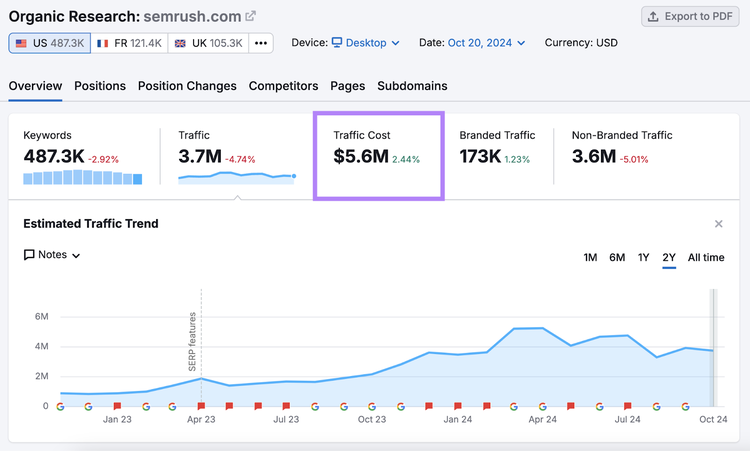
For example, the Organic Rankings overview report shows that Semrush blog’s traffic cost is about $5.6M.
Meaning if Semrush were to pay for all the traffic to its domain, it would have to pay roughly $5.6M.
But it can continue to generate organic traffic even if it stops investing in SEO for a while.
3. It can build trust and credibility.
High search rankings signal to your target audience that your site is reputable and relevant. This can help boost brand awareness and establish your company as an authority in your niche.
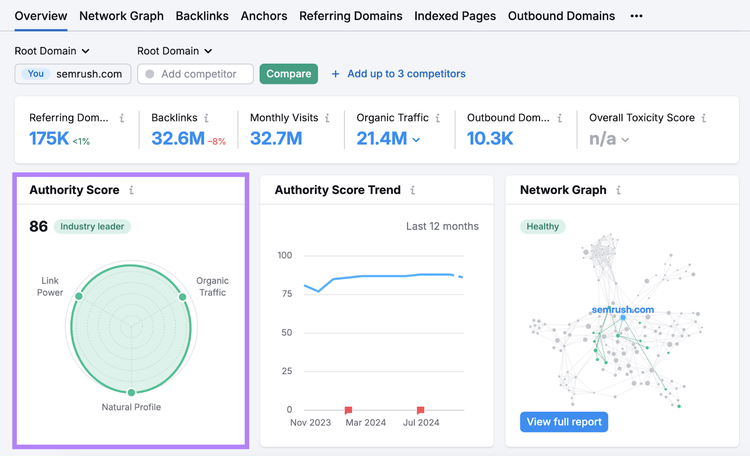
For instance, Semrush has worked on its domain reputation over the years and has an Authority Score of 86.
4. It can improve the user experience
Many SEO best practices, like improving page speed and optimizing for mobile, also enhance the overall user experience.
Which can lead to higher engagement and conversion rates.
It often takes 4-12 months to see significant results. And you'll need to continuously optimize your content to maintain and improve rankings.
2. It requires expertise.
SEO demands a mix of technical knowledge, content creation skills, and strategic thinking. Which means you'll need to invest in learning these skills. Or hire experts to handle your SEO.
3. You have no control over algorithm changes.
Search engines frequently update their algorithms.
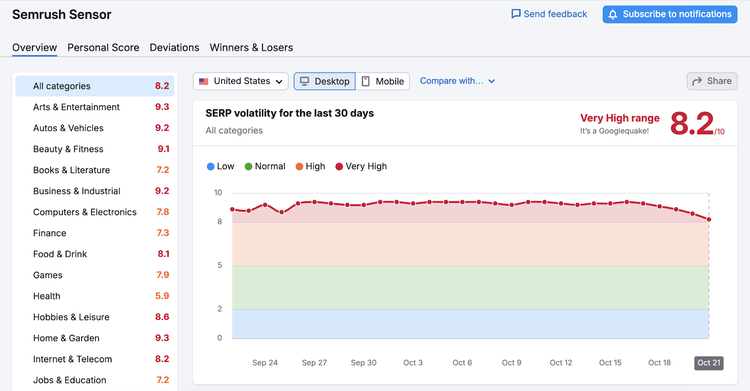
In fact, Semrush Sensor shows search results (and possibly your rankings) have been changing frequently over the last month. With a volatility score consistently above eight.
Algorithm changes could impact your rankings, requiring you to adapt your strategy quickly to maintain your position.
4. Some keywords are very competitive.
For high-value keywords, you're often competing against established sites with significant resources. Breaking through can be challenging and may require substantial effort.
What Is PPC?
PPC (pay-per-click) is an online advertising model where you pay a fee each time someone clicks on one of your ads.
It lets you buy visits to your site instead of earning them organically.
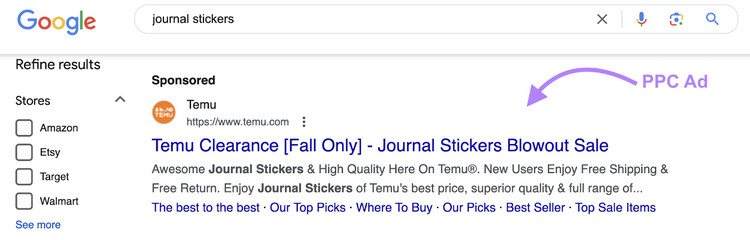
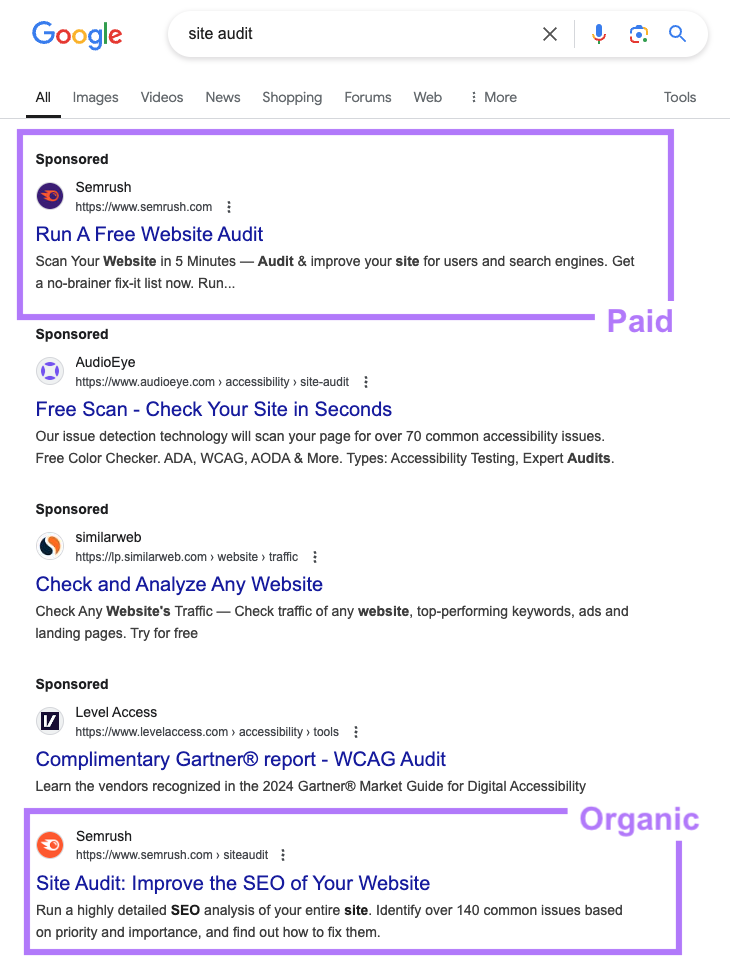
Here’s what a PPC ad looks like in a Google SERP:
The key components of a successful PPC campaign include:
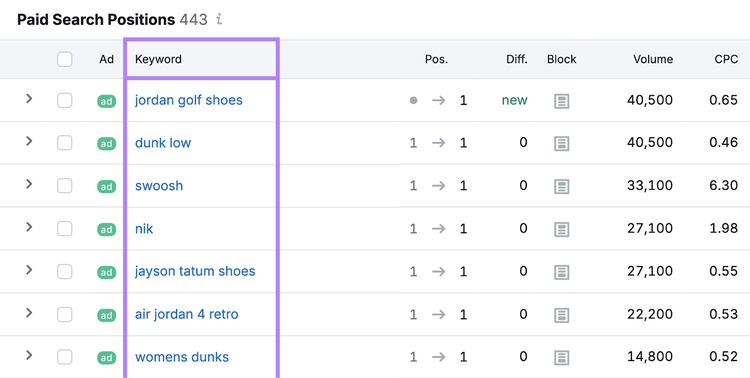
Keyword research: finding relevant terms your target audience is searching for
Keyword bidding: setting the maximum amount you’re willing to pay for a click
Audience targeting and retargeting: showing ads to very specific audiences
Ad creation: crafting compelling text or visual ads to drive clicks
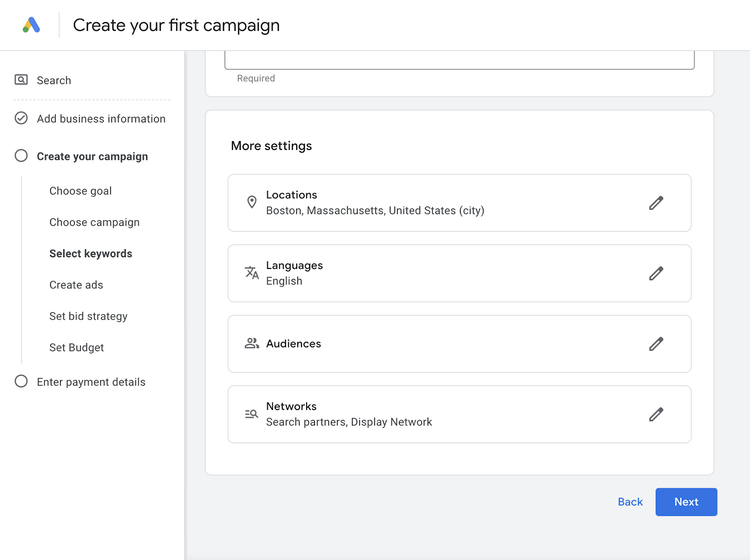
PPC lets you show ads to specific groups of people. This is called audience targeting.
You can choose who sees your ads based on traits like age, location, interests, or online behavior.
Targeting specific audiences can increase your chances of reaching people who are likely to buy from you. Meaning more clicks, leads, and sales for your ad budget.
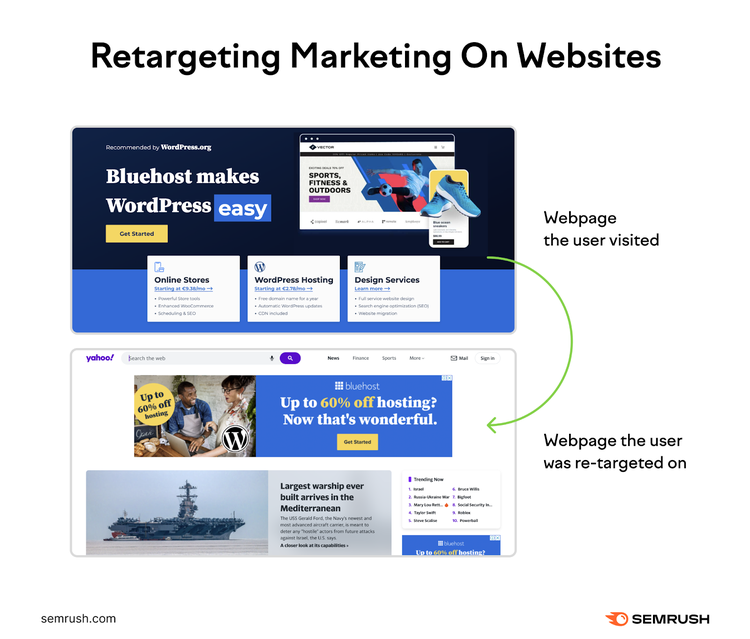
Retargeting takes this a step further. It shows ads to people who've already interacted with your brand.
Let’s say someone visits your website but doesn't buy. Retargeting displays your ads to them on sites they visit later.
Creating ads in PPC involves designing compelling advertisements that encourage users to click and convert.
The ad copy and visuals you use directly impact your click-through rates and Quality Score (i.e., a rating that shows you how good your ad is compared to competing ads).
To create effective PPC ads:
Write headlines that grab attention and address user needs
Craft concise descriptions that highlight the benefits of what you offer
Include clear calls to action (CTAs) that motivate users to take the desired next step (e.g., sign up for a newsletter or buy a product)
Use relevant keywords to improve ad relevance and quality score
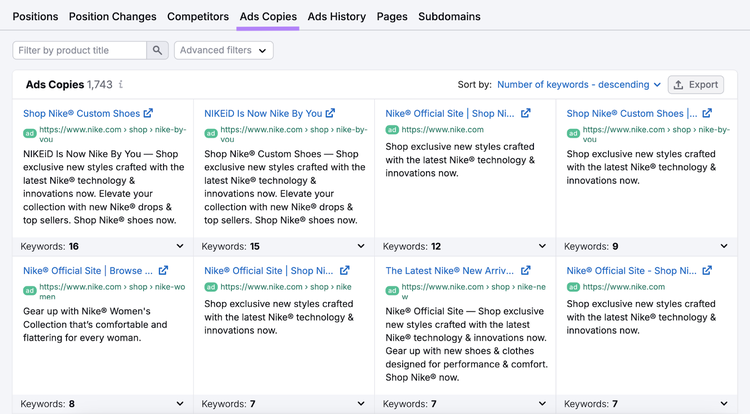
You can use the “Ads Copies” tab in Advertising Research to see the exact ads your competitors are running.
Use these insights to help you craft your own ads.
PPC offers quick visibility but also presents challenges. Let’s explore the pros and cons.
Pros
1. It gives you instant visibility.
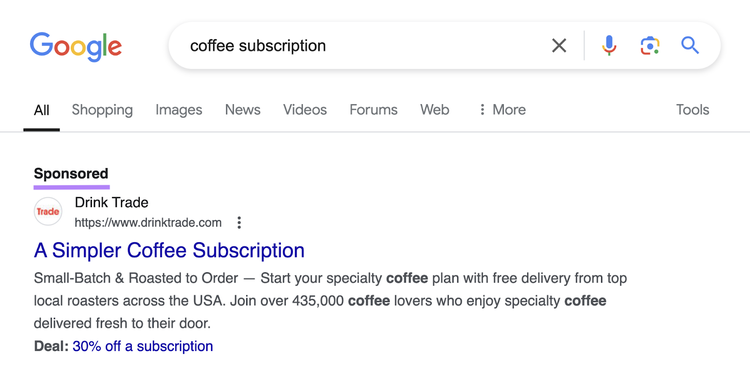
PPC puts your ads at the top of search results immediately, so you can start driving traffic to your site as soon as your campaign goes live—unlike SEO, which takes time to build momentum.
For example, the search results page for “coffee subscription” shows an ad right at the top of the page.
2. It allows for precise targeting.
PPC platforms let you target your audience by location, device, time of day, and even specific interests or behaviors. This level of control helps you reach your ideal customers more effectively.
3. It produces measurable results.
PPC provides clear, trackable data on your ad performance. You can see exactly how many clicks, conversions, and sales your ads generate, which makes it easy to calculate ROI and adjust your strategy.
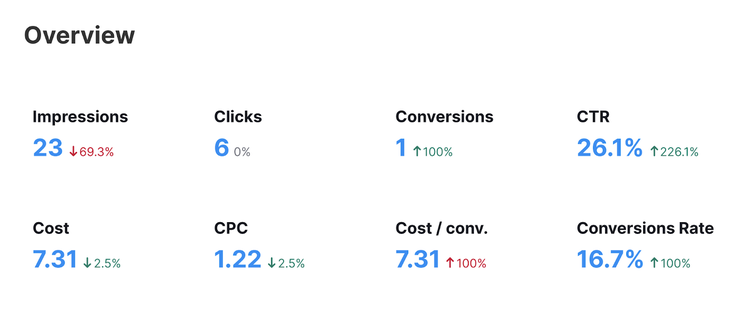
To illustrate, here’s a performance overview from Semrush’s My Reports tool.
It shows impressions (how many people saw the ad), clicks, conversions, CTR, cost, CPC, cost per conversion, and conversion rate.
4. It allows for flexible budgeting.
You decide how much to spend on PPC. Whether you have $10 or $10,000 to invest, you can run campaigns that fit your budget and scale up or down as needed.
Cons
1. It requires ongoing costs.
PPC requires continuous investment. Once you stop paying, your ads disappear from search results. This makes it harder to build long-term, sustainable traffic compared to SEO.
2. You risk experiencing click fraud.
Competitors or bots might click your ads without any intention of buying. This wastes your budget and skews your data.
While major platforms have safeguards, click fraud is still a concern for advertisers.
3. Ad fatigue is real.
Ad fatigue occurs when users see your ads too often and stop engaging with them.
In other words, people can become "blind" to ads over time.
As your target audience sees your ads repeatedly, they may start ignoring them. Leading to decreased click-through rates and higher costs per click.
4. There’s a learning curve.
Effective PPC management takes skill and experience. You need to understand keyword research, ad copywriting, landing page optimization, and bidding strategies.
Carlos Silva leads the editorial pipeline for the English blog—coordinating writers, editors, strategy, and building AI workflows that boost content quality and AI visibility. With 10+ years of experience writing and editing across in-house and agency roles, Carlos blends content strategy, SEO, and AI to help marketers stay ahead of an evolving search landscape.
Subscribe to learn more about General SEO
Subscribe
By clicking “Subscribe” you agree to Semrush Privacy Policy and consent to Semrush using your contact data for newsletter purposes
Carlos Silva
Carlos Silva leads the editorial pipeline for the English blog and builds AI workflows that boost content quality and AI visibility. 10+ years writing and editing across in-house and agency roles.
Share
Tells Google to show you more from Semrush in AI, Search, and Discover.